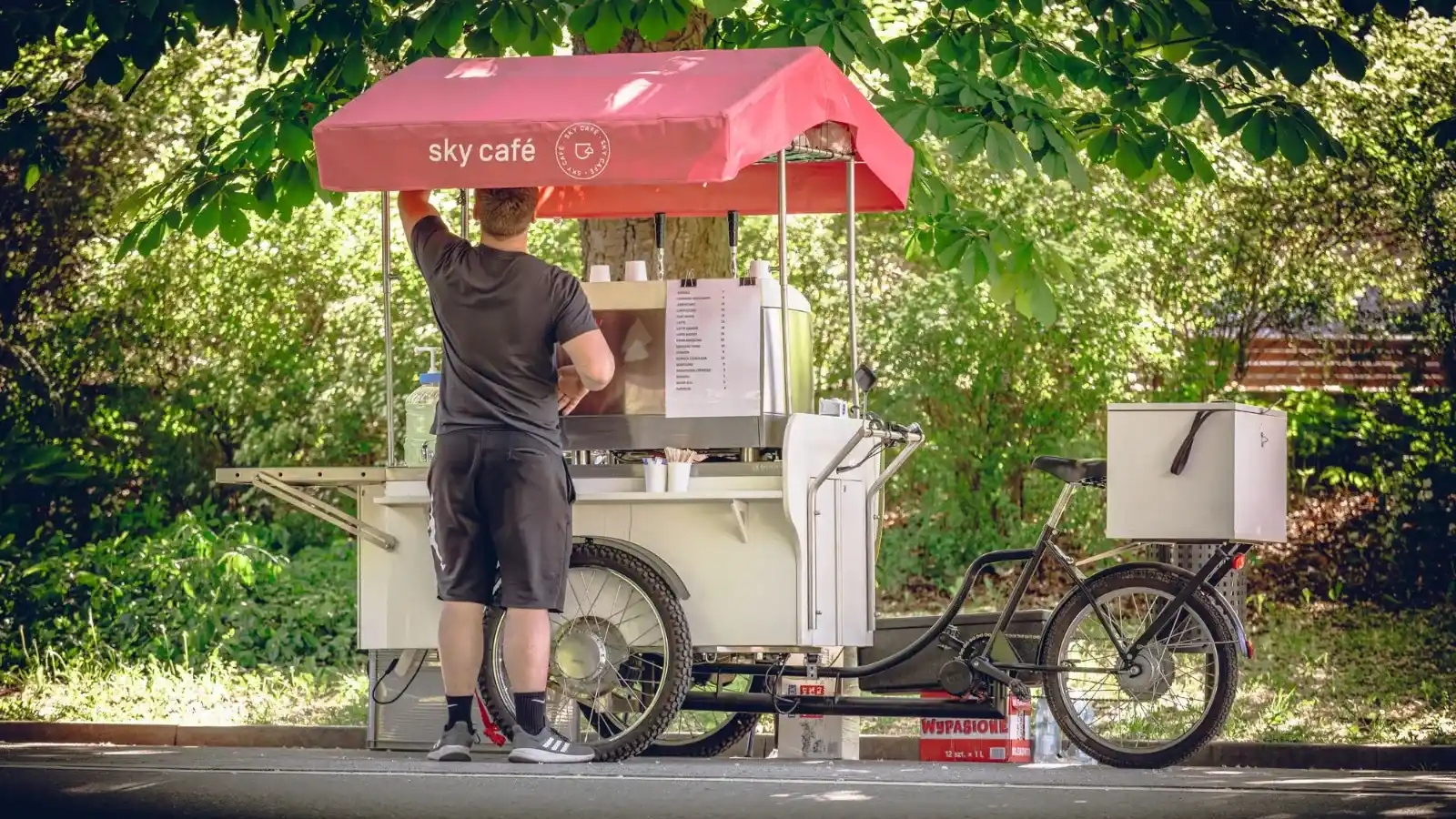
Since July 1, 2026, a coffee trailer in Texas needs one health license from the state instead of a separate permit from every city it parks in. The Texas Department of State Health Services (DSHS) now licenses all mobile food vendors, and it puts coffee trucks in its Type II tier: $618 to apply plus a $400 pre-licensing inspection. Add $300 to form an LLC with the Secretary of State, a free sales tax permit from the Comptroller, a local fire inspection and a commissary agreement, and the paperwork side of the business costs a little over $1,300 before equipment. Many online guides still describe the old city-by-city system.
Key Takeaways
- House Bill 2844 moved mobile food vendor licensing from local health departments to DSHS on July 1, 2026, and local rules that conflict with the new state chapter are preempted.
- Coffee trucks are Type II: $618 application fee, $400 pre-licensing inspection, then $400 for each routine inspection. The license runs one year from the passed inspection.
- You must still operate from a central preparation facility (commissary) unless the trailer meets every condition for an exemption, and post your itinerary at least seven days ahead.
- Cities keep fire, zoning and location rules. Houston and Austin both run their own fire inspections.
- Hot coffee is taxable prepared food. In our model, 110 drinks a day at $5.75 leaves about $6,560 a month before the owner’s pay and income tax.
What Changed for Texas Mobile Food Vendors in 2026
Governor Abbott signed HB 2844 on June 20, 2025, adding Chapter 437B to the Health and Safety Code, according to a DSHS briefing to its advisory committee. DSHS adopted the matching rules, 25 TAC Chapter 226, which took effect on May 19, 2026, per the Texas Register. Statewide licensing began July 1, 2026.
The practical effect is that a vendor licensed by DSHS can work anywhere in the state. Local health departments no longer issue mobile food licenses, and a city cannot block a licensed vendor who follows state and local law, the DSHS flyer for local health departments says. Houston’s health department confirms that city medallions are no longer valid and that it now inspects trucks on the state’s behalf.
Which DSHS License Does a Coffee Trailer Need?
DSHS sorts vendors into three types by food-safety risk. Its own examples place coffee trucks, snow cone stands and hot dog carts in Type II: vendors who sell food made to order for immediate consumption, or who cold-hold, thaw or reheat commercially packaged products. Milk, a time and temperature controlled food, is why. Cooking breakfast tacos from scratch would push a trailer into Type III.
| License type | Typical vendor | Application fee | Pre-licensing inspection | Routine inspection |
|---|---|---|---|---|
| Type I | Prepackaged, non-TCS snacks or ice cream | $309 | None | None ($300 complaint inspection) |
| Type II | Coffee trucks, snow cones, hot dogs | $618 | $400 | $400 |
| Type III | Burger, BBQ and taco trucks | $876 | $500 | $500 |
Fees are as listed by DSHS in October 2026 and include a Texas Online processing charge. You apply and pay through DSHS Online Licensing Services, then DSHS schedules the pre-licensing inspection. A new vendor with no existing Texas license cannot sell until that inspection is passed. The license expires one year from the date of the successful inspection.
Commissary Rules Under Chapter 226
The commissary did not disappear with the city permits. Under the adopted rules, a vendor and its vehicle must operate from a central preparation facility (CPF) or another fixed food establishment, and report there as required for supplies, cleaning and servicing.
- Written authorization: if you do not own the CPF, you need a signed letter of authorization. A separate servicing area (where you fill fresh water and empty the wastewater tank) also needs a signed letter if you do not own it.
- Servicing log: each servicing visit must be logged with the date and time.
- Exemption: a trailer can skip the CPF only if the inspector confirms it meets every listed condition, including enough refrigeration, adequate warewashing compartments, potable water from an approved source, approved waste disposal and records kept on board.
- Itinerary: planned locations, dates and times must be posted on your website or social media, or sent to DSHS, at least seven days before the first date. A vendor DSHS cannot find risks suspension.
- Tanks and sinks: the potable water tank and hose must be labeled, wastewater tanks labeled separately with different connections, and at least one handwashing sink with soap and towels.
Houston’s health department says vendors there must report daily to an approved servicing area and that only 16 are approved in its jurisdiction.
City Rules That Still Apply in Austin and Houston
State law left fire codes, zoning and location restrictions with local governments, as long as they do not conflict with Chapter 437B. In Austin, the Austin Fire Department handles mobile vending fire applications and inspections inside the city, and the Travis County Fire Marshal covers unincorporated areas. Austin Public Health also expects at least one certified food manager per business, with the certificate posted, and food handler cards for staff within 60 days of hiring.
In Houston, the Fire Marshal’s Office runs an annual food truck permit inspection. Its 2026 inspection checklist requires a 3A:40BC extinguisher, sets rules for propane cylinders and gas-leak alarms, and bans extension cords as permanent wiring. An all-electric trailer avoids the propane items but must bring its own power to the inspection. Neither page lists fire fees.
State Business Registrations and Taxes
| Registration | Agency | Fee (as of October 2026) | What to know |
|---|---|---|---|
| LLC certificate of formation (Form 205) | Texas Secretary of State | $300 | Needs a Texas registered agent; the LLC cannot be its own agent |
| Sales and use tax permit | Texas Comptroller | Free | A security bond may be required |
| Franchise tax | Texas Comptroller | No tax due below $2.65 million in revenue | File the Public Information or Ownership report by May 15 |
| DSHS mobile food vendor license (Type II) | DSHS | $618 + $400 inspection | Renew yearly |
Texas charges a 6.25% state sales tax, and local jurisdictions can add up to 2%, for a combined maximum of 8.25%. The Comptroller treats hot coffee and tea as taxable prepared food, and cold drinks become taxable when sold in a cup with a straw. Because the local portion differs between cities, a trailer that moves around should confirm the rate for each place it trades. Once the LLC is filed, a separate business account keeps sales tax and expenses clean; our Found Pro review covers one option for solo owners.
How Much Does It Cost to Start a Coffee Trailer in Texas?
Only the first four lines below are official fees. Everything else is our planning assumption for a used, already-plumbed trailer with a commercial espresso setup; a new custom build can cost much more, and a simpler cart much less.
| Item | Cost (USD) | Basis |
|---|---|---|
| Texas LLC certificate of formation | 300 | SOS fee |
| DSHS Type II application | 618 | DSHS fee |
| DSHS pre-licensing inspection | 400 | DSHS fee |
| Sales tax permit | 0 | Comptroller |
| Used coffee trailer with sinks and tanks | 28,000 | Assumption |
| Two-group espresso machine | 9,000 | Assumption |
| Two grinders | 2,500 | Assumption |
| Inverter generator | 3,000 | Assumption |
| Refrigerator, blender, smallwares | 2,000 | Assumption |
| POS hardware | 300 | Assumption |
| Opening inventory (beans, milk, cups, syrups) | 1,500 | Assumption |
| Food manager and food handler training | 200 | Placeholder |
| Signage, menu boards, website | 800 | Assumption |
| Total | 48,618 | Calculated |
Insurance
- General liability with product liability: covers a customer burned by a spilled drink or sickened by spoiled milk; event organizers and private lots often require a certificate.
- Commercial auto: for the tow vehicle, and confirm the trailer itself is covered while parked and while towed.
- Equipment and inland marine: espresso machines and grinders are the most expensive things on board and the easiest to damage on the road.
- Workers’ compensation: Texas lets private employers opt out and become non-subscribers, but they lose the liability limit that coverage provides if an employee sues, and they must notify employees and the state of that choice.
Pricing and Revenue: A Worked Example
Our model assumes 22 trading days a month, 110 drinks a day and an average price of $5.75 before sales tax. Cost of goods (beans, milk, cups, lids, syrups) is set at 28% of sales. All of these are assumptions; your own menu costing should replace them.
| Line | Monthly (USD) |
|---|---|
| Sales: 22 days x 110 drinks x $5.75 | 13,915 |
| Cost of goods at 28% | 3,896 |
| Commissary/CPF rent | 600 |
| Insurance | 200 |
| Generator fuel | 300 |
| Card processing at 3% | 417 |
| POS software | 60 |
| Event and site fees | 400 |
| DSHS routine inspection reserve ($400 / 12) | 33 |
| Repairs reserve | 250 |
| Part-time barista, 80 hours at $15 | 1,200 |
| Profit before owner pay and income tax | 6,559 |
| Sales tax collected on top at 8.25% (passed to the Comptroller) | 1,148 |
Each drink contributes about $3.97 after ingredients and card fees. Fixed costs excluding card fees are $3,043 a month, so break-even is roughly 35 drinks a day. At 110 drinks a day, the $48,618 startup budget pays back in about 7.4 months. Drop to 70 drinks a day and monthly profit falls to about $3,070, stretching payback beyond a year. Location moves these numbers more than anything else. Our break-even calculator lets you test your own numbers.
Launch Checklist
- Form the business: file Form 205 with the Secretary of State ($300) and appoint a registered agent; get a free EIN from the IRS.
- Register for sales tax: apply for the Comptroller permit before your first sale.
- Secure a commissary: get a signed letter of authorization from a CPF and a servicing area near where you plan to trade.
- Buy or build the trailer: confirm labeled potable and wastewater tanks, a handwashing sink and warewashing compartments.
- Train staff: one certified food manager, food handler cards for everyone else.
- Apply to DSHS: submit the Type II application with $1,018 and pass the pre-licensing inspection.
- Book local inspections: fire department or county fire marshal, plus any zoning or location approvals.
- Insure and publish: buy liability and auto cover, then post your itinerary at least seven days ahead.
For more guides on launching and financing a small business, see our Startups and Finance sections.
This article is for information and education only and is not investment, tax or financial advice. Figures were checked on October 28, 2026; confirm current details with the official source or a registered adviser before acting.
More state launch guides: how to start a pressure washing business in Florida and a mobile dog grooming business in North Carolina. For bookkeeping tools, see QuickBooks Solopreneur alternatives for 1099 contractors.
FAQ
Do I Need a City Permit for a Food Truck in Texas Now?
Not a health permit. Since July 1, 2026, DSHS issues the only mobile food vendor license. Cities can still require fire inspections and enforce zoning and location rules.
How Much Is a DSHS Mobile Food Vendor License for a Coffee Truck?
Coffee trucks are Type II: a $618 application fee plus a $400 pre-licensing inspection, with $400 for each routine inspection.
Does a Coffee Trailer Need a Commissary in Texas?
Yes, unless the inspector confirms the trailer meets every exemption condition in 25 TAC 226.6, including water, waste disposal, refrigeration and warewashing.
Is Coffee Taxable in Texas?
Hot coffee and tea are taxable prepared food, at 6.25% state tax plus up to 2% local tax.
How Much Does It Cost to Start a Coffee Trailer?
Official fees total about $1,318 for an LLC and a Type II license. Our assumption-based budget with a used trailer and espresso equipment comes to about $48,600.
Sources
- Texas DSHS: Mobile food vendors (license types and fees)
- Texas DSHS: Mobile food vendor information for local health departments
- Texas DSHS: HB 2844 overview to the Public Health Funding and Policy Committee, October 2025
- Texas Register, May 15, 2026: adopted rules, 25 TAC Chapter 226
- Texas Register, May 29, 2026: related adopted rules and Chapter 226 effective date
- Austin Public Health: Mobile food vendors
- Houston Health Department: Mobile food units
- Houston Fire Marshal’s Office: 2026 food truck inspection points
- Texas Secretary of State: Form 205 instructions
- Texas Comptroller: Sales and use tax
- Texas Comptroller: Sales tax permit FAQ
- Texas Comptroller: Grocery and convenience stores (prepared food rules)
- Texas Comptroller: Franchise tax
- Texas Department of Insurance: Workers’ compensation employer FAQ