
About 1.6% of insured US homes file a water damage or freezing claim in a typical year, and the average claim paid from 2019 to 2023 was $15,400. That is why the best smart water leak detection systems do more than beep. For whole-home protection, Phyn Protect ($579.99) and Flo by Moen ($675.99) watch the main water line and can shut it off on their own. On a smaller budget, the Zooz Titan valve actuator turns an existing ball valve into an automatic shutoff for $169.95, and battery sensors from YoLink ($19.99 each) or Eve ($99.95) cover the spots where leaks start.
We compared six systems on published prices, how each one detects a leak, whether it can stop the water, what it needs to run and what installation involves. We also worked out what water damage costs the average insured home each year, so you can weigh each price against a real number.

Smart Water Leak Systems Compared on Price and Shutoff
| System | Type | Price (Nov 2026) | Shuts water off? | Install | Needs |
|---|---|---|---|---|---|
| Phyn Protect (replaces Phyn Plus) | Inline monitor and valve on the main line | $579.99 on Phyn’s site; adapters extra | Yes, automatically | Licensed plumber advised, 1 to 2 hours | Outlet within 12 ft, Wi-Fi |
| Flo by Moen 900-006 (1 inch) | Inline monitor and valve on the main line | $675.99 on Ring’s store; pro install from $129.99 | Yes, automatically | Professional install offered | Plug-in power, Wi-Fi |
| Zooz Titan ZAC36 LR | Motor that turns your existing ball valve | $169.95 at Apollo Automation | Yes, via wired probe or hub | Clamps onto 0.5 to 1.25 inch ball valves, no pipe cutting | Z-Wave hub for anything beyond the wired probe |
| Flume 2 | Sensor strapped to the water meter | $249 list, $200 sale on Rain Bird’s store | No, alerts only | About 10 minutes, no tools beyond a lid key | Wi-Fi bridge |
| Eve Water Guard (Thread) | Plug-in sensor with long sensing cable | $99.95; two for $189.90 at Eve | No, alerts and can trigger other devices | Plug in | Apple Home; a home hub for alerts away from home |
| YoLink Water Leak Sensor 4 | Battery spot sensor with siren | $19.99 each on YoLink’s shop | No, unless paired with a YoLink valve | Place on the floor | YoLink hub with internet |
The table splits naturally into two groups: Phyn, Flo and the Zooz Titan can stop a leak on their own. Flume, Eve and YoLink can only tell you about one, which is still very useful if you are home or nearby, but less so if a pipe bursts while you are away for a week.
What Water Damage Costs the Average Insured Home
Water damage and freezing claims happened at a rate of 1.50 per 100 house-years from 2019 to 2023, with an average claim of $15,400. These losses made up between 19.8% and 28.7% of all homeowners losses each year in that period.
We multiplied those two numbers to get an expected yearly loss. Our method: 1.50 claims per 100 homes, or 0.015 per home, times $15,400 equals about $231 per insured home per year. Over ten years that is $2,310. This is an average across all homes, so a house with old pipes, a finished basement or a cold-climate holiday cabin carries more risk, and a new condo with little plumbing carries less.
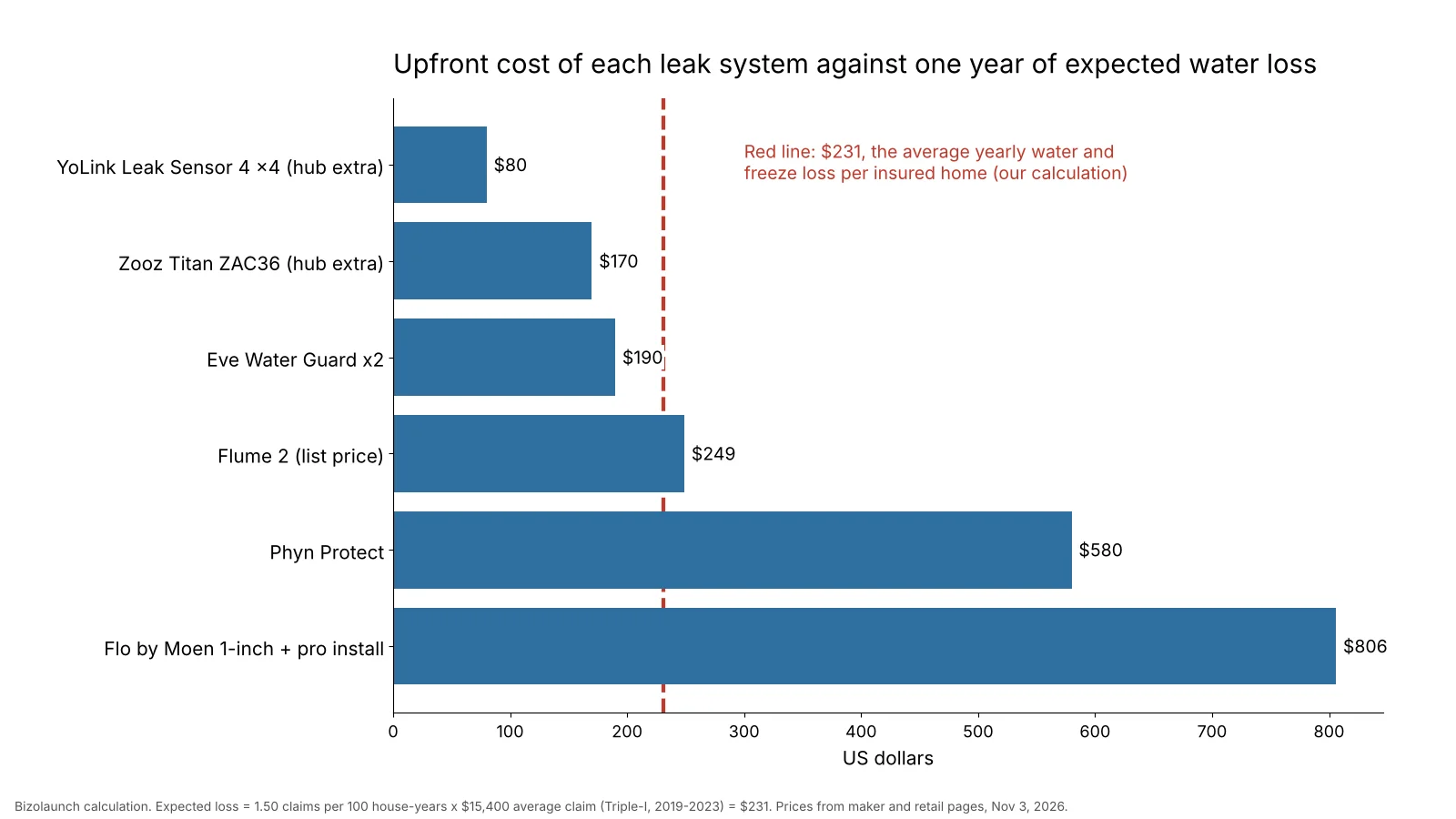
Seen this way, three of the six systems cost less than one year of average expected loss, and even the priciest, Flo with professional installation at about $806, equals roughly three and a half years. A single claim, at $15,400 on average, is about 19 times that. The insurance deductible you would pay on that claim is often enough on its own to cover a shutoff valve.
Phyn Protect for Whole-Home Detection and Shutoff
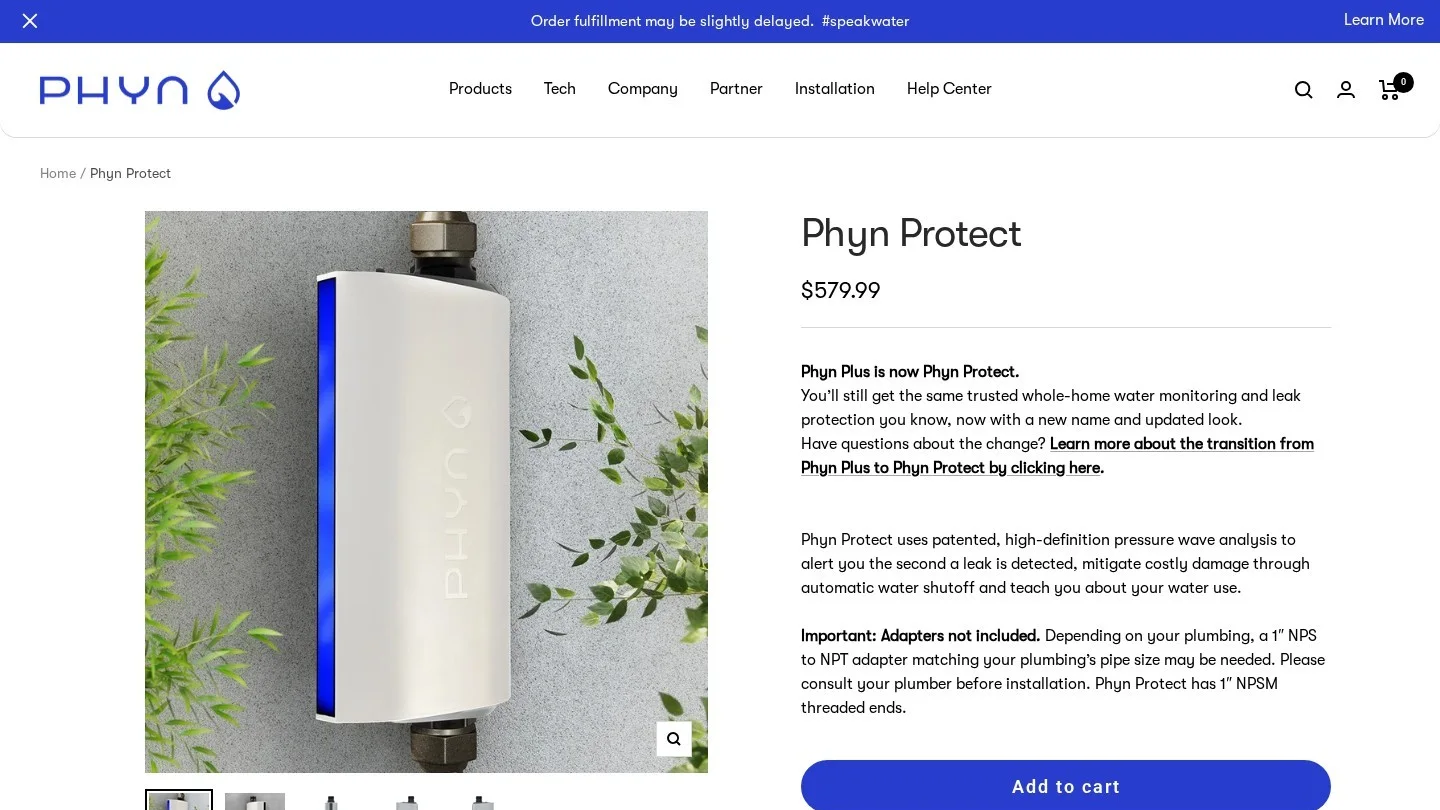
Phyn Protect has replaced Phyn Plus and is listed at $579.99. It mounts on the main supply line, up to 1 1/4 inches, and uses pressure-wave analysis together with an ultrasonic flow sensor that has no moving parts. After a learning period, it can close its valve on its own when flow looks abnormally high, and you can close it from the app.
Its Plumbing Check runs while the main is off and looks for small faults such as poor seals and pinhole leaks, the slow drips that do damage inside walls. Phyn recommends a licensed plumber because the main line is cut, and says installation usually takes one to two hours. The unit needs a power outlet within 12 feet, ideally GFCI, and it holds its current state if power fails, with a manual tool on the bracket for opening or closing the valve.
Flo by Moen for Homes Already Using Ring or Alexa
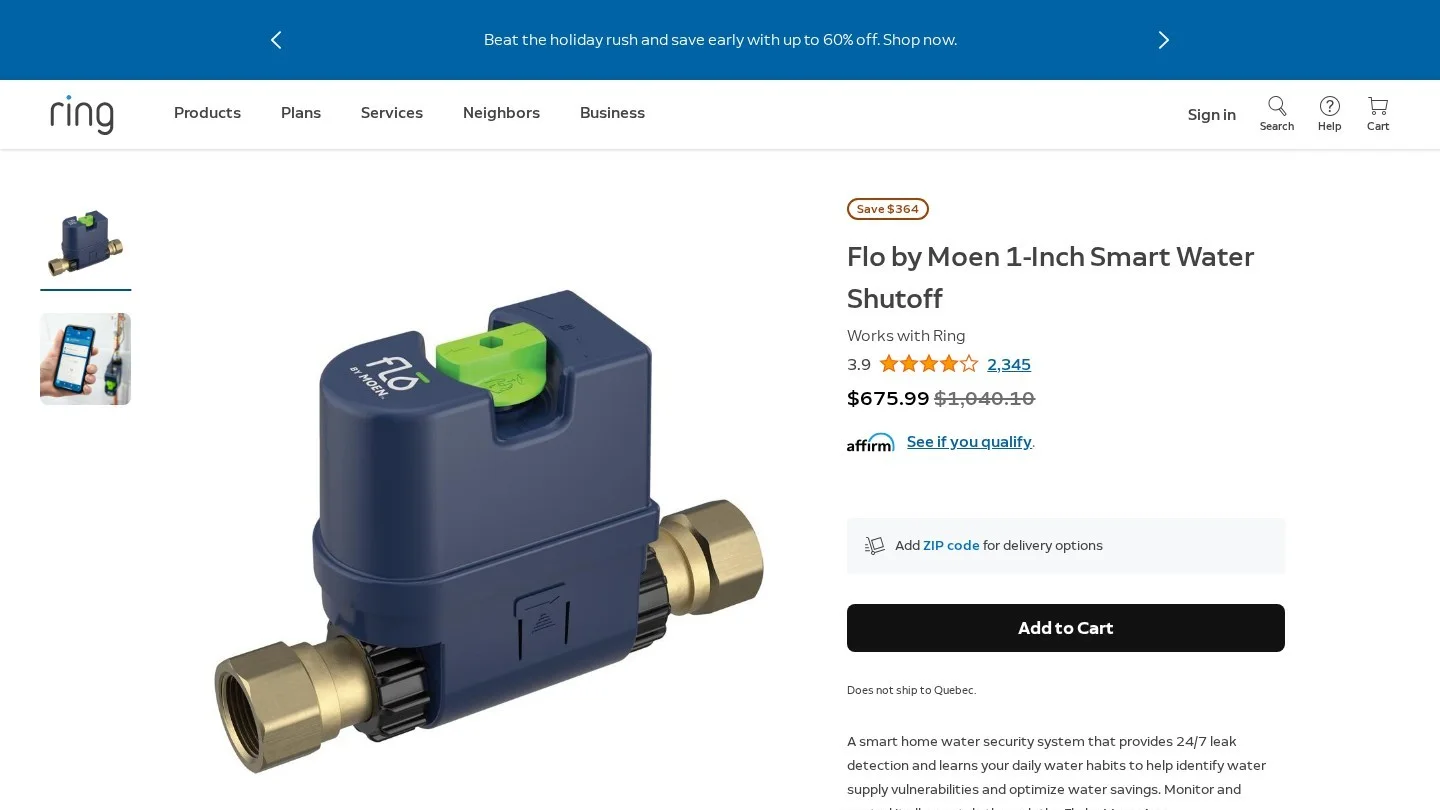
Flo by Moen does the same job with a different design. Ring’s store sells the 1-inch Flo smart water shutoff for $675.99, with professional installation from $129.99. It runs 24/7 leak detection, works with the Ring app and with Alexa and Google Assistant, and takes plug-in power with an optional battery backup sold separately.
The standard warranty is one year. An optional FloProtect subscription extends it to five years; FloProtect costs $5 a month and includes up to $5,000 of deductible coverage. Moen could make the plan easier to compare by listing its price next to the device. If your home already runs on Ring, Flo is the most natural fit.
Zooz Titan for a Low-Cost, Local Shutoff
The Zooz Titan ZAC36 LR is a motor that clamps onto the ball valve you already have, so no one has to cut your pipes. Apollo Automation sells it for $169.95, with a wired leak probe in the box. It fits ball valves from half an inch to 1 1/4 inches.
Its best feature is that the wired probe can close the valve even if your hub is offline or you have no hub at all. Adding more sensors around the house needs a Z-Wave controller, and the Titan supports Z-Wave Long Range. That makes it a strong match for a smart home that runs without the internet, because the shutoff decision never depends on a server.
Flume 2 for Watching Water Use Without a Plumber
Flume 2 straps onto your water meter and reads it in real time. Rain Bird’s store lists it at $249, on sale for $200, and Rain Bird says it installs in about 10 minutes with no pipe cutting or wiring. It breaks water use down by fixture, tracks irrigation and sends leak alerts. Rain Bird says customers save 10% to 20% a month on their water bills on average.
Flume does not shut water off, so it suits renters who cannot touch the plumbing, homeowners who mainly want to cut water bills, and anyone who wants a cheap way to spot a running toilet or a broken sprinkler line. Some water utilities have offered Flume rebates, so check your utility’s site before paying full price.
Eve Water Guard and YoLink Sensors for Spot Coverage
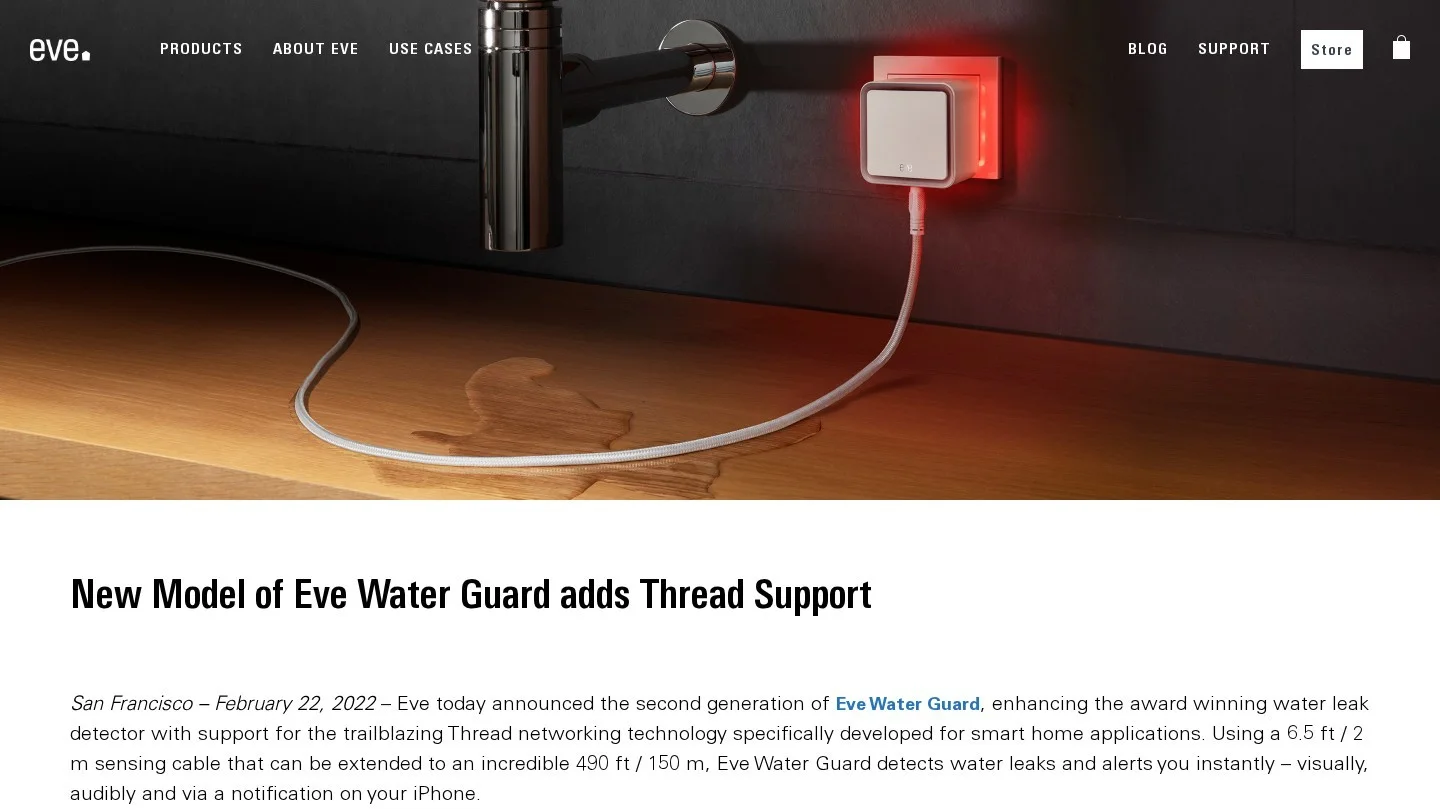
Spot sensors are designed to sit where household leaks usually begin: under sinks, behind the washer, beside the water heater and near the dishwasher. The Eve Water Guard costs $99.95, plugs into the wall and uses a 6.5-foot sensing cable that can be extended to 490 feet, so one unit can guard a whole run of appliances. It has a 100 dB siren, joins a Thread network and works with Apple Home without a bridge. It can also switch off a connected plug, such as one feeding a washing machine.
YoLink’s Water Leak Sensor 4 is the cheap way to cover many spots. It costs $19.99 and has a 105 dB siren and battery life of five years or more. It uses YoLink’s LoRa radio, which the company markets for extreme long range, a help in detached garages and deep basements. It needs a YoLink hub with an internet connection for full use, so plan for that cost.

Four Ways These Devices Sense a Leak
The products above use four different detection methods, and understanding them explains most of the price differences. A conductive probe, used by YoLink, Eve and the Zooz wired probe, is the simplest: two contacts on the floor complete a circuit when water bridges them. It is cheap and reliable, but it only knows about water that reaches that exact spot.
Meter reading, used by Flume, reads your utility water meter in real time, so it sees water flowing to every tap, toilet and sprinkler in the property. It can spot a dripping tap or a running toilet anywhere in the home, but it cannot act on what it finds. Ultrasonic flow sensing, used inside Phyn’s unit, measures how fast water moves through the pipe with sound waves and no moving parts. Pressure-wave analysis, Phyn’s main technique, reads tiny pressure changes in the plumbing each time a fixture opens or closes, which helps it tell normal use from a slow hidden leak.
Whole-home systems combine sensing with a motorized valve, which is why they cost several times more than spot sensors. In practice, the four methods complement each other rather than compete. Spot sensors catch a failing washer hose within seconds at the source, while a main-line system catches the pinhole leak inside a wall that no floor sensor will ever touch.
Two Layered Setups and What They Cost
Most homes get the best protection from a shutoff on the main line plus a few spot sensors where leaks usually start. We priced two layered setups from the published prices above. Hub costs are left out because many readers already own one.
| Setup | Parts | Total before hub and plumber | Equal to this many years of average expected loss |
|---|---|---|---|
| Budget local setup | Zooz Titan $169.95 + four YoLink sensors at $19.99 | $249.91 | 1.1 years |
| Premium whole-home setup | Phyn Protect $579.99 + two Eve Water Guards $189.90 | $769.89 | 3.3 years |
The method is the sum of the parts, divided by the $231 expected yearly loss worked out above. Mixing brands means mixing apps, so the budget setup works best for someone who already runs a local hub, while the premium setup suits a household that wants each part to work on its own with little upkeep.
Matching a Leak System to Your Home
- Second homes and long trips: an automatic main-line shutoff, Phyn Protect or Flo by Moen, because no one is there to act on an alert.
- Homeowners who use a local hub: the Zooz Titan on the existing main valve, with Zigbee or Z-Wave sensors in wet rooms.
- Renters: Flume 2 if the landlord agrees to a meter strap, plus spot sensors you can take with you.
- Apple Home users: Eve Water Guard, with its long cable laid along the laundry and kitchen.
- Tight budgets: four YoLink sensors and a hub, then add a shutoff valve later.
Landlords should think about leak protection across a whole building rather than one unit at a time. One burst pipe in an upstairs unit can damage the units below, so shutoffs pay back faster in multi-unit property than in a single house. Our guide to starting a property management business covers how upgrades like this fit into a maintenance plan, and the break-even calculator can turn the numbers above into a payback time for your own buildings.
Installing a Shutoff Valve: What to Check First
Before buying an inline system, find your main shutoff valve and measure the diameter of the pipe it sits on. Phyn takes lines up to 1 1/4 inches with 1-inch threaded ends, and adapters are not included. Flo comes in 3/4-inch and 1-inch models. The Zooz Titan needs a ball valve, not an old gate valve with a round handle, and about three inches of clearance on each side.
Next, check whether there is power and a usable Wi-Fi signal at that location. Main valves often sit in a garage, a crawl space or an outdoor box, where outlets are scarce and Wi-Fi is weak. If your home already has an energy monitor in the breaker panel, you will know whether the signal reaches that part of the house. Finally, call your insurance company before you buy anything. Some carriers offer a discount for an automatic shutoff, and the size of that discount can change which system makes sense.
Questions Homeowners Ask About Leak Detectors
Are Smart Water Shutoff Valves Worth It?
The average water or freezing claim is $15,400, and the expected loss per insured home is about $231 a year. A $170 to $806 shutoff costs less than one average claim many times over, so for homeowners with valuable finishes or long absences, the case is strong.
What Is the Difference Between Phyn and Flo by Moen?
Both devices sit on the main water line and can shut off the supply automatically when they detect a problem. Phyn uses pressure-wave analysis with an ultrasonic sensor and costs $579.99. Flo costs $675.99, ties in closely with Ring, and offers an optional FloProtect plan for a longer warranty.
Can a Leak Sensor Work Without Wi-Fi?
Sirens sound locally on Eve and YoLink sensors, and the Zooz Titan’s wired probe closes the valve without any hub. Phone alerts away from home need an internet link.
Where Should I Put Water Leak Sensors?
Put them on the floor under sinks, behind the washing machine and dishwasher, next to the water heater, near the fridge water line and by any sump pump.
Product Pages and Insurance Data We Used
- Maker and store pages: Phyn, Flo by Moen on Ring, Flume 2 on Rain Bird, Eve, YoLink, Zooz Titan at Apollo Automation.
- Insurance data: Triple-I homeowners and renters insurance facts.
- Background: Smart Home Field Guide, September 2026.