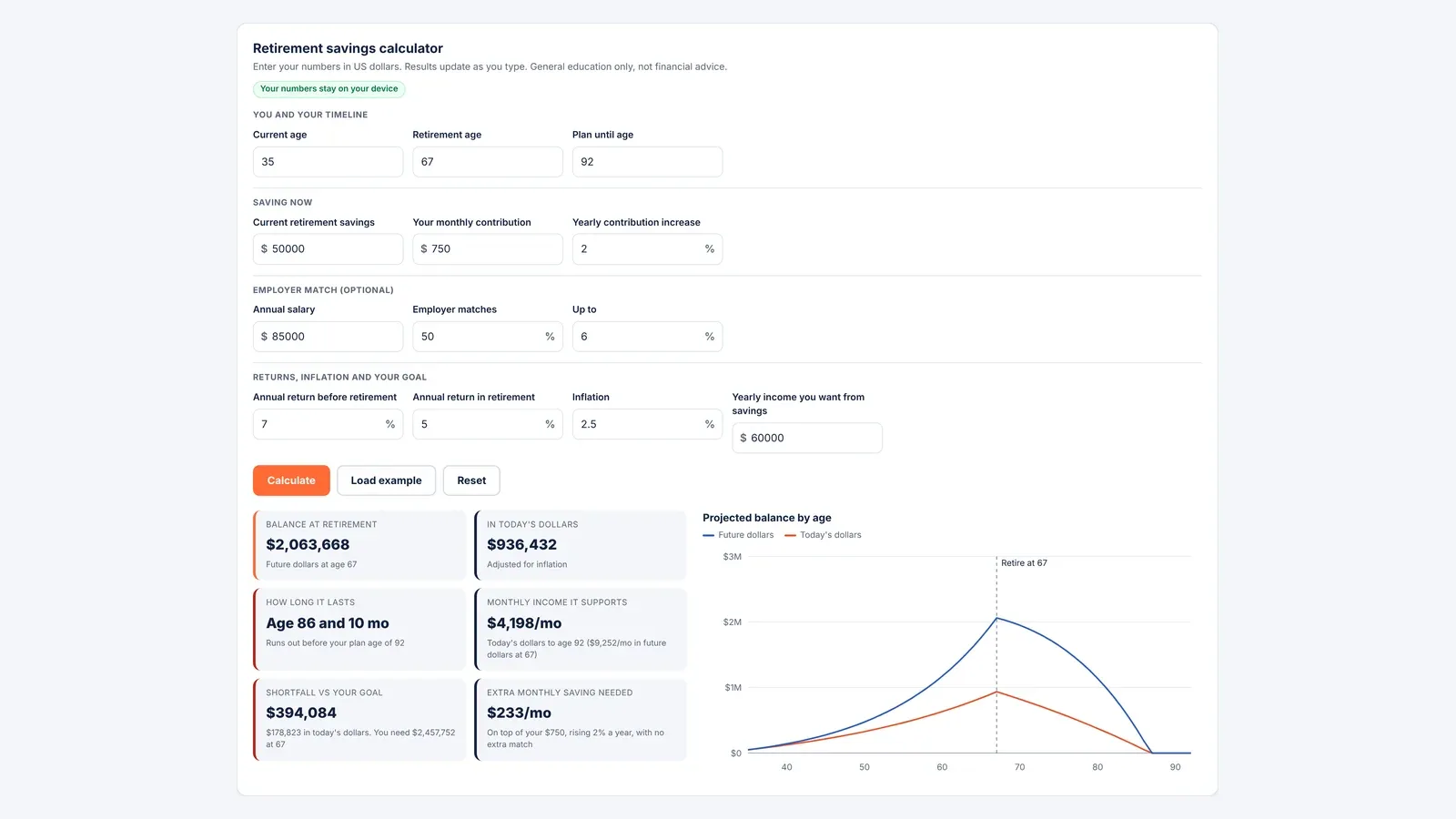
A retirement savings calculator answers two questions: how much money you are likely to have when you stop working, and whether that balance can pay the income you want for the rest of your life. A 35-year-old with $50,000 saved who invests $750 a month and receives a 50% employer match would reach about $2.06 million by age 67 at a steady 7% return. After 2.5% yearly inflation, that sum has the buying power of roughly $936,000 at current prices, and withdrawals of $60,000 a year (adjusted for inflation) would exhaust it at about age 86.
The free calculator below runs the same projection with your own numbers. It estimates your 401(k) and IRA balance in future and current dollars, shows how long the money lasts and what monthly income it can support, and compares the result with your goal. When there is a shortfall, it calculates the extra monthly saving needed to close it, and a year-by-year table and chart show the full path. The tool is for general education and is not financial advice.
Inflation-Adjusted Balances and Two Ways to Close a $394,000 Gap
- A projected balance means little until you adjust it for inflation: in our example, $2.06 million in 32 years buys what about $936,000 buys now.
- The nest egg you need depends on your income goal, the length of your retirement and the return you earn after you stop working.
- In the same example, saving an extra $233 a month or working until 70 closes a $394,000 shortfall.
- For 2026, the IRS allows up to $24,500 in a 401(k) and $7,500 in an IRA, with higher catch-up limits from age 50.
Retirement savings calculator
Enter your numbers in US dollars. Results update as you type. General education only, not financial advice.
Your numbers stay on your device
Balance at retirement
–
Future (nominal) dollars
In today’s dollars
–
Adjusted for inflation
How long it lasts
–
Withdrawing your goal income
Monthly income it supports
–
Today’s dollars, rising with inflation
Gap vs your goal
–
Compared with the nest egg you need
Extra monthly saving needed
–
Starting now, to close any gap
Projected balance by age
- Future dollars
- Today’s dollars
Line chart of your projected balance from today to the end of your plan. The full figures are in the year-by-year table below.
Year-by-year table
| Age | Start balance | Contributions | Withdrawals | Growth | End balance | End, today’s $ |
|---|
General education only, not financial advice. The calculator assumes steady returns, monthly contributions and withdrawals, and income that rises with inflation each year. It ignores taxes, fees and Social Security unless you net them out of your goal. Real markets go up and down, so treat the result as a rough guide and check it again every year.
How to Use the Retirement Savings Calculator
Press Load example to see a completed case, then replace the figures with your own; the results update as you type. Every field is required except the employer match and the yearly contribution increase.
- Ages: enter your current age, your retirement age and the age your money should last until. Choose a plan age a few years beyond your life expectancy, because outliving your savings is the risk you are guarding against.
- Savings and contributions: add together your 401(k), IRA and other retirement money, then enter your monthly contribution. A 2% yearly increase turns $750 a month into $765 next year.
- Employer match: a common formula is "50% of what you contribute, up to 6% of salary," which you would enter as 50 and 6 along with your salary. The tool assumes your salary grows at the same rate as your contributions.
- Returns and inflation: use a lower return for retirement if you expect to hold more bonds and cash by then. The inflation rate converts future dollars into current dollars.
- Income goal: enter the yearly income you want from savings at current prices, after subtracting Social Security and any pension. If you want $75,000 a year and expect $25,000 from Social Security, enter $50,000.
How the Calculator Projects Your Savings
The projection runs month by month. Before retirement, the balance grows at the monthly equivalent of your yearly return, and then your contribution and any employer match are added. A 7% yearly return becomes about 0.565% a month, which compounds to exactly 7% over twelve months, and your contribution steps up once a year by the increase you chose.
At retirement, the calculator converts your income goal into future dollars. With 32 years of 2.5% inflation, $60,000 at current prices becomes about $132,225 a year, or $11,019 a month. Each month the tool withdraws that income and lets the remaining balance grow at your retirement return, and each year the withdrawal rises with inflation so your spending power stays level.
The nest egg you need is the sum that pays your goal income until your plan age and then reaches zero. The supported income is the inflation-linked amount your projected balance could pay over that period. The extra monthly saving, which rises each year like your contributions and earns no match, is the amount that grows to exactly the shortfall.
Worked Example: Saving $750 a Month From Age 35
Consider a 35-year-old with $50,000 saved who puts $750 a month into her 401(k) and raises it by 2% a year. She earns $85,000, and her employer matches 50% of her contributions up to 6% of pay, which adds $212.50 a month. She assumes a 7% return before retirement, 5% after, 2.5% inflation and a goal of $60,000 a year from savings until age 92.
| Result | Amount | What it means |
|---|---|---|
| Her own contributions to 67 | $398,043 | 32 years of saving, rising 2% a year |
| Employer match to 67 | $112,779 | Money she receives only because she saves enough |
| Balance at 67 | $2,063,668 | About $1.5 million of it is investment growth |
| Balance at current prices | $936,432 | What that sum would buy now |
| Nest egg needed at 67 | $2,457,752 | Pays her goal income until 92 |
| Shortfall | $394,084 | About $178,823 at current prices |
| Money runs out | Age 86 and 10 months | About five years before her plan age |
| Income her savings support | $4,198 a month | At current prices, against the $5,000 a month she wants |
| Extra saving needed | $233 a month | Starting now and rising 2% a year |
The fix is smaller than the shortfall suggests. Adding $233 to her $750 monthly contribution lifts the balance at 67 to about $2.46 million, enough to pay $5,000 a month at current prices all the way to 92, because each extra dollar has 32 years to compound.
Which Inputs Change Your Retirement Number Most
We changed one input at a time in the example and kept everything else fixed, which shows where extra effort pays off and which assumptions deserve the most care.
| Change from the example | Balance at retirement | Gap to goal | Money lasts until |
|---|---|---|---|
| None (retire at 67, 7% return) | $2,063,668 | $394,084 short | Age 86 |
| Retire at 65 | $1,763,086 | $709,403 short | Age 82 |
| Retire at 70 | $2,601,665 | $194,994 surplus | Age 94 |
| 5% return before retirement | $1,372,391 | $1,085,361 short | Age 79 |
| 8% return before retirement | $2,552,045 | $94,293 surplus | Age 93 |
| 3.5% inflation | $2,063,668 | $1,667,642 short | Age 79 |
| No employer match | $1,704,261 | $753,491 short | Age 82 |
| No yearly contribution increase | $1,749,127 | $708,625 short | Age 83 |
Retiring three years later turns the shortfall into a surplus, because those years add savings and growth while also shortening the period the money must cover. Returns matter just as much, but you cannot control them, so run the tool at a low, middle and high rate and plan around the low one. Inflation hurts twice, since it raises the income you need and reduces what your balance can buy.
2026 401(k) and IRA Contribution Limits
The calculator warns you when your first-year contributions exceed the 401(k) limit. The figures below come from the IRS announcement of November 13, 2025, and the 401(k) limit also applies to 403(b) plans, governmental 457 plans and the federal Thrift Savings Plan.
| Account (2026) | Under 50 | Age 50 or older | Ages 60 to 63 |
|---|---|---|---|
| 401(k), 403(b), 457, TSP | $24,500 | $32,500 | $35,750 |
| Traditional or Roth IRA | $7,500 | $8,600 | $8,600 |
| SIMPLE IRA (most plans) | $17,000 | $21,000 | $22,250 |
Eligibility to contribute to a Roth IRA phases out between $153,000 and $168,000 of income for single filers and between $242,000 and $252,000 for married couples filing jointly. The IRS updates these limits each year, so check the current figures before you change your saving plan.
Ways to Close a Retirement Savings Gap
Start with the employer match, because contributing less than the amount your employer will match leaves part of your compensation unclaimed. In our example, the match adds $112,779 over 32 years, and without it the shortfall nearly doubles.
Next, link your saving to your raises, and turn on automatic yearly increases if your plan offers them. If you are preparing to ask for a raise, our salary negotiation email templates can help you make the case.
Then test the two biggest levers: when you retire and how much you plan to spend. Working three more years closed the whole gap in our example, while cutting the income goal by 10%, to $54,000, shrinks the shortfall from $394,084 to about $148,308 and requires only $88 a month more. Self-employed workers fund retirement from their own fees, so check that your rates cover it with our freelance hourly rate calculator, and see our Found Pro review for one banking app that sets money aside for taxes automatically.
What This Retirement Calculator Leaves Out
Real returns rise and fall from year to year, and a crash early in retirement does more damage than the same crash a decade later, because you sell investments while prices are low. A steady average return cannot capture that risk. The tool also ignores taxes and fund fees, so raise your income goal to cover tax on withdrawals and use a return that is net of fees. Treat the result as a starting point, repeat the exercise once a year and speak to a fee-only planner before major decisions. For more free tools, browse the Bizolaunch tools page.
This calculator and article are for general education only and are not investment, tax or financial advice. Contribution limits were checked on October 31, 2026; confirm current rules with the IRS or a registered adviser before acting.
How Long Savings Last and Which Return Rate to Assume
How Much Do I Need to Save for Retirement?
The amount depends on the income you want from savings, the number of years retirement lasts and the return you earn. In our example, $60,000 a year at current prices from 67 to 92 requires about $2.46 million at 67, which equals roughly $1.12 million at current prices.
How Long Will My Retirement Savings Last?
Enter your balance, income goal, retirement return and inflation, and the calculator shows the age at which the money runs out. If your return covers your withdrawals indefinitely, it reports that the money lasts past age 120.
What Rate of Return Should I Use?
Nobody knows future returns, so test a range of rates and use a lower one for retirement if you plan to hold more bonds and cash. If your plan only works at the highest rate you tried, treat that as a warning sign.
How Much Can I Put in a 401(k) in 2026?
The IRS limit for 2026 is $24,500. Savers aged 50 or older can add an $8,000 catch-up contribution, and those aged 60 to 63 can add $11,250 instead. The IRA limit is $7,500, plus $1,100 from age 50.