The post-quantum cryptography companies worth knowing in late 2026 fall into five groups. PQShield and SEALSQ supply the code and chips. Thales makes the boxes that store keys, and DigiCert issues certificates. SandboxAQ, QuSecure, CryptoNext Security and IBM help firms find and replace old cryptography. And network operators such as Cloudflare already switch it on for millions of users. Each group solves a different part of the move away from RSA and elliptic-curve cryptography, which NIST deprecates after 2030.
This list is not a ranking by revenue or hype. We picked companies with a shipping product or service that uses the NIST post-quantum standards. We checked each one on its own site or in its own announcement. Then we sorted them by the job a buyer would hire them for. Funding figures appear only where they have been made public.

The Five Jobs in a Post-Quantum Migration
A company moving to post-quantum cryptography has five jobs to do. It must find where old cryptography lives and decide what to fix first. Then it must get new algorithms into software and hardware, store the new keys safely, and issue certificates people can trust. No single vendor does all five well, which is why the market has split.
| Job | What it means | Companies in this list |
|---|---|---|
| Discovery and inventory | Finding every RSA and elliptic-curve key, certificate and library in use | SandboxAQ, CryptoNext Security, IBM |
| Migration and crypto agility | Swapping algorithms without rebuilding systems | QuSecure, CryptoNext Security |
| Algorithms in code and silicon | Libraries, chip designs and secure chips that run ML-KEM and ML-DSA | PQShield, SEALSQ |
| Key storage | Hardware security modules that create and guard post-quantum keys | Thales (and Crypto4A, which DigiCert supports) |
| Certificates and delivery | Issuing post-quantum certificates and protecting traffic at scale | DigiCert, Cloudflare |
All of them build on the same standards. These are FIPS 203 for key establishment (ML-KEM), FIPS 204 for signatures (ML-DSA) and FIPS 205 for hash-based signatures (SLH-DSA). NIST finalized all three in August 2024. Our guide on how businesses can prepare for post-quantum encryption explains those standards and the 2030 to 2035 deadlines in detail.
Which NIST Algorithms Each Company Lists
We read each company’s product material and recorded the post-quantum algorithms it names.
| Company | Product checked | Algorithms supported | Date published |
|---|---|---|---|
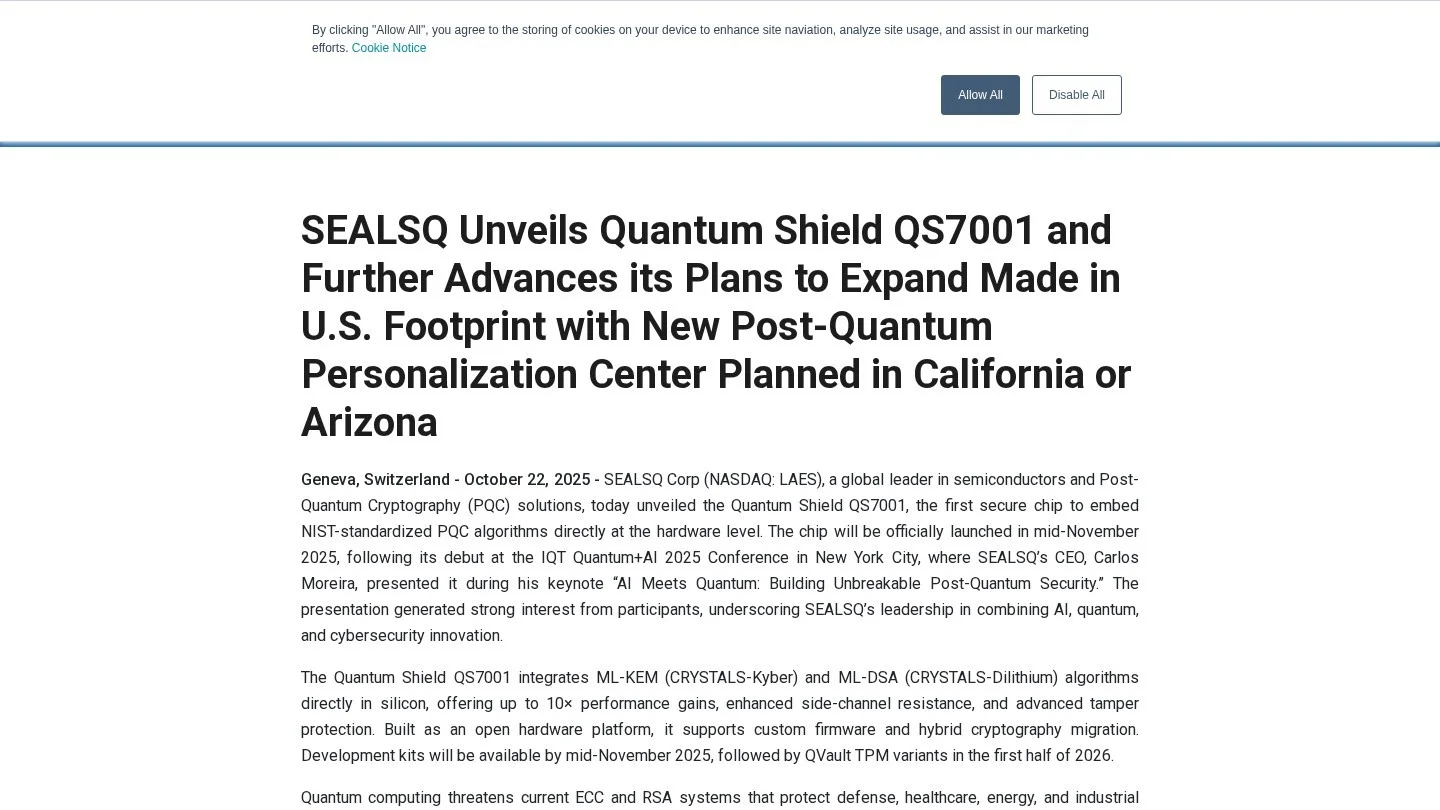
| SEALSQ | QS7001 secure chip | ML-KEM and ML-DSA, built into the hardware | October 22, 2025 |
| Thales | Luna HSMs | ML-KEM and ML-DSA in firmware, plus HSS hash-based signatures | July 2026 |
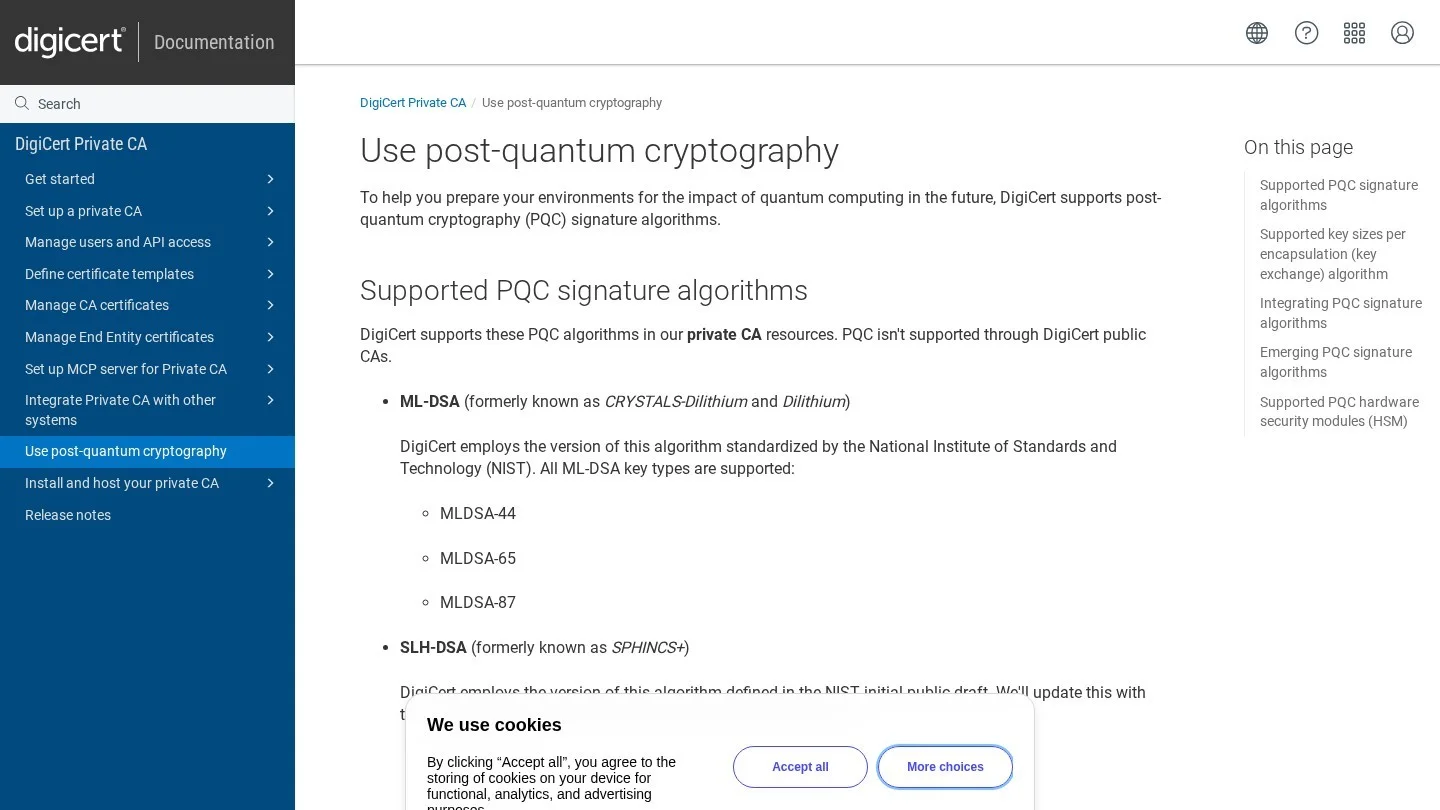
| DigiCert | Private CA | ML-DSA-44, 65 and 87; SLH-DSA-128, 192 and 256 (draft version); ML-KEM-512, 768 and 1024 | Undated documentation page |
| Cloudflare | TLS at its network edge | Hybrid X25519MLKEM768 key exchange | June 23, 2026 |
For the software and services firms, the public material describes capabilities rather than algorithm lists, so we cover them in the profiles below.
Chip and Code Suppliers
PQShield
PQShield grew out of research at Oxford in the UK, founded by mathematician Ali El Kaafarani. It licenses post-quantum cryptography in three forms. Chipmakers build its designs into processors and smart cards. App makers use its software kit for mobile and server apps. And a third toolkit protects secure messaging. In June 2024 it raised a $37 million Series B led by Addition. Chevron Technology Ventures, Legal & General, Braavos Capital and Oxford Science Enterprises also took part.
The customer list announced with that round is the best sign of where PQShield fits: AMD, Microchip Technology, Collins Aerospace, Lattice Semiconductor, Sumitomo Electric, NTT Data and Mirise Technologies, an R&D venture of Toyota and Denso. PQShield also provides its technology to the Signal Foundation without charge. For a buyer, PQShield is usually invisible: you get its work inside a chip or device you buy from someone else.
SEALSQ
SEALSQ, based in Geneva and listed on Nasdaq as LAES, makes secure chips for devices. In October 2025 it unveiled the QS7001, which it describes as the first secure chip to build NIST’s ML-KEM and ML-DSA directly into hardware. The chip was due to launch in mid-November 2025, along with development kits. Versions for trusted platform modules, called QVault TPM, were planned for the first half of 2026.
Hardware matters most for devices that must last a decade or more, such as meters, cars and industrial controllers. A software update cannot add new cryptography if the chip lacks the room or speed. Choosing a post-quantum-ready chip now avoids a costly swap later. The QS7001 also shows that post-quantum support is moving from software updates into the parts list that device makers choose at the design stage.
Key Storage and Hardware Security Modules
Thales
Thales makes Luna hardware security modules, the locked boxes that banks, certificate authorities and cloud providers use to create and guard keys. The Luna 7 family runs ML-KEM and ML-DSA directly in firmware. It also supports HSS, a hash-based signature scheme defined in NIST SP 800-208. It also describes a next-generation Luna 8. Thales says the modules are designed to meet FIPS 140-3 and Common Criteria EAL4+.
HSM support is a quiet but vital step. A certificate authority cannot issue post-quantum certificates until its HSM can create and protect post-quantum keys. DigiCert’s documentation, covered next, names Thales Luna with firmware 7.9 or later as a supported module for its post-quantum roots. HSMs from Crypto4A are also supported.
Certificates and Large-Scale Delivery
DigiCert
DigiCert is a long-standing certificate authority, and its private CA shows how far post-quantum certificates have come. The private CA supports ML-DSA and ML-KEM in all three NIST sizes. It also supports SLH-DSA in three sizes, based on the draft version of that standard. DigiCert says it will update SLH-DSA to the final version.
The limits are just as useful to know. Post-quantum certificates come only from DigiCert’s private CAs, not its public ones. So they suit internal systems such as device fleets and company networks, not public websites. Revocation checks work through certificate revocation lists, but online status checks (OCSP) do not yet work for ML-DSA or SLH-DSA certificates.
Cloudflare
Cloudflare is not a cryptography vendor in the usual sense, but it may protect more traffic with post-quantum key agreement than anyone else. On June 23, 2026, Cloudflare said over two-thirds of browser traffic to its network was protected with post-quantum encryption. It uses X25519MLKEM768, the hybrid key exchange the industry settled on. The company also said it had moved its target for full post-quantum security, including authentication, to 2029. That date is a useful benchmark when you ask your other suppliers for their own post-quantum plans, since it shows what a large operator thinks is achievable.
For a business, Cloudflare’s work is the easiest win on this list. Picture a website behind a large content delivery network with post-quantum TLS turned on. Visitors with current browsers get protection against harvest-now, decrypt-later attacks on that link. The site’s own code does not change.
Discovery, Inventory and Migration Specialists
SandboxAQ
SandboxAQ works at the meeting point of AI and quantum technology. In April 2025 it added $150 million to its Series E, taking that round past $450 million at a $5.75 billion valuation. Google, NVIDIA, BNP Paribas and Ray Dalio were among the investors. Total funding passed $950 million.
Its security product is AQtive Guard. It maps human and machine identities, finds expiring TLS certificates and replaces them. It also pulls data from tools such as CrowdStrike, Palo Alto Networks and ServiceNow. The company presents it as groundwork for post-quantum migration, since a firm cannot replace keys and certificates it cannot find.
QuSecure
QuSecure, a Silicon Valley startup, sells QuProtect, software that layers post-quantum protection onto existing networks so organizations can change algorithms without rebuilding their systems. After an extra Series A round led by Two Bear Capital with Accenture Ventures, its total funding reached $28 million. Its customer base includes the US Army and Air Force.
The approach suits organizations with old systems that cannot be patched quickly. Instead of waiting for every vendor to ship an update, a protective layer can carry post-quantum key exchange across the network in the meantime.
CryptoNext Security
Jean-Charles Faugère founded CryptoNext Security in Paris in 2019. The firm spun out of research labs at Inria, CNRS and Sorbonne University, and it builds on more than 20 years of post-quantum research. In November 2023 it raised €11 million in a round led by AXA Venture Partners and Quantonation, with Auriga Cyber Ventures.
Its products cover most of the migration chain: a remediation suite (C-QSR), a post-quantum library (C-QSL), discovery and inventory tools, and crypto-agility management. In June 2025 it launched COMPASS Discovery, which it describes as an open tool for finding and analyzing cryptographic assets. For European buyers, its research roots and French base may also matter in public-sector procurement.
IBM
IBM’s researchers worked on the algorithms that NIST standardized, and the company sells tools to put them to use. In October 2024 it launched Guardium Quantum Safe as part of its Guardium Data Security Center. The product shows where an organization uses cryptography and ranks weak spots for fixing. It applies policies based on internal and government rules, and it puts algorithm use in code and on the network into one dashboard.
IBM may suit large enterprises that already use its Guardium security tools. Adding a feature from a current supplier is often easier to approve than hiring a new vendor.
Why the Market Split into So Many Niches
It is fair to ask why a buyer needs five kinds of vendor for one change. The reason is that cryptography is spread through every layer of a company’s technology. It sits in chips, in operating systems, in web servers, in certificates and in the boxes that hold keys. Each layer has its own makers, its own upgrade cycle and its own standards body.
That spread also explains the order of events. Code libraries came first, because they are the cheapest to change. Network operators such as Cloudflare followed, since they control both ends of many connections. Key storage and certificates come next, because they need audited hardware and trusted roots. Chips and long-life devices come last, since a meter or a car built today may still be running in 2040.
For a buyer, the practical upshot is to plan by layer. Ask which layer each vendor covers. Then make sure that, together, your suppliers cover every layer that handles your sensitive data.
Funding Disclosed by the Startups on This List
Funding says little about product quality, but it does show which firms have money to support customers through a ten-year migration. We collected only publicly disclosed figures.
| Company | Latest disclosed round | Amount | Named investors |
|---|---|---|---|
| SandboxAQ | Series E extension, April 2025 | $150 million, taking the round past $450 million and total funding past $950 million | Google, NVIDIA, BNP Paribas, Ray Dalio |
| PQShield | Series B, June 2024 | $37 million | Addition (lead), Chevron Technology Ventures, Legal & General, Braavos Capital |
| QuSecure | Series A extension | Total funding of $28 million | Two Bear Capital (lead), Accenture Ventures |
| CryptoNext Security | Series A, November 2023 | €11 million | AXA Venture Partners, Quantonation, Auriga Cyber Ventures |
SEALSQ is a listed company. Thales, DigiCert, IBM and Cloudflare are established firms that fund this work from their own budgets, so they are not in the table. To follow new rounds in this space as they happen, our weekly startup funding roundup covers security and deep-tech deals.
How to Shortlist Post-Quantum Vendors
Most buyers will not buy “post-quantum cryptography” as a product. They will buy it inside a VPN, a certificate service, an HSM or a device. A sensible shortlist follows your own inventory.
- Start with discovery: a tool from SandboxAQ, CryptoNext Security or IBM, or your existing security vendor, tells you where RSA and elliptic curves live.
- Ask current suppliers first: your CDN, HSM, certificate authority and VPN vendor may already support ML-KEM and ML-DSA, as Cloudflare, Thales and DigiCert do.
- Fill gaps with specialists: use an overlay such as QuSecure where old systems cannot be upgraded soon.
- Specify post-quantum chips for long-life devices: ask hardware makers whether their secure elements use designs such as PQShield’s or chips such as SEALSQ’s QS7001.
- Check validation status: if you are regulated, ask for algorithm validation and FIPS 140-3 module status before you rely on a product.
- Keep the basics running: new algorithms do not stop stolen passwords or unpatched servers. Our small business cybersecurity checklist covers the controls that still matter most while the migration runs.
Identity systems belong on the list too, because passkeys and single sign-on rely on elliptic-curve signatures today. Our comparison of passwordless authentication software is a good place to start those vendor conversations. For a hands-on feel for the machines behind all this, our guide on accessing quantum computers through the cloud shows what a test run costs on IBM, Amazon and Microsoft platforms.
Questions Buyers Ask About Post-Quantum Vendors
Which Companies Make Post-Quantum Cryptography?
PQShield and SEALSQ supply chips and code, Thales makes HSMs, and DigiCert issues certificates. Cloudflare protects web traffic. SandboxAQ, QuSecure, CryptoNext Security and IBM handle discovery and migration.
Is Post-Quantum Cryptography Available Today?
Yes. NIST finalized ML-KEM, ML-DSA and SLH-DSA in August 2024, and products from Thales, DigiCert and SEALSQ name them in their documentation. Cloudflare says over two-thirds of browser traffic to its network used post-quantum key agreement in June 2026.
Do I Need a Specialist Post-Quantum Vendor?
Often not at first. Many firms will get post-quantum support through updates from their current CDN, HSM, certificate and VPN suppliers. A specialist helps with discovery or with systems that cannot be upgraded.
Are Post-Quantum Certificates Available for Public Websites?
Not from DigiCert’s public CAs. Its post-quantum certificates are available through private CAs for internal use.
Standards, Vendor Pages and Funding Reports for This List
- NIST: FIPS 203, Module-Lattice-Based Key-Encapsulation Mechanism Standard
- TechCrunch: PQShield Secures $37M for Quantum-Resistant Cryptography (2024)
- SEALSQ: QS7001 Announcement (October 2025)
- Thales: Luna HSMs Post-Quantum Readiness Solution Brief (July 2026)
- DigiCert: Use Post-Quantum Cryptography in Private CA
- Cloudflare Blog: Post-Quantum Update (June 23, 2026)
- The SaaS News: SandboxAQ Raises $150 Million in Series E
- Cyber Defense Magazine: Inside SandboxAQ’s Quantum and AI Security Vision
- SecurityWeek: QuSecure Banks $28M Series A
- CryptoNext Security: Raises €11M (November 2023)
- The Quantum Insider: IBM Launches Guardium Quantum Safe (October 2024)