Twelve startup rounds announced between October 26 and November 2, 2026, raised $4.27 billion plus €100 million, and four American companies took 96% of the dollar total. Re:Build, a Massachusetts manufacturer, raised $2.1 billion led by General Catalyst and JPMorganChase. Prediction market Kalshi raised $1 billion at a $40 billion valuation, Bedrock Robotics $600 million and cloud security firm Upwind $400 million. In India, six startups in our table raised $73.1 million between them, led by Cent’s $15 million Series A.
We built this table ourselves and checked each amount, lead investor and date against the company’s announcement or a news report. Below the table, we break the week down by sector, round size, valuation jumps and the investors who showed up most often.
The Week’s Money in Four Numbers
- $4.27 billion plus €100 million: raised across the 12 rounds in our table, October 26 to November 2, 2026.
- 96%: the share of the dollar total taken by Re:Build, Kalshi, Bedrock Robotics and Upwind.
- $15 million: the median dollar round, which shows how far the giant deals pull up the average.
- 3 rounds: led or co-led by General Catalyst, more than any other investor this week.
Startup Funding This Week: The Full Table
Rounds are sorted by size, and each date is the day the deal was announced. “Lead investors” lists only the firms named as leads or co-leads.
| Startup | What it does | Round | Amount | Lead investors | Date |
|---|---|---|---|---|---|
| Re:Build (Framingham, US) | Hard-tech manufacturing and launching new industrial companies | Not named | $2.1 billion | General Catalyst, JPMorganChase Strategic Investment Group | Oct 27 |
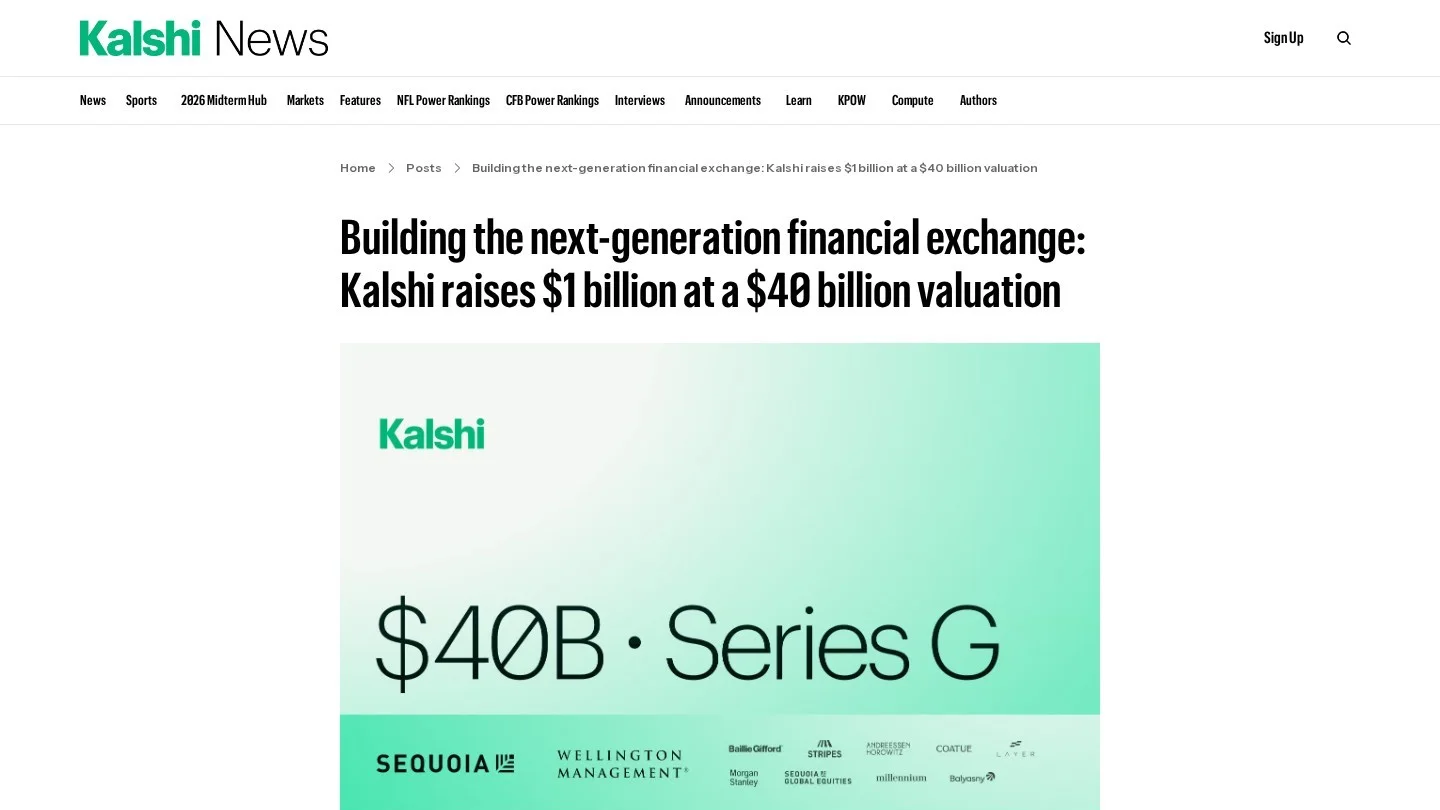
| Kalshi (New York, US) | Prediction market exchange | Series G | $1 billion | Wellington, Sequoia | Oct 29 |
| Bedrock Robotics (San Francisco, US) | Autonomy kits for excavators and other construction machines | Series C | $600 million | CapitalG, Emergence Capital | Oct 26 |
| Upwind (San Francisco, US) | AI runtime security for cloud infrastructure | Series C | $400 million | Bessemer Venture Partners | Oct 28 |
| General Compute | AI cloud built on specialised inference chips | Series A | $100 million | Blackbird Ventures, Abstract Ventures | Oct 27 |
| Hypersonica (Munich, Germany) | Hypersonic long-range missiles for European defence | Series B | €100 million | Lightspeed, General Catalyst | Nov 2 |
| Cent (India) | Healthtech, diagnostics | Series A | $15 million | Blume Ventures, South Park Commons | Oct 27 |
| Simplismart (India) | AI infrastructure and development tools | Series B | $14 million | Dallas Venture Capital | Oct 27 |
| Live2.ai (India) | AI applications for businesses | Pre-Series B | $13.7 million | IvyCap Ventures | Oct 27 |
| Troovy (India) | Direct-to-consumer brand | Series B | $10.5 million | Fireside Ventures | Oct 27 |
| Matiks (India) | Math, logic and puzzle games app | Pre-Series A | $10 million | General Catalyst | Oct 26 |
| Ace Blend (India) | Direct-to-consumer brand | Series A2 | $9.9 million | 3one4 Capital | Oct 29 |
Four US Megadeals Took Almost Everything
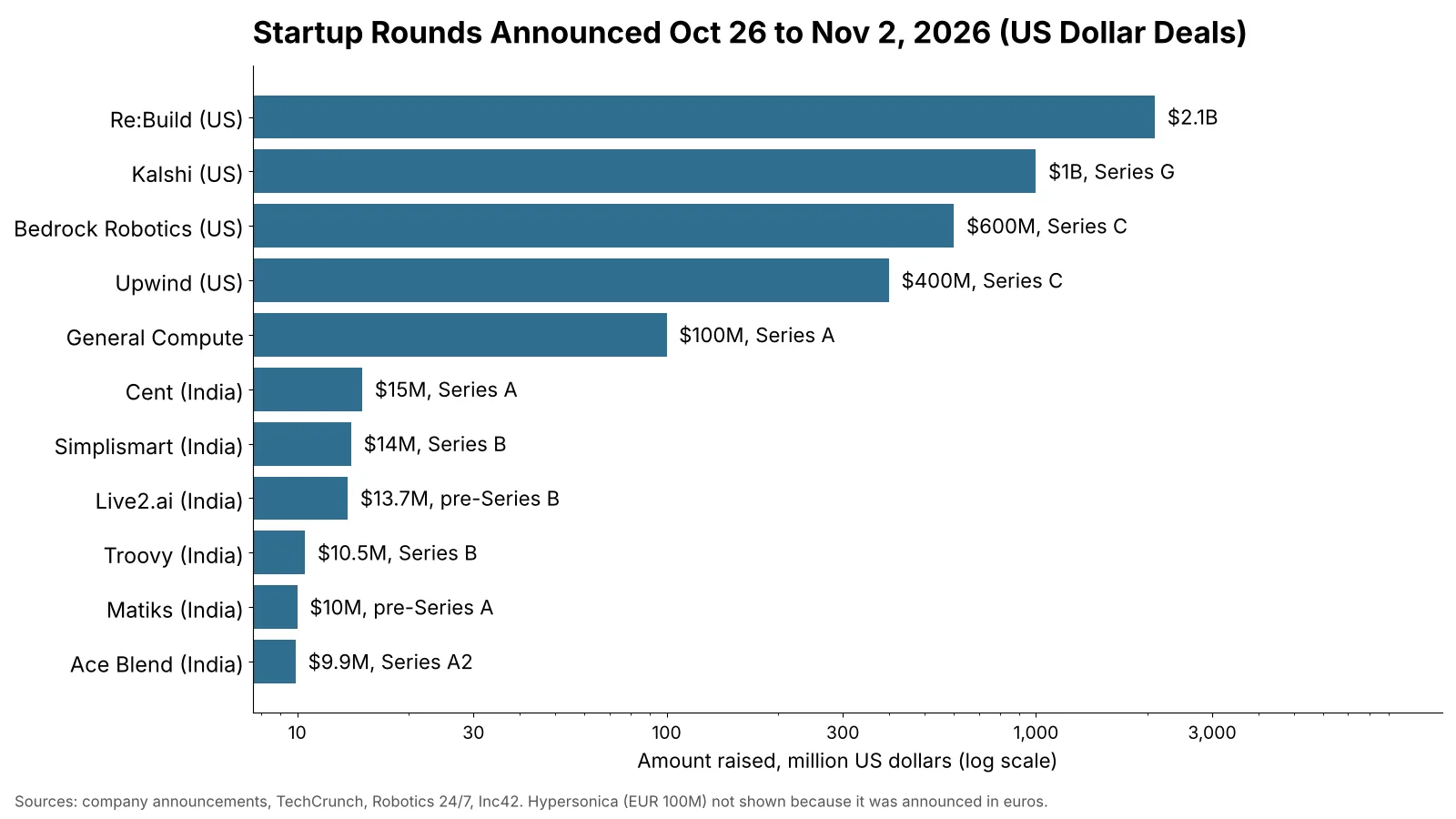
Adding up the dollar rounds in our table gives $4,273.1 million, and Re:Build, Kalshi, Bedrock and Upwind account for $4,100 million of that, or 96%. The other seven dollar rounds, from General Compute down to Ace Blend, share the remaining 4%. Hypersonica’s €100 million sits outside these sums because it was announced in euros.
That skew is the reason a simple average misleads anyone reading weekly funding totals. The mean dollar round in our table is about $388 million, while the median is $15 million. A founder reading “startups raised billions this week” should picture the median, since the typical round on this list was a $10 million to $15 million Series A or B.
Re:Build: $2.1 Billion for American Factories
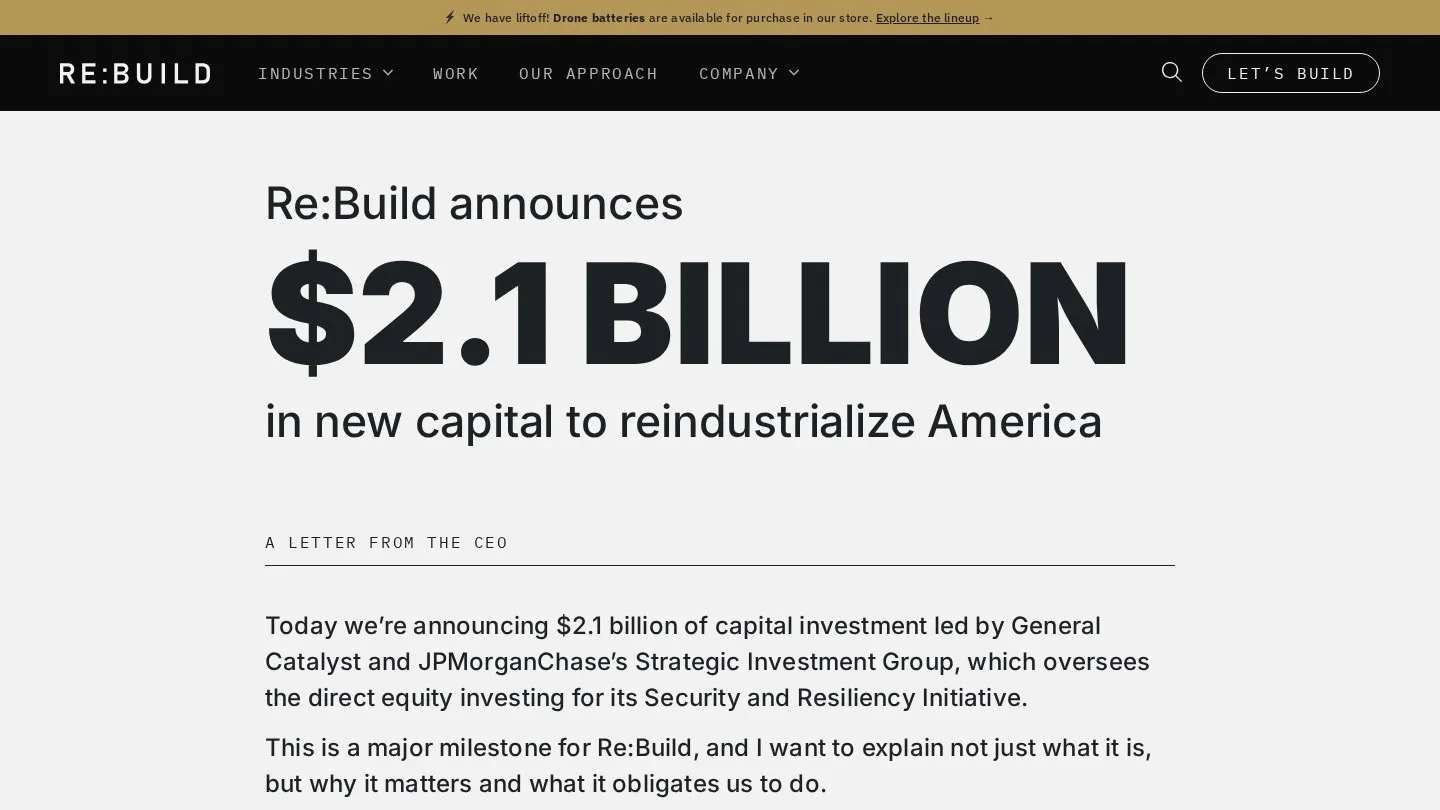
Re:Build, based in Framingham, Massachusetts, builds hard-tech products for partners and starts new industrial companies of its own. Slate and Neon Aero are two examples. The company says more than 2,000 people work at Re:Build and its associated companies. Co-founder and CEO Miles Arnone said the money will expand manufacturing and back new industrial firms over long time horizons. It was the largest US round of the week.
Kalshi: $1 Billion Series G at a $40 Billion Valuation
Kalshi runs a prediction market, an exchange where people trade on the outcome of events. Wellington and Sequoia co-led the round, joined by Baillie Gifford, a16z, Coatue, CapitalG, Morgan Stanley Investment Management and others. The company says its annualized trading volume is above $1 trillion and that it has created more than 30 million accounts. It plans to expand in Latin America and Europe and launch indices, single-stock perpetual futures and compute markets.
Bedrock Robotics: Self-Driving Excavators on Paid Jobs
Bedrock fits autonomy systems to existing excavators rather than building new machines. The company says its fully autonomous excavators began paid work on live job sites in mid-August 2026, and that customer volume has more than doubled since 2025. New investors include the US Innovative Technology Fund, Bessemer and Temasek. Total funding is now close to $1 billion.
Upwind: $400 Million After Turning Down a Buyer
Upwind secures cloud workloads while they run. Datadog tried to buy the company but did not offer more than the new $3.8 billion valuation, so Upwind raised instead. Founder Amiram Shachar previously sold Spot.io to NetApp for $450 million. The company adds $20 million to $30 million in annualized recurring revenue each quarter and expects to end the year near $90 million.
The Mid-Sized and Early Rounds, One by One
The eight smaller rounds tell a different story from the megadeals. Most are first or second institutional rounds, and several come from India, where checks between $10 million and $15 million made up the top of the week.
General Compute Bets on Chips Beyond Nvidia
General Compute provides bare-metal servers to inference cloud companies, built on chips from Nvidia rivals. Co-founder and CEO Finn Puklowski plans to deploy 75 megawatts of computing capacity in 2027, and the company has a $400 million chip purchase deal with SambaNova. Its chip suppliers include Cerebras Systems, SambaNova and Positron AI.
Hypersonica Builds Hypersonic Missiles for Europe
Hypersonica was founded in 2023 by Dr. Philipp Kerth and Dr. Marc Ewenz and is based in Munich, with a subsidiary in London. Its €100 million Series B came only nine months after a €23.2 million Series A in February 2026. Existing backers Plural and 201 Ventures joined co-leads Lightspeed and General Catalyst. The company says the money will pay for testing, expansion across Europe and hundreds of engineering and manufacturing jobs in the UK and Germany.
Cent, Simplismart and Live2.ai in India
Cent’s $15 million Series A was co-led by Blume Ventures and South Park Commons, with Vodafone’s Arun Sarin and OpenAI’s Srinivas Narayanan also investing. Simplismart, which builds AI infrastructure and development tools, raised a $14 million Series B led by Dallas Venture Capital, with NVIDIA, Accel, Shastra VC and Micromax taking part. Live2.ai, which builds AI applications for businesses, raised $13.7 million in a pre-Series B round from IvyCap Ventures.
Troovy, Matiks and Ace Blend in Consumer
Two direct-to-consumer brands raised in the same week. Troovy’s $10.5 million Series B was led by Fireside Ventures with Sharrp Ventures, and Ace Blend’s $9.9 million Series A2 was led by 3one4 Capital, with Fireside again taking part. These two rounds made up 61% of the $33.4 million that went to Indian ecommerce that week. Matiks, the puzzle games app, raised $10 million led by General Catalyst, with Ronnie Screwvala, Info Edge Ventures, Tanglin Venture Partners and Untitled Ventures also investing.
Valuation Jumps: How Fast Prices Rose Between Rounds
Four companies disclosed a valuation with this round, and three also had a dated earlier price. We divided the new valuation by the old one to show how much each company’s price rose, and how quickly.
| Company | Earlier valuation | New valuation | Increase | Time between rounds |
|---|---|---|---|---|
| General Compute | $60 million (seed, May 2026) | $800 million post-money | 13.3x | About 5 months |
| Upwind | $1.5 billion | $3.8 billion | 2.5x | About 9 months |
| Bedrock Robotics | $1.75 billion (February 2026) | $4.1 billion post-money | 2.3x | About 8 months |
| Kalshi | Not used | $40 billion post-money |
These are steep rises for the space of a few months, and each one sets a high bar for the next round. Upwind’s price works out to about 42 times its forecast year-end revenue of $90 million, in line with the “more than 40 times” multiple reported at the time. Investors at that price are paying for growth that has yet to happen, so the company will need to keep adding revenue at its current pace. Founders raising at earlier stages can see how the instruments work in our guide to SAFE notes and how they convert.
Which Sectors Drew the Money
We grouped the 12 rounds into five sectors using each company’s own description. Physical industry, meaning factories, construction machines and defence, drew the most dollars by far.
| Sector | Rounds | Companies | Dollars raised |
|---|---|---|---|
| Manufacturing, construction and defence | 3 | Re:Build, Bedrock Robotics, Hypersonica | $2,700 million plus €100 million |
| Markets and fintech | 1 | Kalshi | $1,000 million |
| Security | 1 | Upwind | $400 million |
| AI infrastructure and AI apps | 3 | General Compute, Simplismart, Live2.ai | $127.7 million |
| Consumer and health | 4 | Cent, Troovy, Matiks, Ace Blend | $45.4 million |
Two patterns stand apart. First, investors are backing companies that make physical things, often with an AI or autonomy layer on top. Second, AI money this week went to the layer that runs models, General Compute and Simplismart, rather than to chat assistants. Hypersonica, which aims to have hypersonic deep-strike systems ready by 2029 under the UK and Germany’s Trinity House Agreement, shows that European defence is now a venture category in its own right.

Investors Who Showed Up More Than Once
General Catalyst led or co-led three rounds in our table: Re:Build, Hypersonica and Matiks. That spread runs from a $2.1 billion US manufacturing raise to a $10 million Indian gaming round, which says a lot about how widely the firm is investing. Sequoia co-led Kalshi, and Bessemer led Upwind while also joining Bedrock as a new investor. CapitalG co-led Bedrock and also took part in Kalshi.
Co-leads were common. Six of the 12 rounds named two lead investors, including every round of $100 million or more except Upwind. For a founder planning a large raise, this week suggests that lining up two lead firms is now a normal way to fill a big round.
India’s Week: 32 Deals and $130.2 Million
Our table lists India’s six largest disclosed rounds. Between October 26 and 30, 32 Indian startups raised $130.2 million. That was 29.2% less money than the week before, but 88% more deals. Ecommerce led with nine deals worth $33.4 million, and AI was second with five deals worth $30.4 million. Blume Ventures and Antler backed three startups each.
Set side by side, the gap with the US is wide. Kalshi’s single round was about 7.7 times India’s whole weekly total. India’s week was about many smaller checks: the average Indian deal that week works out to about $4.1 million, against a $15 million median in our global table.
Two Indian rounds had notable backers. Simplismart’s Series B included NVIDIA and Accel alongside lead Dallas Venture Capital. Matiks says its daily users grew from 22,000 earlier in the year to more than 300,000 by September, and it had 2.2 million monthly users that month.
What Founders Raising in 2027 Can Take From This Week
- Traction carries the round: Bedrock pointed to paid job-site work, Kalshi to trading volume, Upwind to quarterly revenue added, and Matiks to daily users. Each led with a hard number.
- Know your growth math: At 40 times forecast revenue, investors expect fast compounding. Our guide to CAC payback period shows the metric many of them check first.
- Have a use of funds ready: Hypersonica tied its money to testing, hiring in the UK and Germany, and a 2029 target. Specific plans read better than “growth.”
- Present it cleanly: If your deck needs work before you pitch, our list of pitch deck design companies in the USA is a good place to start.
For earlier-stage companies that launched or left stealth this autumn, see our list of new startups to watch. For a smaller single-company story, our report on Sunlight AI’s seed funding walks through one seed round in detail.
Funding Week Questions From Readers
Which Startup Raised the Most Money This Week?
Re:Build, with $2.1 billion announced on October 27, 2026, led by General Catalyst and JPMorganChase’s Strategic Investment Group.
How Much Did Indian Startups Raise This Week?
Indian startups raised $130.2 million across 32 deals between October 26 and 30, 2026. Cent’s $15 million Series A was the largest.
What Is Kalshi’s Valuation After Its Series G?
Kalshi says the $1 billion Series G values it at $40 billion post-money. Wellington and Sequoia co-led the round on October 29, 2026.
Which Investor Led the Most Rounds This Week?
In our table, General Catalyst led or co-led three: Re:Build, Hypersonica and Matiks.
Announcements and Reports Behind the Table
- Re:Build: $2.1 billion announcement
- Kalshi: Series G at a $40 billion valuation
- Robotics 24/7: Bedrock Robotics announces $600M Series C
- The Real Deal: Bedrock’s valuation rise from $1.75 billion
- TechCrunch: Upwind raises $400M
- TechCrunch: General Compute raises $100M Series A
- Tech.eu: Hypersonica raises €100M
- Inc42: Indian startups’ weekly funding, October 26 to 30
- TechCrunch: Matiks raises $10M
- Crunchbase News: the week’s 10 biggest US rounds