A warehouse automation system can cost as little as a few hundred dollars a month for one mobile robot or several million dollars for a storage and picking system that fills a building. Published prices put a single autonomous mobile robot (AMR) at about $6,500 to $21,000 from a US dealer, or $589 a month on a robots-as-a-service plan, and a 250 kg industrial AMR at €44,284 before tax from a European dealer. Large systems such as cube storage grids and full-building robotics are sold only on quotes, and in MHI’s 2026 survey, 52% of companies planning automation spending expected to spend more than $1 million.
Because so much of this market runs on private quotes, we built the article around what can be checked: dealer list prices, the financial filings of the biggest system makers, and federal wage data. With those inputs we calculated how many labor hours each robot needs to save to pay for itself. Every figure is dated, and our own assumptions are labeled.
Warehouse Automation Cost Anchors
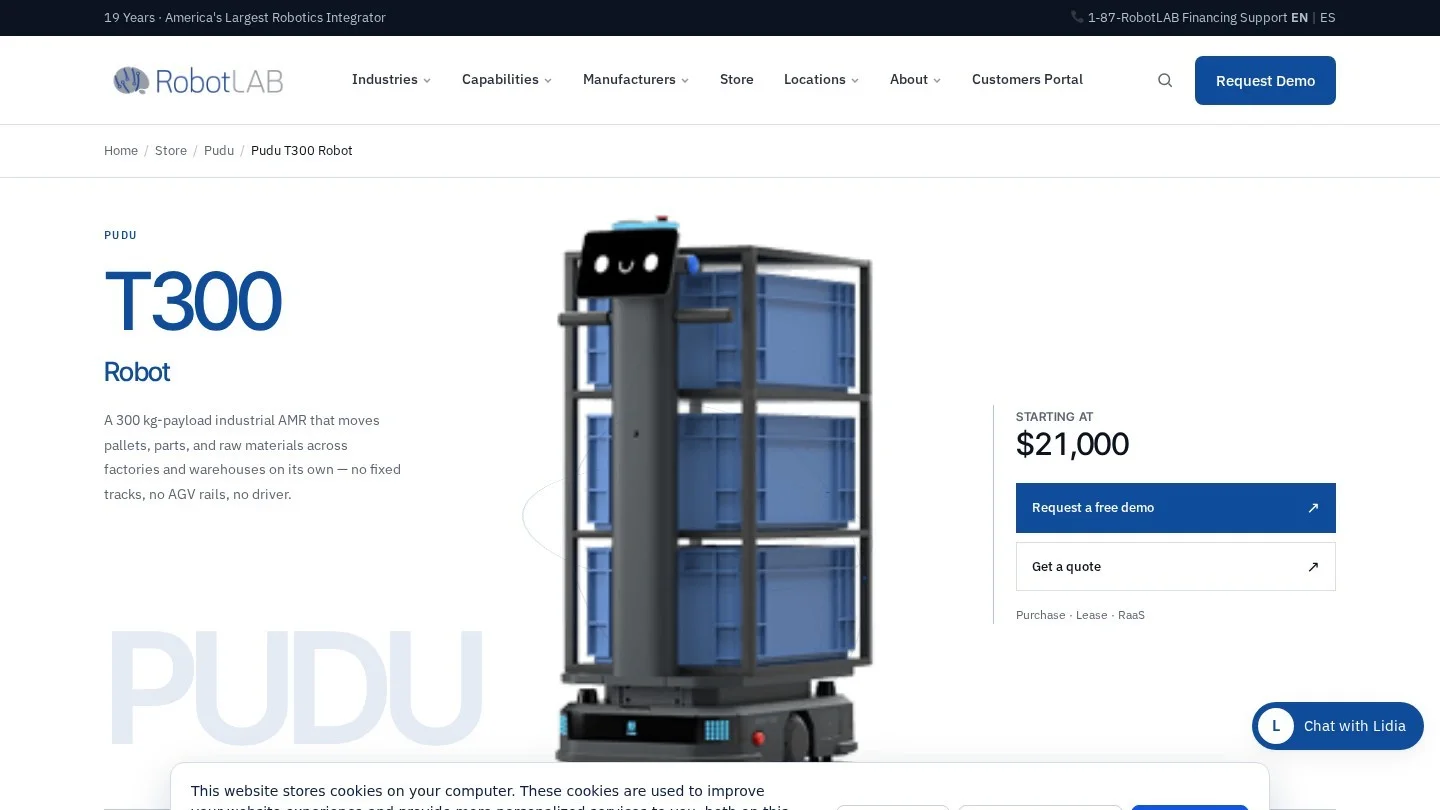
- Single mobile robot: $6,500 for a small AGV base and $20,990 for a 300 kg Pudu T300 at RobotLAB, or $589 a month on its service plan.
- Industrial AMR: MiR250 base at €44,284 net from Polish dealer Elmark, with chargers and top modules extra.
- Project budgets: 52% of companies planning automation spending expect more than $1 million; 17% expect more than $10 million (MHI 2026).
- Labor benchmark: Stockers in warehousing earn a mean $21.13 an hour; with benefits, we estimate about $30.80.
- Payback test: A $589-a-month robot breaks even if it saves about 19 labor hours a month, under one hour per workday.
Warehouse Automation Cost by System Type
Warehouse automation is a family of very different machines. The table groups them from the smallest commitment to the largest, with the best public price evidence we could find for each tier.
| System type | What it does | Price evidence | Source and date |
|---|---|---|---|
| Small AGV platform | Carries up to 100 kg along set routes; often a base for custom builds | AgileX Tracer from $6,500 | RobotLAB store, Nov 2026 |
| Transport AMR, 300 kg class | Moves carts and totes between stations without fixed tracks | Pudu T300 $20,990 to buy or $589 a month | RobotLAB T300 page, Nov 2026 |
| Industrial AMR, 250 kg class | Factory and warehouse transport with safety scanners | MiR250 base €44,284 net | Elmark listing, Nov 2026 |
| Robotic case packing and palletizing | Packs and stacks cases at the end of a line | Flat monthly fee, no capital outlay; amount quote-based | Formic pricing page |
| Cube storage and retrieval (AS/RS) | Robots on a grid fetch bins to picking ports | Quote-based through integrators | AutoStore Q4 2025 release |
| Full-building automation | Storage, picking, palletizing and software for whole distribution centers | Multi-year contracts; Symbotic backlog $22.5 billion | Symbotic 10-K, fiscal 2025 |
Dealer prices for the robot itself leave out the costs of getting it to work: site surveys, mapping, integration with your warehouse management system, chargers, top modules such as conveyors or shelf carriers, staff training and ongoing support. The Elmark listing notes that chargers, shelf carriers and hooks for the MiR250 are sold separately, which is typical.
What One Mobile Robot Costs and Does
Mobile robots are where most small and mid-size warehouses start, because they can be added one at a time without rebuilding the floor. The specs explain what you get for the money.
Pudu T300: Moving Carts of Up to 300 Kilograms
RobotLAB lists the Pudu T300 at $20,990 (its header shows $21,000) or $589 a month as a service. It carries up to 300 kg (661 lb), runs up to 12 hours empty or about 6 hours fully loaded, recharges from 0 to 90% in about two hours, and travels at up to 1.2 m per second. It navigates with visual and LiDAR mapping instead of floor tape, meets the ISO 3691-4 safety standard for driverless industrial trucks, and can run in fleets of up to 20 robots through Pudu’s scheduler.
MiR250: An Industrial AMR With Long Runtime
Elmark lists the MiR250 base at €44,284 net, with a second price of €54,469.32 that appears to include VAT. The page gives a 250 kg payload, a top speed of 2.0 m per second, and runtimes of 17.5 hours empty and 13 hours at full load, with two SICK safety scanners and two 3D cameras. The longer runtime and heavier safety package are a large part of why industrial AMRs cost roughly twice as much as lighter service-style robots such as the T300.
The choice between the two comes down to the work. A site that moves light carts over short distances in one or two shifts can do well with a service-style robot such as the T300. A plant that runs around the clock, moves heavier loads or needs certified safety scanners near forklifts usually justifies an industrial AMR. Many of the same dealers also sell commercial cleaning robots on similar monthly plans, which we compared in our guide to starting a robot cleaning business.
Labor Hours a Robot Must Save to Pay for Itself
The most useful way to judge a robot’s price is to turn it into labor hours. We started with the BLS Occupational Employment and Wage Statistics for May 2023, which put the mean wage for stockers and order fillers in the warehousing and storage industry at $21.13 an hour. Wages are not the whole cost of an employee. The BLS Employer Costs for Employee Compensation release for June 2026 shows wages making up 68.6% of total compensation for private-industry transportation and material moving workers, with benefits the other 31.4%.
Dividing $21.13 by 0.686 gives an estimated fully loaded cost of about $30.80 an hour. That mixes two BLS series from different dates, so treat it as an estimate. We then divided each robot’s monthly cost by $30.80. For purchased robots we spread the price over 36 months, with no interest, maintenance or integration added.
| Robot option | Monthly cost | Labor hours to break even each month | Per workday (21.7 days) |
|---|---|---|---|
| AgileX Tracer, bought | $6,500 / 36 = $181 | 5.9 hours | About 16 minutes |
| Pudu T300, bought | $20,990 / 36 = $583 | 18.9 hours | About 52 minutes |
| Pudu T300, service plan | $589 | 19.1 hours | About 53 minutes |
| Five Pudu T300s, service plan | $2,945 | 95.6 hours | About 4.4 hours |
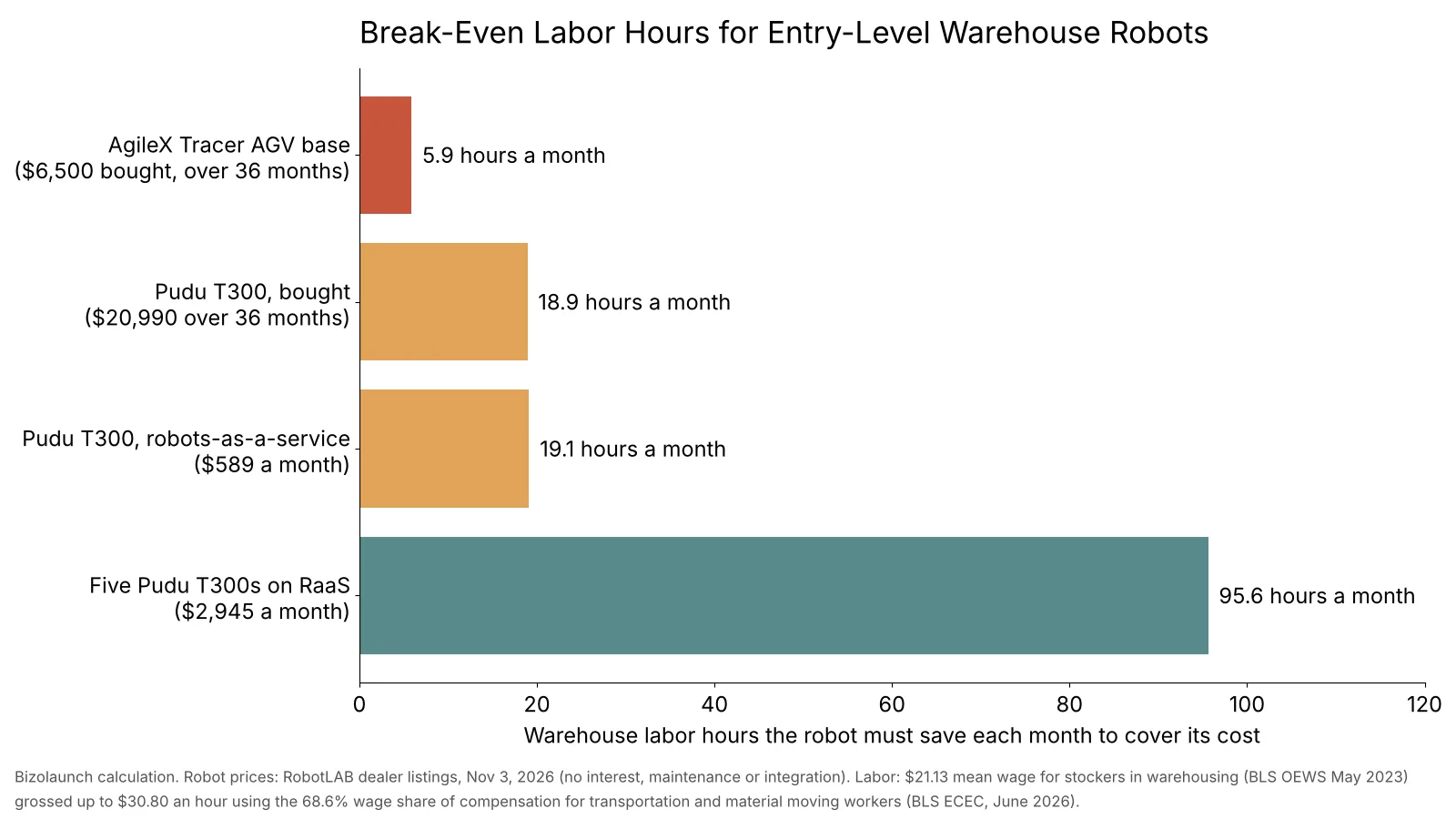
A single transport robot needs to save under an hour of loaded labor per workday to cover its sticker cost. In a warehouse where pickers walk carts back and forth to packing stations all shift, that bar is low. The real risk sits in the costs our table leaves out. If integration, mapping and training add tens of thousands of dollars, the break-even point moves out by months, so ask for every one of those lines in the quote. Our break-even calculator can rerun the math with your own setup costs.
Scaled up, five T300s on a service plan cost $35,340 a year, equal to about 1,147 hours of loaded labor. A full-time worker at 2,080 hours a year costs about $64,068 at the same $30.80 rate. In other words, a five-robot fleet costs a little more than half of one full-time picker’s loaded cost, and it only makes sense if it removes at least that much walking and carrying across all shifts.
What the Big System Makers’ Filings Reveal
Cube storage and full-building systems are priced privately, but the companies that build them publish results that show the scale of spending.
AutoStore: Cube Storage With High Margins
AutoStore reported fourth-quarter 2025 revenue of $179.7 million, a gross margin of 73.7%, order intake of $194.2 million and an order backlog of $557.0 million, according to its results release of February 12, 2026. It has about 1,900 systems installed in 65 countries and added 150 new customers in 2025. AutoStore sells mainly through integrator partners, so the final price a warehouse pays includes the integrator’s design, installation and software work on top of AutoStore’s grid, robots and ports.
Symbotic: Building-Scale Contracts
Symbotic’s annual report for the fiscal year ended September 27, 2025 lists a backlog of about $22.5 billion, of which about 12% is expected to turn into revenue in fiscal 2026. Walmart made up about 85% of its revenue. Under a 2025 agreement, Walmart committed to buy 400 micro-fulfillment systems, with an option for 200 more, and to pay $520 million for a related development program. The filing says Symbotic’s systems are typically sold in three parts: the initial system, software maintenance and support, and operation services. That structure is a good model for any buyer to copy when comparing quotes, because it separates the one-time cost from the yearly cost.
Amazon: The Payoff Big Operators Expect
Amazon says its Shreveport, Louisiana, site, a five-floor building of more than 3 million square feet, uses ten times more robotics than earlier sites, according to its October 2024 announcement. The company says next-generation sites have cut processing times by up to 25%, and it is aiming for a 25% improvement in cost to serve during peak seasons. It also expects these sites to need 30% more workers in reliability, maintenance and engineering roles. That last point matters for smaller buyers too: automation shifts labor toward technicians, and their wages belong in the budget.

How Much Companies Plan to Spend on Automation
The 2026 MHI Annual Industry Report, produced with Deloitte and based on a survey of 500 supply chain professionals, gives a rare view of project budgets. DC Velocity’s summary reports that 56% of respondents are increasing technology and automation spending. Among those planning to spend, 52% expect to spend more than $1 million and 17% more than $10 million. The survey also found 41% of companies using AI, up from 30% the year before.
Read together with the dealer prices above, these figures show two very different markets. A small operator can test automation for a few thousand dollars a month with mobile robots. Most companies that commit to a full program, though, end up in seven-figure territory, because storage systems, conveyors, software and integration add up quickly.
Buying, Leasing or Paying a Monthly Fee
How you pay changes the cost as much as what you buy. There are three common routes.
- Outright purchase: You own the robot and can take tax deductions. Under the One Big Beautiful Bill Act, 100% bonus depreciation is permanently restored for qualifying property acquired and placed in service after January 19, 2025, and the Section 179 limit is $2.5 million with a $4 million phase-out, according to BDO. Ask your tax adviser how this applies to your equipment.
- Robots as a service: A fixed monthly fee covers the robot and usually support. At RobotLAB, the T300’s 36 monthly payments of $589 total $21,204, only about 1% more than its $20,990 purchase price.
- Fully managed automation: Formic charges one fixed monthly price that covers robots, software, installation, training, maintenance and 24/7 monitoring, with no upfront capital, according to its FAQ. Its case-packing systems are offered month to month.
If you finance a purchase, compare the loan’s monthly payment with the service fee over the same period; our guide to calculating an EMI shows the formula.
Hidden Costs in a Warehouse Automation Quote
The robot price is only one line in a project. These are the lines to ask about before you sign.
- Site survey and design: Mapping aisles, doors, floor quality and Wi-Fi coverage.
- Software integration: Connecting robots to your warehouse management or execution system.
- Accessories: Chargers, top modules, carts, shelf carriers and spare batteries.
- Facility changes: Floor repairs, network upgrades, safety signage and, for storage systems, sprinklers or racking changes.
- Training and change management: Time for staff to learn new workflows, which lowers output for a few weeks.
- Maintenance and support: Yearly support contracts and technician wages, which Amazon’s experience shows tend to grow with automation.
- Software subscriptions: Fleet management, analytics and update fees, billed monthly or yearly.
Track these lines in a simple expense spreadsheet during the pilot, so you can compare the real cost with the quote before expanding.
A Five-Step Plan for a First Automation Project
- Measure the task. Time how long pickers spend walking, carrying and waiting, per shift. This is the pool of hours a robot can save.
- Price the labor properly. Use your loaded hourly cost, including benefits. The BLS figures above suggest benefits add roughly 30% or more to wages.
- Start with one robot type. Transport AMRs are the lowest-risk first step for most sites.
- Run a fixed-length pilot. Use a service plan for three to six months and measure hours saved against the break-even hours in our table.
- Scale only with data. Add robots, or move to storage automation, once the pilot shows savings above the break-even line.
For wider context on where robots are heading, see our robotics and automation news coverage, and our humanoid robot cost guide for the newest class of machines being tested in warehouses.
Warehouse Automation Cost Questions From Operators
How Much Does an AMR Cost?
Dealer prices we found range from $6,500 for a small AGV platform to $20,990 for a 300 kg Pudu T300 in the US, and €44,284 net for a MiR250 base in Europe. Service plans start at $589 a month for the T300.
How Much Does an Automated Storage and Retrieval System Cost?
AS/RS systems such as AutoStore are sold on quotes through integrators, and the price depends on the number of bins, robots and picking ports. In MHI’s 2026 survey, most companies planning automation spending expected to spend over $1 million.
What Is the Payback Period for Warehouse Robots?
It depends on hours saved. With labor at about $30.80 an hour loaded, a robot costing $589 a month pays for itself if it saves about 19 labor hours a month. Add integration costs to see the real payback.
Is Robots as a Service Cheaper Than Buying?
Over 36 months, RobotLAB’s T300 service plan totals $21,204, close to its $20,990 purchase price. The plan reduces upfront cash and may include support, while buying lets you use depreciation rules and keep the robot afterward.