Four of the eight young companies on this list were still out of public view a year ago. Since then, an AI lab founded in 2025 has raised $1 billion, a texting assistant started in 2026 has been valued at $300 million, and a two-year-old construction robotics firm has put self-driving excavators on paid job sites. These are the new startups to watch in November 2026: Flapping Airplanes, Bedrock Robotics, Wabi, Tab, SuperMe, Pluto Security, Different and Matiks.
Every company here launched, left stealth or raised a major round between October 7 and October 29, 2026. We built our own dataset for each one from launch announcements and reports in TechCrunch, Calcalist, Tech Funding News and other outlets, recording who founded it, what it builds, its funding and the traction it has made public. The comparison and the patterns we found are below the profiles.
The Watch List by Its Biggest Numbers
- Biggest round: Flapping Airplanes, a $1 billion Series A on October 21, 2026, at a reported $6 billion valuation.
- Fastest rise: Tab, which began work in 2026 and came out of stealth valued at $300 million.
- Most customers named: Pluto Security, with more than 40 enterprise customers when it left stealth.
- Common thread: Five of the eight have founders from well-known tech companies, such as Waymo, Replika, Pinterest, ThoughtSpot and Palo Alto Networks.
Eight Young Startups Compared
This table is our own compilation. “Started” is the founding year or first public launch as reported by the cited source. Funding figures are the latest round the company or its investors disclosed.
| Startup | Started | What it builds | Founders | Latest disclosed round | Lead investors |
|---|---|---|---|---|---|
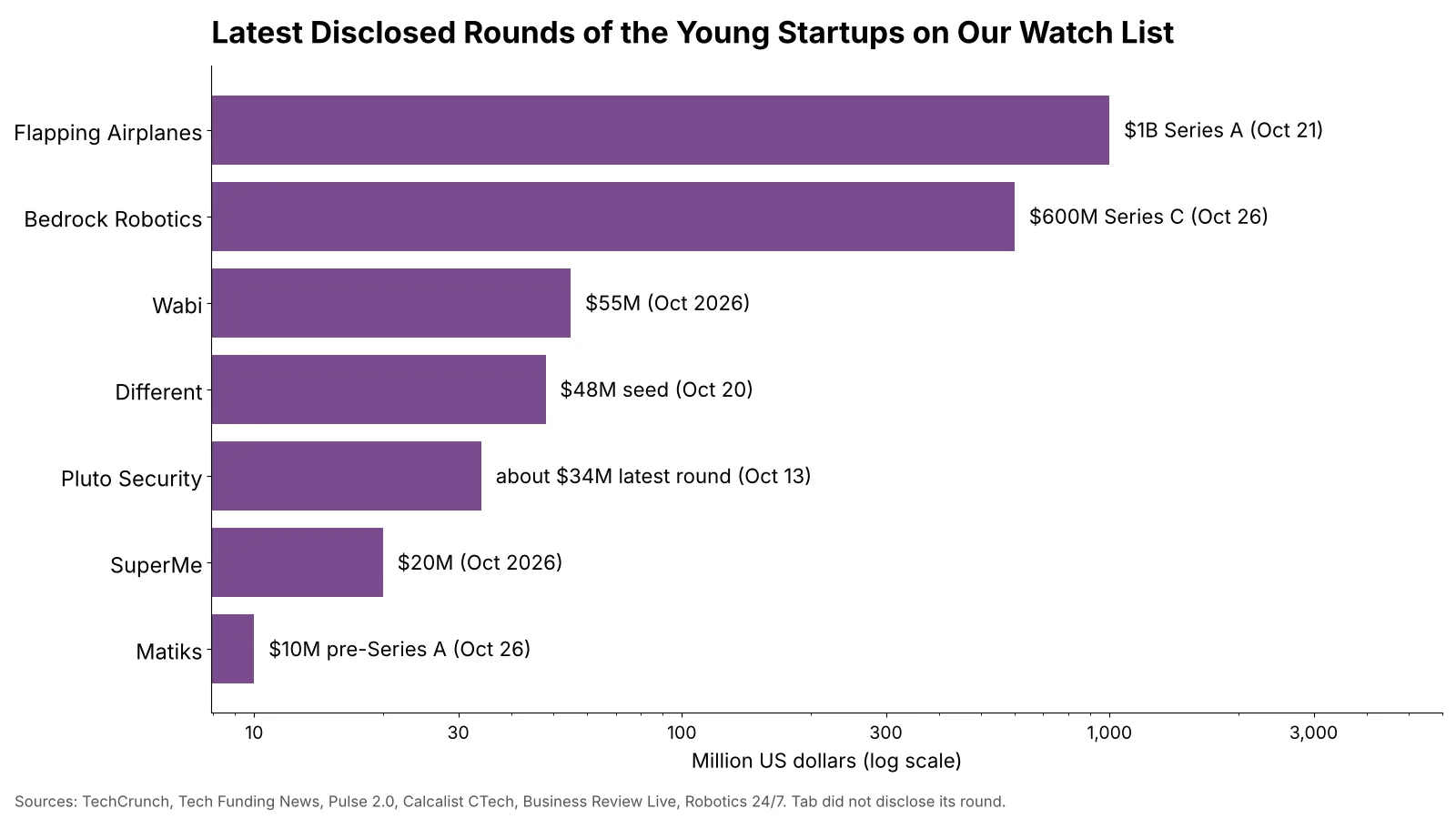
| Flapping Airplanes | About a year old (TechCrunch, Oct 2026) | AI models that need less training data and compute | Aidan Smith, Asher Spector, Ben Spector | $1 billion Series A, Oct 21, 2026 | Index, Lux |
| Bedrock Robotics | Founded 2024 | Autonomy kits for excavators and other construction machines | Boris Sofman, Kevin Peterson, Ajay Gummalla | $600 million Series C, Oct 26, 2026 | CapitalG, Emergence Capital |
| Wabi | Started 2025, beta October 2025 | AI messenger with a personal agent that builds mini apps | Eugenia Kuyda | $55 million, October 2026 | IVP |
| Tab | Work began in 2026 | Personal AI assistant you text on iMessage or WhatsApp | Brennan Erbz, Stafford Schlitt, Ammar Amdani | Not disclosed; valued at $300 million | Not named (backers: SV Angel, Valar Ventures, American Spirit) |
| SuperMe | Founded 2024 | Network of AI profiles built from real experts’ knowledge | Casey Winters, Ludo Antonov | $20 million, October 2026 | Forerunner |
| Pluto Security | Founded 2025 | Security for AI tools, agents and apps that employees build | Shahar Bahat, Tal Ofer Regev, Gil Maman | About $34 million, Oct 13, 2026 ($42 million total) | Jump Capital |
| Different | Out of stealth Oct 20, 2026 | AI system that runs B2B demand generation campaigns | Ajeet Singh, Abhishek Pani, Abhinav Yajurvedi | $48 million seed, Oct 20, 2026 | General Catalyst |
| Matiks | App live for about two years | Math, logic and puzzle games, plus a game-creation platform | Sudhanshu Bhatia, Mohan Kumar, Sushant Timmapur | $10 million pre-Series A, Oct 26, 2026 | General Catalyst |
Flapping Airplanes: An AI Lab Trying to Do More With Less Data
Most large AI models learn from enormous piles of text. Flapping Airplanes wants to build models that need far less of it, or in its own phrase, without “ingesting half the internet.” According to TechCrunch, the lab has built a “megakernel” GPU framework that runs inference and training side by side, so chips spend less time idle. The aim is AI that costs less to train and to run.
The money has moved fast. The lab launched with a $180 million seed from GV, Sequoia and Index that valued it at $1.5 billion. About nine months later, Index and Lux co-led a $1 billion Series A at a reported $6 billion, which is four times the seed price. Sequoia, GV, Kleiner Perkins, Valor, Atreides, A* and Nvidia are also investors.
Why it matters: If cheaper training works at scale, smaller companies could afford capable models of their own. The next milestone to watch is a public model or paper that shows the efficiency gains in practice.
Bedrock Robotics: Former Waymo Engineers Take On the Job Site
Bedrock was founded in 2024 by three former Waymo engineers: Boris Sofman, Kevin Peterson and Ajay Gummalla. Instead of designing new machines, it retrofits existing excavators with a roof rack, an in-cab computer, LiDAR-equipped cameras, GPS and a cellular link, according to the Association for Advancing Automation. It raised $80 million across its seed and Series A rounds.
Growth since then has been quick. A $270 million Series B in February 2026 valued the company at $1.75 billion. On October 26, it announced a $600 million Series C at $4.1 billion. The announcement says fully autonomous excavators started paid work on live commercial sites in mid-August 2026, with new customers in Minnesota, Florida, Virginia, Colorado, Missouri, Georgia and Arkansas.
Why it matters: Retrofitting machines contractors already own lowers the cost of trying autonomy. Watch how quickly it moves from excavation into demolition and other tasks, which the company says it plans to do. We cover the round in more detail in our weekly startup funding roundup.

Wabi: The Replika Founder’s Group AI Messenger
Eugenia Kuyda created Replika, then stepped down as its CEO in 2025 to start Wabi. The San Francisco company has changed shape quickly. It opened a beta in October 2025 that let users build mini apps from prompts. On September 28, 2026, it relaunched as an AI messenger, and it went public on iOS, Android and Mac on October 19, 2026, according to Tech Funding News.
Users keep separate agent threads for different goals and can share them in group chats with family or friends. Thirty-one days after the pivot, IVP led a $55 million round at a $1.25 billion valuation, with Forerunner, a16z and the Amazon Alexa Fund. Angels include Shopify’s Tobi Lütke and Salesforce’s Marc Benioff. Total funding is about $75 million.
Why it matters: Wabi is betting that AI helpers work better when shared, rather than used alone. The app is free today and has no clear business model yet, so its first paid product will be the thing to watch.
Tab: A Texting Assistant With Its Own Phone Number and Wallet
Tab is the youngest company on our list. Its founders, Brennan Erbz, Stafford Schlitt and Ammar Amdani, began working on it earlier in 2026, and it came out of stealth on October 7. Users text Tab on iMessage or WhatsApp to order groceries, find gifts, pay bills, make bookings or place calls. TechCrunch reports that Tab has its own phone number, computer and wallet to carry out those tasks.
The company did not disclose how much it raised, but it is valued at $300 million and backed by SV Angel, Valar Ventures and American Spirit. It has grown mostly by word of mouth and plans to launch a new product soon.
Why it matters: An assistant that can pay and call on your behalf goes further than one that only answers questions. Trust and security will decide how far people let it go, so watch for how Tab explains its controls.
SuperMe: Advice From AI Versions of Real Experts
SuperMe was founded in 2024 by Casey Winters, who held senior roles at Grubhub, Pinterest and Eventbrite, and Ludo Antonov, who led engineering at companies including Pinterest, Lyft and Whatnot. Its platform builds AI profiles from the knowledge of real professionals. A user asks a question, and SuperMe pulls the right expert profiles into a group chat to answer it.
Business Review Live reported on October 30 that Kirsten Green of Forerunner led a $20 million round, with Greylock taking part. The team has about 13 employees. The platform supports the Model Context Protocol, so people can reach it from tools such as Claude and ChatGPT. It is free for now, with plans to limit questions before asking users to pay.
Why it matters: SuperMe tests whether experts will let an AI speak in their name. How it shares value with those experts is the question to follow.
Pluto Security: Guarding the AI Tools Employees Build
Staff now build their own AI agents, apps and automations, often without the security team knowing. Pluto Security, founded in 2025 by Palo Alto Networks veterans Shahar Bahat, Tal Ofer Regev and Gil Maman, gives security teams a view of that activity and can block risky actions in real time without shutting the tools down. Calcalist’s CTech reported its launch from stealth on October 13, 2026.
It has raised $42 million in total. The latest round, about $34 million, was led by Jump Capital with Shlomo Kramer’s Skinos Ventures and AlphaDrive Ventures; TLV Partners led the seed. Pluto already has more than 50 employees across Israel and the US and over 40 enterprise customers, including Oscar Health, Workato, Sixt and AlphaSense.
Why it matters: Every company that lets staff use AI needs rules for it. Small firms can start with our AI acceptable use policy guide and our small business cybersecurity checklist.
Different: A Marketing Team in Software Form
Different came out of stealth on October 20, 2026, with a $48 million seed round led by General Catalyst, according to Pulse 2.0. Lightspeed, Together Fund, Haystack Ventures, MXV Capital and Firebolt Ventures also invested. The San Francisco company’s system plans campaigns and creates ads, emails and landing pages for small B2B marketing teams. Marketers set the strategy and approve the work before it goes live.
The founders have done this before. CEO Ajeet Singh co-founded ThoughtSpot and Nutanix, Abhishek Pani led machine-learning work behind Adobe’s marketing products, and Abhinav Yajurvedi worked on marketing systems at Flipkart and Myntra. Customer Descope used the platform to find and redirect 60% of paid ad spend that was being lost to poor targeting.
Why it matters: The size of the seed shows how much investors expect from AI that handles marketing work end to end, while keeping a human in charge of approval. Watch for more named customers and results like Descope’s.
Matiks: India’s Brain-Game App Finds a Global Investor
Matiks was started by college friends Sudhanshu Bhatia, Mohan Kumar and Sushant Timmapur, and its app has been live for about two years. Players compete in math, puzzle, memory and logic games against bots or real people. It also runs Jelo, an experimental platform where users create games for others to play. On October 26, 2026, General Catalyst led its $10 million pre-Series A.
The traction numbers are the clearest on this list. Daily users grew from 22,000 earlier in 2026 to more than 300,000 by September, about 14 times higher, and monthly users reached 2.2 million that month. The company has 41 full-time staff and has raised more than $13.5 million in total.
Why it matters: Matiks shows that an Indian consumer app can win a global lead investor with usage alone. Watch whether Jelo’s user-made games grow as fast as the core app.
Patterns We Found Across the Eight
Looking at the dataset as a whole, three patterns appear. None of them is a forecast. They describe what these eight companies have in common right now.
Repeat Founders Raise Bigger First Checks
Five of the eight teams include founders from well-known tech companies: Waymo at Bedrock, Replika at Wabi, Grubhub and Pinterest at SuperMe, ThoughtSpot, Nutanix, Adobe and Flipkart at Different, and Palo Alto Networks at Pluto Security. Those five raised between $20 million and $600 million in their latest rounds, and Different’s $48 million seed is the largest seed on the list. Matiks, started by college friends, made its case to General Catalyst with usage numbers instead.
AI Agents That Act, Not Only Answer
Tab, Wabi, SuperMe and Different all build AI that does things for people: pays bills, builds apps, gathers experts or launches campaigns. Pluto exists because of that shift, since agents that act also need guardrails. Five of the eight companies are building on, or protecting against, AI that takes actions.
Valuations Are Rising Within Months
We compared the two companies with dated earlier prices. Flapping Airplanes went from $1.5 billion to a reported $6 billion in about nine months, a fourfold rise. Bedrock went from $1.75 billion in February to $4.1 billion in October, about 2.3 times. Prices that rise this quickly leave little room for a slow quarter, so the next round for each will be a real test.
| Company | Earlier valuation | Latest valuation | Increase | Months between |
|---|---|---|---|---|
| Flapping Airplanes | $1.5 billion (seed) | $6 billion (reported, Series A) | 4.0x | About 9 |
| Bedrock Robotics | $1.75 billion (Series B, Feb 2026) | $4.1 billion (Series C, Oct 2026) | 2.3x | About 8 |
What Small Founders Can Borrow From This List
Very few founders will raise $1 billion, but several habits on this list cost little. Each company could explain its product in one plain sentence, and most published at least one concrete number: paid job sites, enterprise customers, daily users or ad spend recovered. If you are naming a new venture, our business name generator can help you find a short, memorable name. When you are ready to show it to the world, our Product Hunt launch guide covers one well-tested route, and our SAFE note explainer covers the most common early funding paper.

Reader Questions on New and Emerging Startups
Which New Startup Raised the Most Money in October 2026?
Of the companies on this list, Flapping Airplanes raised the most: a $1 billion Series A on October 21, 2026, co-led by Index and Lux.
What Does Emerging From Stealth Mean?
It means a company that has been building quietly announces itself publicly, often with its funding and first customers. Tab, Pluto Security and Different all did this in October 2026.
Who Founded Wabi?
Eugenia Kuyda, the creator of Replika. She stepped down as Replika’s CEO in 2025 to start Wabi.
Are There Indian Startups Among the New Ones to Watch?
Yes. Matiks, an India-based maker of math and puzzle games, raised $10 million led by General Catalyst on October 26, 2026, and had 2.2 million monthly users in September.
Launch Reports and Announcements We Used
- TechCrunch: Flapping Airplanes raises $1B at a $6B valuation
- Association for Advancing Automation: Bedrock Robotics founding and early funding
- Robotics 24/7: Bedrock Robotics $600M Series C
- The Real Deal: Bedrock’s earlier $1.75 billion valuation
- Tech Funding News: Wabi raises $55M at $1.25B
- TechCrunch: Tab emerges from stealth
- Business Review Live: SuperMe raises $20M
- Calcalist CTech: Pluto Security emerges from stealth
- Pulse 2.0: Different raises $48M seed
- TechCrunch: Matiks raises $10M