
Product Hunt is a free website where makers post new tech products and the community upvotes and comments on them, with each day’s launches competing on a homepage leaderboard for Product of the Day. To launch there, you create a personal account, submit your product’s link, and ideally schedule it for 12:01 am Pacific Time, the best slot for makers who plan ahead. You do not need a hunter, it costs nothing, and the one rule that sinks most launches is simple: you may share your launch anywhere, but you may not ask people directly to upvote it.
That sounds easy, and the mechanics are. The hard part is that Product Hunt’s team now chooses which launches to feature, and an unfeatured launch gets far less attention on the homepage. So the work that decides a launch happens weeks earlier, in the product itself, the tagline and the people you can bring to the page. For products that are not a good fit, BetaList, Show HN on Hacker News and Indie Hackers are covered further down.
Free to Launch, 12:01 AM Pacific and Featuring Is Editorial
- Product Hunt started as an email list on November 6, 2013, was founded by Ryan Hoover, and has been owned by AngelList since a reported $20 million deal in 2016.
- Launching is free, company accounts are banned, and a third-party hunter gives no clear advantage over posting your own product.
- The best launch time is 12:01 am Pacific Time, which is 3:01 am on the US East Coast and 8:01 am in London.
- Product Hunt’s team decides which launches are featured, and CEO Rajiv Ayyangar has said to expect the bar to rise rather than fall.
- BetaList charges for every submission with an automatic refund if rejected, while Show HN is free but only accepts products people can try right away.
What Product Hunt Is and How the Site Works
Product Hunt is a discovery site for new software, apps, hardware and AI tools. Each day a fresh set of launches appears on the homepage leaderboard, and community members upvote, comment on and share the products they like. The products with the most support win the top spots, including Product of the Day.
The site is completely free for makers. Submitting takes a minute: you log in, click Submit in the top right corner, choose New Product and paste in your product’s URL. Around the leaderboard, Product Hunt also runs forums, a changelog, events and a daily newsletter that rounds up the best launches.
The audience is the reason founders care. People who browse a leaderboard of new products every day tend to enjoy trying new tools, so a strong launch can bring a burst of sign-ups and honest feedback from users who are happy to say what is broken. It suits software and consumer tech far better than local services or traditional businesses.
Who Owns Product Hunt: A Short History
Product Hunt began as a side project. Ryan Hoover started it on November 6, 2013 as an email list built with a tool called Linkydink, and over Thanksgiving that year he and Nathan Bashaw built the first version of the website. Y Combinator backed it in 2014, and AngelList bought it in November 2016 for a reported $20 million.
| Date | Milestone |
|---|---|
| November 6, 2013 | Launches as an email list built with Linkydink |
| Thanksgiving 2013 | Ryan Hoover and Nathan Bashaw build the first website |
| July 17, 2014 | Announces Y Combinator backing |
| Fall 2014 | Raises a $6.1 million Series A led by Andreessen Horowitz |
| November 2016 | Acquired by AngelList for a reported $20 million |
| July 2019 | Launches “Launch Day” for real-time launch tracking |
| October 2020 | Josh Buckley named CEO |
| August 2021 | Ashley Higgins, formerly general manager, named CEO |
| September 2023 | Rajiv Ayyangar, founder of Tandem, named CEO |
Product Hunt is still owned by AngelList and is based in San Francisco. Shortly after Ayyangar took over in 2023, the company laid off about 60% of its team.
How Product Hunt Ranking and Featuring Work
Two separate things decide how visible your launch is. The first is the leaderboard, where launches compete on community support through upvotes, comments and shares. The second is featuring, which is a human decision made by Product Hunt staff rather than by votes.
The Product Hunt team features products it believes the community should know about. Gabe Perez does most of that work, and a product might be chosen for an unusual level of craft or something distinct in its approach. The team does not get every call right, and CEO Rajiv Ayyangar has told makers to “expect our bar to rise, not lower.”
Featuring matters because it decides where people see you. An unfeatured launch does not appear among the featured products, and fewer visitors bother to load the rest of the list. The internal team always has the final word, and a product should be innovative, useful and not a copy of something already on the site.
For founders, the practical lesson is that votes cannot rescue a product the team sees as ordinary. With AI making it easier to ship software, the bar for compelling apps is rising, so build something that solves an unsolved problem or solves an old one in a new way. Your best ranking strategy is a product with a clear reason to exist.
Launch Day Timing and the 12:01 AM Pacific Start
Product Hunt runs on Pacific Time. 12:01 am Pacific is the best time to launch for makers who plan ahead and have no other constraints, because it gives your product the whole Pacific day on the leaderboard. The best day is simply the one on which you are most prepared, since every weekday and weekend day has trade-offs.
The clock matters most for teams outside California. A launch at 12:01 am Pacific lands in the middle of the night for a New York founder and in the middle of the working day in India, so plan who will be awake to answer comments in the first hours.
| Location | Local time when PT is on standard time (November to March) | Local time when PT is on daylight time (March to November) |
|---|---|---|
| San Francisco (PT) | 12:01 am | 12:01 am |
| New York (ET) | 3:01 am | 3:01 am |
| London (UK) | 8:01 am | 8:01 am |
| Berlin (Central Europe) | 9:01 am | 9:01 am |
| India (IST) | 1:31 pm | 12:31 pm |
Europe and the US change clocks on different dates in spring and autumn, so for a week or two the European times shift by an hour. If your launch falls near one of those changes, check it with our time zone converter before you send any announcement emails.
Do You Need a Hunter on Product Hunt?
A “hunter” is the person who submits a product, and for years founders chased well-known hunters in the hope that their followers would lift a launch. That advice is out of date. Makers are now encouraged to hunt their own products, and there is no discernible advantage to using a third-party hunter.
Two account rules matter here. Company accounts are prohibited, so the launch must come from a real person’s profile, usually a founder’s. Every maker on the team should also have a personal profile and be listed on the launch, because people trust a product more when they can see and question the humans behind it.
Sometimes a stranger posts your product before you are ready. In that case you can launch again later or contact Product Hunt for help, so do not panic or create a duplicate listing.
Product Hunt Rules on Upvotes and Vote Manipulation
The rule is short and strict. You can share your launch link anywhere you like, but you cannot ask people directly to upvote it, and the FAQs suggest asking them to visit and leave a comment instead. Accounts that break community guidelines can be marked as spammers, and the FAQs link to those guidelines for the full list.
In practice, that rule separates two kinds of launch promotion. These are generally safe:
- Telling people you launched: An email to your users or a post on LinkedIn or X that says you are live on Product Hunt and would value their feedback.
- Inviting comments and questions: Asking existing customers what they think of the new feature, which gives the page real discussion.
- Offering something to the community: A discount or extended trial for Product Hunt visitors, mentioned on the launch page.
These cross the line, because each one is a request for upvotes by another name:
- “Please upvote us” messages: Direct requests in emails, group chats or social posts break the stated rule.
- Upvote swap groups: Trading votes with other founders is still asking for upvotes, only in bulk.
- Paid upvotes or new throwaway accounts: These are the clearest way to get an account flagged and a launch buried.
Hacker News takes the same line. Asking friends to upvote or comment on a Show HN post is not OK, so a team that learns good habits on one site can use them on the other.

Preparing Your Product Hunt Launch Assets
A launch page has a few parts, and each does a specific job. The name and tagline earn the click, the gallery and video show the product working, and the maker’s first comment explains why it exists. Ayyangar’s advice on the tagline was to write a one-liner that is both clear and compelling and to test it on friends before launch day.
- Name: Short, easy to spell and free to register as a domain. If you are still choosing, our business name generator can produce a long list to filter.
- Tagline: Say what the product does and for whom, in plain words. “Invoices for freelance designers that chase late payments” beats a clever slogan nobody understands.
- Gallery images: Show real screens of the product doing its main job, in the order a new user would see them, with one short caption each.
- Demo video: Keep it short and show the product in use from the first seconds, since most visitors will not wait for a long intro.
- Maker’s first comment: Explain the problem you saw, why you built this, what is free and what you want feedback on. Write it as a person, not a press release.
- Landing page and launch post: Make sure the site loads fast and sign-up works without friction. If you are publishing a launch announcement on your blog, a checker such as the one in our BlogVitals review can flag weak spots first.
Most of the work happens before launch day. The timeline below is our suggested schedule for a small team, built around the official rules above.
| When | What to do |
|---|---|
| 4 weeks before | Set up personal maker profiles, take part in discussions and study recent featured launches in your category |
| 2 to 3 weeks before | Write the tagline and description, capture gallery images and record the demo video |
| 1 week before | Test the tagline on people outside the team, prepare the maker comment and the launch offer, and schedule the launch |
| Day before | Draft the emails and social posts, check sign-up flow and server capacity, and agree who covers each block of hours |
| Launch day | Go live at 12:01 am PT, answer every comment and share the launch on your own channels |
| Week after | Reply to late comments, follow up with new sign-ups and write down what you learned |
What to Expect on Launch Day and After
Launch day is mostly conversation. Visitors will ask about pricing, privacy, integrations and how you differ from a rival, and a fast, honest reply from a founder does more for the page than any marketing copy. Ayyangar’s advice was to commit fully, avoid half-measures and be as loud as possible on as many channels as possible, which means your newsletter, your social accounts and every community where you already take part.
Measure what the launch actually delivers. Tag your Product Hunt links with UTM codes, count sign-ups and paid conversions separately, and compare the cost of your team’s time with what you would pay for the same users through ads. Our explainer on blended CAC versus paid CAC shows why a free launch can make your overall acquisition numbers look better than your paid channels really are.
A launch also gives you a story to tell investors, as long as you report real usage rather than vote counts. Founders raising a first round often use a SAFE, which our SAFE note explainer covers in detail, and a deck built around launch results reads better than one built around hopes. If you need help with that deck, see our list of pitch deck design companies in the USA.
One launch is not your only chance. You can launch again as often as you have significant new product iterations, so a major new version, a mobile app or an AI feature can each be a fresh launch.
Is a Product Hunt Launch Worth It for Your Product?
Product Hunt rewards products that tech-savvy people can try today, such as developer tools, productivity apps, AI assistants and design tools. If your buyers are on the site, a launch costs nothing but time and can bring early users, feedback and a lasting listing.
It is a weaker fit when your buyers are not there. A home care agency, a construction supply firm or a clinic software vendor selling to hospital buyers will reach few customers through a tech leaderboard, even though several of those sectors appear among the fastest growing industries in the US. For those businesses, trade shows, industry newsletters and direct sales usually work better.
Timing matters too. If the product is still a landing page with a waitlist, Product Hunt’s team is unlikely to feature it, and a directory built for early-stage startups may suit you better for now.
Product Hunt Alternatives: BetaList, Show HN and Indie Hackers
Each alternative serves a different stage and audience, so many founders use more than one. The table compares the basics before the details below.
| Platform | Cost to post | Best stage | Main rule to know | Audience |
|---|---|---|---|---|
| Product Hunt | Free | Working product or major update | No direct requests for upvotes, no company accounts | Early adopters, makers, investors |
| BetaList | Paid, refunded if not accepted | Waitlist, private beta or new live product | Own domain required, must be new to its audience | Early adopters, 500,000+ monthly pageviews |
| Show HN (Hacker News) | Free | Product people can try now | No landing pages or sign-up pages; no asking friends to upvote | Technical readers and developers |
| Indie Hackers | Free to join | Any stage | Community forum norms | Bootstrapped and solo founders |
BetaList
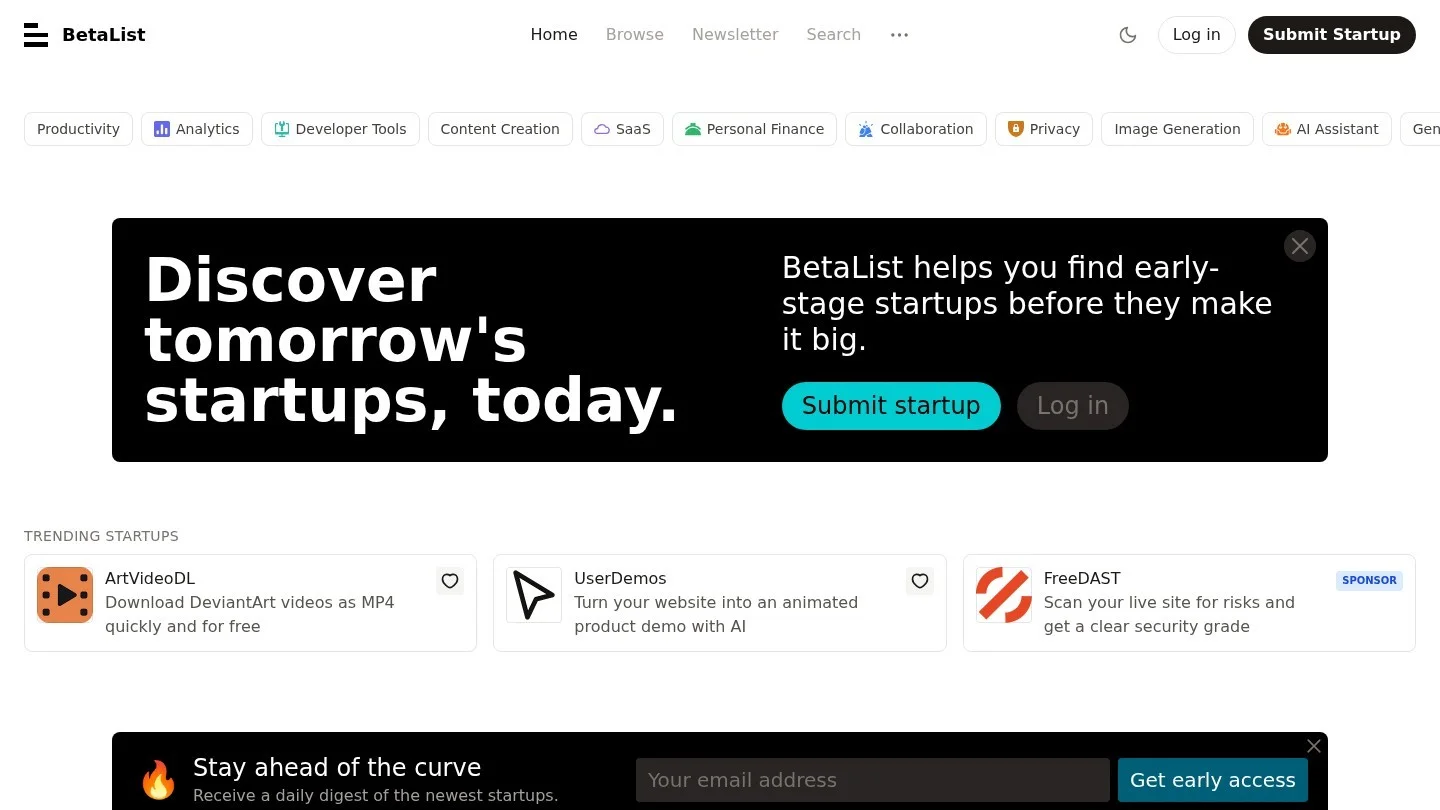
BetaList is a directory where early adopters discover new internet startups, and it accepts products at the waitlist, private beta or live stage. Every submission is paid, with no free option, but startups that are not selected get an automatic full refund. The startup needs its own domain, since free hosting subdomains and direct app store links are refused, and it must be new to BetaList’s audience.
Accepted startups get a permanent listing, and BetaList says it gets more than 500,000 pageviews a month. Faster plans guarantee a place in its newsletter, which goes to more than 70,000 subscribers, while on other plans only the most popular startups appear there. This makes BetaList the natural step before a Product Hunt launch, when you have a waitlist but not yet a finished product.
Show HN on Hacker News
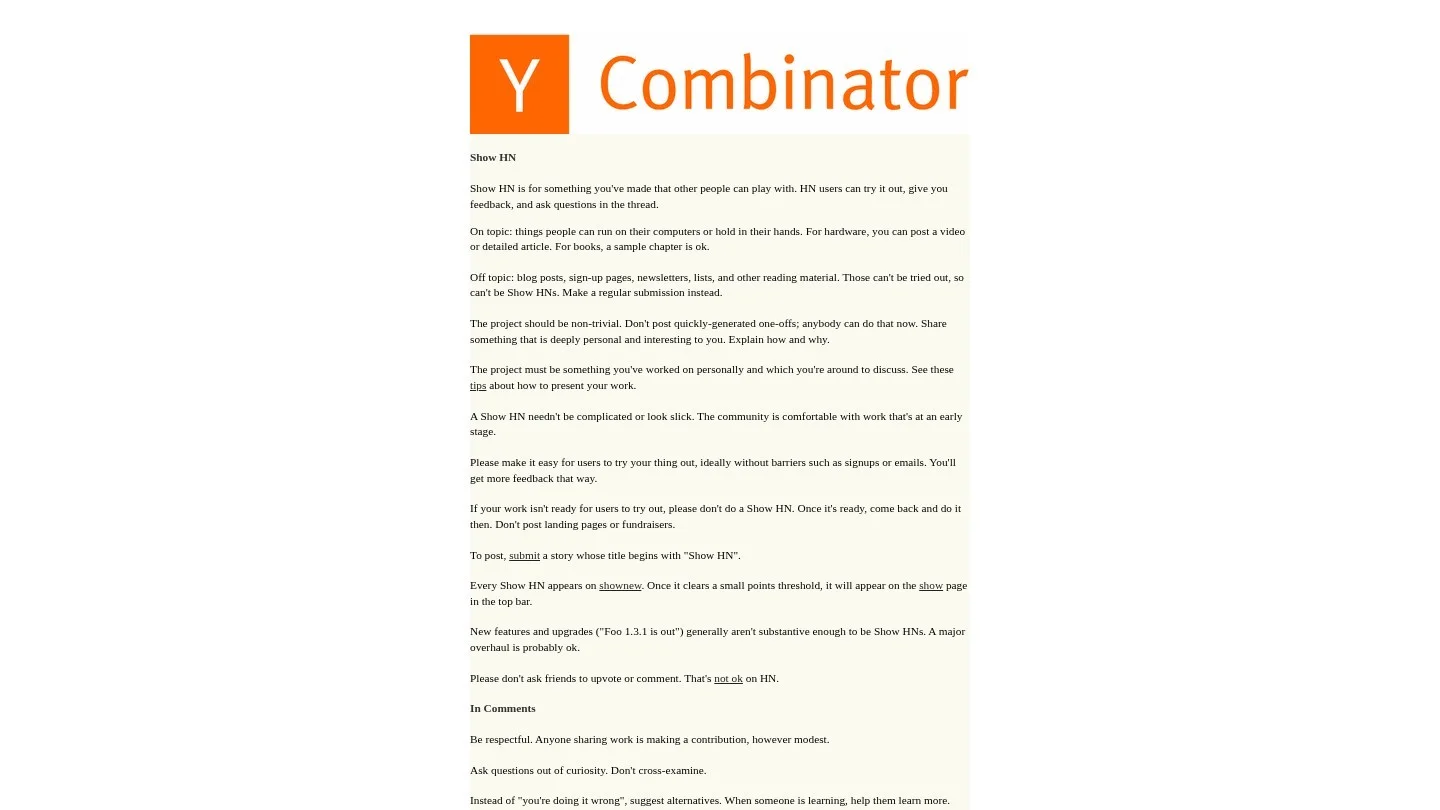
Show HN is a section of Hacker News for things people have made. The project must be something users can try, must be your own work, and must not be trivial. Blog posts, newsletters, sign-up pages, landing pages and fundraisers do not qualify, and the title has to begin with “Show HN.”
The guidelines add that people should be able to try the product without signing up or handing over an email, since that brings more feedback. New posts start on the “shownew” page and move to the main Show page after passing a small points threshold. The audience is technical and blunt, which makes it ideal for developer tools and open-source projects.
Indie Hackers
Indie Hackers is a community for founders who build profitable online businesses, many of them alone or with small teams. It works less like a launch site and more like a forum, so the best results come from sharing what you learned building the product, with a link, rather than posting an advert. Founders regularly post detailed write-ups of their own Product Hunt launches there, which are worth reading before you plan yours.
Beyond these three, tech blogs that publish software roundups can also send steady traffic after a launch. Our Techolac.com website overview shows how one such listicle-heavy site works and where its readers come from.
Upvote Requests, Not Being Featured and Relaunching
Is It Free to Launch on Product Hunt?
Yes. The site is 100% free to use, and there is no charge to submit or launch a product.
What Time Does Product Hunt Reset?
Product Hunt runs on Pacific Time, and 12:01 am Pacific is the best time to launch if you plan ahead. That is 3:01 am Eastern and 8:01 am in London.
Can I Ask People to Upvote My Product Hunt Launch?
No. You may share your launch link anywhere, but you cannot ask people directly to upvote. Ask them to visit and comment instead.
Why Was My Product Not Featured on Product Hunt?
Product Hunt’s team picks featured launches by hand and chooses products the community should know about, with signs of real craft or a distinct approach. Products that copy something already on the site, or that are not ready for people to use, are less likely to be chosen.
Can You Launch on Product Hunt More Than Once?
Yes. You can launch again as often as you have significant new iterations of the product to show.