You can run programs on a real quantum computer today from a laptop, through three main cloud services. IBM Quantum gives every user up to 10 minutes of machine time a month for free, then charges from $96 a minute. Amazon Braket charges $0.30 per task plus a per-shot fee that ranges from under a tenth of a cent to 8 cents, depending on the machine. Azure Quantum resells machines from IonQ, Quantinuum, Rigetti and Pasqal, each with its own pricing formula.
What a first experiment costs depends far more on the machine you pick than on the platform. In our worked example below, the same 1,000-shot circuit costs $0.72 on Rigetti’s machine through Braket and $80.30 on IonQ Forte through Braket. That gap is the most useful thing to know before you start.

The Three Main Routes to a Real Quantum Computer
| Platform | Machines you can reach | How you pay | Free option |
|---|---|---|---|
| IBM Quantum Platform | IBM’s own superconducting processors, 100+ qubits | Per minute of machine runtime | Open Plan: up to 10 minutes a month |
| Amazon Braket | AQT, IonQ, IQM, QuEra, Rigetti | Per task plus per shot; or hourly reservations | One hour of simulator time a month for the first 12 months |
| Azure Quantum | IonQ, Quantinuum, Rigetti, Pasqal | Each provider’s own formula: per gate-shot, per credit, per time slice or per hour | Free IonQ simulator and Rigetti simulator |
The three platforms differ in philosophy: IBM sells access to its own fleet and measures time, while Amazon runs a marketplace that measures work: each program run is a task, and each repetition of the circuit inside it is a shot. Microsoft passes through each hardware maker’s own pricing, so the meter changes with the machine you choose.
IBM Quantum Plans and What a Minute Buys
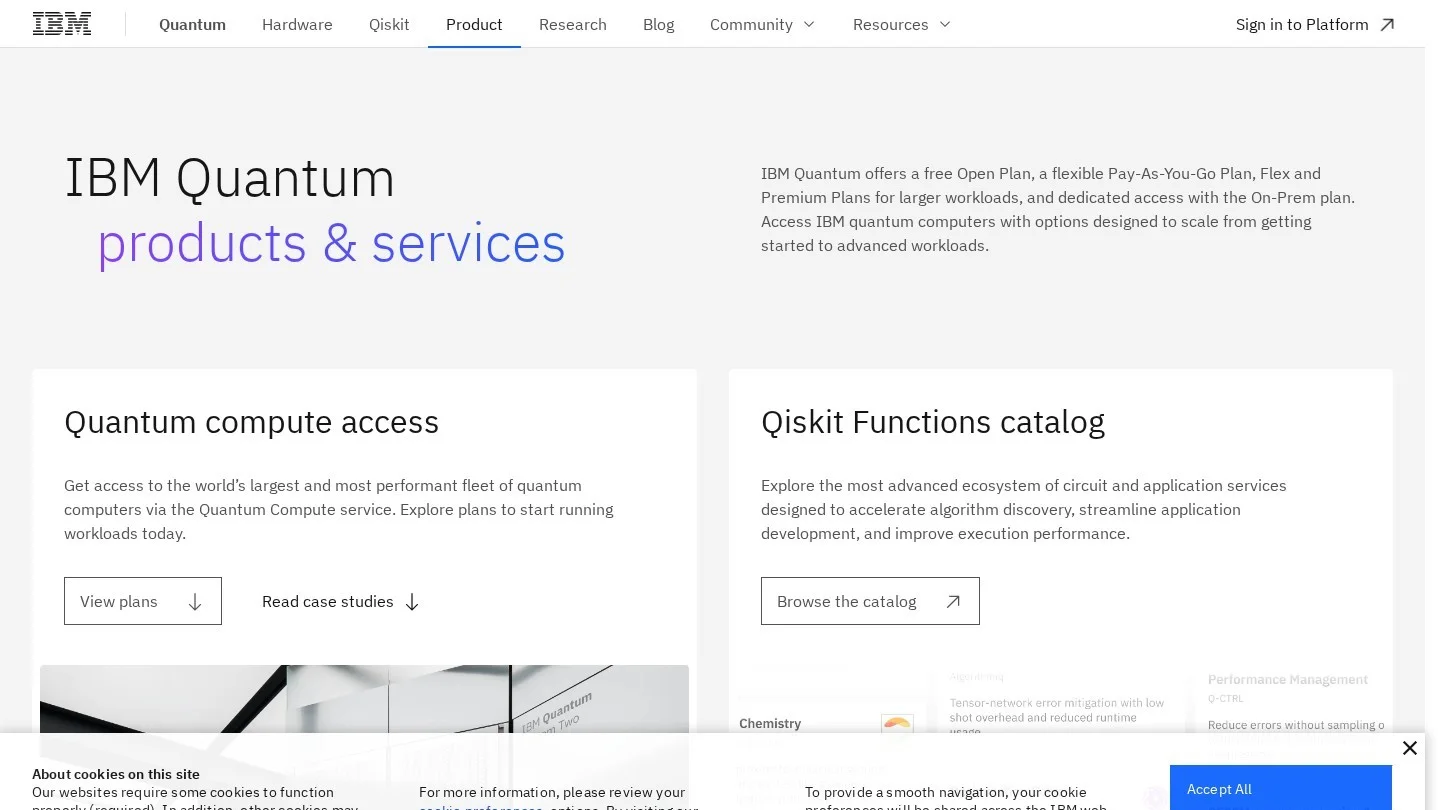
IBM has four plans. The first is the Open Plan, which is free and gives up to 10 minutes of runtime a month, and active users may request more. Pay-As-You-Go starts at $96 a minute with a one-second minimum. Flex starts at $72 a minute with a 400-minute yearly minimum. Premium starts at $48 a minute with a 5,200-minute yearly minimum, and an on-premise system is priced by quote.
We converted those minimums into yearly spend: Flex at $72 a minute for 400 minutes comes to $28,800 a year. Premium at $48 a minute for 5,200 minutes comes to $249,600 a year. Those are entry points for research groups and companies, not hobby budgets.
For a sense of scale, suppose a small job uses 10 seconds of machine time. That is an assumption for illustration, since runtime depends on the circuit and the number of shots. At list prices, those 10 seconds would cost $16 on Pay-As-You-Go, $12 on Flex and $8 on Premium. On the Open Plan, the free 10 minutes a month would cover about 60 such jobs.
Amazon Braket Prices by Machine
Braket charges the same $0.30 for every task on real hardware, then a per-shot fee set by machine.
| Provider and device | Per task | Per shot | Hourly reservation (Braket Direct) |
|---|---|---|---|
| Rigetti Cepheus | $0.30 | $0.000425 | $4,100 |
| IQM Garnet | $0.30 | $0.00145 | $3,000 |
| IQM Emerald | $0.30 | $0.0016 | $4,000 |
| QuEra Aquila | $0.30 | $0.01 | $2,500 |
| AQT IBEX-Q1 | $0.30 | $0.0235 | $4,800 |
| IonQ Forte | $0.30 | $0.08 | $7,000 |
Reservations are billed in one-hour blocks and can be cancelled free up to 48 hours ahead. The managed state-vector simulator, SV1, costs $0.075 a minute, billed by the millisecond with a three-second minimum. AWS’s own example puts a 10,000-shot task on Rigetti Cepheus at $4.55: $0.30 for the task and $4.25 for the shots.
One machine on the list works differently, because QuEra’s Aquila is an analog machine built from neutral atoms. Instead of running gate-by-gate circuits, it evolves a group of atoms under a programmed pattern of laser pulses. It suits physics simulation and some optimization research, and it cannot run the gate circuit in our example, so we left it out of the comparison.
Is a Braket Reservation Worth It?
Our math says reservations are rarely about price for small users. An hour on IQM Garnet costs $3,000 reserved, while at on-demand rates our 1,000-shot example costs $1.75, so the reserved hour equals about 1,714 such tasks. An hour on IonQ Forte costs $7,000, the same as about 87 of our example tasks at $80.30 each. A reservation buys dedicated, scheduled access with no queue, which matters for workshops, deadlines and long hybrid algorithms more than for one-off tests.
Azure Quantum Providers and Their Formulas
Microsoft’s pricing page lists a separate meter for each hardware partner. Providers set their own prices, and Azure infrastructure costs come on top.
IonQ charges per gate and per shot, with a minimum per program. On Aria 1, each one-qubit gate costs $0.000220 per shot and each two-qubit gate $0.000975 per shot. The minimum per run is $97.50 with error mitigation on and $12.4166 with it off. On Forte 1 and Forte Enterprise 1, the rates are $0.0001645 and $0.001121, with minimums of $168.195 and $25.7899.
Quantinuum charges in H-System Quantum Credits, or HQCs, worked out as 5 + C(N1q + 10 N2q + 5 Nm)/5,000, where C is shots, N1q one-qubit operations, N2q two-qubit operations and Nm state preparation and measurement steps. Its Standard subscription costs $125,000 a month for 10,000 HQCs on System Model H2, and Premium costs $175,000 a month for 17,000 HQCs.
Rigetti charges $0.02 for each 10 milliseconds of execution time on its Cepheus-1-108Q machine, with no per-shot or per-gate charge.
Pasqal charges €3,000 per QPU-hour on its FRESNEL machines and €15 per emulator-hour.
What Kind of Machine Sits Behind Each Service
The cloud hides the hardware, but the hardware decides speed, cost and the kind of problem you can try. The machines on these three services use three broad designs.
Superconducting qubits are tiny electrical circuits cooled to a fraction of a degree above absolute zero, and IBM, Rigetti and IQM build machines this way. Their gates are very fast, which keeps runtime short, and that helps explain why Rigetti and IQM have the lowest per-shot prices on Braket. The trade-off is that each qubit usually connects directly to only a few neighbors, so a circuit may need extra steps to move information around.
Trapped-ion qubits are single charged atoms held in place by electric fields and controlled with lasers, the approach used by IonQ, Quantinuum and AQT. Any qubit can usually interact with any other, which can make circuits shorter, but each gate takes longer to run. That slower pace is one reason per-shot and per-gate prices on these machines are higher.
Neutral-atom machines, such as QuEra’s Aquila and Pasqal’s FRESNEL, hold uncharged atoms in beams of light. Many of them are used in analog mode, where the whole system evolves together under a programmed sequence of pulses, rather than step by step through gates. Pasqal’s per-hour pricing on Azure reflects that style of use.
None of these designs has won yet, so for a learner trying one machine of each type is a cheap way to see how the same idea behaves on different hardware.
What One 1,000-Shot Circuit Costs: Our Worked Example
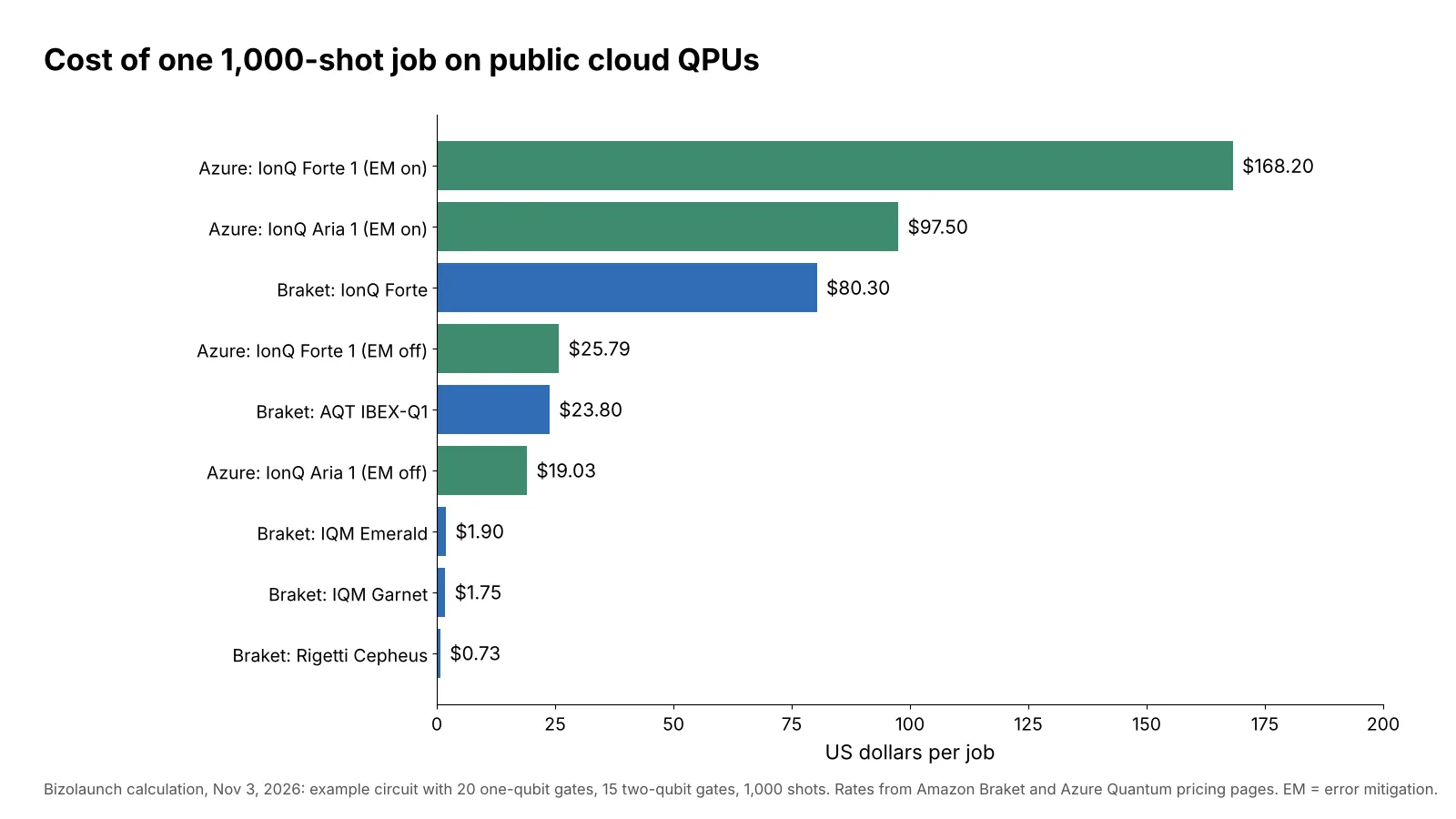
To compare platforms fairly, we priced one example circuit everywhere it could run on per-use pricing. The circuit uses 20 one-qubit gates, 15 two-qubit gates and 10 measurements, run for 1,000 shots. That is a typical size for a first experiment, such as a small entangled state or a toy chemistry model.
The method was simple. For Braket, cost equals $0.30 plus 1,000 times the per-shot price. For IonQ on Azure, cost equals the gate formula or the minimum, whichever is higher. For Quantinuum, we computed the credits and then an effective price per credit from the Standard subscription.
| Platform and machine | How we calculated it | Cost of one run |
|---|---|---|
| Braket, Rigetti Cepheus | $0.30 + 1,000 x $0.000425 | $0.72 |
| Braket, IQM Garnet | $0.30 + 1,000 x $0.00145 | $1.75 |
| Braket, IQM Emerald | $0.30 + 1,000 x $0.0016 | $1.90 |
| Azure, IonQ Aria 1, error mitigation off | Gate formula $19.03 (above $12.42 minimum) | $19.03 |
| Braket, AQT IBEX-Q1 | $0.30 + 1,000 x $0.0235 | $23.80 |
| Azure, IonQ Forte 1, error mitigation off | Gate formula $20.11, below $25.79 minimum | $25.79 |
| Braket, IonQ Forte | $0.30 + 1,000 x $0.08 | $80.30 |
| Azure, IonQ Aria 1, error mitigation on | $97.50 minimum applies | $97.50 |
| Azure, IonQ Forte 1, error mitigation on | $168.195 minimum applies | $168.20 |
| Azure, Quantinuum H2 (Standard plan) | 49 HQCs x $12.50 effective per HQC | $612.50 |
For Quantinuum, the formula gives 5 + 1,000 x (20 + 150 + 50) / 5,000 = 49 credits. The $12.50 figure comes from dividing $125,000 by 10,000 credits, so it applies only if a subscriber uses the whole monthly allowance.
Cheap is not the same as good value, because machines differ in qubit quality, connectivity and error rates, and those differences change how many runs it takes to reach a clean answer. Price per run is the right first filter for learning, while for research the better measure is the cost of a usable result.
Getting Started Step by Step
Each platform follows the same basic path: you make an account, write a circuit in Python, test it on a simulator and only then send it to real hardware.
On IBM Quantum
Create an IBM Quantum account and choose the Open Plan, then install Qiskit, IBM’s open-source Python library, and copy your API key into your environment. Build a small circuit, such as two qubits in an entangled state, and run it on a local simulator until the results look right. When you send it to a real processor, keep an eye on the dashboard, because the free plan’s 10 minutes a month go quickly once you start looping over many circuits.
On Amazon Braket
Turn on Braket in your AWS account and pick a region where your chosen machine is offered, then open a notebook and install the Braket Python SDK. Run your circuit on the SV1 simulator first, which falls inside the free hour for your first 12 months. Before your first hardware task, set the number of shots on purpose, since every shot is billed, and create a billing alert in AWS so that a loop with the wrong settings cannot run up a large charge.
On Azure Quantum
Create an Azure Quantum workspace and add the providers you want to try, then install the azure-quantum Python package, which works with Qiskit and other common tools. Test your work on the free IonQ or Rigetti simulator before you touch hardware. Check each provider’s minimum charge before you submit, especially IonQ’s per-program minimum, which can be several times the gate-based cost of a small circuit.

Reading the Results of Your First Run
A quantum program does not return one answer the way a normal program does. Each shot ends with a measurement that gives a string of zeros and ones, and the result of a job is a count of how often each string appeared. If you prepare two qubits in an entangled state and run 1,000 shots, a perfect machine would return “00” about half the time and “11” about half the time, and never “01” or “10.”
Real machines are noisy, so some shots land on the wrong strings. Comparing the hardware counts with a simulator run of the same circuit is the simplest way to see that noise for yourself. The gap between the two is a rough, hands-on measure of how much error a given machine adds, and it is one of the best lessons a first experiment can teach.
This is also why shot counts matter for cost, since more shots give a smoother picture of the true probabilities, but every shot is billed on Braket and counted in the formulas on Azure. For learning, a few hundred to a thousand shots is usually enough to see the pattern.
Ways to Keep Quantum Cloud Bills Small
Most surprise bills come from three habits, and each has a simple fix.
Running hardware before simulating. Simulators are free or cheap and show whether your circuit is even correct. AWS’s free tier covers one hour of simulation a month for a year, and Azure’s IonQ and Rigetti simulators are free.
Asking for more shots than you need. On Braket, shots drive the cost on most machines. Halving shots from 1,000 to 500 on IonQ Forte cuts our example from $80.30 to $40.30.
Turning on error mitigation without checking the minimum. On Azure, IonQ Aria’s minimum jumps from about $12 to $97.50 with error mitigation on. On Braket, AWS’s own example shows an IonQ Forte error-mitigation run needs at least 2,500 shots and costs $200.30, and jobs with fewer shots fail without charge.
Which Quantum Cloud Service Fits You
- Students and curious developers: IBM’s Open Plan, because the free 10 minutes a month are enough for many first experiments.
- Developers who want to compare hardware types: Amazon Braket, where one SDK reaches superconducting, trapped-ion and neutral-atom machines with per-shot pricing.
- Teams already on Azure or using Quantinuum: Azure Quantum, where workspace billing and Microsoft tools are already in place.
- Research groups with steady use: IBM Flex or Premium, or Braket reservations, priced against the yearly minimums above.
Why Businesses Watch Quantum Computing Now
Today’s cloud machines are small and noisy, and they do not threaten real encryption. Companies still pay attention for two reasons. The first is skills, because teams that learn quantum programming now will be ready for useful machines later. The second is security, since larger future machines could break RSA and elliptic-curve cryptography, which is why NIST has set 2030 and 2035 cutoffs for those algorithms. Our guide on preparing for post-quantum encryption lays out that plan, and our profile of post-quantum cryptography companies shows who is building the defenses.
Quantum services also sit inside the same cloud contracts as everything else your company runs there. Microsoft’s heavy data-center spending, covered in our report on Microsoft’s Azure capital spending, is the backdrop for services like Azure Quantum. And if your team is weighing how to protect sensitive data while it is processed in any cloud, our explainer on confidential computing covers that related technology.
Quick Answers on Quantum Cloud Access
Can I Use a Quantum Computer for Free?
Yes. IBM’s Open Plan gives up to 10 minutes of real quantum runtime a month at no cost. Amazon and Microsoft offer free simulators, and AWS includes one free hour of simulator time a month for the first 12 months.
How Much Does It Cost to Run a Quantum Program on AWS?
Each hardware task costs $0.30 plus a per-shot fee. In our example, 1,000 shots cost $0.72 in total on Rigetti Cepheus and $80.30 on IonQ Forte.
Do I Need to Know Physics to Use a Quantum Computer?
No. You write circuits in Python with libraries such as Qiskit or the Braket SDK, although some linear algebra helps you understand the results.
Which Quantum Computer Is Cheapest to Use in the Cloud?
In our example on per-use pricing, Rigetti Cepheus on Amazon Braket was cheapest at $0.72 for 1,000 shots, followed by IQM Garnet at $1.75.