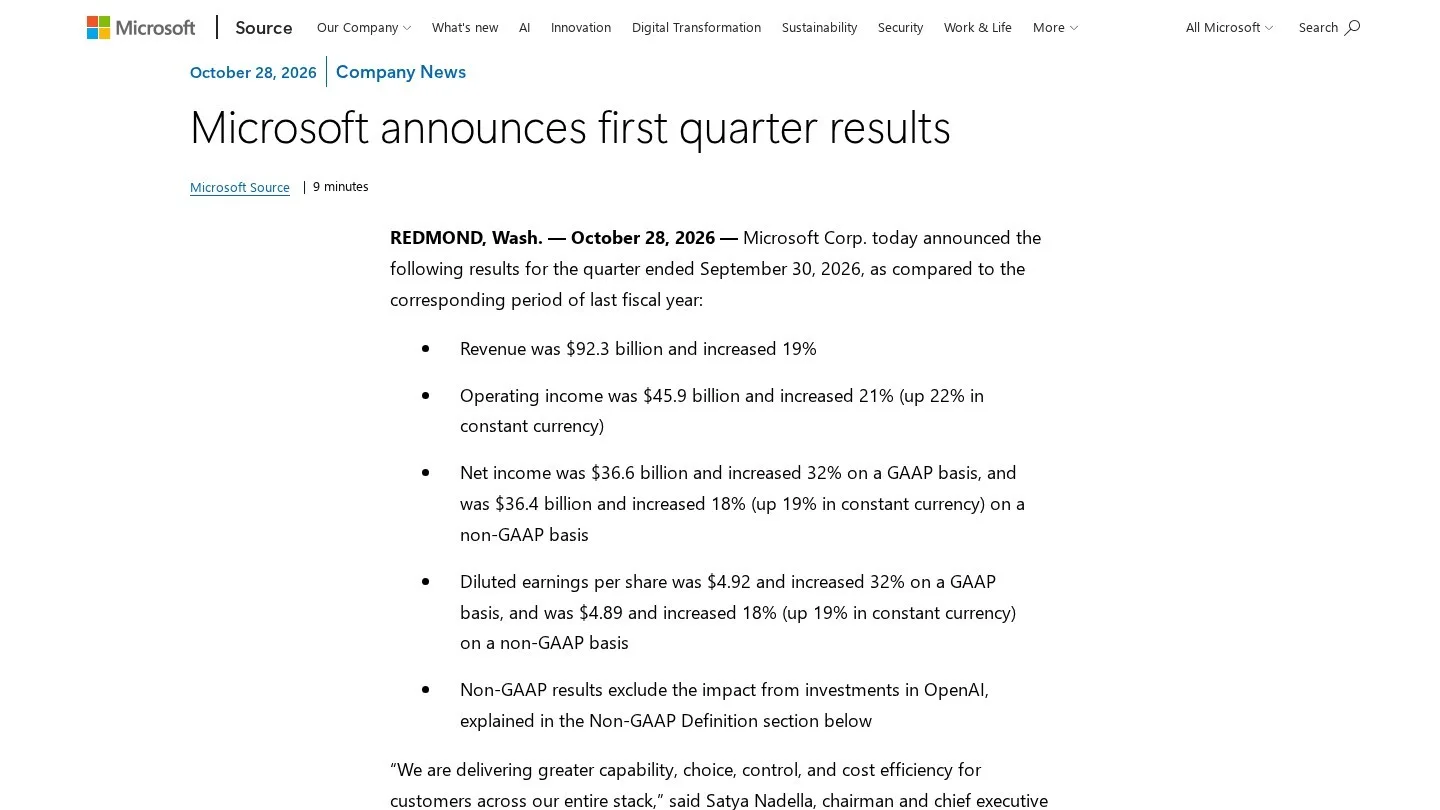
Microsoft’s cloud backlog now stands at $677 billion. That figure, up 73% from a year earlier, sat inside the first-quarter results Microsoft published on October 28, 2026, for the three months to September 30. Revenue rose 19% to $92.3 billion, Azure grew 48%, and capital spending reached $45.2 billion in a single quarter. It was also the first report under Microsoft’s new two-segment structure, and it landed two days after the company offered voluntary buyouts to tens of thousands of staff.
Microsoft’s September Quarter by the Numbers
- Revenue was $92.3 billion, up 19%, and GAAP net income rose 32% to $36.6 billion.
- Azure revenue grew 48%, and Microsoft guided to 49% to 50% growth in constant currency for the December quarter.
- Capital spending was $45.2 billion including finance leases, and CFO Amy Hood expects more than $50 billion this quarter.
- Windows OEM and Devices revenue fell 22%, pulling the new Devices and Consumer segment down 3%.
Agents and Infra Replaces Microsoft’s Old Three-Part Report
For years Microsoft reported three segments, but this quarter’s release uses only two. Agents and Infra, the segment that includes Azure, brought in $76.8 billion, up 25%. Devices and Consumer, which includes Windows sold through PC makers, Xbox and search advertising, brought in $15.5 billion, down 3%.
The names tell you where Microsoft thinks its money will come from. Selling AI agents and the cloud infrastructure that runs them is now the headline business. The consumer side, once the heart of the company, now makes up about a sixth of revenue, and it shrank this quarter.
| Measure (Quarter to Sept. 30, 2026) | Result | Change vs Year Earlier |
|---|---|---|
| Total revenue | $92.3 billion | +19% |
| Operating income | $45.9 billion | +21% |
| Net income (GAAP) | $36.6 billion | +32% |
| Diluted EPS (GAAP / non-GAAP) | $4.92 / $4.89 | +32% / +18% |
| Agents and Infra revenue | $76.8 billion | +25% |
| Devices and Consumer revenue | $15.5 billion | -3% |
| Microsoft Cloud revenue | $63.9 billion | +30% |
| Azure revenue | Not given in dollars | +48% |
| Commercial remaining performance obligation | $677 billion | +73% |
Net income grew much faster than revenue partly because of OpenAI. Last year, losses tied to Microsoft’s OpenAI investment cut net income by $3.1 billion. This quarter the same line added $207 million. Strip that out, and non-GAAP earnings per share rose 18%, close to the pace of revenue.
Azure Growth Is Limited by Data Center Supply
Azure’s 48% growth beat Microsoft’s own plan, and the company still says it could have sold more. On the earnings call, Hood said: “Customer demand continues to exceed available supply.” She added that some capacity Microsoft expected in the December quarter has moved into the second half of the fiscal year.
That shortage explains the spending. Capital expenditure, including finance leases, was $45.2 billion, and Hood said the figure reflected delays in some third-party capacity deliveries that Microsoft had expected during the quarter. Roughly three quarters of the quarter’s spending went to short-lived assets such as chips and networking gear, and Microsoft spent $115.9 billion on property and equipment in the fiscal year to June, up from $64.6 billion a year before.
Chief executive Satya Nadella said Microsoft added 24 data centers across five continents during the quarter. In the release, he said the company is delivering “greater capability, choice, control, and cost efficiency for customers across our entire stack.”
What Microsoft Said About Copilot Usage
Analysts asked for a Copilot seat count and did not get one. Hood said Microsoft would not update that number this quarter. Nadella offered growth rates instead. Daily Copilot users rose nearly 50% from the previous quarter and more than fivefold from a year earlier. Customers with more than 50,000 seats grew more than eight times from a year earlier, and customers buying credits through usage-based billing grew more than 75% in the quarter.
That last figure points to a pricing shift. Paying per use, rather than per seat, is a model many software buyers already know from cloud services. Our explainer on SaaS pricing models covers how each approach changes the monthly bill. Firms rolling out Copilot to staff should also set clear rules first, as outlined in our AI acceptable use policy guide.

Windows and Xbox Drag on the Consumer Side
The weak spots sat in the smaller segment. Windows OEM and Devices revenue fell 22%, and Xbox content and services slipped 2%. Search and advertising revenue, excluding traffic acquisition costs, grew 12%, and Microsoft 365 consumer cloud revenue rose 17%. For the December quarter, Microsoft expects Devices and Consumer revenue of $15.9 billion to $16.4 billion.
The 60,000-Employee Buyout Offer Behind the Results
The results came two days after a memo from chief people officer Amy Coleman introduced a voluntary exit offer. Up to 60,000 employees are eligible, roughly a quarter of the workforce. Eligibility covers staff at level 70 and below on participating teams in the U.S., Canada, the UK and India. People have until early December to decide.
Microsoft has played down the scale. A spokesperson said the company expects fewer than 5% of eligible staff to accept, and Hood wrote that she expects “very few people” to take it. Microsoft had about 223,000 employees on June 30. For workers in India, one of the four countries covered, the offer is one more sign that big tech is reshaping teams around AI work. Those weighing a move may find our list of high-paying certifications useful, since cloud certifications feature prominently.
Microsoft’s Guidance for the December Quarter
Microsoft expects total revenue of $96.0 billion to $97.1 billion, up 18% to 19%. Agents and Infra should bring in $80.1 billion to $80.7 billion. Azure is guided to 49% to 50% growth in constant currency, and capital spending to more than $50 billion. Commercial bookings fell 12% this quarter, which Hood put down to very large Azure contracts signed a year earlier, and she warned that timing of such deals will keep bookings volatile.
Where AI Spending and the Buyouts Leave Microsoft
This was a strong quarter that shows where Microsoft’s limits now lie. Demand is not the constraint; chips and finished data center capacity are. When a company says it could have grown faster with more supply, every new data center turns into revenue quickly, which explains why spending keeps rising.
The new segment names and the buyout offer point the same way. Microsoft is moving money and people toward agents and infrastructure, while inviting staff on some teams to leave by choice. For business customers, the practical message is to plan Azure capacity early and watch Copilot billing terms, which are moving toward usage. For job seekers, the spending figures point to cloud infrastructure and AI deployment as the areas Microsoft is funding hardest.
This article is for information and education only and is not investment, tax or financial advice. Figures were checked on November 2, 2026; confirm current details with the official source or a registered adviser before acting.
Questions About Microsoft’s First-Quarter Report
How Much Did Azure Grow in Microsoft’s Latest Quarter?
Azure revenue grew 48% in the quarter to September 30, 2026. Microsoft expects 49% to 50% growth in constant currency for the December quarter.
What Are Microsoft’s New Reporting Segments?
Microsoft now reports Agents and Infra ($76.8 billion this quarter) and Devices and Consumer ($15.5 billion), in place of its earlier three segments.
Are Microsoft India Employees Eligible for the Voluntary Exit Offer?
Eligible employees at level 70 and below on participating teams in India, the U.S., Canada and the UK can take the offer, with a decision due by early December.