Basecamp charges a 120-person company the same $199 a month that it charges a team of 20. Slack bills that same company for every member who has used Slack in the last 28 days. Twilio does not care how many people work there at all, because it counts text messages instead. Those three companies use three different SaaS pricing models, and each one changes who pays more as a customer grows.
There are seven common ways to price software as a service: flat-rate, per-seat, tiered, usage-based, credits, hybrid and freemium. Many real price pages mix two or three of them. Below, each model is shown on a vendor’s own pricing page, with the math behind a real bill, the trade-offs, and the kinds of products it suits. A worked example then runs one customer base through five price sheets so you can see how far the revenue moves.
What Revenue Tracks Under Seats, Tiers, Usage and Credits
- The pricing model decides what your revenue tracks: accounts (flat-rate), people (per-seat), feature bundles (tiered) or consumption (usage and credits).
- Per-seat pricing is easy to forecast, but it caps revenue at headcount and invites seat sharing. Slack softens it by billing only active members.
- Usage pricing grows with the customer. By 2021, 45% of SaaS firms used it fully or in part, up from 34% the year before.
- Credits and hybrid plans give buyers a predictable bill while still charging heavy users more. Snowflake sells compute as credits at $2 to $4 each.
- In our worked example, one growing customer raised its bill by 0% under flat-rate pricing and by 151% under tiered pricing.
How Each of Seven Models Bills, With a Real Vendor Example
Each model answers one question, which is what exactly the customer is paying for, and the answer shapes your sales motion, your billing system and your growth rate. The table sums up how each one calculates the bill and gives a real public example of each.
| Model | How the bill is calculated | Real example | Usually fits |
|---|---|---|---|
| Flat-rate | One fixed price per account | Basecamp Pro Unlimited, $199/month billed annually | Simple tools with one buyer and light variable costs |
| Per-seat | Price per user, per month | Slack Pro, $8.75 per member | Collaboration tools where value rises with each user |
| Tiered | Packages at set prices, with limits per tier | Basecamp Freelancer, Pro and Pro Plus | Products with clear small, medium and large customers |
| Usage-based | Price per unit consumed | Twilio, $0.0083 per US SMS segment | APIs and infrastructure with real cost per unit |
| Credits | Prepaid units spent on different actions | Snowflake, $2 to $4 per credit on demand | Products with many billable actions of different cost |
| Hybrid | Fixed fee plus metered charges | Twilio number rental plus per-message fees | Products with both a base value and variable cost |
| Freemium | Free plan with limits, paid plans above it | Basecamp Free: 1 project, 3 users, 1 GB | Products that users can adopt without a sales call |
Flat-Rate Pricing: One Price for the Whole Account

Flat-rate pricing sells one package at one price, so every customer gets the same features and the bill does not change when they add people or do more work. It is the oldest software subscription model and still the easiest one to explain on a sales call.
Basecamp is the best-known example. Its top plan, Pro Unlimited, costs $199 a month billed annually or $329 a month billed monthly, with unlimited projects, unlimited users and 1 TB of storage. A customer that pays yearly spends $2,388 a year instead of $3,948, a saving of $1,560. Because the price is fixed, the cost per user falls as the team grows: $13.27 per user at 15 people, $3.32 at 60 and $1.66 at 120.
That falling per-user cost is the strength and the weakness of the model. Buyers like it because they can budget a year ahead and invite anyone without asking finance for approval. The vendor, though, earns nothing extra when a customer doubles in size, so expansion revenue has to come from add-ons instead. Basecamp, for instance, sells extra storage on Pro Unlimited at $50 a month per extra terabyte.
Fits best: single-product tools sold to small and mid-size teams, where the cost to serve one more user is close to zero. It also suits products that compete on simplicity, since “one price, everything included” is a message in itself. It fits badly when a few large customers use far more of your servers or support than everyone else.
Per-Seat Pricing and the Inactive-User Problem
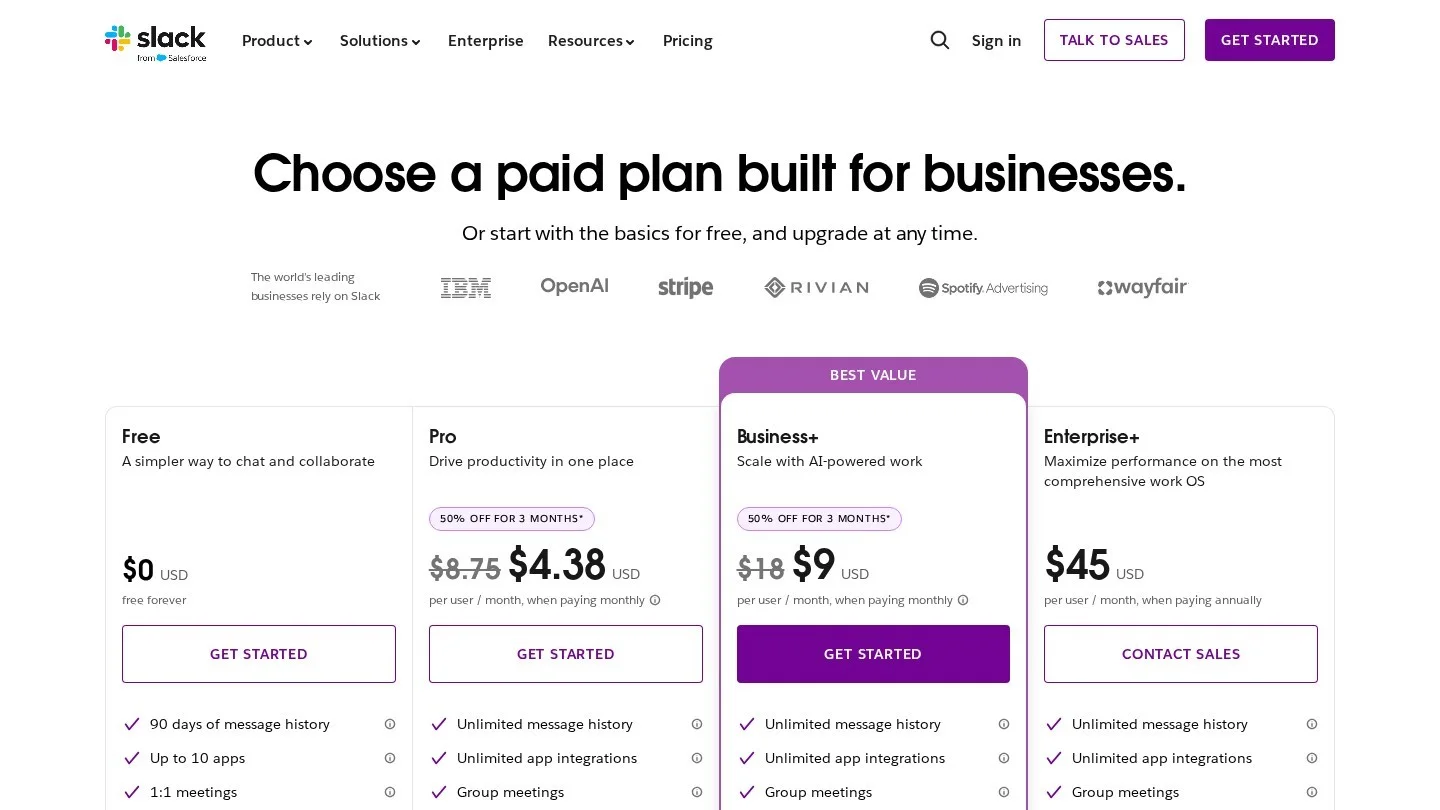
Per-seat pricing, also called per-user pricing, charges a set amount for each person who has access. A 30-person team on a $10 seat pays $300 a month, and if it hires five more people the bill goes up to $350. CRMs, help desks and chat apps have used this model for years because the value of the product grows with each person who uses it.
Slack is the classic case, and its billing rules show how a seat model can be made to feel fairer to customers. Under Slack’s fair billing policy, workspaces pay only for active members. A member counts as inactive after 28 days without using Slack, and the unused part of their fee comes back as a credit. On the Pro plan at $8.75 per member, deactivate someone with 15 days left in a 30-day month and the workspace gets a $4.38 credit. Guests in a single channel and bots are free.
The math for a 30-member workspace is simple: 30 × $8.75 = $262.50 a month, and if five people stop using Slack for more than 28 days, the workspace stops paying for them, a saving of $43.75 a month at that rate.
Per-seat pricing has two known weak spots. Revenue is tied to headcount, so layoffs at your customers quickly become your churn, and customers sometimes share logins to save money, which hides real usage. Policies like Slack’s reduce the resentment of paying for “shelfware,” but they also mean the vendor bills less than the number of seats sold.
Fits best: tools where each extra user gets real value, such as CRM, project management, design and support software. It fits poorly for products used by machines or by one admin on behalf of a whole company.
Tiered Pricing: Good, Better, Best Packages
Tiered pricing groups features and limits into a few packages at rising prices, and each buyer picks the tier that matches their size or needs. Most SaaS price pages you see today are tiered in some way, even when each tier is also priced per seat.
Basecamp shows a clean version. Below Pro Unlimited, its paid tiers are sorted by projects, users and storage:
| Basecamp plan | Price | Active projects | Users | Storage |
|---|---|---|---|---|
| Freelancer | $29/month | Up to 3 | Up to 5 | 10 GB |
| Pro | $79/month | Up to 8 | Up to 10 | 25 GB |
| Pro Plus | $99/month | Up to 12 | Up to 15 | 100 GB |
| Pro Unlimited | $199/month billed annually | Unlimited | Unlimited | 1 TB |
Snowflake tiers a different thing: the price of its billing unit. Its Standard, Enterprise and Business Critical editions charge $2, $3 and $4 per credit on demand in its listed US regions. The customer chooses features and security level through the edition, then pays for use on top.
Tiers work because buyers sort themselves: a freelancer will not pay $199 for unlimited users they will never invite, and a 40-person agency will not squeeze into a five-user plan. The risk sits at the edges. When a customer is one user or one project over a limit, the jump to the next tier can feel like a penalty, and that moment drives either an upgrade or a cancellation.
Fits best: products with clearly different customer sizes, where one feature set would be too much for small buyers and too little for large ones. Keep the list short, because every extra tier is one more choice a buyer has to make.
Usage-Based Pricing: Paying per Message, Query or Gigabyte
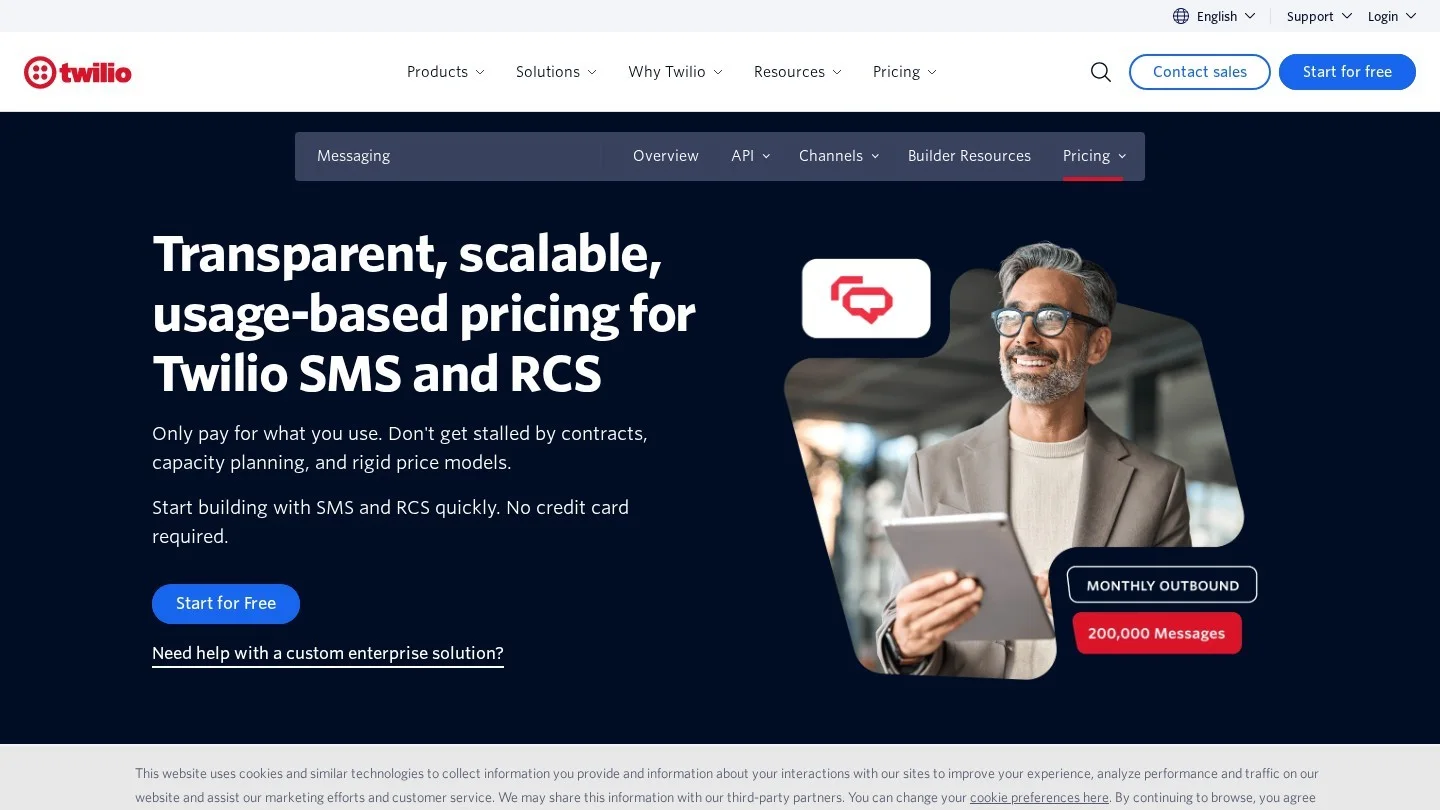
Usage-based pricing, also called consumption or pay-as-you-go pricing, bills for what the customer actually uses. There is no fixed seat count and often no fixed monthly fee, so spending rises and falls with the customer’s own business.
Twilio’s messaging prices show the model in plain numbers. Twilio charges $0.0083 per US SMS segment, sent or received, on long code, toll-free and short code numbers. Outbound MMS costs $0.022 per message. On top of that, US carriers add their own per-message fees, which Twilio passes through. For an outbound long-code SMS the carrier fee is $0.005 for Verizon, $0.0045 for T-Mobile and $0.0035 for AT&T.
Suppose a clinic sends 50,000 appointment reminders a month from one long-code number, all to Verizon customers. Each text costs $0.0083 plus the $0.005 carrier fee, or $0.0133, which comes to $665 for the messages. Add $1.15 for the leased number and the month totals $666.15, and if the clinic sends only 10,000 reminders the next month, the bill shrinks with it.
The model has spread well beyond telecom. In a 2021 survey of 600 SaaS companies, 45% used usage pricing fully or in part, up from 34% the year before and about a quarter in 2018. Among top-quartile companies, the usage-priced group reported net dollar retention of 122%, against 109% for subscription-only companies. Their customer acquisition cost payback was five months against nine. More than 60% of the companies said they planned to adopt usage pricing.
Those retention numbers explain the appeal, since a usage-priced customer expands without a new sales conversation. The downside is forecasting: revenue can dip when customers cut back, and buyers in finance teams dislike bills they cannot predict. Many vendors answer that with committed-use contracts, as Twilio does for enterprise volumes.
Fits best: APIs, data and infrastructure products, payments, messaging and AI features where each unit has a real cost to serve. The metric must be something the customer understands and links to value, such as messages sent or records processed. For a pay-for-what-you-pull model outside infrastructure, see how DataForSEO is priced in our guide to Ahrefs alternatives without a subscription.
Credits: Prepaid Units That Stand In for Usage

A credit system is a form of usage pricing with a currency in the middle. The customer buys credits, each action in the product burns a set number of them, and the vendor can then price very different actions, such as a small query and a large one, on a single bill.
Snowflake is the standard example. A credit costs $2 on Standard, $3 on Enterprise and $4 on Business Critical when bought on demand in its listed US regions. Compute warehouses burn credits by size: 1 credit an hour for X-Small, 2 for Small, 4 for Medium and 8 for Large. Billing is per second, with a one-minute minimum, and a suspended warehouse uses no credits. Storage is billed apart, at $23 per TB a month in its main AWS US regions.
Run a Medium warehouse on the Enterprise edition for six hours a day, 22 working days a month. That is 4 × 6 × 22 = 528 credits, and 528 × $3 comes to $1,584 for the month’s compute. Shut the warehouse down on weekends and the weekend cost is zero.
Snowflake also sells capacity in advance. The customer commits a dollar amount up front, and the per-credit price is fixed by the size of the commitment. Usage is drawn down from the balance, Snowflake sends a notice at 70%, and anything beyond the commitment is billed at on-demand rates.
Credits help both sides. The buyer gets a budget they can approve once, while the vendor gets cash up front and can change what an action costs in credits without rewriting the price page. The risk is confusion, because buyers who cannot tell what a credit buys soon stop trusting the bill, so publish a plain conversion table like Snowflake’s credits per hour by warehouse size.
Fits best: data platforms, AI tools and any product with many billable actions of very different cost. It is a natural choice when the cost of serving a request varies widely from one request to the next.
Hybrid Pricing: A Base Fee Plus Metered Charges
Hybrid pricing mixes a fixed component with a variable one. The most common shape is a platform fee or seat fee that covers a set amount of usage, then overage charges above it. Other versions add usage-based add-ons to a tiered plan.
Twilio’s own bills are hybrid even though the headline is usage. A US long-code number costs $1.15 a month to lease and a toll-free number $2.15, whether or not it sends a single message. Short codes cost $1,000 or more, billed quarterly. The messages are metered on top. Snowflake works the same way with two meters, storage per terabyte and compute per credit, plus an optional prepaid commitment.
The fixed part gives the vendor a revenue floor that helps cover onboarding and support, and the metered part lets a heavy user pay for heavy use. Buyers get a known minimum, which most prefer to an open-ended usage bill. The cost is complexity, since two meters mean two things to explain and two lines where an invoice can go wrong.
Fits best: products with a clear base value, such as a dashboard or workspace, plus a variable cost driver, such as API calls, contacts or storage. Many SaaS companies move here from pure per-seat pricing when they add AI features with real compute costs.
Freemium: A Free Plan That Has to Earn Its Keep
Freemium is less a billing method than a way to acquire customers. A free plan with hard limits sits under the paid plans, and the limits are set so that a growing team runs into them, which means every freemium product still needs one of the other six models for its paid plans.
Basecamp’s free plan allows one project, up to three users and 1 GB of storage. A small team can try the product for real, but the second project forces a decision. Basecamp also blocks moves the other way: a paid account cannot downgrade to Free, and the customer would need a new free account. Slack’s fair billing policy points to the same exit, noting that a workspace with no active members is billed for at least one unless it moves to the free version.
The free plan replaces part of the marketing budget, so its cost belongs in your acquisition math, because servers, storage and support for free users are real expenses. When you work out what each paying customer costs to win, count them, as our explainer on blended CAC vs paid CAC explains. Free users who arrive from a single traffic spike, such as a Product Hunt launch, also need a clear upgrade trigger, or they stay free forever.
Fits best: products that one person can sign up for and get value from in minutes, and that become more useful as more people join. It fits poorly for products that need a long setup, data migration or a sales call before anyone sees value.
Same Customers, Five Price Sheets: A Revenue Worked Example
The fastest way to compare SaaS pricing models is to run one customer base through each of them, so take an imaginary customer-feedback tool with three customers. A small team has 8 users and records 5,000 events a month. A mid-size firm has 40 users and 60,000 events. A large company has 150 users and 400,000 events. The prices below are hypothetical, chosen to be in a normal SMB range.
| Model | Price sheet used |
|---|---|
| Flat-rate | $199 per account per month |
| Per-seat | $9 per user per month |
| Tiered | $49 up to 10 users, $199 up to 50 users, $499 up to 200 users |
| Usage-based | $0.004 per event |
| Hybrid | $99 platform fee including 20,000 events, then $0.003 per extra event |
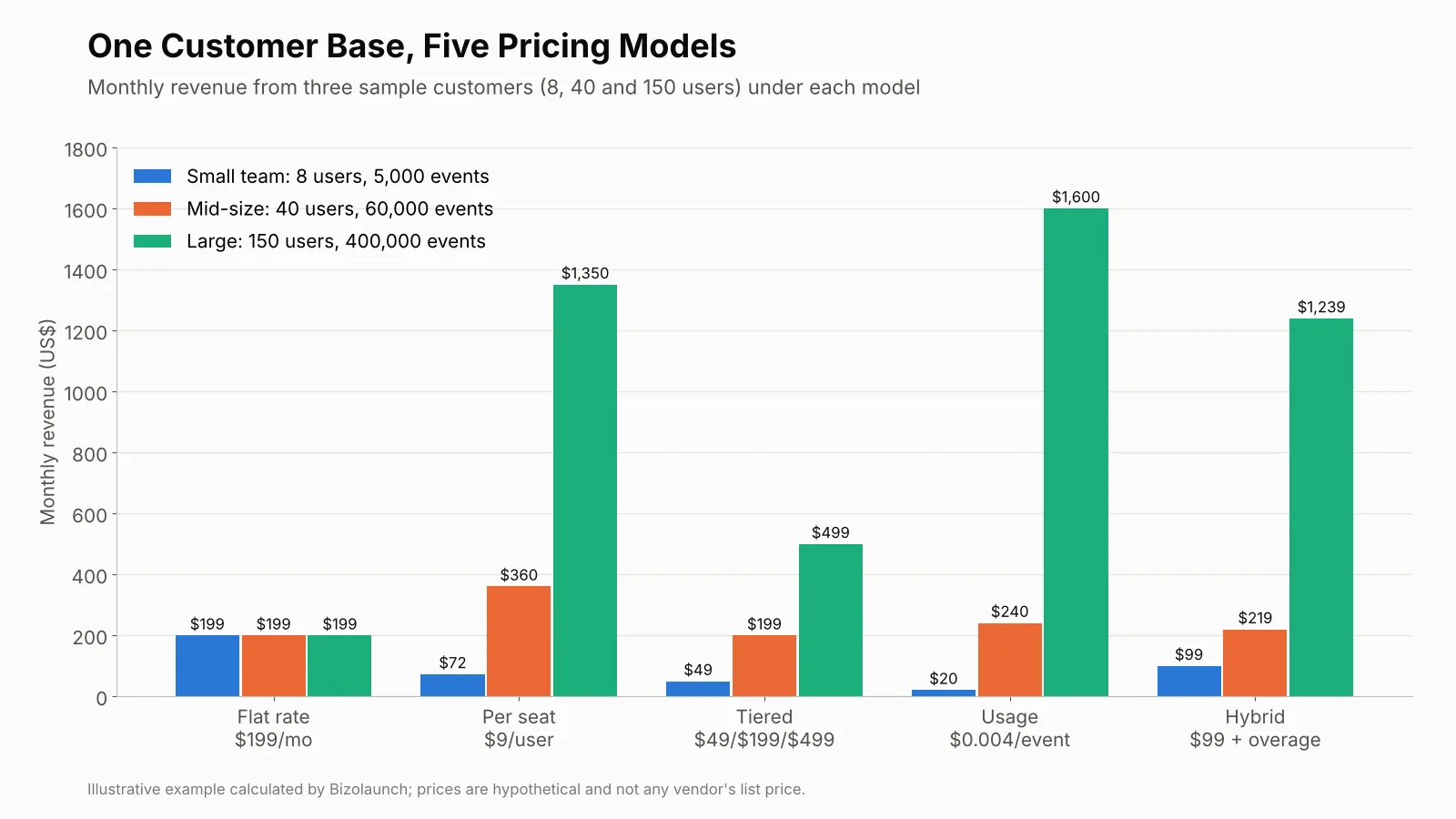
| Model | Small team | Mid-size | Large | Total monthly revenue |
|---|---|---|---|---|
| Flat-rate | $199 | $199 | $199 | $597 |
| Per-seat | $72 | $360 | $1,350 | $1,782 |
| Tiered | $49 | $199 | $499 | $747 |
| Usage-based | $20 | $240 | $1,600 | $1,860 |
| Hybrid | $99 | $219 | $1,239 | $1,557 |
Flat-rate earns the least from this base because the large customer pays the same as the small one. Usage earns the most, but almost all of it comes from one account: the large company provides $1,600 of $1,860, or 86%, so losing that customer would cut usage revenue to $260. Per-seat and hybrid pricing land in between, with much less dependence on a single buyer.
Now let the mid-size customer grow over a year, from 40 users to 60 and from 60,000 events to 120,000 a month. Its bill changes like this:
| Model | Bill before | Bill after | Change |
|---|---|---|---|
| Flat-rate | $199 | $199 | +$0 (0%) |
| Per-seat | $360 | $540 | +$180 (50%) |
| Tiered | $199 | $499 | +$300 (151%) |
| Usage-based | $240 | $480 | +$240 (100%) |
| Hybrid | $219 | $399 | +$180 (82%) |
Tiered pricing gives the biggest jump because 60 users push the customer past the 50-user limit into the top tier, which is great for revenue if the customer accepts it and a churn risk if the jump feels unfair. Usage tracks the customer’s growth exactly, while flat-rate pricing captures none of it. If you want to test your own price points against costs, our break-even calculator shows how many customers you need at a given price.
A credit plan works the same way with one more step. Say the tool sold a $450 plan with 10,000 credits a month, charged 5 credits per AI summary and 1 per data export, and sold extra packs of 2,000 credits for $100. A customer running 1,500 summaries and 3,000 exports uses 10,500 credits. That is 500 over the plan, so they buy one pack and pay $550, and the 1,500 unused credits in the pack become both the vendor’s cushion and the buyer’s reason to watch the meter.
How Your Pricing Model Shapes Churn, Expansion and Payback
A pricing model is also a retention and growth decision, because each one sets up a different path for expansion revenue, and expansion is what pushes net revenue retention above 100%.
- Flat-rate: low expansion, low surprise. Retention depends almost wholly on keeping logos, so watch logo churn closely.
- Per-seat: grows with hiring and shrinks with layoffs. Seat contraction shows up as revenue churn even when no customer leaves.
- Tiered: grows in steps. Each tier limit is both an upgrade trigger and a cancel trigger.
- Usage and credits: grow without a sales call, which is why usage-priced companies post higher net dollar retention. Revenue can also fall in a quiet month.
- Hybrid: the fixed fee protects the floor, while the meter adds upside.
These differences flow straight into your SaaS metrics. Our guide to the SaaS churn rate shows how to separate logo churn from revenue churn and how expansion turns gross retention into net retention. The model also changes how fast you earn back the cost of a new customer. A low entry tier wins more sign-ups but stretches the CAC payback period, while an annual prepaid plan pulls the cash forward.

Choosing a SaaS Pricing Model for Your Product
Start with the value metric, the unit that best tracks what the customer gets from your product. If value grows with each person, price per seat; if it grows with volume, such as messages, records or compute, meter it; and if your customers differ widely in size but use the product the same way, tier it. Then check the metric against three tests: the customer can predict it, it grows as they succeed, and your costs grow roughly in line with it.
Some practical rules follow from the examples above:
- Selling to small businesses with a self-serve sign-up: a free plan or trial, then two or three tiers, priced flat or per seat. Small buyers usually want a single number they can put on a company card.
- Selling an API or infrastructure product: usage-based pricing with published unit prices, plus volume discounts or a commitment for large accounts.
- Adding AI features with real compute cost: credits or a hybrid plan, so heavy users pay for what they burn and light users are not scared off.
- Selling to enterprise buyers: a predictable annual contract, often a platform fee plus seats or a prepaid usage commitment.
- Competing against a complex, expensive incumbent: a simple flat or tiered price can be your main message. Our breakdown of Semrush pricing vs competitors shows how rivals use cheaper tiers against a market leader.
Whatever you choose, publish the limits plainly and give customers a way to see their usage before the invoice arrives. When you raise prices, consider keeping existing customers on their old plan for a while, because price changes that surprise buyers can cost more in churn than they earn in revenue.
Is Per-Seat Pricing Dying, and How Many Tiers to Offer
What Is the Most Common SaaS Pricing Model?
Tiered and per-seat plans are the familiar defaults, and many price pages combine them. Usage pricing has grown fast. In 2021, 45% of 600 surveyed SaaS companies used it fully or in part, up from 34% a year earlier.
What Is the Difference Between Usage-Based and Credit-Based Pricing?
Usage-based pricing bills each unit directly, such as $0.0083 per Twilio SMS segment. Credit-based pricing adds a prepaid currency: the customer buys credits, and each action burns a set number. Snowflake, for example, sells credits at $2 to $4 each and burns them by warehouse size and run time.
Is Per-Seat Pricing Dying?
No, but it is increasingly mixed with other meters. Per-seat pricing still suits tools where each person gets value from the product, such as Slack. Many vendors now add usage charges for AI or API features on top of seats, which turns the plan into a hybrid.
How Many Pricing Tiers Should a SaaS Company Have?
Basecamp, for instance, lists a free plan and four paid plans. Fewer tiers make the choice easier for buyers. Each tier should match a clearly different customer, with limits that make the upgrade feel natural.
Is Freemium Better Than a Free Trial?
Freemium suits products that one person can adopt alone and that grow more useful as others join, while a free trial suits products that need setup or show their value only at full scale. Either way, count the cost of serving free users in your customer acquisition cost.