People run more than 80 billion searches a month on Pinterest, and until September most of that intent sat outside a dedicated ad slot. Pinterest Visual Search Ads change that. Announced on 17 September 2026 at Pinterest Presents, the company’s annual advertiser summit, they let a brand bid for the top response in Pinterest Search Results and in Pin closeups, then send the shopper straight to its own site, according to Pinterest’s announcement. The format is in beta, it is built for lower-funnel goals and it plugs into Pinterest Performance+.
For a small retailer selling furniture, fashion, beauty or anything bought by look rather than by spec, this is the most interesting ad product Pinterest has shipped in a while. It is also early. What follows sets out what the new unit does, where it appears, how it sits beside the Pinterest ads you may already run, and how to judge whether it can pay for itself once your account gets access.
Placement, Eligibility and Bidding for the New Search Format
- What it is: a performance ad format that pairs keyword relevance with Pinterest’s own visual understanding of images, products, taste and intent.
- Where it runs: the top of Pinterest Search Results and inside Pin closeups, the screen a person sees after tapping a Pin.
- Who can use it: eligible advertisers, in beta, across all Pinterest ad markets as the rollout reaches them (status as of October 2026).
- How it buys: advertisers bid for the top response and link directly to their website; it works with Performance+ campaigns.
- Who should test first: sellers with a clean product catalogue, strong photography and conversion tracking already in place.
What Pinterest Visual Search Ads Actually Are
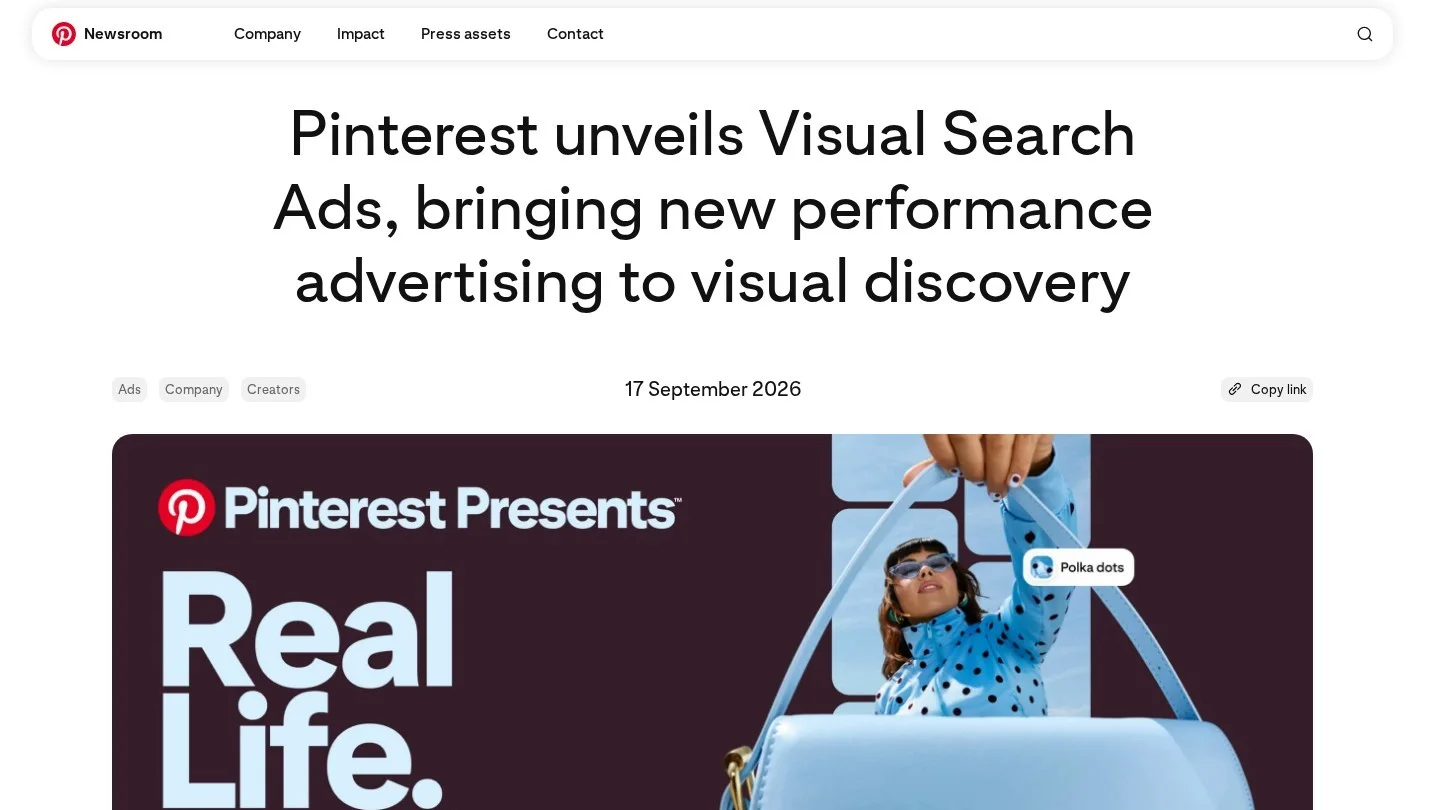
Pinterest describes Visual Search Ads as a new performance feature that combines keyword relevance with an ad format designed to meet people while they search, compare and move towards a purchase. The targeting engine behind it is what Pinterest calls Pinterest Intelligence, its AI-based reading of images, products, taste and intent, which the company says turns those signals into targeting an advertiser can act on.
The pitch rests on one statistic. Pinterest says that of its 80 billion-plus monthly searches, the vast majority are visual and more than half are commercial. In other words, a large share of people on the platform are already shopping, often by pointing the camera at a sofa or tapping a lamp inside someone else’s photo rather than typing “walnut side table”.
Pinterest’s chief executive, Bill Ready, framed the launch around that behaviour, saying people “are expressing themselves in much richer ways” as AI changes search. The commercial logic is plainer: a query typed into a search bar has been monetised by Google for two decades, while a query made with an image has had few dedicated ad products built around it. Pinterest wants to own that slot.
Where Visual Search Ads Appear on Pinterest
Two surfaces carry the format, and they catch the shopper at slightly different moments.
| Placement | What the person is doing | What the ad offers |
|---|---|---|
| Search Results (top response) | Has typed or snapped a query and is scanning options | A prominent result at the top of the page, linking to the advertiser’s site |
| Pin closeup | Has tapped a specific Pin and is looking closely at one idea or product | A relevant product placed beside an item the person already likes |
The Search Results slot behaves most like a classic search ad: the person has stated a need and you are bidding to be the first answer. The Pin closeup is closer to a “shop similar” moment. Someone admiring a rattan chair in an influencer’s living room is a warm prospect for a rattan chair from your store, even if they never typed a word.
How Visual Search Ads Differ From the Pinterest Ads You Already Run
Pinterest advertisers have long been able to add keywords to a campaign so that Promoted Pins can show when people search. Visual Search Ads go further in two ways that Pinterest has spelled out: the format is new and sits in a prominent top position, and relevance comes from visual understanding as well as from words.
| Question | Keyword-targeted Promoted Pins | Visual Search Ads (beta) |
|---|---|---|
| Main signal | The keywords you add | Keyword relevance plus Pinterest Intelligence’s reading of images, products, taste and intent |
| Position | Among search results | Bid for the top response in Search Results; also shown in Pin closeups |
| Funnel stage | Any objective you choose | Lower-funnel objectives |
| Automation | Manual or automated campaigns | Compatible with Performance+ |
| Availability | Generally available | Beta for eligible advertisers, rolling out across all Pinterest ad markets |
The practical difference is control over intent. With keyword targeting, you guess the words a buyer might use. With Visual Search Ads, Pinterest is also matching your product imagery to what the person is looking at. That should help categories where shoppers struggle to name what they want (“that boho mirror with the wavy edge”), and it puts more weight on how good your product photos are.
Who Gets Access to the Visual Search Ads Beta
Pinterest said the beta would reach eligible advertisers across all of its ad markets “in the coming weeks” after the September announcement, and a recap posted on Pinterest’s business community on 6 October 2026 repeated the same wording. The company has not published eligibility criteria, so access is decided account by account (status as of October 2026).
Two things are worth doing while you wait. First, ask your Pinterest account representative, if you have one, whether your account is on the beta list. Second, check whether Pinterest sells ads in your country at all. “All Pinterest ad markets” means the countries where Pinterest already runs advertising, and Pinterest publishes that country list in its business help centre.
Getting Your Account Ready for Visual Search Ads
The beta will reward advertisers whose basics are already tidy. None of the steps below needs the new format to be switched on, and each one improves the Pinterest ads you run today.
- Clean the product catalogue: titles that describe the item the way a shopper would (“oak bedside table with drawer”, not “SKU 4471 OAK”), accurate prices, live stock and one product per image where possible.
- Fix the photography: because Pinterest Intelligence reads images, a crisp, well-lit product shot on a plain or styled background gives the system more to match against than a cluttered flat lay.
- Install conversion tracking: a lower-funnel format is judged on sales, so the Pinterest tag and server-side events need to report checkouts and add-to-carts correctly before you spend.
- Build a keyword list anyway: keyword relevance is still half of the matching logic. Pull search terms from your existing Pinterest campaigns, your site search and your Google Ads search terms report.
- Run Performance+ now: the new unit is built to work with Performance+, so a campaign that already has learning history is a sensible home for it when it arrives.
- Pick the products to push: Pinterest also announced Priority Products inside Performance+ (more on that below). Decide which seasonal lines or high-margin items deserve the top slot.
Will a Top Search Slot Pay for Itself? A Worked Example
Top positions usually cost more per click. Whether that is worth it depends on whether the better position lifts your conversion rate by more than it lifts your cost. The figures below are illustrative inputs for a US home decor store, not Pinterest benchmarks. Swap in your own.
Assumptions: a $1,500 monthly test budget ($50 a day for 30 days), an average order value of $85 and a 55% gross margin. At a 55% margin, the break-even return on ad spend is 1 divided by 0.55, or about 1.82. Anything below that loses money on the first order.
| Metric | Scenario A: standard search placement | Scenario B: top response |
|---|---|---|
| Cost per click (assumed) | $0.90 | $1.20 |
| Clicks from $1,500 | 1,667 | 1,250 |
| Conversion rate (assumed) | 2.0% | 3.0% |
| Orders | 33.3 | 37.5 |
| Revenue at $85 per order | $2,833 | $3,188 |
| ROAS | 1.89 | 2.12 |
| Cost per order | $45.00 | $40.00 |
| Gross profit after ad spend | $58 | $253 |
In this example the top slot costs a third more per click, yet a one-point rise in conversion rate turns a near break-even campaign into one that earns $253 of gross profit on the month. Flip the assumption and the picture changes fast: if the conversion rate in Scenario B stayed at 2%, you would get 25 orders, $2,125 in revenue and a ROAS of about 1.42, well under break-even. That is why the test needs proper conversion tracking from day one.
First-order profit is only part of the story for repeat-purchase categories. If your customers come back, judge the test on how quickly a new buyer repays the cost of acquiring them; our guide to the CAC payback period walks through that maths, and blended CAC vs paid CAC explains why a channel-level number can flatter or punish a new test. Amazon sellers moving budget across platforms can sanity-check margins with our Amazon seller profit calculator, and the break-even calculator handles the fixed-cost side.
Everything Else Pinterest Announced at Pinterest Presents 2026
Visual Search Ads arrived alongside a batch of updates to Performance+ and two consumer features. Several of them matter to the same advertisers.
| Update | What it does | Status (October 2026) |
|---|---|---|
| Priority Products (Performance+) | Lets advertisers favour chosen products for seasonal launches, promotions or category pushes while keeping automated delivery | Announced; timing not given |
| Self-serve A/B testing | Tests creative, targeting and Performance+ campaign strategies against each other | Announced; timing not given |
| App Promotion objective | A dedicated objective for app installs | Global beta with qualified advertisers |
| Restyle | Lets users take a photo of a room and reimagine it, test ideas and compare options | Beta in the US and Canada |
| Bring My Pinterest to Life | Premium connected-TV series pairing users with creators and brands | Returning for a second season |
Pinterest said one App Promotion advertiser saw up to an 85% improvement in cost per install compared with the workarounds it used before, a single-advertiser figure from the company rather than an average. Restyle is the one to watch for home and furniture brands: a person photographing their own living room and asking for alternatives is about as clear a buying signal as a platform can capture, and it feeds the same visual search behaviour the new ads are built on.
Our Read on Visual Search Ads for Small Advertisers
We think Visual Search Ads are a sound idea aimed at the right gap. Google owns the typed query. Amazon owns the product-name query. Nobody has a strong ad product for “I saw this and want something like it”, and Pinterest’s search data says that is a big, commercial habit on its platform.
Three caveats temper that. The format is a beta, and Pinterest has published no performance data for it yet, so early adopters are buying an untested placement. Top-of-page slots tend to attract the biggest retailers’ budgets, and a small seller can be priced out of the most commercial queries quickly. And because matching leans on image understanding, brands with weak photography will see less benefit than those with a polished catalogue.
- Test early if: you sell visually chosen products (home decor, furniture, apparel, jewellery, beauty, wedding), already run profitable Pinterest campaigns and have sales tracking you trust.
- Wait if: your products are bought on specification or price alone, your catalogue images are inconsistent, or Pinterest is not yet a profitable channel for you at standard placements.
- Keep the test small: a fixed monthly budget, a short list of hero products set as Priority Products and a hard break-even ROAS line agreed before launch.
Pinterest has been explicit that this is a performance product, not a branding one, so judge it on cost per order and payback rather than impressions. For more on paid social and search planning, browse our marketing coverage.
Launch Date, Performance+ Support and Awareness Use
When Did Pinterest Launch Visual Search Ads?
Pinterest announced them on 17 September 2026 at Pinterest Presents and said the beta would roll out to eligible advertisers in the following weeks.
Where Do Pinterest Visual Search Ads Show Up?
In Pinterest Search Results, where advertisers bid for the top response, and in Pin closeups.
Are Visual Search Ads Available to Every Pinterest Advertiser?
Not yet. As of October 2026 they are in beta for eligible advertisers across Pinterest’s ad markets, so access depends on your account.
Do Visual Search Ads Work With Pinterest Performance+?
Yes. Pinterest says the format is compatible with Performance+, its AI-driven suite for performance campaigns.
Can I Use Visual Search Ads for Brand Awareness?
They are built for lower-funnel objectives such as sales and site traffic that leads to purchases. Awareness campaigns are better served by Pinterest’s other formats.