
The debt avalanche saves more money. The debt snowball gets you early wins. Our first example had $20,500 of debt and $800 a month to pay it. The avalanche cost $361 less in interest, and both plans finished in the same month. In our second example, the gap grew to $1,395.
So which one should you pick? It depends less on math than you might think. It depends on what your debts look like and on how likely you are to keep going.
We built both plans in a spreadsheet, month by month, with real-looking balances and rates. The results surprised us a little.
What Are the Debt Snowball and Debt Avalanche Methods?
Both methods follow the same rules. You pay the minimum on every debt each month. Then you put every extra dollar on one target debt. When that debt is gone, its payment rolls onto the next target.
The only difference is the order.
- Debt snowball: Target the smallest balance first, no matter the rate.
- Debt avalanche: Target the highest interest rate first, no matter the balance.
That rolled-over payment is why both work. Each cleared debt frees up cash, so the payment on the next target grows like a snowball rolling downhill.
Debt Snowball vs Debt Avalanche: Example Calculation 1
Meet a borrower with four debts. The minimum payments add up to $585, and they can afford $800 a month in total. That leaves $215 extra each month to throw at the target debt.
| Debt | Balance | APR | Minimum payment |
|---|---|---|---|
| Credit card | $6,200 | 24.99% | $155 |
| Store card | $1,100 | 29.99% | $35 |
| Car loan | $9,800 | 7.50% | $285 |
| Personal loan | $3,400 | 13.90% | $110 |
| Total | $20,500 | $585 |
We charged interest monthly (APR divided by 12) on each balance, paid the minimums, then sent the rest to the target. These are the results.
| Result | Snowball | Avalanche |
|---|---|---|
| Order of targets | Store card, personal loan, credit card, car loan | Store card, credit card, personal loan, car loan |
| Store card paid off | Month 5 | Month 5 |
| Second debt paid off | Month 14 (personal loan) | Month 23 (credit card) |
| Third debt paid off | Month 27 (credit card) | Month 26 (personal loan) |
| Debt-free | Month 31 | Month 31 |
| Total interest paid | $4,220 | $3,859 |
The avalanche saved $361. Both finished in month 31.
Why so close? Because the store card was both the smallest balance and the highest rate. So both plans attacked it first. The paths only split after month 5.
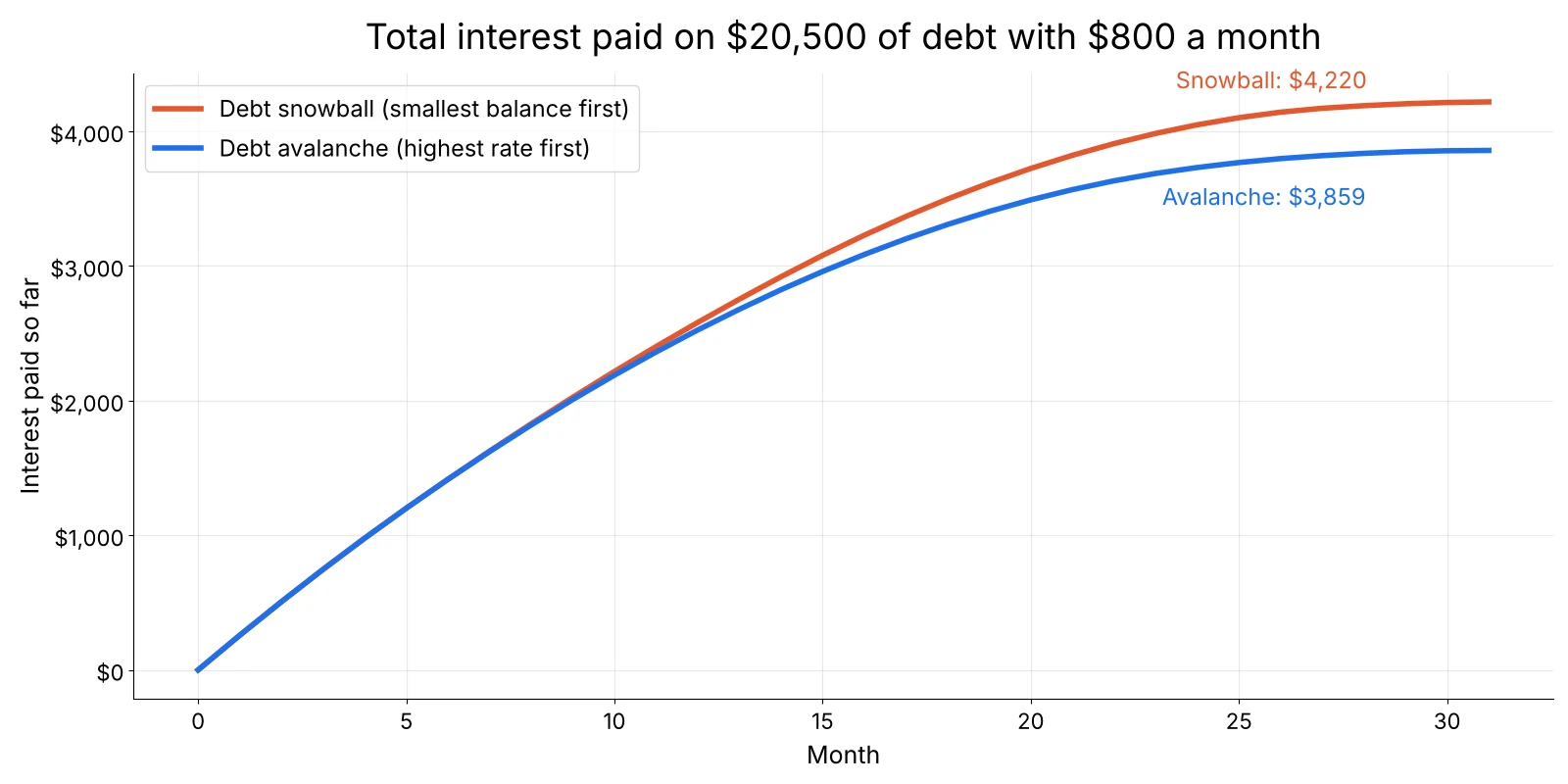
Look at month 14, though. The snowball borrower has already closed two accounts. The avalanche borrower has closed one and is still chipping at a $6,200 credit card. That feeling of progress is the whole case for the snowball.
Debt Snowball vs Debt Avalanche: Example Calculation 2
Now change the debts. This borrower has a small 0% medical payment plan and two expensive credit cards. Total debt is $22,200, minimums are $630 and the budget is $900 a month.
| Debt | Balance | APR | Minimum payment |
|---|---|---|---|
| Medical payment plan | $1,500 | 0% | $75 |
| Car loan | $7,000 | 6.90% | $210 |
| Credit card A | $9,500 | 27.24% | $240 |
| Credit card B | $4,200 | 22.90% | $105 |
| Result | Snowball | Avalanche |
|---|---|---|
| First debt paid off | Month 5 (medical plan) | Month 20 (medical plan, by minimums) |
| Credit card A paid off | Month 33 | Month 24 |
| Debt-free | Month 33 | Month 32 |
| Total interest paid | $7,110 | $5,715 |
Here the avalanche saved $1,395 and finished a month sooner.
The reason is simple. The snowball spent its first months paying off a debt that charged no interest at all. Meanwhile, Credit card A kept growing at 27.24%.
What to take from it: The more your small balances carry low rates, the more the snowball costs you. When your smallest debt is also your priciest, the two methods are nearly the same.
Debt Snowball vs Debt Avalanche Compared
| Factor | Debt snowball | Debt avalanche |
|---|---|---|
| Target order | Smallest balance first | Highest APR first |
| Interest paid | Same or more | Same or less |
| First account closed | Usually sooner | Sometimes much later |
| Works best when | Motivation is the problem | Discipline is not the problem |
| Main risk | Paying more interest | Giving up before the first win |
Behavior research backs both sides. A 2012 study of debt settlement clients showed that people who closed small accounts first were more likely to clear all their debt. On the other hand, the math never changes: interest on the highest rate grows fastest.
Which Is Better: Debt Snowball or Debt Avalanche?
Use these quick checks.
- Sort your debts both ways. If the smallest balance is also the highest rate, pick either. The result will be close.
- Find your 0% and low-rate debts. If a small debt charges 0% or under 7%, the snowball wastes months on it. Lean avalanche.
- Be honest about past attempts. If you started a payoff plan before and quit, the snowball’s early wins may be worth a few hundred dollars.
- Check the dollar gap. Run your own numbers. If the avalanche saves under $300 over three years, choose the plan you will stick with.
Many people use a hybrid. They clear one tiny balance first for the early win, then switch to the highest rate. In Example 2, that would still beat the pure snowball because the expensive cards get the extra cash sooner.
How to Calculate Debt Snowball and Avalanche in a Spreadsheet
You do not need special software. A simple sheet does it.
- List each debt with balance, APR and minimum payment.
- Add a monthly budget for all debt payments combined.
- Each month, add interest (balance × APR ÷ 12), subtract the minimum, then send the extra to the target.
- When a balance hits zero, move its minimum to the next target.
- Copy the sheet, sort the order the other way and compare total interest.
Run it once with the snowball order and once with the avalanche order. The difference is your real price for motivation.
How to Pay Off Debt Faster With Either Method
The order matters less than the extra payment. In Example 1, we reran both plans with different budgets.
| Monthly budget | Snowball: months / interest | Avalanche: months / interest |
|---|---|---|
| $700 | 38 / $5,778 | 37 / $5,035 |
| $800 | 31 / $4,220 | 31 / $3,859 |
| $1,000 | 24 / $3,011 | 24 / $2,722 |
Going from $700 to $1,000 a month saved about $2,700 in interest with the snowball. Switching methods saved at most $743. So find the extra $100 or $200 first, then worry about the order.
Other ways to cut the cost:
- Ask for a lower rate. Card issuers sometimes cut the APR for customers with a good payment record.
- Use a 0% balance transfer carefully. It can stop interest for a year or more, but most charge a fee of 3% to 5%. Our balance transfer vs personal loan comparison runs those numbers.
- Stop adding new debt. Neither plan works if the cards keep getting used.
Related reading: calculating EMI, how Fed rate changes affect your money and what reward points are worth.
Debt Snowball and Debt Avalanche: Common Questions
Which is better, debt snowball or debt avalanche?
The avalanche always costs the same or less in interest. The snowball often closes your first accounts sooner. Pick the avalanche if you trust yourself to stay on track, and the snowball if early wins keep you going.
Does the debt snowball hurt your credit score?
No. Paying debts on time helps your score, and so does lowering card balances. Closing paid-off card accounts can raise your utilization ratio, so many people leave old cards open with a zero balance.
Should a mortgage be part of the snowball?
Usually not. Most plans leave the mortgage out because it is large, long-term and low-rate. Focus on cards, personal loans and car loans first.
How much extra do I need for either method to work?
Any amount above the minimums helps. In our first example, an extra $215 a month cleared $20,500 in 31 months. With minimums alone, the same debts would take far longer and cost much more.