
A sinking fund is money you set aside each month for a cost you know is coming, such as car registration, holiday gifts or an annual subscription. Instead of paying a big bill all at once, you split it into small monthly amounts. When the bill arrives, the money is already waiting.
The math is simple: divide the expected cost by the number of months until it is due. After the formula, we share 20 sinking funds examples with sample amounts, grouped by type, so you can copy the ones that fit your life.
The Sinking Fund Formula
Every sinking fund uses one calculation:
| Step | What to do | Example |
|---|---|---|
| 1 | Estimate the cost | Holiday gifts: $900 |
| 2 | Count months until it is due | 10 months |
| 3 | Divide cost by months | $900 ÷ 10 = $90 a month |
| 4 | Add a small buffer | Round up to $95 a month |
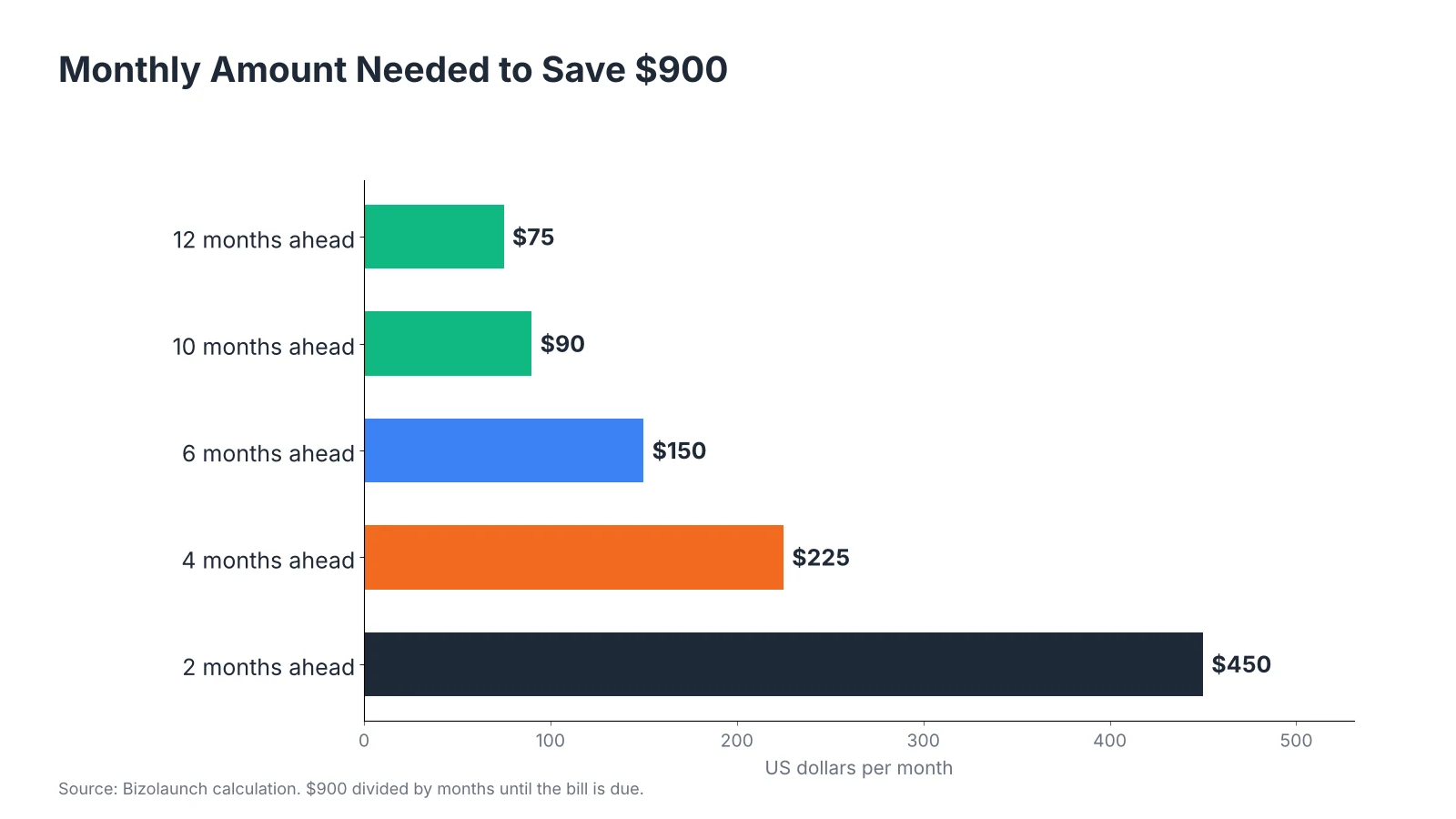
If you start late, the monthly amount goes up. For example, $900 saved over 4 months needs $225 a month instead of $90. That is the main lesson of sinking funds: the earlier you start, the smaller each payment.
Sinking Funds Examples for Your Car
Car costs are the most common surprise expense. These funds smooth them out:
| Sinking fund | Sample yearly cost | Monthly amount |
|---|---|---|
| Car maintenance and repairs | $1,200 | $100 |
| Registration and inspection | $240 | $20 |
| New tires (every 3 to 4 years) | $800 over 40 months | $20 |
| Car insurance (paid yearly) | $1,500 | $125 |
| Next car down payment | $6,000 over 5 years | $100 |
Sinking Funds Examples for Your Home
Homes create costs that do not show up every month:
| Sinking fund | Sample yearly cost | Monthly amount |
|---|---|---|
| Home repairs and maintenance | $1,800 | $150 |
| Property tax (if not in escrow) | $3,600 | $300 |
| Home insurance (paid yearly) | $1,440 | $120 |
| New appliances | $1,200 | $100 |
| Furniture and decor | $600 | $50 |
Sinking Funds Examples for Family and Kids
Family costs arrive on a calendar, which makes them easy to plan:
| Sinking fund | Sample yearly cost | Monthly amount |
|---|---|---|
| Holidays and gifts | $1,200 | $100 |
| Birthdays | $480 | $40 |
| Back to school | $600 | $50 |
| Summer camp and activities | $1,500 | $125 |
| Pet care and vet bills | $720 | $60 |
Sinking Funds Examples for Health and Personal Costs
These costs are easy to forget until they hit:
| Sinking fund | Sample yearly cost | Monthly amount |
|---|---|---|
| Medical deductible and copays | $1,200 | $100 |
| Dental and vision | $480 | $40 |
| Annual subscriptions and memberships | $360 | $30 |
| Travel and vacations | $2,400 | $200 |
| Clothing and shoes | $720 | $60 |
What 20 Sinking Funds Add Up To
Our 20 examples total $1,890 a month. That looks big, but no household needs every fund. More importantly, these costs exist whether you plan for them or not. A sinking fund does not add costs. It moves them from “surprise” to “planned.”
Our take: begin with three funds, not twenty. Pick the three costs that hurt most last year, usually car repairs, holidays and medical bills. Once those are running, add one new fund every month or two.
How to Set Up Sinking Funds
These steps work for any income:
- List last year’s surprise costs. Look at bank statements for bills over $100 that were not monthly.
- Estimate this year’s amount. Use last year’s cost, plus a little for price increases.
- Choose a due date. Write down the month each cost will hit.
- Do the math. Divide each cost by the months until it is due.
- Automate it. Set an automatic transfer on payday into a savings account.
- Spend from the fund only for its purpose. Holiday money is for holidays.
Sinking Funds When Your Income Changes Month to Month
Freelancers, commission earners and gig workers can still use sinking funds. The trick is to fund them by percentage instead of a fixed dollar amount.
For example, say your sinking funds need $400 a month on average, and your average take-home pay is $5,000. That is 8% of income. So in a $7,000 month you move $560, and in a $3,500 month you move $280. Over a year, the totals come out close to the plan.
There is one more rule we suggest for irregular earners. Fund the funds with the nearest due dates first. If car insurance is due in two months and holidays are eight months away, the insurance fund gets money before the holiday fund in a slow month.
We cover more ways to handle two paychecks of different sizes in our guide on how to budget with two sources of income.
Where to Keep Sinking Fund Money
You have three common options:
| Option | How it works | Good for |
|---|---|---|
| One savings account with a spreadsheet | All funds in one account, tracked by category in a sheet | Simple setups with 3 to 5 funds |
| Several savings accounts | One account per fund, often named in the banking app | People who like to see each balance |
| Budgeting app categories | The app tracks each fund inside your budget | Zero-based budgeters |
Keep sinking fund money in an insured savings account rather than investing it. These funds are for near-term costs, so stability matters more than growth.
Sinking Funds vs an Emergency Fund
People often mix these up. An emergency fund covers the unknown, such as a job loss or a sudden medical bill. A sinking fund covers the known, such as the car registration due every March.
Our take: you need both. Without sinking funds, normal yearly bills drain the emergency fund, and it is empty when a real emergency comes. For a full monthly plan that includes both, see our zero-based budgeting example for a family of four.
Sinking Funds Examples: Questions People Ask
What are good examples of sinking funds?
Common sinking funds include car repairs, holidays and gifts, back to school, medical deductibles, home repairs, annual insurance premiums, travel and pet care.
How do you calculate a sinking fund?
Divide the expected cost by the number of months until it is due. For example, $900 for holiday gifts in 10 months needs $90 a month.
How many sinking funds should I have?
Begin with three for your biggest irregular costs, then add more over time. Most households end up with 5 to 10.
Where should I keep my sinking funds?
Keep them in an insured savings account, either one account tracked with a spreadsheet or several accounts named for each goal.
Is a sinking fund the same as an emergency fund?
No. A sinking fund saves for a known future cost, while an emergency fund covers unexpected events like job loss.