
A zero-based budget gives every dollar of take-home pay a job, so income minus planned spending, saving and debt payments equals zero. It does not mean spending everything. It means savings and debt payments get their own lines, just like rent and groceries.
To make it practical, we built a full example for a family of four: two parents and two school-age kids with $6,500 a month in take-home pay. We used USDA food plan figures for the grocery line, and we added a second version for a tighter $5,000 month. Use the numbers as a starting point, then swap in your own bills.
How Zero-Based Budgeting Works for a Family
The rule is simple: take-home pay minus every planned dollar must equal zero. A family budget just has more moving parts, such as school costs, activities and irregular bills.
Follow these five steps each month:
- Write down take-home pay. Use what lands in your account, after taxes and payroll deductions.
- List fixed bills first. Rent or mortgage, insurance, phones and minimum debt payments.
- Add variable needs. Groceries, gas, utilities and household supplies.
- Fund goals. Emergency savings, sinking funds and extra debt payments.
- Assign the rest. Fun money, gifts and anything left until the total reaches zero.
If the total comes out negative, cut from the flexible lines before touching savings. If money is left over, give it a job, such as extra savings, rather than leaving it unassigned.
Zero-Based Budget Example: $6,500 a Month for a Family of Four
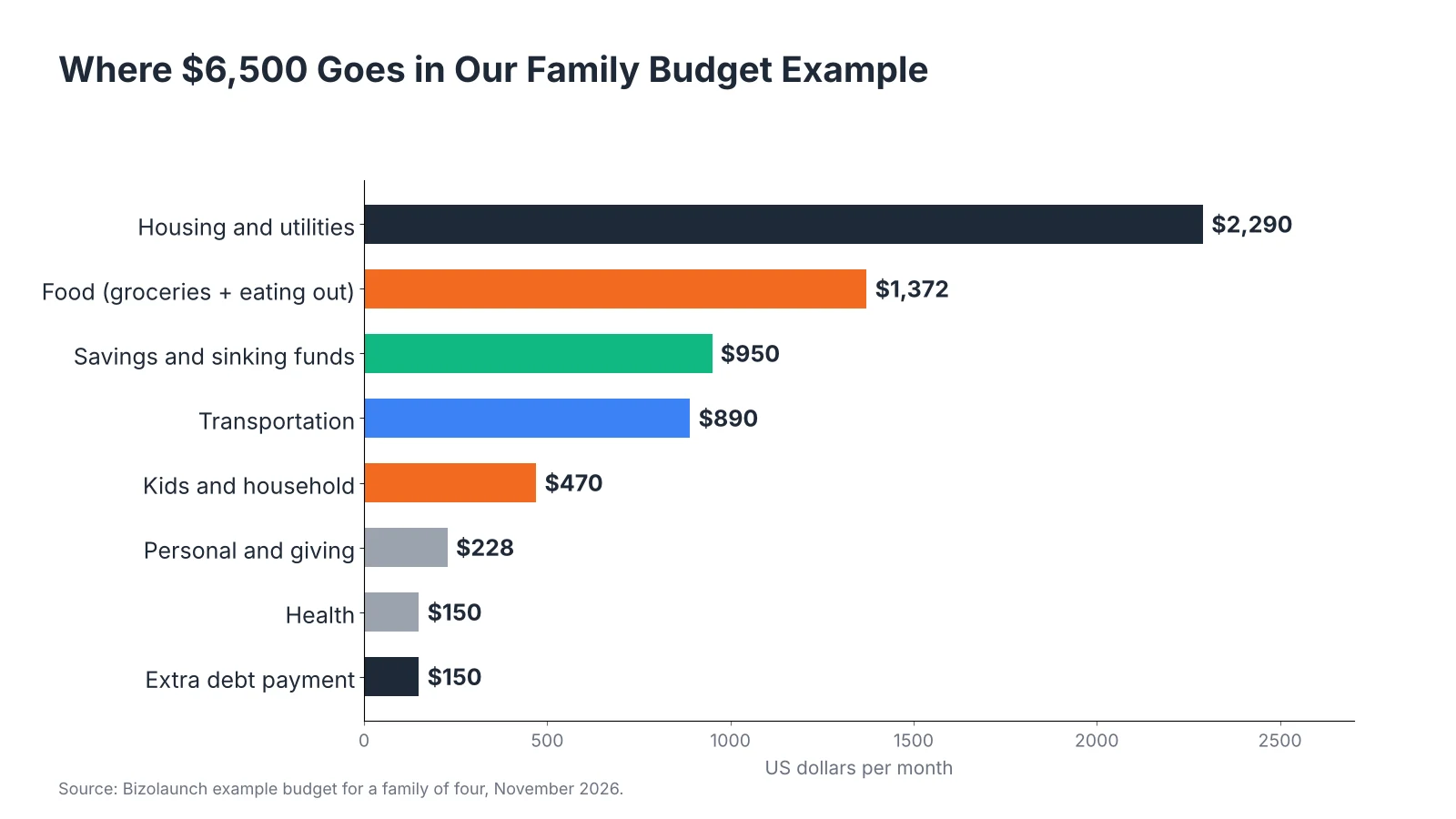
This example assumes two working parents, two kids ages 6 to 11, one car loan and a rented home. Every dollar has a line:
| Category | Monthly amount | Share of take-home pay |
|---|---|---|
| Rent | $1,850 | 28.5% |
| Utilities (power, water, gas) | $280 | 4.3% |
| Internet and phones | $160 | 2.5% |
| Groceries | $1,122 | 17.3% |
| Car payment | $420 | 6.5% |
| Gas and car maintenance | $260 | 4.0% |
| Car and renters insurance | $210 | 3.2% |
| Health costs (copays, prescriptions) | $150 | 2.3% |
| Kids’ activities and school costs | $200 | 3.1% |
| Household supplies and toiletries | $150 | 2.3% |
| Clothing | $120 | 1.8% |
| Emergency fund | $400 | 6.2% |
| Retirement savings (beyond payroll) | $200 | 3.1% |
| Sinking funds (car repairs, gifts, holidays, back to school) | $350 | 5.4% |
| Extra debt payment | $150 | 2.3% |
| Eating out and family fun | $250 | 3.8% |
| Personal spending money (two adults) | $200 | 3.1% |
| Giving | $28 | 0.4% |
| Total assigned | $6,500 | 100% |
Income $6,500 minus $6,500 assigned leaves $0. That is a balanced zero-based budget.
Where the Grocery Number Comes From
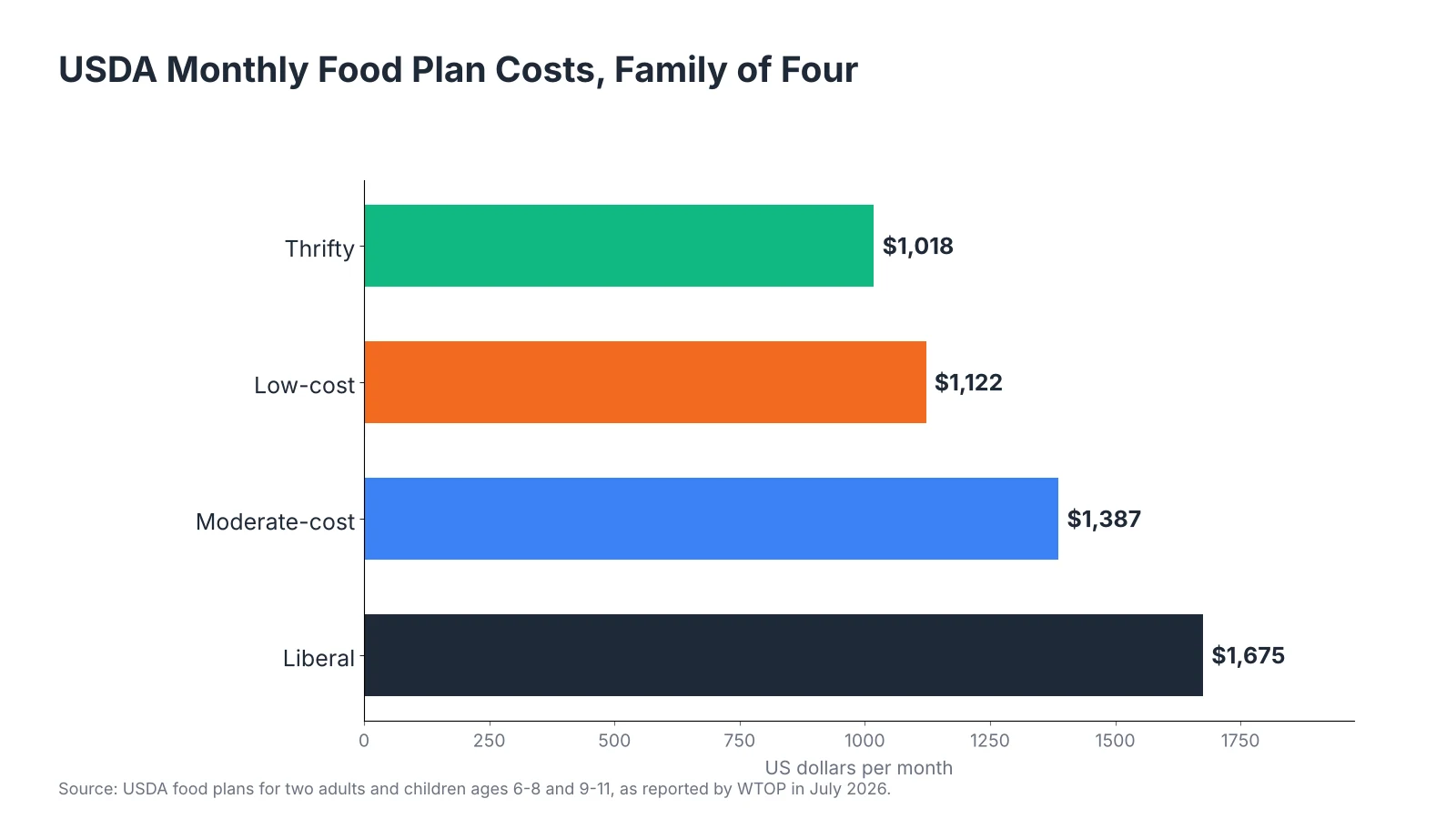
Groceries are the hardest line to guess, so we used the USDA food plans. For a family of four with two children ages 6 to 8 and 9 to 11, the USDA plan costs reported in July 2026 were:
| USDA food plan | Monthly cost for a family of four |
|---|---|
| Thrifty | $1,018.20 |
| Low-cost | About $1,122 |
| Moderate-cost | $1,386.70 |
| Liberal | $1,675.30 |
Our example uses the low-cost plan, at about $1,122. Notice that we kept eating out on a separate $250 line. Many families blow their budget because restaurant meals hide inside the grocery line.
A Tighter Version: $5,000 a Month
Not every month looks the same. If take-home pay drops to $5,000, the same family needs to cut $1,500. In a zero-based budget, you decide where the cut comes from instead of finding out at the end of the month.
| Category | At $6,500 | At $5,000 | Change |
|---|---|---|---|
| Rent | $1,850 | $1,850 | $0 |
| Utilities | $280 | $260 | −$20 |
| Internet and phones | $160 | $120 | −$40 |
| Groceries | $1,122 | $1,018 | −$104 (switch to the thrifty plan) |
| Car payment | $420 | $420 | $0 |
| Gas and maintenance | $260 | $230 | −$30 |
| Insurance | $210 | $210 | $0 |
| Health costs | $150 | $150 | $0 |
| Kids’ activities | $200 | $100 | −$100 |
| Household supplies | $150 | $120 | −$30 |
| Clothing | $120 | $40 | −$80 |
| Emergency fund | $400 | $150 | −$250 |
| Retirement savings | $200 | $0 | −$200 |
| Sinking funds | $350 | $200 | −$150 |
| Extra debt payment | $150 | $0 | −$150 |
| Eating out and fun | $250 | $80 | −$170 |
| Personal spending | $200 | $50 | −$150 |
| Giving | $28 | $2 | −$26 |
| Total | $6,500 | $5,000 | −$1,500 |
Our take: in a tight month, fixed costs barely move. Rent, the car payment and insurance stay the same, so almost all of the cut lands on savings, fun and flexible spending. That is why a family with a high fixed-cost share feels squeezed fastest. If your fixed bills are more than about 60% of take-home pay, the long-term fix is lowering a fixed bill, not trimming groceries.
Sinking Funds That Keep a Family Budget at Zero
Irregular costs break most family budgets. A sinking fund saves a little each month for a known future cost. In our example, the $350 sinking fund line splits like this:
| Sinking fund | Monthly amount | Saved in a year |
|---|---|---|
| Car repairs and registration | $100 | $1,200 |
| Holidays and birthdays | $100 | $1,200 |
| Back to school | $50 | $600 |
| Annual subscriptions and memberships | $40 | $480 |
| Medical deductible | $60 | $720 |
| Total | $350 | $4,200 |
When the December gift bill or a car repair arrives, the money is already there. As a result, the budget stays at zero without new debt. For more on this method, read our guide to sinking funds examples for monthly expenses.
Common Zero-Based Budgeting Mistakes Families Make
We see the same mistakes again and again:
- Budgeting gross pay. Always use take-home pay, after taxes and payroll deductions.
- Forgetting small subscriptions. Five $10 apps add $50 a month.
- No buffer line. Add $50 to $100 for “missed items” in the first three months.
- Skipping the monthly meeting. Both parents should agree on the plan before the month starts.
- Treating zero as a spending target. Savings lines count as assigned dollars.
Tools to Run a Zero-Based Family Budget
You do not need special software. A spreadsheet works, and so do budgeting apps that support giving every dollar a job. Choose a tool both parents will open each week. For a deeper look at debt lines, see our comparison of debt snowball vs debt avalanche, and if your household has unequal incomes, our guide on splitting household expenses on unequal incomes helps set fair shares.
Zero-Based Budgeting: Questions Families Ask
What is an example of a zero-based budget?
A family takes home $6,500 a month and assigns all $6,500 to bills, groceries, savings, sinking funds, debt and fun money, so income minus assigned money equals zero.
How much should a family of four spend on groceries?
USDA food plan figures reported in July 2026 put a family of four with two school-age children at $1,018.20 a month on the thrifty plan and $1,386.70 on the moderate-cost plan.
Does zero-based budgeting mean spending all your money?
No. Savings, emergency fund contributions and extra debt payments are assigned dollars. Zero means every dollar has a plan, not that every dollar is spent.
How often should a family do a zero-based budget?
Make a new budget before each month starts, because income and costs change. Check it once a week to adjust lines that run high.