In California, you cannot legally rekey a stranger’s front door for money until the state has run your fingerprints through both the Department of Justice and the FBI. Drive across the line into Arizona and no state locksmith license exists at all. That split shapes everything else about how to start a locksmith business in the US: first find out what your state demands, then get trained, insured and verified, and only then spend serious money on tools and ads.
The rest is a trade business like any other. You pick the services you are good at, set prices that cover your time on the road, and earn trust in a field where many customers have been burned before. Each of those steps is covered below.
13 Licensing States, California’s Fees and the ALOA Ladder
- Thirteen states license locksmiths: Alabama, California, Connecticut, Illinois, Louisiana, Maryland, Nevada, New Jersey, North Carolina, Oklahoma, Oregon, Texas and Virginia. New York City, Nassau County and two Florida counties add local rules.
- California charges a new locksmith company $275 to apply and $275 for the license, and each employee pays $60 to register, under fees that took effect on October 1, 2025.
- ALOA’s certification ladder starts at Certified Registered Locksmith (CRL) and climbs to Certified Master Locksmith (CML). It is voluntary in most places but counts toward the license in Louisiana, Alabama and Illinois.
- Google makes every US and Canadian locksmith pass Advanced Verification, including a live video call, before it will show the business in Local Services ads. Plan for 6 to 8 weeks.
- A lean, van-based start can run about $5,500 to $25,000 before the vehicle.
Check Whether Your State Licenses Locksmiths
Locksmith licensing in the US is a patchwork. Most states leave the trade alone, a handful run full licensing programs with background checks and exams, and a few cities and counties regulate it even where the state does not. Two states, Nebraska and Tennessee, repealed their locksmith laws in 2021.
The list below reflects state rules in 2024. Use it to find your starting point, then confirm the current rules and fees with the agency named, because programs change.
| State or area | Who regulates it | What the review notes |
|---|---|---|
| Alabama | Alabama Electronic Security Board of Licensure | Company, individual and qualifying agent fees, plus a background check |
| California | Bureau of Security and Investigative Services (BSIS) | Company license and employee registration, DOJ and FBI fingerprinting |
| Connecticut | Department of Consumer Protection | $200 application and $200 renewal |
| Illinois | Department of Financial and Professional Regulation | 20-hour approved course and a state exam |
| Louisiana | Office of the State Fire Marshal | 24 hours of continuing education every three years |
| Maryland | Department of Assessments and Taxation | $225 license or renewal |
| Nevada | County sheriff | Local work permit |
| New Jersey | Division of Consumer Affairs | $150 fee |
| North Carolina | North Carolina Locksmith Licensing Board | $438 to start, including the exam and records check |
| Oklahoma | Department of Labor | Separate individual, trainee and company licenses |
| Oregon | State licensing program | $60 test and $60 two-year license |
| Texas | Department of Public Safety, Private Security | Company license and individual registration |
| Virginia | Department of Criminal Justice Services | 18 hours of training |
| New York City, Nassau County (NY), Miami-Dade and Hillsborough (FL) | Local consumer protection offices | Local licenses with their own fees |
Pennsylvania is a special case. It has no locksmith license, but locksmiths who earn more than $5,000 a year there need a Home Improvement Contractor license. Everywhere else, you still need the ordinary paperwork: a business registration with your state, a local business license where your city requires one, and a sales tax permit if you sell locks and hardware.
California Uses Two Layers, and Sometimes Three
California is the most detailed program, so it is a good model of what licensing looks like. Under BSIS rules, any person or company that installs, repairs, opens or modifies locks, or cuts original keys, needs a Locksmith Company license. Simply duplicating existing keys does not count. Each owner, partner or officer goes through a Live Scan fingerprint check, and the application must name the manager who will run the business day to day.
Every employee who does locksmith work also needs a Locksmith Employee registration. After the application and fee go in, a worker gets a 120-day temporary registration, unless they have a criminal conviction on record. The BSIS fees changed on October 1, 2025.
| California fee | Before Oct. 1, 2025 | From Oct. 1, 2025 |
|---|---|---|
| Locksmith company, initial application | $250 | $275 |
| Locksmith company, initial license | $250 | $275 |
| Locksmith company, renewal | $500 | $550 |
| Branch office, initial application | $250 | $275 |
| Locksmith employee, initial application | $55 | $60 |
| Locksmith employee, renewal | $40 | $44 |
The third layer catches people out. If a single job site involves more than $500 of work, you also need a contractor’s license, such as the C-28 for locksmiths. Installing access control across an office floor can pass that line quickly.
Texas Treats Locksmiths as Part of the Private Security Industry
In Texas, locksmith companies are licensed by the Department of Public Safety’s Private Security program under Chapter 1702 of the Occupations Code, the same law that covers security guard companies and alarm installers. Individuals who work for a licensed company register separately. The training route is a 48-hour basic course or about 600 hours at an approved trade school plus a year of full-time work, with about two years of apprenticeship as another option. Company owners must also show proof of liability insurance and that applicants are fingerprinted through IdentoGo.
Illinois and New Jersey Tie the License to Proof of Skill
Illinois requires a 20-hour approved course and a state exam, and its licensing law is set to sunset in January 2029 unless lawmakers extend it. New Jersey licenses locksmiths through the Division of Consumer Affairs for a $150 fee. If you plan to work across a state line, for example from New York City into northern New Jersey, budget for both sets of rules.
Get Trained Through an Apprenticeship, a School or Both
Nobody needs a degree to become a locksmith, but you do need hands-on hours. Picking, impressioning, rekeying, master keying and car openings are physical skills, and you learn them fastest next to someone who already earns a living from them. Many new owners spend a year or two working for an established shop first. That time also teaches the parts nobody puts in a course, like how to price a job over the phone or what to do when a customer cannot prove they live at the address.
Trade schools and online programs fill the theory gaps and can shorten the path in states that count school hours toward a license. If you are in Texas, Illinois or Virginia, pick a course the state has approved.
From CRL to Certified Master Locksmith: ALOA’s Exam Ladder
The ALOA Security Professionals Association runs the best-known voluntary certification program in the US. Each level is earned by passing written exams in specific subjects, which ALOA calls electives. Each elective has 25 to 40 questions, and you can test at ALOA events, at a proctored test center or from home with a webcam proctor.
| ALOA credential | What it takes |
|---|---|
| Certified Registered Locksmith (CRL) | Mandatory exam plus any two electives |
| Certified Professional Locksmith (CPL) | CRL plus 12 more electives |
| Certified Master Locksmith (CML) | CPL plus 9 more electives |
| Certified Automotive Locksmith (CAL) | Entry automotive credential, leads to Certified Master Automotive Locksmith |
| Certified Professional Safeman (CPS) | Entry safe and vault credential |
| Certified Electronic Locksmith (CEL) | Entry electronic access credential |
| Certified Licensed Locksmith (CLL) | Required for licensing in Louisiana and Alabama |
Illinois applicants take ALOA’s L-00 exam along with L-07 (life safety codes) and L-13 (basic electricity). Outside those states, a CRL is still worth earning in your first year. It gives you something concrete to print on your van and quote to commercial buyers, and the study work fills gaps that on-the-job training leaves.
Choose the Work You Will Sell First
A new locksmith business does better with a narrow menu done well than with a long list it cannot deliver. The four main lines need different tools and attract different customers.
- Residential: Lockouts, rekeys after a move, new deadbolts and smart lock installs. The tools are affordable and the work is steady, which makes it the usual first line.
- Automotive: Car openings, key cutting and fob replacement. The programming equipment costs more, but each job is worth more, and fob replacement can run up to $500 for the customer.
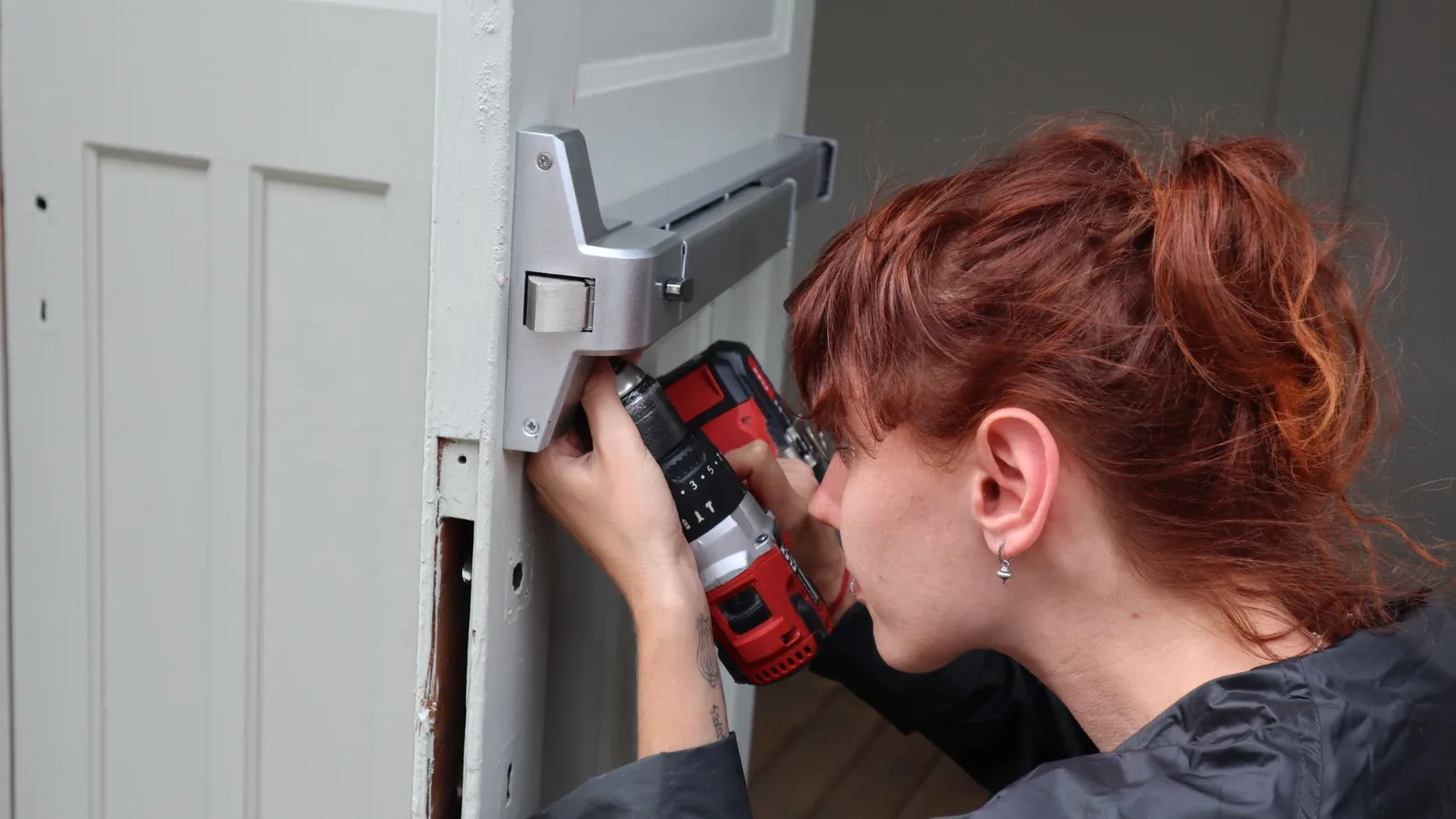
- Commercial: Master key systems, panic bars, door closers and access control for offices, schools and apartment buildings. It pays well and repeats, but buyers expect insurance certificates, references and sometimes a contractor’s license.
- Safes: Opening, servicing and moving safes. This is specialist work that most owners add later, once they have the training and the customer base.
Most solo founders start with residential work plus basic car openings, then add a line once they see what local customers ask for. Pick a name that will still fit when you grow; the free business name generator can help you test options before you file anything with the state.
Insure and Bond the Business Before the First Job
Insurance is not optional in practice, even where the law does not demand it. You work inside people’s homes and businesses, you hold their keys, and you sometimes drill their locks. Commercial clients and property managers will ask for a certificate of insurance before they send work.
General liability for a locksmith costs about $700 a year, and a business owner’s policy, which bundles liability with property cover, about $1,750 a year. Your own quote will depend on your state, payroll and the services you offer. Ask about these covers as well:
- Commercial auto: A personal car policy may not cover a vehicle used for business calls.
- Tools and equipment: Protects your key machines and programmers if they are stolen from the van.
- Workers’ compensation: Usually required once you hire employees, under state rules.
- Surety bond: Some cities and clients ask for one. A bond usually costs 0.5% to 10% of its face value each year, with the rate set by your credit.
Budget for Tools, a Vehicle and Launch Costs
Most locksmiths work from a van, not a storefront, so the vehicle is the biggest single cost. If you already own a reliable van or pickup, your launch budget drops sharply. The ranges below leave the vehicle out, because new owners either convert one they own or finance one separately.
| Startup cost | Low | High |
|---|---|---|
| Tools, equipment and supplies | $3,000 | $10,000 |
| Licensing and permits | $100 | $500 |
| Insurance (general liability to a business owner’s policy) | $700 | $1,750 |
| Website | $500 | $3,000 |
| Initial advertising | $200 | $5,000 |
| Early operating costs (fuel, uniforms, small tools) | $1,000 | $5,000 |
| Total before the vehicle | $5,500 | $25,250 |
An all-in estimate for a launch runs from $11,600 to $40,500. The gap between the two figures is mostly the vehicle, bigger tool kits and how much you spend on marketing in the first months.
Spend the tool budget in the order the work arrives. A good pick set, a plug spinner, a rekeying kit with pinning trays, a key duplicator and a set of car opening tools cover most residential and lockout calls. Leave the high-end automotive programmer until you have proof that car key jobs are coming in. Track every purchase from day one in a simple small business expense spreadsheet so your first tax return is not a shoebox of receipts.
Price Jobs So the Drive Pays for Itself
Locksmith pricing has two parts: a service call or trip fee that covers your time on the road, and the price of the work itself. These are typical US ranges for 2025.
| Service | Typical price |
|---|---|
| Labor during business hours | $50 to $100 per hour |
| House lockout | $75 to $200, plus trip fee |
| Car lockout, regular hours | $60 to $150 |
| Car lockout, night or weekend | $150 to $250 or more |
| Rekey, per lock | $15 to $40, plus trip fee |
| Deadbolt installation, per lock | $100 to $350 |
| Emergency or after-hours labor | $150 to $250 or more per hour |
| House key duplication | $15 to $40 |
Take a weekday house lockout. You quote $125 to open the door, and the owner, who has just moved in, asks you to rekey the front, back and garage entry doors at $25 each. That is $75 more, so the ticket comes to $200 for perhaps an hour on site. At that average, about 28 jobs would earn back the $5,500 low-end budget above. Run your own numbers through the break-even calculator once you know your fixed monthly costs, and use the hourly rate calculator to check that your labor rate covers unpaid driving and admin time.
Quote a firm price, or a narrow range, on the phone. Then confirm it in writing before you touch the lock. That single habit separates you from the operators who give a low number on the call and a much higher one at the door, and it is the fastest way to earn reviews in this trade.
Win Trust in a Trade With a Scam Problem
Customers who call a locksmith are often locked out, late and stressed. They tend to pick whoever answers first, and the trade has a reputation for operators who quote low on the phone and charge far more at the door. Many homeowners now check a locksmith carefully before they let one near the lock. The good news for an honest new shop is that proof of legitimacy is something you can build on purpose.
Pass Google’s Advanced Verification
Google requires every locksmith business in the US and Canada to pass Advanced Verification before it can appear in the Local Services ads unit. The process is separate from the Local Services background and license checks, so passing those does not exempt you.
You fill in a form with your Google Ads customer ID, business name, owner name, full address, phone number and a working website. If your area requires a locksmith license, you must hold it and list it. Then comes a live video call with a Google agent, during which you must be at your business location. Mobile locksmiths should have their work vehicle nearby, with official documents such as a business license on hand. Verification usually takes 6 to 8 weeks, and an appeal takes about as long, so start the moment your license and website are live.
Make Every Detail Checkable
Put your legal business name and, in licensing states, your license number on the van, your website, your invoices and your Google Business Profile. Use a real address, not a virtual office. Wear a uniform or ID badge. Ask customers for ID and proof of residence before you open a home, and explain why you are asking. A clean invoice with an itemized breakdown also helps, since a vague total is exactly what a suspicious customer is looking for.
Find Your First Customers Without Buying Leads
Emergency lockouts bring in cash, but repeat clients build a business. The most reliable early sources are people who need locks changed again and again.
- Property managers and landlords: Every tenant turnover needs a rekey. A manager running dozens of units is worth more than a hundred one-off lockouts. If you want to understand how these firms work and what they need from vendors, read our guide on how property management companies operate.
- Real estate agents: Buyers are often told to rekey after closing. Agents who hand out a trusted locksmith’s card make that easy.
- Small businesses and offices: Staff turnover means lost keys and master key changes. Offer a free lock survey and a written quote.
- Car dealers and repair shops: Used car lots need spare keys cut and programmed for cars that arrive with one key or none.
- Your Google Business Profile: Fill in every field, add real photos of your van and work, and ask each happy customer for a review on the spot.
Cold outreach to managers and agents works better with a short script you have practiced. Our sales call script examples show how to open a call, ask about their current vendor and set a next step without sounding pushy.
Certified vs Licensed, Training Time and Lockout Pricing
Do You Need a License to Be a Locksmith?
It depends on where you work. Thirteen states license locksmiths, including California, Texas, Illinois, New Jersey and North Carolina, and some cities and counties such as New York City and Miami-Dade have their own rules. In other states, you only need the normal business registration and local permits.
How Much Does It Cost to Start a Locksmith Business?
Tools, licensing, insurance, a website and early marketing come to roughly $5,500 to $25,000 before a vehicle. An all-in estimate, which allows for bigger kits and more marketing, is $11,600 to $40,500.
How Long Does It Take to Become a Licensed Locksmith?
It varies by state. Illinois requires a 20-hour approved course and an exam, Virginia requires 18 hours of training, and Texas offers a 48-hour course or about 600 school hours plus a year of work. Most new owners also spend a year or more working for an established shop.
What Is the Difference Between a Certified and a Licensed Locksmith?
A license is a legal permission from a state or city. Certification, such as ALOA’s CRL, is a voluntary credential that proves you passed exams in specific skills. In Louisiana and Alabama, ALOA’s Certified Licensed Locksmith exam is part of getting the license.
How Much Do Locksmiths Charge for a Lockout?
A house lockout typically costs $75 to $200 plus a trip fee, and a car lockout $60 to $150 during regular hours. Night and weekend car lockouts often run $150 to $250 or more.
Locksmith Ledger’s State Survey, BSIS Fee Sheets and Texas DPS
- Locksmith Ledger: Locksmith Licensing, 2024 Update (August 2024)
- California BSIS: Locksmith Company and Locksmith Employee Fact Sheet
- California BSIS: Fee Changes Effective October 1, 2025
- Texas Department of Public Safety: Private Security
- Texas Occupations Code, Chapter 1702
- Workiz: Locksmith License in Texas
- ALOA Security Professionals Association: Certifications
- Google Ads Help: About Advanced Verification
- Housecall Pro: How to Start a Locksmith Business
- HomeServe: How Much Does a Locksmith Cost? (June 2025)