Self-cleaning windows are ordinary windows built with a coated outer pane, so the choice that matters is the glass coating, not the frame brand. For most US homes the best option is Cardinal’s Neat+ glass, which window makers can add to their standard low-E units without changing the energy rating. Pilkington Activ has the longest track record and the clearest care instructions, and it suits skylights and conservatories as well as windows. In the UK and Europe, Saint-Gobain’s Bioclean is the one to ask about for roof glass. Vitro’s SunClean, once a fourth choice, was discontinued in late 2014.
We compared these coatings using the makers’ own technical pages and care bulletins. The aim is to show what each coating does, where it works well, where it does not, and what it can and cannot save you in cleaning bills.

Self-Cleaning Window Glass Brands Compared
We looked at five things for each coating: whether a homeowner can still buy it, how it works, what it does to the window’s energy numbers, what the maker says about how long it lasts, and how clear the care instructions are. Those are the questions that decide whether a coating keeps paying off after the first rainy season.
| Coating | Maker | How it works | Effect on energy ratings | Track record the maker cites | Best fit |
|---|---|---|---|---|---|
| Neat+ | Cardinal Glass (US) | Titanium dioxide breaks down dirt in sunlight; surface sheds static so less dust sticks | None; same U-factor and solar heat gain as the base low-E glass | More than 57 million Neat windows sold since 2006 | Standard US replacement and new-build windows |
| Activ Clear and Activ range | Pilkington (NSG Group) | Photocatalytic plus hydrophilic: sunlight loosens dirt, rain sheets it off | Combined with other glass types for insulation or solar control | Lasts as long as the glass under normal conditions; more than 10 million square meters sold | Hard-to-reach windows, skylights, conservatories |
| Bioclean and Bioclean+ | Saint-Gobain | Photocatalytic plus hydrophilic on the outer face | Paired with Planitherm low-E for a 1.0 W/m²K U-value; tinted versions cut solar heat | Sold mainly as roof and overhead glass in the UK | Roof lanterns, conservatory roofs, rooflights |
| SunClean | Vitro (formerly PPG) | Photocatalytic coating | Not applicable | Discontinued in the fourth quarter of 2014 | Only relevant if your home already has it |
How Titanium Dioxide Coatings Clean a Window
All the coatings above rely on a very thin layer of titanium dioxide on the outside of the glass. Pilkington’s layer is 20 to 30 nanometers thick and Cardinal’s is under 10 nanometers. That is far thinner than a human hair, which is why the glass looks the same as normal glass.
The cleaning happens in two steps. First, ultraviolet light in daylight starts a reaction that breaks down organic dirt, such as pollen, bird droppings and grime from traffic. Second, the surface becomes hydrophilic, which means it attracts water. Rain spreads into a thin sheet instead of forming droplets, and that sheet carries the loosened dirt away. Fewer droplets also means fewer dried water spots.
Cardinal adds a third effect with Neat+. Its coating is more conductive than bare glass, so it does not build up as much static charge, and less dust clings to it. Cardinal says an outside lab measured 40% less dust than on uncoated glass, and that Neat+ is 25% more photoactive than the original Neat.
Cardinal Neat+: The Easiest Self-Cleaning Upgrade for US Homes
Cardinal makes glass for many American window brands rather than selling windows itself, and that is the main reason Neat+ comes first for US buyers. The coating goes on in the same pass as Cardinal’s LoĒ coatings, so it can ride along with the low-E glass your window maker already uses.
The energy numbers do not change. Cardinal’s table shows Neat+ with LoĒ²-272 at 72% visible light and a 0.41 solar heat gain coefficient, and with LoĒ³-366 at 65% and 0.27, the same as the base products. The company says no new NFRC certification is needed. In plain terms, you can add self-cleaning without giving up the energy label that your local code or rebate program asks for.
Cardinal’s own advice to homeowners is to contact their window manufacturer or architect, because Neat+ is ordered as a glass option on a new window. When you get a quote, ask the dealer to name the coating on the order so you know you are getting Neat+ and not only a low-E pane.
Pilkington Activ: The Longest Record and the Best Care Guide
Pilkington Activ was the first commercial self-cleaning glass, announced in 2001. Pilkington describes Activ Clear as an on-line coated glass with photocatalytic and hydrophilic properties, aimed at large areas such as conservatories and hard-to-reach spots such as skylights. Pilkington says the coating lasts as long as the glass under normal conditions, and that north-facing windows still get enough UV light for it to work.
Activ comes in several versions, including Activ Blue, Activ SunShade and Activ Suncool for solar control, plus Insulight Activ double-glazed units. That range matters if your sunny rooms overheat. You can get self-cleaning and heat control in one pane, instead of choosing between them.
Where Pilkington is most helpful is its care guidance. Pilkington says dirt spots usually disappear within about a week of normal weather, and it gives the most detailed list of what not to do, which we cover further down.
Saint-Gobain Bioclean for Roof Lanterns and Conservatories
Bioclean is Saint-Gobain’s second-generation self-cleaning glass, launched in 2003. In the UK it is sold mostly as roof glass for rooflights, roof lanterns, conservatories and atria, and the coating works best on a slope. In a double-glazed unit, Bioclean sits on the outer face and Planitherm One T low-E sits on face 3, giving a U-value of 1.0 W/m²K for every version.
The tinted versions also control heat. In Saint-Gobain’s table, the Mariana grey unit lets in only 7% of visible light with a g-value of 0.08, while the clear Natura+ lets in 38% with a g-value of 0.30. For a south-facing conservatory roof, that heat control is often worth as much as the cleaning.
Which Windows in a House Gain the Most From Self-Cleaning Glass
Self-cleaning glass does not help every window equally. It needs daylight and rain on the outside surface, so placement decides most of the benefit. We sorted typical spots in a home using the makers’ own guidance.
| Window location | Benefit | Why |
|---|---|---|
| Skylights and roof lanterns | High | Hard to reach, full sun and rain; Pilkington and Saint-Gobain both target these first |
| Upper-floor windows | High | Ladders cost time or money; rain reaches them |
| Conservatory roofs | High | Large area; a pitch of at least 10° lets water run off |
| Ground-floor windows in open walls | Medium | Easy to hose, so the saving is smaller |
| Windows under deep eaves or porches | Low | Little rain reaches the glass to rinse it |
| Coastal homes facing the sea | Medium | Salt is not organic, so the coating cannot break it down; hosing still clears it more easily |
| Shower screens and inside faces | None | The coating is for outside glass; the inner face still needs normal cleaning |
A rule of thumb follows from this. If a window is cheap to reach and well sheltered, plain glass with good low-E is fine. If it is high, sloped or open to the weather, the coating earns its place. Homeowners in rainy northern climates gain more than those in dry, dusty areas, where the glass will need hosing in long dry spells anyway.

What Self-Cleaning Glass Can Save on Window Cleaning Bills
Cleaning costs add up over the life of a window. A professional window-cleaning visit costs $150 to $300 per session, with at least one a year. We multiplied that range by 10, 20 and 30 years of ownership, keeping prices flat.
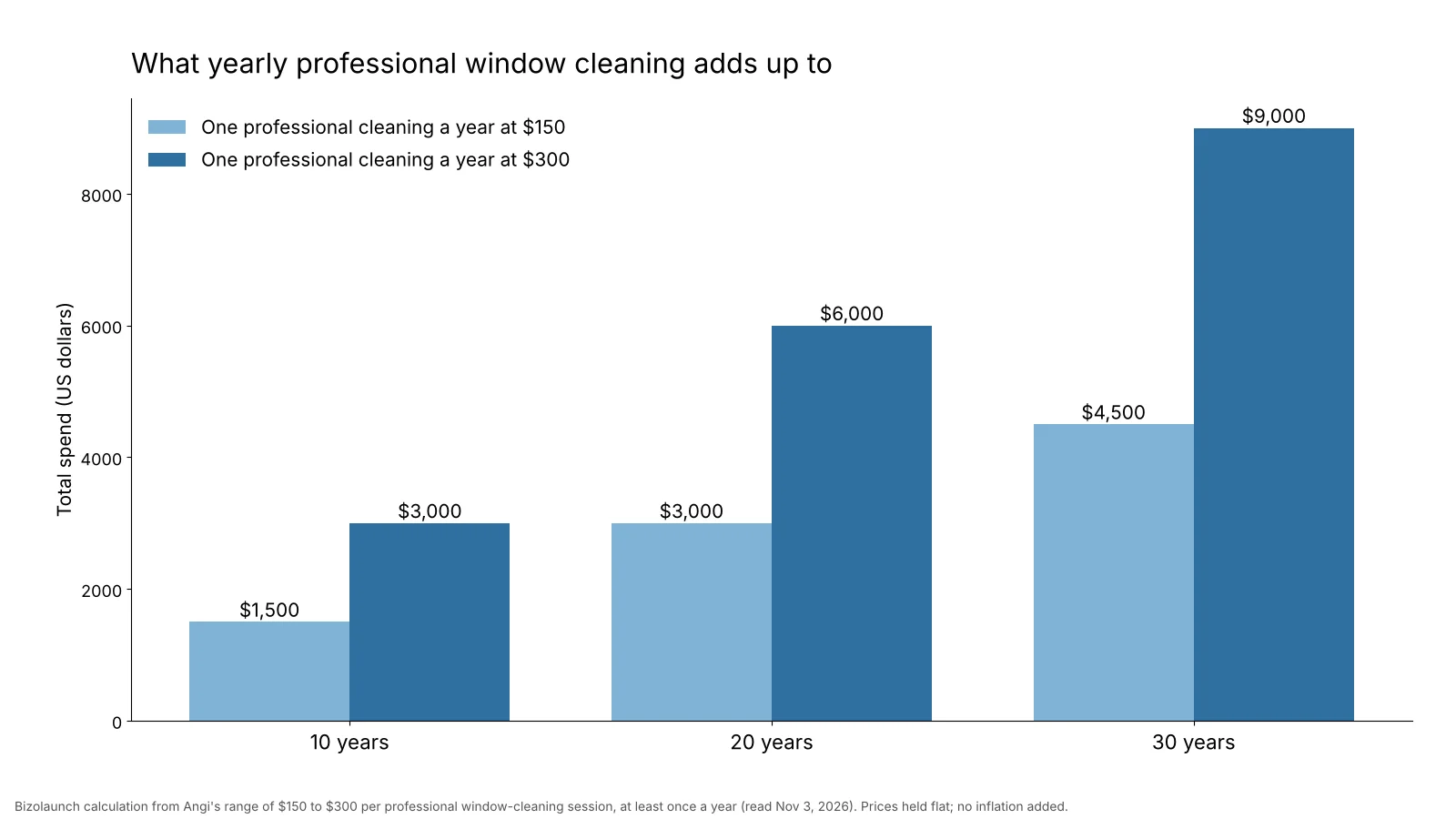
Over 20 years, one visit a year costs $3,000 to $6,000. Now take a cautious scenario: say the coating lets you skip one professional visit in every two. That would save $1,500 to $3,000 over 20 years. This is an illustration, not a measured result, and the real figure depends on your climate and how fussy you are about streaks. Remember too that the inside faces still need cleaning, so a visit is rarely skipped entirely.
The makers we checked do not publish a price premium for coated glass, so ask for it as a separate line on every window quote. Divide that extra cost by the yearly cleaning you expect to save, and you get a payback period in years. Our break-even calculator does the same sum if you would rather not work it by hand. For landlords, the saving is easier to see: one fewer ladder job per building per year is real money across a portfolio, which is why it is worth raising when you run a property management business.
Cleaning Rules That Keep the Coating Working
A self-cleaning coating can be damaged by the wrong tools, and most problems people report trace back to cleaning habits. Pilkington’s bulletin is specific, and its advice is a safe default for any titanium dioxide coating unless your window maker says otherwise.
- In dry spells: hose the glass with clean water to shift dust, salt or droppings. No rubbing or squeegee is needed.
- For hand cleaning: use a mild glass cleaner such as Windex or a vinegar and water mix, a lint-free cloth, then a rinse with soft water.
- With hard water: rinse with soft or distilled water, or add two to three drops of dish soap per half liter.
- Never use: razor blades, steel wool or other metal on the coated side, or abrasive cleaners such as Bon Ami, cerium oxide or Soft Scrub.
- Watch out for building work: Plaster, rust, adhesives and silicone-lubricated sealants can mask or damage the coating, so rinse the glass after any work nearby.
If someone else cleans your windows, tell them which panes are coated. Window cleaners often use scrapers to lift stubborn spots, and that one habit can scratch the coating. If you run a cleaning firm, adding coated-glass care to your service list is a small but useful skill for anyone starting a cleaning business in the UK or running a pressure washing business in Florida, where high-pressure jets and harsh chemicals near coated glass need extra care.
After a detergent or solvent clean, the coating may need several days of daylight to start working again, Pilkington adds. New glass that sat in a warehouse can also take up to seven days to fully activate, so do not judge it in the first week.
Sprays, Films and Other Ways to Add Self-Cleaning Later
Many homeowners ask whether they can make their current windows self-cleaning. Pilkington says its coating is applied when the glass is made and that no spray-on film does the same job. Be careful with anything that leaves a film behind. Silicone left on the glass makes rain bead into droplets, which is the opposite of what a hydrophilic coating needs.
So the real moment to choose self-cleaning glass is when you replace windows or build. If you are planning other glass upgrades at the same time, our guide to what smart glass windows cost covers switchable privacy and tinting glass, which can be ordered on some of the same projects.
Six Questions to Put to a Window Dealer Before You Order
Because the coating is ordered as a glass option, the dealer’s paperwork is where mistakes happen. These questions come straight from the gaps we found in the makers’ pages, and a good dealer should answer each one in writing.
- Which coating is it, by name? “Easy-clean glass” can mean many things, so ask for Neat+, Activ or Bioclean to be printed on the order.
- Which panes get it? Ask for the coating on the windows that gain most, such as upper floors and skylights, rather than paying for it on sheltered ground-floor glass.
- What is the extra cost per window? Get it as its own line so you can work out the payback.
- Do the energy ratings change? With Neat+ they should not, and the NFRC label should match the plain low-E version.
- What does the warranty say about cleaning? Some warranties exclude damage from blades or abrasive cleaners, so keep the care sheet.
- What sealants will the installer use? Silicone-lubricated sealants and gaskets can mask the coating’s action.
If you are buying an older house, it is also worth asking the seller or the original builder what glass was used. Homes built before 2015 may have Vitro SunClean or an early Neat or Activ coating, and the same no-blades care rules apply to them.
Homeowner Questions About Windows That Clean Themselves
Do Self-Cleaning Windows Really Work?
They work on organic dirt on the outside of the glass when the window gets daylight and rain. They do not clean the inside, they struggle under deep overhangs, and they cannot break down salt or mineral deposits, which still need a rinse.
How Long Does a Self-Cleaning Coating Last?
Pilkington says Activ lasts as long as the glass under normal conditions. The main risk is physical damage from blades, steel wool or abrasive cleaners, so care habits matter more than age.
Does Self-Cleaning Glass Affect Energy Efficiency?
Cardinal says Neat+ leaves U-factor, solar heat gain and visible light unchanged, so no new NFRC rating is needed. Pilkington and Saint-Gobain sell versions combined with low-E or solar control glass.
Which Window Brands Offer Self-Cleaning Glass?
Glass makers supply the coating to window companies, and the options vary by product line and region. Cardinal advises asking your window manufacturer or architect for Neat+, so ask each dealer to name the coating on the quote.
Glass Maker Pages and Care Bulletins We Checked
- Maker pages: Cardinal Neat+, Pilkington self-cleaning windows, Pilkington general FAQ, Saint-Gobain Bioclean, Vitro discontinued products.
- Care and background: Pilkington maintenance and hand cleaning bulletin, Glass Times, self-cleaning glass product history.
- Cleaning cost input: Angi.