Smart glass windows cost about $50 to $150 per square foot in the US, depending on the technology, and a single installed window usually lands between $1,000 and $4,000. Switchable smart film stuck onto existing glass is the cheapest route at roughly $25 to $55 per square foot. Electrochromic glass, the kind that tints slowly like sunglasses, sits at the top. Using one Los Angeles installer’s published price list, we worked out that a single 6-square-foot bathroom window costs about $1,520 with film, while ten average windows cost about $8,440.
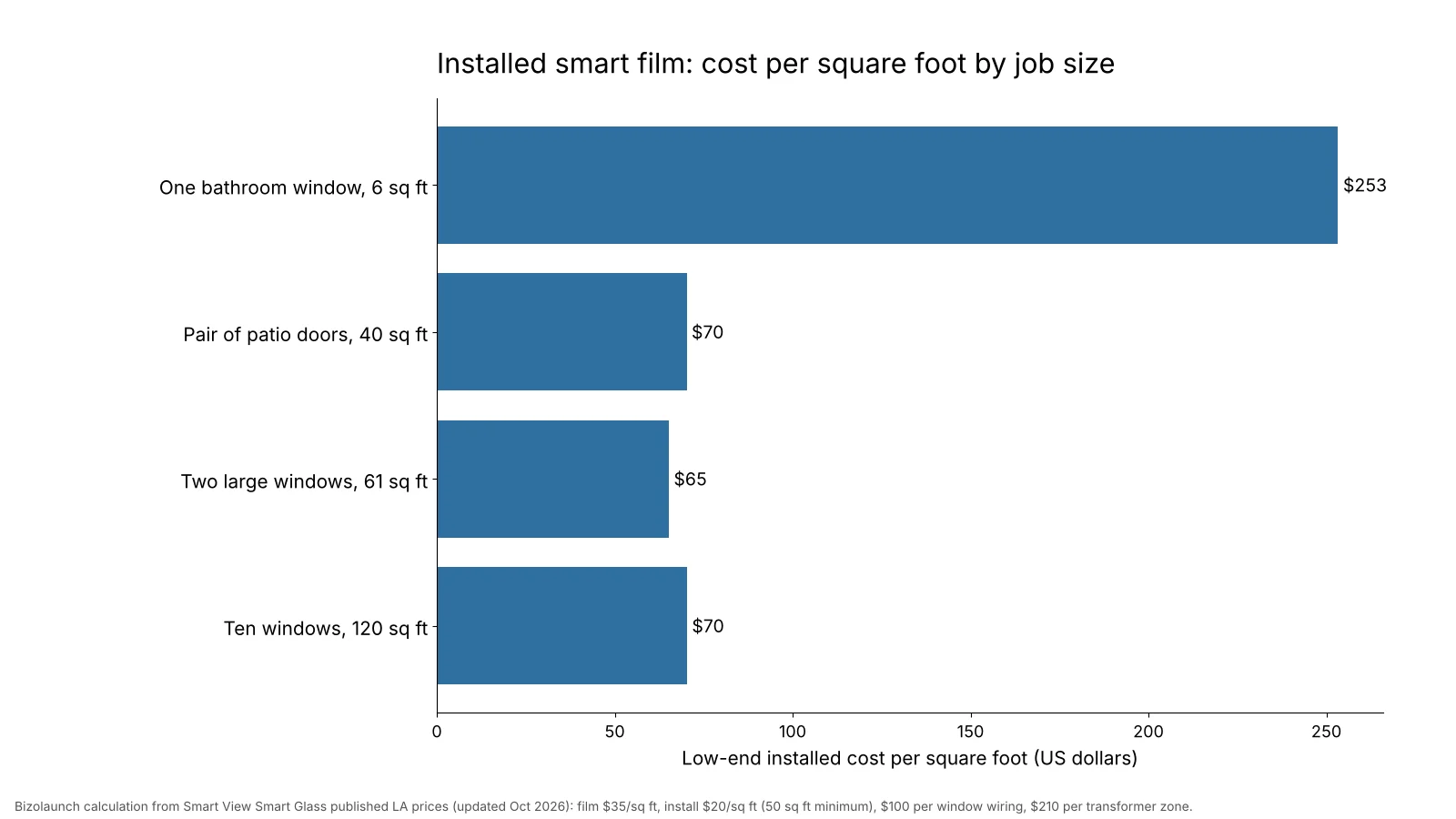
That gap between small and large jobs is the most useful thing to know before asking for quotes. Fixed costs for wiring and power supplies mean one small window can cost over $250 per square foot, while a whole room drops to about $65 to $70. Every figure below is dated, and the math is shown so you can redo it for your own windows.

Smart Glass Window Prices by Technology
Smart glass is a family of products rather than one thing, and the price follows the technology. PDLC (polymer dispersed liquid crystal) glass and film switch from frosted to clear in under a second. SPD (suspended particle device) glass dims smoothly from dark to clear. Electrochromic glass tints over several minutes and holds that tint without power. Each has its own price band, and three widely read cost guides broadly agree on the order from cheapest to most expensive.
| Technology | National cost guide A (installed) | National cost guide B (installed) | California installer, March 2026 (materials) |
|---|---|---|---|
| Smart film retrofit (PDLC) | $25 to $50 per sq ft | $25 to $55 per sq ft | $25 to $55 per sq ft |
| PDLC laminated glass | $85 to $130 per sq ft | $85 to $150 per sq ft | $50 to $100 per sq ft |
| SPD glass | $50 to $150 per sq ft | $80 to $130 per sq ft | $80 to $150 per sq ft |
| Electrochromic glass | $50 to $100 per sq ft | $90 to $120 per sq ft | $50 to $100 per sq ft |
| Plain low-E double pane, for comparison | Not listed | Not listed | $15 to $25 per sq ft |
The ranges come from two national cost guides and a licensed California window contractor. The national average is about $100 per square foot with labor. Orders over 100 square feet tend to cost $70 to $100 per square foot, while small single-unit orders run $130 to $150.
Compared with ordinary double glazing, the premium is large. On the California contractor’s figures, electrochromic glass costs roughly two to nearly seven times as much per square foot as a good low-E double pane. Most of that extra money pays for the switching layer, the electrical connections and the controls, rather than for better insulation.
One Installer’s Published Price List, Line by Line

Cost guides give broad ranges, and installers rarely publish exact prices, so one installer’s price list is useful. Smart View Smart Glass, a Los Angeles company based in Canoga Park, lists these line items:
| Line item | Published price (October 2026) |
|---|---|
| Self-adhesive PDLC smart film, custom cut | From $35 per sq ft |
| Film installation | From $20 per sq ft, 50 sq ft minimum for on-site jobs |
| Laminated smart glass panels | From $100 per sq ft, installation quoted after measuring |
| Busbar and wire connections | $100 per window |
| Transformer with receiver and remote | $210 to $636 per switching zone |
| Single small window, fully installed | From about $1,500 |
| Two large windows, 61 sq ft | $3,975 plus tax |
We checked whether the individual line items add up to the company’s own published examples, and they do. For the two-window, 61-square-foot job: 61 x $35 for film plus 61 x $20 for labor is $3,355. Add $100 per window for wiring ($200) and two $210 transformers ($420), and you get $3,975, exactly the figure on the page. That gave us a tested pricing model that we could apply to other typical homes.
Four Homes, Four Smart Glass Budgets
We ran four common projects through that model in Python. The formula is: (square feet x $35) + (the larger of square feet or 50, x $20) + ($100 x windows) + (transformer cost x zones). The low column uses the $210 transformer and the high column the $636 one. A zone is a group of windows that switch together on one power supply.
| Project | Glass area | Windows / zones | Installed total | Cost per sq ft |
|---|---|---|---|---|
| One bathroom window, 24 x 36 in. | 6 sq ft | 1 / 1 | $1,520 to $1,946 | $253 to $324 |
| Pair of patio doors, 36 x 80 in. each | 40 sq ft | 2 / 1 | $2,810 to $3,236 | $70 to $81 |
| Two large living room windows | 61 sq ft | 2 / 2 | $3,975 to $4,827 | $65 to $79 |
| Ten windows, 36 x 48 in. each | 120 sq ft | 10 / 4 | $8,440 to $10,144 | $70 to $85 |
Our bathroom figure of $1,520 lines up with Smart View’s “from about $1,500” for one small window, which is a good sign the model holds. Sales tax, smart-home hookups and hard-to-reach glass all add to these totals, and prices outside Los Angeles will differ.
To see what the same ten windows would cost as factory-made glass, the math changes. At $100 per square foot, 120 square feet of laminated smart glass is $12,000 for the panels alone, before installation. A fully installed electrochromic window costs $1,500 to $4,000 or more, so ten of them would run $15,000 to $40,000.
Smart Glass Prices for Showers, Skylights and Partitions
Windows are only one place where homeowners use switchable glass. Installed price ranges for the other common spots show how much the location changes the bill, mainly because of access, glass thickness and the need for tempered or laminated safety glass.
| Where the smart glass goes | Installed price range | What drives the price |
|---|---|---|
| Bathroom window | $200 to $600 | Small area; film on existing glass is common |
| Living room window | $1,000 to $3,600 | Larger panes and often a separate zone |
| Switchable shower door | $1,300 to $2,700 | Tempered safety glass and sealed wiring near water |
| Skylight | $500 to $8,000 | Roof access, size and whether the frame is replaced |
| Office partition wall | $2,000 to $7,000 | Large laminated panels and floor-to-ceiling framing |
The low end of the bathroom range is well below the $1,520 our model gives for a fully installed small window in Los Angeles. The difference most likely comes from DIY film or a job folded into larger work, since some film price ranges include do-it-yourself jobs. If you are handy, self-adhesive film is the one part of this market where your own labor can cut the bill by hundreds of dollars, although you still need the busbars and a transformer.
Skylights deserve a special word. They let in a lot of summer heat, and a tinting skylight is one of the few places where electrochromic glass can pay back part of its cost in comfort. The wide $500 to $8,000 range reflects how different a simple film job is from replacing a large roof unit with factory-made dynamic glass.
Why One Small Smart Window Costs So Much per Square Foot
Three costs barely change with window size. The installer has to come out (hence the 50-square-foot labor minimum), every pane needs busbars and a wire run, and every zone needs its own transformer. On a 6-square-foot window, those fixed parts are $1,310 of the $1,520 total. The adhesive film itself accounts for only $210 of the total.
The budgeting lesson that follows from this is straightforward. If you want smart glass in one bathroom now and a home office later, doing both in one visit is cheaper than two separate jobs. Putting several windows in one room on a single zone also saves a transformer, as long as you are happy for them to switch together. You can use our percentage calculator to see how much of any quote goes to fixed costs rather than glass.
Smart Film Retrofit, Laminated PDLC or Electrochromic Glass
The cheapest option is not always the right one. Each type behaves differently once it is in your wall.
- Smart film on existing glass: the lowest price and no window replacement. PDLC film needs power to stay clear, so it turns frosted in a power cut. It is mainly a privacy product, best for bathrooms, street-facing rooms and glass partitions.
- Laminated PDLC glass: the same switching layer sealed between two panes, so it is better protected from scratches and cleaning. Kolbe, a US window maker, launched smart privacy glass for single-family homes in 2023 with Gauzy, offered in its VistaLuxe, Ultra and Forgent lines.
- Electrochromic glass: it dims to block heat and glare rather than to give privacy. It holds a tint without constant power and switches in 5 to 20 minutes. If the electronics fail, it still works as a normal insulated window.
A useful way to decide is to name the problem you are solving. If the problem is neighbors seeing in, PDLC film or laminated PDLC glass does the job at the lowest cost, and the frosted state is the feature you are paying for. If the problem is a hot west-facing room or glare on a screen, you need glass that blocks solar heat, which points to electrochromic or SPD glass and a much bigger budget. Buying privacy film to fix heat, or electrochromic glass to fix privacy, is the most common way to spend money on the wrong product.
In SageGlass, Saint-Gobain’s electrochromic brand, a small charge moves lithium ions through five thin ceramic layers. A typical double-glazed unit ranges from about 60% visible light when clear to about 1% when fully tinted. The brand’s examples are mostly offices, airports and campuses, so homeowners will usually reach it through an architect or a commercial glazier, with quote-based pricing.
What Switchable Windows Add to the Electric Bill
Running costs are small compared with the purchase price. A 10 to 15 square foot PDLC window draws about 5 to 7 watts while it is clear. We multiplied that by hours per day and 365 days, then by the US average residential price of 18.16 cents per kWh for January to June 2026.
| Power draw while clear | Clear 8 hours a day | Clear 12 hours a day | Clear all day |
|---|---|---|---|
| 5 watts | 14.6 kWh, $2.65 a year | 21.9 kWh, $3.98 a year | 43.8 kWh, $7.95 a year |
| 7 watts | 20.4 kWh, $3.71 a year | 30.7 kWh, $5.57 a year | 61.3 kWh, $11.14 a year |
Even in the worst case, with the glass kept clear around the clock, one window costs about $11 a year to run. Your own rate may be higher or lower, and our post on the average electricity bill by state shows how much prices vary. Electrochromic glass draws power only while it changes, so its running cost is lower still. SageGlass says 3,000 square feet of its glass uses less power than a typical home internet modem.
Energy savings are harder to promise, because they depend on climate, orientation and how you use the glass. Tinting glass cuts solar heat in summer, and a home energy management system can show you whether your cooling use actually drops after the install. PDLC privacy film is not designed to block much heat, so treat any savings from it as a bonus.
Tax Credits and Energy Codes for Dynamic Glazing
Some older cost guides still mention the federal Energy Efficient Home Improvement Credit. That credit applied to qualifying property placed in service from January 1, 2023 and before December 31, 2025, with windows and skylights capped at $600. A smart window installed in late 2026 does not fall in that window of time, so check state and utility rebates instead.
Local building codes are the other thing to check before you sign a contract. In California, Title 24 does not require smart glass, and electrochromic glass in its clear state (solar heat gain coefficient 0.41) is above the prescriptive limit of 0.23 in many climate zones. It can still be approved through the performance path, which uses an energy model. Ask your installer to confirm this before you order, not after.

Brands You Will Meet When Getting Smart Window Quotes
Gauzy makes PDLC film and glass and works with local fabricators in many US cities. Its pricing is quote-based. SageGlass leads in electrochromic glass for large buildings. View, another electrochromic maker, went through Chapter 11 in 2024 and came out focused on commercial work. Halio and Gentex are smaller electrochromic names you may see in specifications.
For most homes, the real choice is between a local film installer and a window maker that offers smart glass as an option. Get at least two quotes, and ask each one to split out film or glass, labor, wiring and transformers, so you can compare them line by line against the table above. Landlords pricing an upgrade across several units can fold these costs into the plans in our guide to starting a property management business.
Ways to Bring a Smart Window Quote Down
- Group the work: doing 50 square feet or more in one visit avoids paying the labor minimum on a tiny job.
- Share zones: windows in the same room can often run off one transformer, which saves $210 to $636 each.
- Use film on sound glass: if your windows are in good shape, film costs a fraction of new laminated glass.
- Skip what you do not need: a wall switch or remote is included in many quotes; full smart-home integration costs extra.
- Pair with other glass work: if you are replacing windows anyway, compare smart glass with self-cleaning window glass so the new panes earn their keep.
Homeowners’ Questions on Smart Window Pricing
How Much Does It Cost to Make an Existing Window Smart?
With adhesive smart film, expect about $1,500 for one small window installed, based on Smart View’s published prices. Larger jobs fall to about $65 to $85 per square foot including wiring and transformers.
Is Smart Glass Worth It for a House?
It is easiest to justify where curtains or blinds are a problem: bathrooms, glass doors, skylights and street-facing rooms. As a pure energy upgrade it is expensive, since good low-E glass costs a fraction of the price per square foot.
Does Smart Glass Work in a Power Outage?
PDLC film and glass go frosted without power, so you keep privacy but lose the view. Electrochromic glass holds its last tint and still insulates like a normal window.
How Long Does Smart Glass Last?
Electrochromic glass typically carries a 10-year warranty on the electrochromic function, a 20-year warranty on the sealed glass unit, and 30,000 to 50,000 tint cycles. Smart View lists one year on film and two years on smart glass, so read each warranty before you sign.
Price Pages and Official Data Behind These Estimates
- Installer and maker pages: Smart View Smart Glass cost page (updated October 2026), SageGlass, Gauzy, Colfax Glass (March 18, 2026).
- Cost guides: Angi and HomeGuide.
- Official data: EIA Electric Power Monthly, Table 5.3 and the IRS Energy Efficient Home Improvement Credit page. Product news: Pro Builder on Kolbe (August 2023).