Form 1099-DA is the IRS information return that US crypto brokers now send to you and to the IRS when you sell, swap or spend digital assets through them. For sales made in 2025, the form shows only your gross proceeds. For assets bought in a custodial account from January 1, 2026 onward, it also shows your cost basis, which means the IRS can compare your reported gain with the broker’s figures line by line.
That comparison is the reason the form matters. Before 1099-DA, a crypto trader’s exchange records rarely reached the IRS in a standard format. Now they do, and a sale that shows up on a broker’s 1099-DA but not on your Form 8949 is the kind of gap that triggers a notice. The first forms reached customers in February 2026, and plenty of people found numbers that did not match their own records. Most of those gaps have ordinary causes, which this guide works through with real form boxes and dollar examples.
Gross Proceeds From 2025, Basis From 2026 and New 8949 Boxes
- Brokers report gross proceeds for digital asset sales made on or after January 1, 2025, and cost basis for covered assets sold on or after January 1, 2026.
- Only custodial US brokers such as centralized exchanges must file. Congress repealed the separate DeFi broker rule in April 2025.
- Brokers may skip qualifying stablecoin sales that total $10,000 or less a year and specified NFT sales of $600 or less, but you still owe tax on any gains.
- Form 8949 has new boxes for digital assets: G, H and I for short-term sales, and J, K and L for long-term sales.
- A blank cost basis box does not mean your basis is zero. Enter your real basis from your own records, or you will overpay.
What Form 1099-DA Covers
The full name is Form 1099-DA, Digital Asset Proceeds From Broker Transactions. You get one if you used a broker to do any of four things: swap one digital asset for another, sell for dollars or another currency, trade crypto for goods, services or property, or pay a broker’s transaction fees in crypto.
That list catches more than most people expect. Selling bitcoin for dollars is the obvious case, but swapping ETH for SOL on an exchange is also a sale, and so is paying a trading fee in a token you hold, and each of those transactions can produce its own line on a 1099-DA.
Some income does not belong on this form at all. Staking rewards and other reward payments are not reported on it. Under Notice 2024-57, brokers also do not have to report wrapping, staking, lending, liquidity provider, short sale and notional principal contract transactions until the IRS issues more guidance. Your tax obligation on those transactions stays the same, because you must report all digital asset income, gains and losses whether or not a form arrives.
The 1099-DA Phase-In: Gross Proceeds First, Cost Basis From 2026
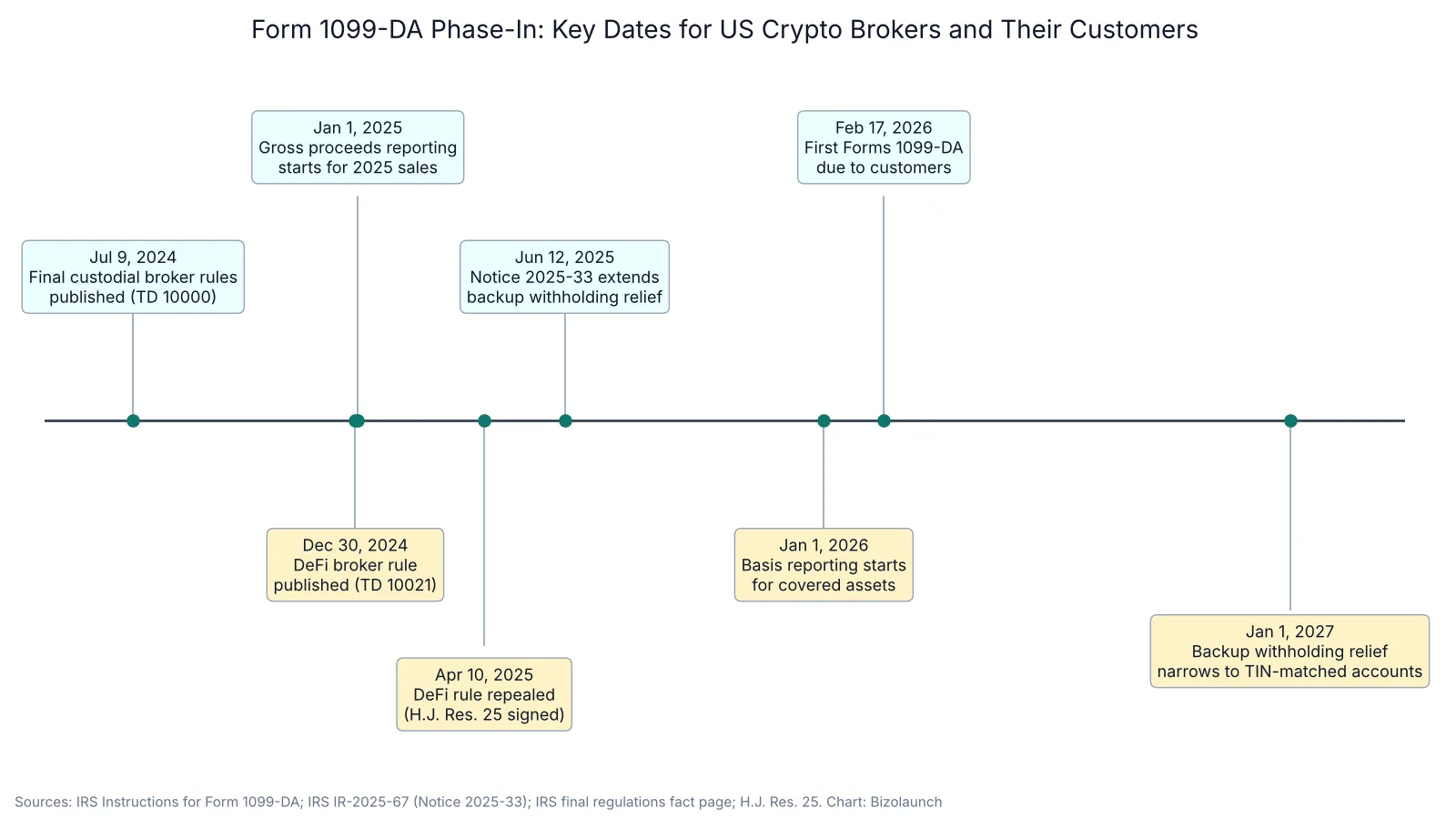
Treasury and the IRS issued the final custodial broker rules in June 2024, and Treasury Decision 10000 was published on July 9, 2024. The rules start in two steps. Brokers report gross proceeds for transactions on or after January 1, 2025. They add cost basis for certain transactions on or after January 1, 2026.
The word “certain” carries a lot of weight. Basis reporting is mandatory only for covered securities. The 1099-DA instructions define a covered digital asset as one acquired after 2025, for cash or other value, in an account where the broker provided custody, and held there until you sold it. Everything else is noncovered, including coins you bought before 2026 and coins you moved in from another wallet or exchange. Brokers may voluntarily report basis for noncovered assets, but they are not required to.
| Sale year | What the broker must report | What you supply yourself |
|---|---|---|
| 2025 | Gross proceeds for all digital asset sales | Cost basis and acquisition date for every sale |
| 2026 onward, covered asset | Gross proceeds plus cost basis, acquisition date and short-term or long-term status | A check that the broker’s basis matches your records |
| 2026 onward, noncovered asset (bought before 2026 or transferred in) | Gross proceeds, with box 9 checked | Cost basis and acquisition date |
The IRS also eased the start for brokers. Under Notice 2024-56, brokers face no penalties for 2025 forms if they made a good faith effort, and none had to backup withhold on 2025 sales. In June 2025 the IRS extended that withholding relief to all transactions in 2026 through Notice 2025-33. For 2027, the relief covers only customers whose name and taxpayer identification number the broker has matched through the IRS TIN Matching Program, so anyone who has ignored an exchange’s request for a Form W-9 could see withholding taken from 2027 sales.
Who Issues a 1099-DA, and Where DeFi Stands
In general, only US digital asset brokers must file. A broker is anyone who, in the ordinary course of business, stands ready to carry out digital asset sales for customers. In practice that means centralized exchanges and other platforms that hold your coins for you. The rules also reach some middlemen, such as crypto kiosk operators and processors of digital asset payments.
Two groups are left out. Miners and validators who only validate transactions are not brokers, and neither are companies that only provide hardware or software that lets you control your own private keys, which is why a hardware wallet maker will never send you a 1099-DA. Trades on foreign exchanges may not produce a 1099-DA, yet they still go on your return.
DeFi had its own rule for a few months. Treasury published Treasury Decision 10021 on December 30, 2024. It treated “trading front-end service providers” as brokers and would have required them to report gross proceeds for sales from January 1, 2027. Congress struck it down using the Congressional Review Act, and the President signed H.J. Res. 25 into law on April 10, 2025. The repeal also bars the IRS from issuing the same or a substantially similar rule without new legislation.
The repeal did not touch the custodial rules, which fell outside the Congressional Review Act window, so 1099-DA reporting by centralized exchanges continues as planned. For DeFi users the result is simple: swaps on a decentralized exchange generally will not appear on any 1099-DA, but they are still taxable sales you must report from your own records.
Stablecoin, NFT and Payment Thresholds in the Final Rules
The final rules include three thresholds that keep small activity off the form. Because they are optional reporting methods for brokers, two exchanges may treat identical activity differently.
- Qualifying stablecoins: A broker using the optional method need not report your designated stablecoin sales if they total $10,000 or less for the year. Above that, it can report them in aggregate rather than trade by trade. To qualify, a stablecoin must track one currency one-to-one, use an effective stabilization mechanism and be generally accepted as payment.
- Specified NFTs: Sales are exempt if your gross proceeds total $600 or less for the year, and a broker may report them together on one form.
- Payment processor sales: A processor of digital asset payments need not report if your sales through it total $600 or less in the year. Cross $600 and every sale gets reported.
The stablecoin rule makes sense once you see how traders use stablecoins: moving from USDC to USDT and back is technically a sale each time, even though the gain is usually a few cents. The $10,000 test applies per broker, so $8,000 of stablecoin sales on each of two exchanges may show up on neither form. Gains or losses on those sales still go on your return. A stablecoin that loses its peg can turn a “cash-like” trade into a real gain or loss, as our explainer on what happens when a stablecoin depegs shows.
Reading the Boxes on a Form 1099-DA
The form looks like a Form 1099-B with cryptocurrency fields added. Most transactions get their own form or line, and brokers must separate short-term covered sales, long-term covered sales and noncovered sales, so the boxes below decide what you put on your return.
| Box | What it shows | Why it matters |
|---|---|---|
| 1a and 1b | Digital token identifier and asset name | Confirms which coin was sold |
| 1c | Units sold, up to 18 decimal places | Lets you match the sale to your own lot records |
| 1d | Date acquired | Sets short-term or long-term status; often blank for noncovered assets |
| 1e | Date sold or disposed | Goes in column (c) of Form 8949 |
| 1f | Gross proceeds, net of transaction costs | Goes in column (d); fees are already taken out |
| 1g | Cost or other basis | Goes in column (e) when reported |
| 2 | Checked if basis was reported to the IRS | Decides box G or J versus H or K on Form 8949 |
| 4 | Federal income tax withheld | Backup withholding you can claim as a payment |
| 6 | Short-term, long-term or ordinary | Tells you which part of Form 8949 to use |
| 8 | Broker relied on information you provided | Flags basis that came from you, not the broker’s own records |
| 9 | Noncovered security | Basis and acquisition date may be missing; you supply them |
| 11a to 11c | Aggregate reporting details | Used for stablecoin and NFT sales reported together |
| 12a and 12b | Units transferred in and transfer-in date | Shows the broker knew the coins came from elsewhere |
Tokenized stocks and other assets that are both securities and digital assets generally go on the 1099-DA rather than the 1099-B, with a CUSIP number added. There are a few exceptions, such as section 1256 contracts, which stay on Form 1099-B.
How to Report Form 1099-DA on Form 8949 and Schedule D
Every digital asset sale eventually ends up on Schedule D, usually by way of Form 8949, and the 2025 instructions for Form 8949 added six checkboxes just for digital assets. You can no longer lump crypto into box C or box F the way many people did in earlier years.
| Your situation | Short-term (held one year or less) | Long-term (held more than one year) |
|---|---|---|
| 1099-DA shows basis was reported to the IRS (box 2 checked) | Box G | Box J |
| 1099-DA received, but basis not reported or not shown | Box H | Box K |
| No 1099-DA or 1099-B received (DeFi, foreign exchange, self-custody) | Box I | Box L |
Next, fill in the columns: units and asset name go in column (a), dates in columns (b) and (c), and box 1f proceeds in column (d). The basis you enter in column (e) depends on which box you checked:
- Box G or J, basis correct: Copy box 1g. If you need no adjustments, the IRS lets you skip Form 8949 and put the totals straight on line 1a or 8a of Schedule D.
- Box G or J, basis wrong: Enter the basis as shown in column (e), then correct it in column (g) with adjustment code B.
- Box H or K: Enter your correct basis in column (e) and zero in column (g).
- Fees not reflected anywhere on the form: Enter them as a negative number in column (g) with code E. Most exchange fees are already netted out of box 1f, so check before you add them.
Your basis is what you paid for the coin, including transaction fees. The holding period matters too, since in the US cryptocurrency held more than one year qualifies for long-term capital gains rates. Other countries draw the line in very different places, as our piece on Germany’s one-year crypto holding rule shows.
A Worked Example: One 2025 Sale and One 2026 Sale
Dana, a hypothetical trader, uses a single US exchange. On March 5, 2024, she buys 2 ETH for $6,965 plus a $35 fee, so her basis is $7,000. On June 10, 2025, she sells both ETH for $5,300 and pays a $26.50 transaction fee.
Her 2025 Form 1099-DA shows $5,273.50 in box 1f, which is the sale price minus the fee. Box 1g is blank because 2025 sales required no basis reporting, and since she held the coins for more than one year, she uses Part II, box K.
| Form 8949 column | Sale 1 (2025, box K) | Sale 2 (2026, box G) |
|---|---|---|
| (a) Description | 2 ETH | 0.10 BTC |
| (b) Date acquired | 03/05/2024 | 02/02/2026 |
| (c) Date sold | 06/10/2025 | 09/15/2026 |
| (d) Proceeds (box 1f) | $5,273.50 | $10,149.00 |
| (e) Cost basis | $7,000.00 (from Dana’s records) | $9,045.00 (box 1g) |
| (g) Adjustment | $0 | $0 |
| (h) Gain or loss | ($1,726.50) long-term loss | $1,104.00 short-term gain |
For the second sale, Dana buys 0.10 BTC on February 2, 2026 for $9,000 plus a $45 fee. She sells it on September 15, 2026 for $10,200 and pays a $51 fee. Because she bought it in 2026 and never moved it, this is a covered sale. Her 1099-DA, due in early 2027, should show $10,149 in box 1f, $9,045 in box 1g, and a check in box 2. She can report it under box G, or directly on Schedule D line 1a since no adjustment is needed.
Now picture Dana treating the empty box 1g as zero on the 2025 sale. She would report a $5,273.50 gain instead of a $1,726.50 loss, a $7,000 swing in taxable income caused by one empty box.
Why Your 1099-DA Doesn’t Match Your Records
A mismatch is not proof that you or the broker made an error. These are the causes that come up most often, and what to do about each one.
Coins You Transferred In Show No Basis
Say you bought 1 BTC in 2021 for $30,000, kept it on a hardware wallet, then moved it to an exchange in 2026 and sold it for $60,000. The exchange never saw your purchase, so it treats the coin as noncovered and checks box 9, leaving box 1g blank while boxes 12a and 12b may show the transfer. Your real gain is $30,000, not $60,000. Use box H or K, enter the $30,000 basis yourself, and keep the original purchase record, because the IRS can ask for it.
Transfers between your own wallets are not sales and should not appear as sales. If you move coins often, a withdrawal allowlist cuts the risk of sending them to the wrong address, as we cover in our guide to crypto address whitelisting on exchanges.
Fees Get Counted Twice
Box 1f already subtracts the transaction costs tied to the sale. Tax software that imports your trades and also adds the fee as a separate expense will shrink your gain twice. In Dana’s 2026 sale, adding the $51 fee again would cut her reported gain to $1,053, which is understated by $51.
Crypto-to-Crypto Swaps Show Proceeds You Never Saw in Dollars
When you swap ETH for SOL, box 1f shows the fair market value of what you received; no dollars reach your account, but the IRS still sees a taxable sale. If your own records value the swap at a slightly different moment or price, small gaps follow. Use one consistent pricing source and keep notes on how you valued each trade.
Missing Stablecoin, NFT or DeFi Lines
Stablecoin sales under the $10,000 threshold, small NFT sales, staking rewards and DeFi swaps may not appear at all. The form is not a complete picture of your tax year, so report these transactions from your wallet history using box I or L where no form exists.
Lot Selection Differs From What You Assumed
If you bought the same coin several times at different prices, which lot you sold changes your basis. A broker applies the default ordering rule unless you gave it instructions in advance. Average cost, which many portfolio apps display, does not fit this system. Our guide to how average cost and FIFO change your per-share figure shows how far apart the two methods can drift.
When the form itself is wrong, the IRS tells you to ask the broker for a corrected 1099-DA. Its advice is blunt: “Don’t contact the IRS. We can’t correct your Form 1099-DA.” Keep the corrected form and your messages with the broker, and do not hold off filing while you wait.
Wallet-by-Wallet Basis and the Records Worth Keeping
The basis rules changed alongside the form. Under Rev. Proc. 2024-28, starting January 1, 2025, you track basis separately for each wallet and each exchange account. You can no longer pool all your bitcoin across every platform into one basis figure, although the IRS allowed taxpayers to allocate their unused basis to the coins sitting in each wallet as of that date.
You can still choose which units you sell, within limits. Notice 2025-7, extended by Notice 2026-20 through December 31, 2026, lets you identify units held at a broker in your own books and records or through a standing order, without broker confirmation. A standing order set before you trade carries more weight than a choice made at tax time.
For each purchase, keep the date, the units, the price, the fee and the wallet or account it sits in. For each transfer, keep the date, the units and both addresses. A simple spreadsheet works if your activity is light, while for daily trading, crypto tax software that imports wallet histories will save you hours, as long as you check that it does not double-count fees.
Reporting crypto at the source is spreading well beyond the US. India, for example, takes a 1% tax deducted at source on many transfers, which buyers on peer-to-peer platforms now deposit through Form 141 for crypto TDS. The direction is the same everywhere: tax authorities want the platform’s data, and they want to match it to your return.
Form 1099-DA Questions Crypto Investors Ask
When Do Brokers Send Form 1099-DA?
Recipient copies follow the same schedule as Form 1099-B. The first forms, for 2025 sales, were due to customers by February 17, 2026. Forms for 2026 sales arrive in early 2027.
Do I Have to Report Crypto If I Didn’t Get a 1099-DA?
Yes. You must report all digital asset income, gains and losses whether or not you receive the form. Use box I or L on Form 8949 for sales with no form.
Does Coinbase or Kraken Send a 1099-DA for DeFi Trades?
Only for trades the exchange carries out for you in a custodial account. Swaps you make from a self-custody wallet on a decentralized exchange are outside the custodial rules, and the DeFi broker rule that would have covered them was repealed in April 2025.
Why Is the Cost Basis Blank on My 1099-DA?
Brokers did not have to report basis for any 2025 sale. From 2026, they report it only for covered assets bought and held in that same account after 2025. A blank box means the basis was not reported, not that it was zero.
Are Staking Rewards Reported on Form 1099-DA?
No. Rewards and staking payments are not reported on this form. They are still taxable income, and some platforms report them on other forms.
IRS 1099-DA Instructions, Final Regulations and H.J. Res. 25
- IRS: Instructions for Form 1099-DA
- IRS: Form 1099-DA (PDF)
- IRS: Understanding Your Form 1099-DA
- IRS: Final Regulations and Related Guidance for Broker Reporting on Digital Assets
- IRS: Instructions for Form 8949 (2025)
- IRS: IR-2025-67, Additional Transition Relief for Digital Asset Brokers (Notice 2025-33)
- House Ways and Means Committee: H.J. Res. 25 Signed Into Law
- Current Federal Tax Developments: Analysis of H.J. Res. 25 and TD 10021
- Monaco CPA: The 1099-DA $0 Basis Trap
This article is for information and education only and is not investment, tax or financial advice. Figures were checked on 1 November 2026; confirm current details with the official source or a registered adviser before acting.