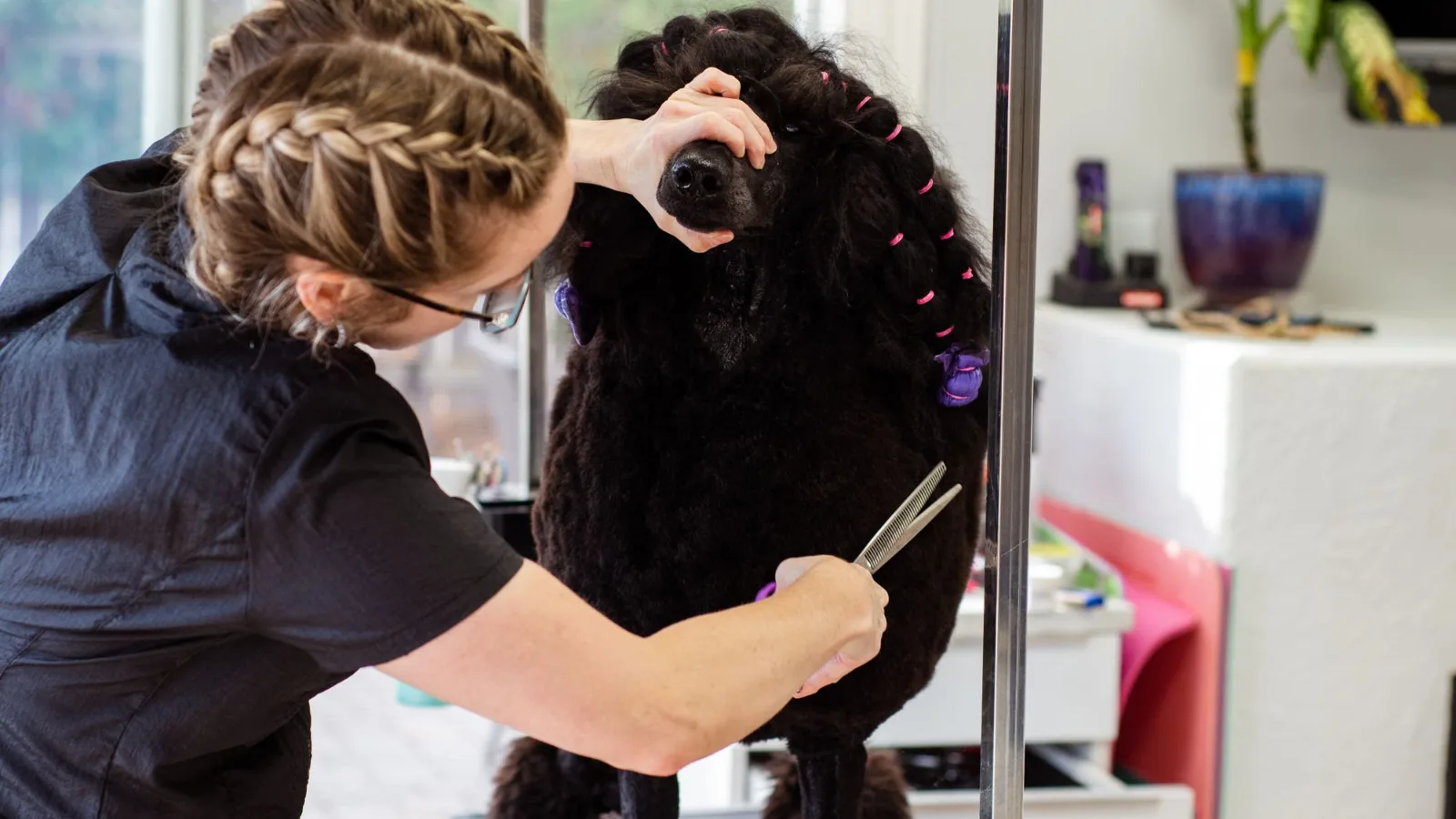
A grooming table, a force dryer and a good set of clippers can be bought for under $1,000, but the room around them is what costs money. Leasing, plumbing and fitting out a storefront dog grooming salon can take the budget from a few thousand dollars to more than $60,000, which is why opening a dog parlor in the USA is mainly a real estate and staffing decision, not an equipment one.
This guide covers the storefront salon: a fixed shop where owners drop dogs off and pick them up later. If you are weighing a van instead, our separate guide on starting a mobile dog grooming business in North Carolina covers that model, from van costs to wash water rules. Everything below is about the shop.
Connecticut’s Facility Licence, NCMG Credentials and Build-Out Costs
- Most states do not license individual dog groomers. Connecticut is a notable exception at the facility level, where the state Department of Agriculture licenses grooming facilities and asks for zoning approval with the application.
- The best-known credential is the National Certified Master Groomer (NCMG) from the National Dog Groomers Association of America, which requires written exams, timed practical exams on a live dog and at least one NDGAA workshop.
- Itemized startup costs for a salon run from about $2,640 to $60,995 in 2026. The build-out is the swing factor, at $0 to $47,500.
- Typical full-groom prices run from $75 to $125 for a small dog up to $200 or more for an extra-large dog.
- Your written safety rules (dryer use, matted coats, vaccines, emergencies) protect the dogs, your staff and your insurance cover.
Storefront Salon or Mobile Van
Both models do the same work on the table, and the difference lies in everything that happens around it. A mobile groomer serves one dog at a time at the owner’s home and charges for the convenience. A salon runs several tables at once, can keep bathers and groomers busy in parallel, and books dogs in waves through the day.
That makes the salon the better fit if you want to build a team. It also suits areas with dense housing, where owners are happy to drop off a dog on the way to work. The trade-off is fixed cost, because rent is due whether or not the diary is full and the build-out has to be paid for before the first dog walks in. The mobile route suits a single groomer who wants low overhead and a premium price.
| Factor | Storefront salon | Mobile grooming |
|---|---|---|
| Dogs groomed at once | Several, across tables | One |
| Biggest upfront cost | Lease and build-out | Van and conversion |
| Staffing | Groomers, bathers, front desk | Usually the owner alone |
| Customer experience | Drop-off and pick-up | At the door |
| Main risk | Fixed rent with empty slots | Vehicle breakdowns and drive time |
State Rules for Dog Grooming Salons
There is no federal license for dog groomers, and most states do not license individual groomers either. Before you sign a lease, though, check three layers of rules: state facility licensing, local permits and the building itself.
Connecticut Licenses Grooming Facilities
Connecticut is the clearest example of state oversight. Its Department of Agriculture issues pet facility licenses under Section 22-344 of the state’s general statutes, which covers commercial kennels, pet shops, training facilities and grooming facilities. The department defines a grooming facility as any place, other than a commercial kennel, kept as a business where dogs are groomed. Applicants upload a zoning approval form with the first application, and licenses are applied for and renewed online.
That zoning step matters well beyond Connecticut. Even in states with no grooming license, the town decides whether a pet business can operate in a given unit.
Local Permits and the Building
In every state, plan for the normal business paperwork. That means registering the company with your secretary of state, getting a city or county business license and getting a sales tax permit if you sell shampoos, collars or treats. Before you sign a lease, ask the local zoning office whether pet grooming is an allowed use for the unit. Ask the building department what permits the plumbing and electrical work needs. Many cities also require a certificate of occupancy for a change of use. Some landlords ban animal businesses outright, so get the permitted use written into the lease.
Certifications Clients and Insurers Notice
Groomers in most of the US can legally work without a certificate, but a credential still helps because it is proof of skill in a trade where owners are handing over a family member.
The National Dog Groomers Association of America runs the National Certified Master Groomer program, which the association says is endorsed by the American Kennel Club. Candidates must pass written exams on the AKC Non-Sporting, Sporting and Terrier groups, with a separate written test for each group. They also complete timed practical exams on their own dog, which must arrive bathed, fluff-dried, with ears cleaned and nails trimmed and at least 8 weeks of coat growth. All clipper and scissor work happens during the test. Every candidate must attend at least one NDGAA workshop before finishing.
| NCMG practical exam | Time allowed |
|---|---|
| Bichon Frise (Non-Sporting) | 1 hour 45 minutes |
| Poodle, 11 inches and under | 1 hour 30 minutes |
| Poodle, over 23 inches | 2 hours 15 minutes |
| American or English Cocker, Springer Spaniel (Sporting) | 1 hour 30 minutes |
| Miniature Schnauzer or Wire Fox Terrier | 1 hour 30 minutes |
| Bedlington, Soft-Coated Wheaten or Kerry Blue Terrier | 2 hours |
| Hand-stripped Cairn Terrier | 2 hours |
For a salon owner, the NCMG is most useful as a hiring and training goal rather than a day-one requirement. A master groomer on staff can train new bathers and juniors to a set standard. Owners can also see it on your website, which helps when you price above the chain store down the road. Grooming schools and apprenticeships are the usual way to learn before testing. Training typically costs $500 to $4,750.
Build-Out and Equipment Costs for a Grooming Salon
Equipment is the predictable part of the budget, while the build-out is not. A unit that was a salon or vet clinic may already have floor drains, water heaters and extra power. A former clothing shop may need all of it added.
These are typical 2026 startup costs for a salon. The midpoint column is our own calculation, halfway between the low and high figures.
| Startup item | Low | High | Midpoint |
|---|---|---|---|
| Grooming training | $500 | $4,750 | $2,625 |
| LLC filing | $50 | $500 | $275 |
| General liability insurance (annual) | $475 | $1,425 | $950 |
| Grooming table (hydraulic preferred) | $190 | $760 | $475 |
| Clippers, blades and shears | $475 | $1,500 | $988 |
| Force dryer | $190 | $760 | $475 |
| Bathing system (tub and sprayer) | $285 | $1,900 | $1,093 |
| Shampoos and starting supplies | $190 | $475 | $333 |
| Salon build-out (lease, renovation, fit-out) | $0 | $47,500 | $23,750 |
| Marketing and website with online booking | $285 | $1,425 | $855 |
| Total | $2,640 | $60,995 | $31,818 |
Midpoints are rounded to the nearest dollar.
The $0 low end for the build-out reflects a groomer who rents a ready space, such as a room inside a pet store or a shared salon, and moves in with their own tools. A full storefront usually lands well above the midpoint once you add a raised tub per bather, a second table, crates or kennels for waiting dogs, a washer and dryer for towels, and sound-damping work. Prices for this equipment vary widely by brand, so get quotes from two or three suppliers before you sign.
Log every purchase in a startup expense spreadsheet as you go. The build-out is often your largest early tax deduction, and your accountant will want the detail.
Pricing Grooms by Size, Coat and Time
Salons price by dog size and coat type, then add services on top. These are typical US ranges for 2026. Treat them as a market guide, since your local rates may be higher or lower.
| Dog size | Bath and brush | Full groom (bath, haircut, nails, ears) |
|---|---|---|
| Small (under 20 lb) | $25 to $50 | $75 to $125 |
| Medium (20 to 50 lb) | $50 to $75 | $125 to $175 |
| Large (50 to 80 lb) | $75 to $125 | $175 to $200 |
| Extra large (80 lb and up) | $125 to $200 | $200 and up |
Size alone misprices many dogs, since a doodle with a matted coat can take twice as long as a short-coated dog of the same weight. A double-coated breed in shedding season needs a long de-shedding session. Our Alsatian breed guide explains why German Shepherd coats are so much work. Build add-ons into your menu, such as de-shedding, de-matting by the quarter hour, teeth brushing and nail grinding, so the price follows the time.
A Day at One Grooming Table
Say one groomer handles five dogs a day: two small dogs at $100, two medium dogs at $150 and one large dog at $187.50. Each price sits in the middle of the typical full-groom range. That table brings in $687.50 a day, or $15,125 across 22 working days a month. Add a second groomer and a bather to wash and dry dogs for both of them, and the same room can earn far more without more rent. That is the salon’s main advantage over a van.
Revenue is not profit, so subtract rent, wages or commissions, products, card fees and insurance before you judge a location. Put your real monthly costs into the break-even calculator to see how many grooms a month keep the doors open.
Insurance for a Pet Grooming Business
General liability covers injuries to customers and damage to their property, and it typically costs $475 to $1,425 a year for a grooming business. On its own, it may not be enough for a salon. Ask your broker whether the policy covers customers’ dogs while they are in your care. If it does not, add animal bailee cover, sometimes called care, custody and control cover, which pays if a dog is hurt, falls ill or escapes while you have it.
Other policies to ask about:
- Professional liability: Covers claims that your grooming work caused harm, such as a clipper cut or a reaction to a product.
- Commercial property: Covers tubs, dryers, tables and the build-out itself against fire, flood or theft.
- Workers’ compensation: Required in most states once you have employees, and bites and repetitive strain are everyday risks in this trade.
- Business interruption: Replaces lost income if a burst pipe or fire closes the salon for weeks.
Booking Software That Saves Hours Each Week
A busy salon lives in its booking system. Generic calendar apps miss most of what a grooming shop needs, so look for pet grooming software with these features:
- Pet profiles: Breed, weight, coat notes, behavior flags and the cut each dog had last time, so any groomer can repeat it.
- Vaccine records: Uploads and expiry dates, with alerts before a dog’s rabies certificate lapses.
- Online booking with deposits: Clients book from their phones, and a card on file or deposit cuts no-shows.
- Automated reminders: Text reminders the day before, plus a “ready for pick-up” message.
- Staff scheduling and commission tracking: Essential if you pay groomers a share of each groom.
- Rebooking prompts: Most coats need a groom every few weeks, so booking the next visit at checkout keeps the diary full.
MoeGo is one of several vendors built for groomers. Compare at least three on a free trial, and book a fake dog through each system from the client side before you commit.
Pet Safety Rules to Write Before Opening Day
Serious grooming accidents tend to come from the same few situations, so write your rules down, train every new hire on them and post them in the back room.
- Never leave a dog alone on a table. A dog held by a grooming loop can be badly hurt in seconds if it jumps or slips. If you must step away, take the dog off the table or put it in a crate.
- Control heat. Set rules for heated cage dryers. Flat-faced breeds, elderly dogs and anxious dogs overheat easily, so check them often or hand-dry them instead.
- Ask for vaccine proof. Require current rabies records, and set your own policy on other core vaccines, before a dog shares the space with others.
- Set a matted-coat policy. Explain before you start that a badly matted coat may need shaving short, and get the owner’s agreement in writing.
- Plan for emergencies. Keep a pet first aid kit, post the nearest emergency vet’s address by the phone and train staff on what to do if a dog collapses or bites.
Hiring Groomers and Bathers
Good groomers are hard to find, and many salons are built around one or two experienced people. Most shops pay groomers by commission, a share of each groom’s price, or by hourly wage. Some use a mix of base pay plus commission. Bathers are usually paid hourly and are the easiest way to raise each groomer’s daily output, because the groomer only does the haircut.
Write a clear job description for each role, covering duties, required experience, certification goals and how pay works. Our free job description generator gives you a solid first draft. Hire bathers who want to learn the trade, then train them toward full grooming. That is often cheaper and more reliable than competing for senior groomers.
Licences, Grooming Prices and Salon vs Mobile Profit
Do You Need a License to Open a Dog Grooming Salon?
Most states do not license individual groomers. You still need normal business registration, a local business license and any zoning approval. Connecticut licenses grooming facilities through its Department of Agriculture, so check your own state’s agriculture department too.
How Much Does It Cost to Open a Dog Grooming Salon?
Itemized, a salon costs about $2,640 to $60,995 to open. The build-out ranges from $0 if you rent a ready space to $47,500 for a full fit-out. The midpoint of the itemized range is about $31,818.
How Much Do Dog Groomers Charge?
In 2026, full grooms run $75 to $125 for small dogs, $125 to $175 for medium dogs, $175 to $200 for large dogs and $200 or more for extra-large dogs.
What Certification Do Dog Groomers Need?
None is legally required in most states. The best-known credential is the National Certified Master Groomer from the NDGAA. It needs written exams for each breed group, timed practical exams and at least one NDGAA workshop.
Is a Grooming Salon More Profitable Than Mobile Grooming?
A salon can earn more per day because several tables and a bather work in parallel. It also carries higher fixed costs, mainly rent and the build-out. A mobile groomer has lower overhead but tops out at one dog at a time.