A patient who calls your office at 2 a.m. with chest pain and reaches a voicemail box is a risk no practice wants to carry. Covering that gap is the job of a medical answering service, and published plans run from $30 a month plus per-minute fees to $1,695 for a 500-minute bundle. For most small and mid-size practices, the best medical answering services are Specialty Answering Service and MAP Communications on price, AnswerFirst for clinical-grade on-call handling, PATLive for scheduling straight into your practice software, Ruby for a polished daytime front desk, and TriageLogic when you need registered nurses rather than operators on the line.
We compared eight services on what matters to a doctor’s office: HIPAA terms and a signed business associate agreement (BAA), on-call routing, Spanish coverage, integrations and real cost.
Which Answering Service Suits Which Practice
- Under HIPAA, an answering service that receives or transmits patient information is a business associate, so you need a signed BAA before it takes a single call.
- At 300 minutes a month, published plans range from $384.20 at Specialty Answering Service to $479 at PATLive, and from $510 to $615 at AnswerFirst.
- MAP Communications lists HIPAA compliance on every plan from its $49 pay-as-you-go tier, plus English and Spanish answering and a free trial.
- AnswerConnect charges a $40 HIPAA add-on, and Ruby says it adds no fee for HIPAA service, so the add-ons change the real price.
- Operators take messages and follow your escalation rules. Only a nurse triage service such as TriageLogic gives callers a clinical assessment from a registered nurse.

Eight Answering Services by Price, BAA and Best Use
The table shows each service’s HIPAA position in its own words, its entry price and who it fits best. Note that the cheapest plan is rarely the one a busy practice should buy, because per-minute overage adds up quickly after hours.
| Service | HIPAA and BAA | Entry price | Main feature | Best for |
|---|---|---|---|---|
| Specialty Answering Service | Calls itself a business associate and provides a BAA | $44 a month plus $1.54 a minute | On-call schedules in 30-minute blocks | Lowest cost per minute at mid volume |
| MAP Communications | HIPAA compliant on every plan; HITRUST and SOC 2 | $49 a month plus $1.37 a minute | English and Spanish on every plan | Small practices that want HIPAA in the base price |
| AnswerFirst | HIPAA and HITECH compliant | $30 a month plus $1.60 to $1.95 a minute | Per-second billing | On-call triage routing and per-second billing |
| PATLive | Get its BAA signed during setup | $49 a month plus $2.99 a minute | Spanish 8 a.m. to 10 p.m. ET at no extra cost | Booking into athenahealth, Phreesia and other systems |
| Ruby | BAA provided after sign-up, no HIPAA fee | $245 for 50 minutes | 100% U.S.-based, English or Spanish | Daytime front desk for a solo or small practice |
| AnswerConnect | $40 HIPAA add-on | $350 for 200 minutes | Live chat on larger plans; Spanish $30 add-on | Practices that also want live chat |
| Answering Service Care | HIPAA-certified agents | About $39 a month | Free email and SMS relay | Very small offices with light after-hours volume |
| TriageLogic | HIPAA compliant; URAC-accredited call center | Custom quote | Registered nurses using Schmitt-Thompson protocols | Registered nurse triage after hours |
The Monthly Bill at 300 Minutes of Calls
Headline prices hide the real bill, so we priced one scenario. Picture a family practice whose after-hours and overflow calls add up to 300 minutes a month, for example 150 calls of two minutes each. We picked the cheapest published plan or mix at each service that covers that volume.
| Service and plan | How the total is built | Monthly cost |
|---|---|---|
| Specialty Answering Service, 220 Minute plan | $269 + 80 extra minutes at $1.44 | $384.20 |
| MAP Communications, Enterprise plan | $339 + 50 extra minutes at $1.28 | $403.00 |
| AnswerConnect, Growth plan with HIPAA | $395 for 300 minutes + $40 HIPAA add-on | $435.00 |
| PATLive, 300 minutes plan | $479 flat | $479.00 |
| AnswerFirst, pay as you go | $30 + 300 minutes at $1.60 to $1.95 | $510.00 to $615.00 |

Two billing details change these numbers in practice. AnswerConnect rounds each call up to the next full minute, though its first 30 calls under 30 seconds in a cycle are free, and it lists a one-time $49.99 setup fee. AnswerFirst bills by the second, which helps if most of your calls are short message-taking.
A Closer Look at Each Answering Service
1. Specialty Answering Service: Lowest Cost per Minute With a Real BAA
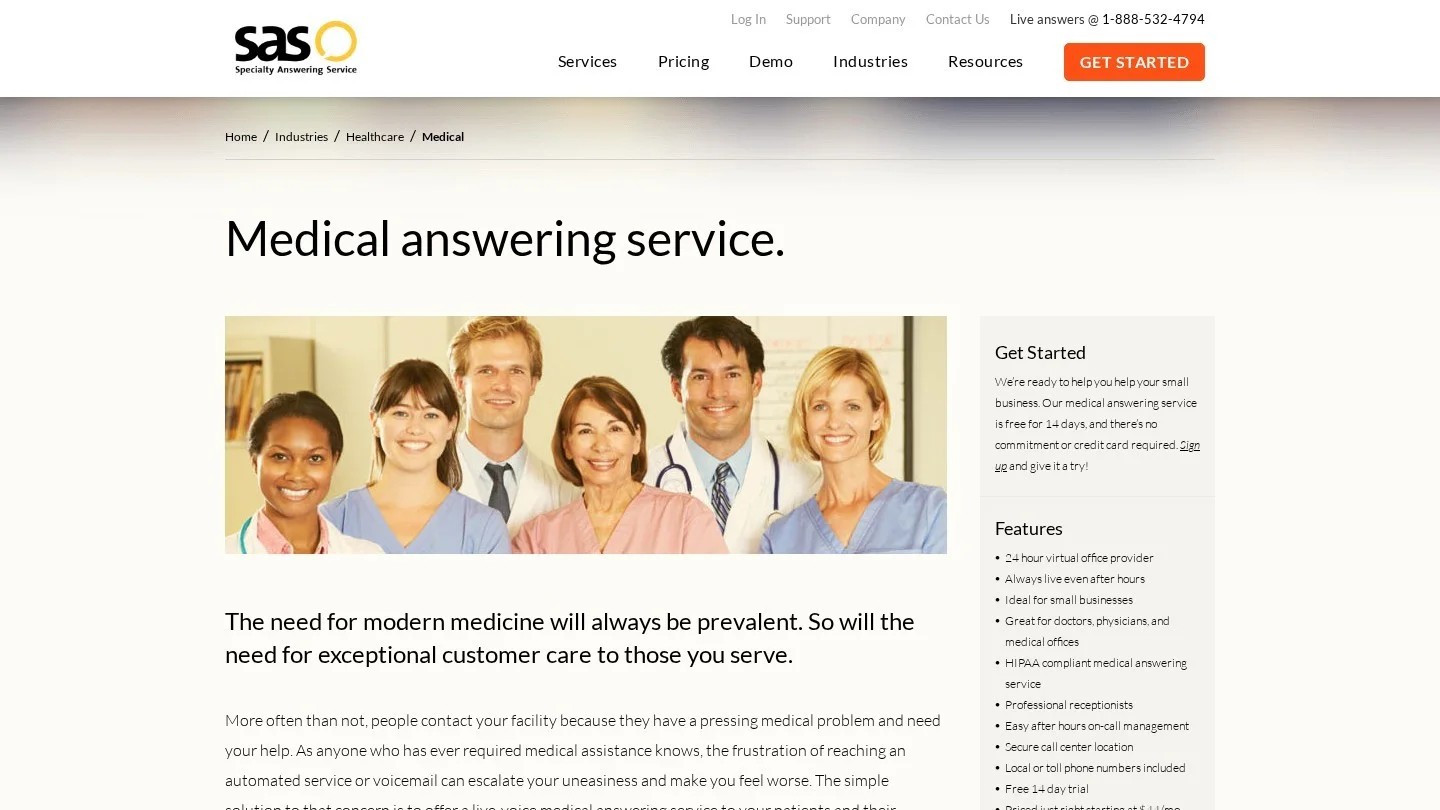
Specialty Answering Service (SAS) has the cheapest per-minute rates of the services here once you move past the entry plan. Plans start at $44 a month with $1.54 per minute, then steps to $159 for 100 minutes, $269 for 220 minutes and $649 for 500 minutes. There is no setup fee, service is month to month, and SAS says there are no cancellation fees. Watch the small add-ons, such as $0.10 a minute for patching a call through and $0.15 a minute for voicemail.
The HIPAA setup is stricter than most, and that is a good sign. SAS says it is a business associate and will provide its BAA. HIPAA accounts cannot use call recordings, text forwarding to email or its SMS app, and messages arrive as a bare alert that tells you to sign in to the portal or mobile app. For on-call, SAS suggests text-to-speech phone alerts rather than text messages. Its medical service lets you set on-call schedules in 30-minute blocks.
Best for: cost-focused practices with steady volume that are happy to read messages in a portal.
2. MAP Communications: HIPAA Included From the First Plan
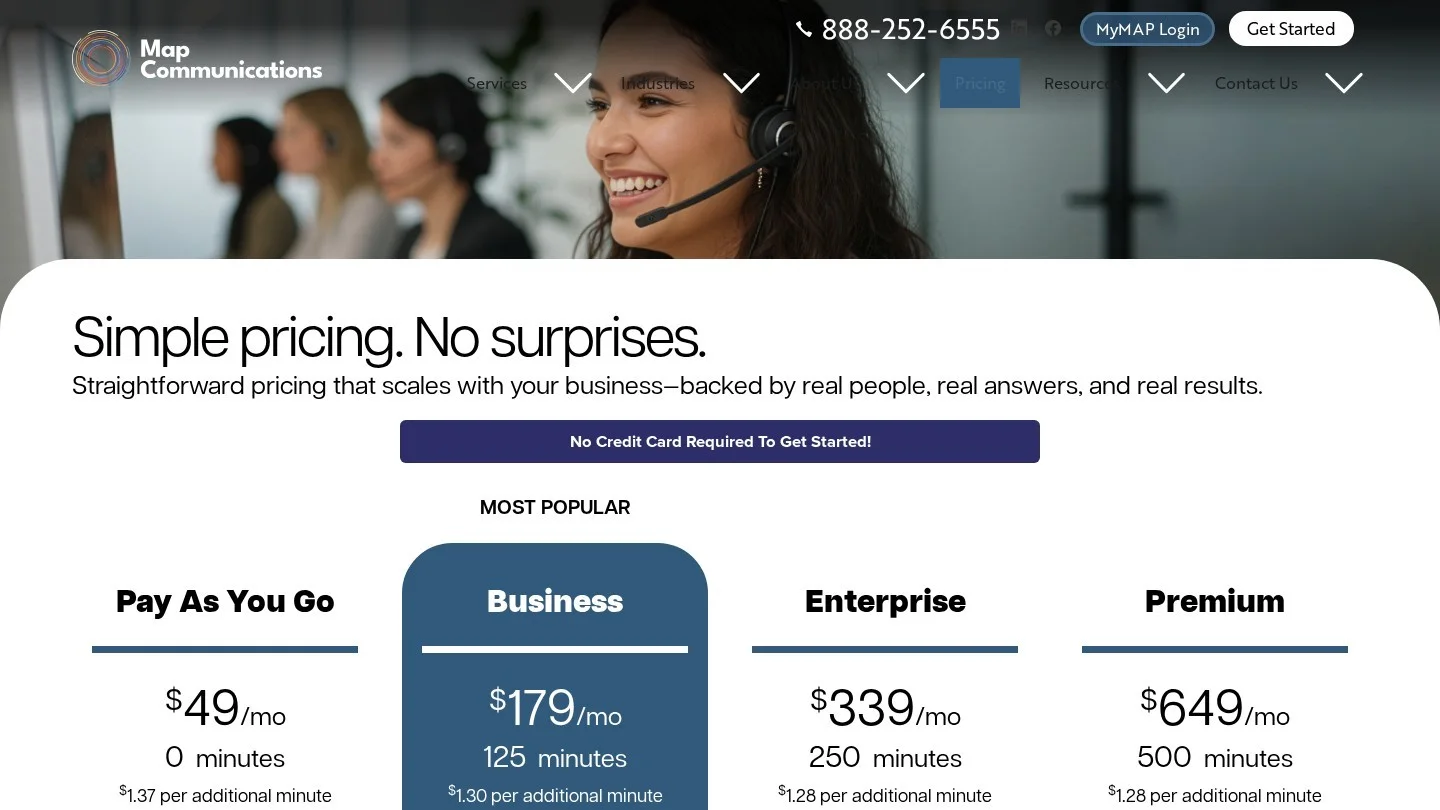
MAP Communications has four plans, and every one is marked HIPAA compliant. Pay As You Go costs $49 a month plus $1.37 a minute. Business costs $179 for 125 minutes, Enterprise $339 for 250 minutes, and Premium $649 for 500 minutes, with overage from $1.28 to $1.30 a minute.
Each plan includes English and Spanish answering. MAP also says it holds HITRUST, SOC 2 and PCI-DSS certifications, which give a practice manager something concrete to check during vendor review. There are no long-term contracts, and a free trial needs no credit card.
Best for: small practices that want HIPAA coverage and Spanish without paying for add-ons.
3. AnswerFirst: Built Around On-Call Escalation
AnswerFirst, based in Tampa, Florida, says it has served callers since 1998 and the medical sector for more than 20 years. It offers 24/7 live receptionists, with no AI bots, who handle triage and emergency dispatch. They reach the on-call provider only when a caller meets the criteria you set, which protects your doctors’ sleep.
You update on-call schedules yourself in the client portal, and messages go through secure, encrypted mobile messaging. AnswerFirst shows Epic, Vocera, TigerConnect, Qliqsoft, Symplr and Baxter as API integrations, while noting that HIPAA safeguards limit some connections. Pricing is $30 a month plus $1.60 to $1.95 a minute, billed by the second, with no contract and a 30-day risk-free guarantee. AnswerFirst says it is HIPAA and HITECH compliant.
Best for: multi-provider practices with a rotating on-call schedule and clear escalation rules.
4. PATLive: Scheduling Straight Into Your Practice Software
PATLive’s strength is what its receptionists can do inside your systems. Its staff book, reschedule and cancel appointments directly in your practice management software. It names native integrations with athenahealth, Klara, Phreesia, SimplePractice and Jane. The same team handles new patient intake, including medical history and insurance details, and passes urgent calls to your on-call team.
Pricing runs from $49 a month with $2.99 a minute, to $349 for 200 minutes and $479 for 300 minutes. Spanish-speaking receptionists are included from 8 a.m. to 10 p.m. Eastern at no extra charge, and the team is 100% U.S.-based. Every plan comes with a 14-day free trial and no contract. Ask for PATLive’s BAA during setup, as you would with any vendor that touches patient data.
Best for: practices that want callers booked into the schedule, not just a message left for the morning.
5. Ruby: A Polished Front Desk, With Clear Limits
Ruby is known for warm, well-trained receptionists, and its pricing reflects that. Plans cost $245 for 50 minutes, $385 for 100, $705 for 200 and $1,695 for 500. Every plan includes the same features, including answering in English or Spanish.
Ruby says it provides a BAA to customers who need one and charges nothing extra for HIPAA service. Its receptionists are 100% U.S.-based and work 24/7. For HIPAA accounts, messages are not emailed or texted, and you read them only in the Ruby app or portal. Receptionists answer non-medical questions and collect intake details. They can book into a HIPAA-compliant scheduling tool, though not into a practice’s personal calendar.
Best for: solo doctors and small specialty practices that care most about how the phone is answered during the day.
6. AnswerConnect: Many Plan Sizes and Paid Add-Ons
AnswerConnect offers 24/7/365 live answering, appointment scheduling with a free online booking app, and Spanish-English bilingual reception. You switch on its HIPAA-compliant communications from the account, and protected messages sit in its portal and apps.
U.S. pricing starts at $350 for 200 minutes, with $2.50 a minute after that, and a Growth plan costs $395 for 300 minutes. A medical office needs the $40 HIPAA add-on, which cannot be reversed once added, and Spanish answering is a $30 add-on. AnswerConnect has no contracts or notice period.
Best for: larger practices that want a wide range of plan sizes and the option to add live chat on the website.
7. Answering Service Care: A Low-Cost Starting Point
Answering Service Care says its medical service starts at about $39 a month. That base plan includes 24/7 coverage, free email and SMS relay, a free local number and portal access, and the company builds custom bundles for higher volume.
The company says its agents are HIPAA-certified. After hours, they screen calls, give instructions when a caller needs the emergency room, and either connect urgent callers to the doctor or relay a message.
Best for: a single-provider office with light after-hours volume that wants a low fixed starting cost.
8. TriageLogic: Registered Nurses Instead of Operators
TriageLogic is a different kind of service. Registered nurses answer symptom calls using Schmitt-Thompson protocols, which TriageLogic calls the industry standard. Each nurse documents decisions in real time, and the practice receives an EHR-compatible file with the assessment, symptoms and next steps, ready for review in the morning.
The company lists URAC accreditation for its health call center, valid until April 1, 2029, and says its systems are reviewed against HIPAA and SOC 2 requirements. Prices are set for each practice, with bilingual support as a possible extra.
Best for: pediatric, primary care and specialty groups that want fewer 3 a.m. calls to the doctor and a clinical record of every call.
HIPAA and the Business Associate Agreement
“HIPAA compliant” on a website is the vendor’s own claim. What protects you is the contract. Under HIPAA, a business associate is any person or company that creates, receives, maintains or transmits protected health information for a covered entity. An answering service that takes patient names, symptoms and callback numbers fits that description.
The BAA must set out how the vendor may use and disclose patient data. It must also require Security Rule safeguards, require the vendor to report security incidents and breaches, and make it sign a BAA with any subcontractor before passing data on. If a service uses an overflow call center or an outside messaging app, ask whether those subcontractors are covered.
Read how each service sends messages, too. SAS and Ruby both block plain text and email delivery of patient details for HIPAA accounts and send you to a secure portal instead. That is safer, but it adds a login step for your on-call doctor at night. Test the workflow before you go live. Our small business cybersecurity checklist covers the basics on your side, such as strong passwords and two-factor login for the portal. If you manage vendor contracts electronically, our guide to DocuSign alternatives lists low-cost e-signature tools for your own paperwork.

Message Taking or Nurse Triage: Which Do You Need?
Most answering services take a message and follow a decision tree you write. If a caller reports a symptom on your urgent list, such as chest pain, the operator patches the call to your on-call provider or tells the caller to seek emergency care, and everything else becomes a message for the morning. Operators are not clinicians. Ruby, for example, says its receptionists answer only non-medical questions, and AnswerConnect describes qualifying new patients by asking a few questions, not clinical triage.
Nurse triage puts a licensed nurse on the call. The nurse assesses symptoms with a standard protocol, decides whether the patient needs the ER, an urgent visit or home care, and documents the call for your chart. TriageLogic sends an EHR-compatible report for every call. The trade-off is cost, since nurse triage is quoted for each practice rather than sold by the minute.
A sensible split for many practices is an answering service by day and for overflow, with nurse triage after hours. Pediatric and primary care offices with many night-time symptom calls are the most likely to gain from the nurse layer.
Contract Terms to Check With Any Provider
Price and HIPAA are the starting point. These are the details that decide whether your staff and on-call doctors will like the service six months in.
- On-call schedule control: Can you change the rotation yourself? SAS uses 30-minute blocks, and AnswerFirst lets you edit schedules in its portal.
- Escalation script: Who writes the decision tree, and how often can you change it? A clear script is the same skill as a good sales call script: short questions, set branches and a defined handoff.
- Integrations: Do agents book into your actual system? PATLive names athenahealth, Klara, Phreesia, SimplePractice and Jane, while AnswerFirst lists Epic and several clinical messaging tools.
- Spanish coverage: MAP and Ruby include Spanish on all plans, PATLive covers 8 a.m. to 10 p.m. ET at no charge, and AnswerConnect charges $30.
- Billing increments: Per-second billing (AnswerFirst) favors short calls, while rounding up to the minute (AnswerConnect) costs more on quick messages.
- Trial and exit: PATLive offers 14 days free, MAP offers a free trial, and AnswerFirst offers a 30-day risk-free guarantee. SAS, MAP, PATLive and AnswerConnect all advertise no long-term contract.
Where AI Receptionists Fit
AI voice agents now answer phones for some clinics at a much lower per-minute cost than a live operator. Retell AI, for example, advertises pay-as-you-go pricing from $0.07 a minute. They can book appointments and answer routine questions, but the same HIPAA rules apply. Vendors of AI chatbots that handle patient information on a provider’s portal count as business associates, so an AI phone agent needs a BAA just like a human service. Before you test one, set ground rules with an AI acceptable use policy for your practice.
The safest use today is narrow: overflow scheduling, office hours, directions and refill requests routed to a queue. Keep urgent symptom calls with a person, whether that is an operator following your script or a triage nurse. The same pattern shows up in AI for remote patient monitoring, where software sorts the routine work and clinicians handle the alerts that matter.
Doctors’ Questions About Answering Services
How Much Does a Medical Answering Service Cost?
Published plans start at about $30 to $49 a month plus per-minute charges, or around $245 for a bundle of 50 minutes. For 300 minutes a month, published plans run from $384.20 at Specialty Answering Service to $479 at PATLive and $510 to $615 at AnswerFirst.
Is a Medical Answering Service Required to Sign a BAA?
Yes. HHS treats a vendor that receives or transmits protected health information for a practice as a business associate, and HIPAA requires a business associate agreement with it. SAS and Ruby both say they provide one.
What Is the Difference Between an Answering Service and Nurse Triage?
An answering service takes messages and routes urgent calls to your on-call provider using your script, without medical advice. A nurse triage service uses registered nurses who assess symptoms with protocols such as Schmitt-Thompson and document the call.
Can a Medical Answering Service Schedule Appointments?
Many can. PATLive books directly into practice software such as athenahealth and Phreesia, AnswerConnect offers a free scheduling app, and Ruby books into a HIPAA-compliant scheduling tool.
Do Medical Answering Services Offer Spanish-Speaking Operators?
Several do. MAP Communications and Ruby include English and Spanish on their plans, PATLive offers Spanish from 8 a.m. to 10 p.m. ET at no extra cost, and AnswerConnect charges a $30 add-on.
Provider Pages and HHS Guidance Cited
- HHS: Business Associates guidance
- Specialty Answering Service: Pricing
- Specialty Answering Service: Medical answering service
- Specialty Answering Service: HIPAA compliance support article
- MAP Communications: Pricing
- AnswerFirst: Medical and physicians answering services
- PATLive: Pricing
- PATLive: Medical and wellness answering service
- Ruby: Plans and pricing
- Ruby: HIPAA answering service
- AnswerConnect: Healthcare professionals
- AnswerConnect: U.S. plans and pricing (PDF)
- Answering Service Care: How much does a medical answering service cost?
- TriageLogic: FAQs about after-hours nurse triage services
- TriageLogic: Medical answering service pricing
- Retell AI: Best medical answering service (vendor blog)