A startup compliance checklist is mostly a list of deadlines. Some are easy to miss, such as the 30-day window for an 83(b) election or the March 1 Delaware franchise tax. Miss one, and the fix ranges from a penalty to a tax bill that can’t be undone. Get them right, and compliance takes a few hours a quarter.
This checklist covers a typical US startup, often a Delaware C corporation raising money from investors. We put the tasks in the order founders meet them: forming the company, the first 30 days, raising money, hiring, and the yearly calendar. Two rules also changed recently. FinCEN has removed beneficial ownership reporting for US companies, and the threshold for sending Form 1099-NEC to contractors rose from $600 to $2,000 for payments made from 2026. So many older checklists are now out of date.
Stage 1: Forming the Company
These are one-time tasks, but everything later depends on them.
- Choose the entity and state. Most venture-backed startups form a Delaware C corporation, because investors know Delaware corporate law. An LLC can work well for a bootstrapped business that will not raise venture capital.
- File the certificate of incorporation with the state, and appoint a registered agent in that state.
- Adopt bylaws, appoint directors and issue founder shares with stock purchase agreements and vesting.
- Get an EIN (Employer Identification Number) from the IRS. You need it for a bank account, payroll and tax filings. Applying on IRS.gov is free.
- Open a business bank account in the company’s name. Keep personal and company money separate from day one.
- Register in your home state if you are not based in Delaware. A Delaware company that operates in, say, California usually must register there as a foreign corporation. That state then has its own annual filings.
- Get local licenses and permits your city, county or industry requires.
Stage 2: The First 30 Days After Founder Stock
File your 83(b) election within 30 days. This is the deadline founders miss most, and it cannot be fixed later. When founders receive shares that vest over time, an 83(b) election lets them pay tax on the shares’ value now, usually close to zero, instead of on their higher value as they vest.
The election must be filed no later than 30 days after the shares are transferred. The IRS created Form 15620 as a standard form for the election. Using it is optional, and you send the election to the IRS office where you file your tax return. Keep proof of the date you filed it, such as certified mail receipts.
Other early tasks:
- Sign IP assignment agreements. Every founder and early contributor should assign their work on the product to the company.
- Set up a cap table that records every share, option and note.
- Draft a founders’ agreement covering roles, vesting and what happens if someone leaves.
Stage 3: Raising Money
Most startups raise money under Regulation D, which lets them sell shares to investors without a full SEC registration. That exemption comes with a filing.
- File Form D within 15 days. Companies relying on Rule 504 or 506 must file Form D no later than 15 calendar days after the first sale of securities in the offering. A late filing does not cost you the exemption, but it is a violation the SEC can penalise.
- Check state securities notices. Many states ask for a notice filing and fee when investors in that state buy shares.
- Confirm investor status. Under the most common Regulation D route, investors must be accredited, so collect the confirmations your lawyer asks for.
- Update the cap table and board consents after each closing.
- Track SAFEs and convertible notes carefully. Our guide to the SAFE note explains how they convert.
Stage 4: Hiring Your First Employees
Hiring adds the most recurring compliance work. Set these up before the first person starts:
- Form I-9: Every US employee must complete it to prove they can work. The employee fills in Section 1 by the first day, and the employer completes Section 2 within three business days. For remote hires, E-Verify employers can review documents on a live video call.
- Form W-4: The employee’s federal tax withholding choices.
- State new hire reporting: Report each new hire to your state’s new hire registry.
- Payroll taxes: Withhold income tax and FICA, and deposit them on the IRS schedule. A payroll provider handles most of this.
- Workers’ compensation and unemployment insurance: Required in most states once you have employees.
- Workplace posters and policies: Federal and state employment law posters, plus an employee handbook.
- Contractors vs employees: Classify people correctly. Paying someone as a contractor when the law treats them as an employee creates back taxes and penalties.
For remote teams, our remote employee onboarding checklist covers the practical side of a new hire’s first week.

Stage 5: The Yearly Compliance Calendar
Once the company is running, compliance becomes a calendar. These are the key dates for a Delaware C corporation with employees and contractors:
| When | Task | Who it applies to |
|---|---|---|
| By January 31 | Send Form 1099-NEC to contractors you paid $2,000 or more in the past year, and file it with the IRS | Companies that pay contractors |
| By January 31 | Send Form W-2 to employees | Companies with employees |
| By March 1 | Delaware annual report and franchise tax | Delaware corporations |
| By April 15 | Federal corporate income tax return (Form 1120), or file an extension | C corporations on a calendar year |
| By June 1 | Delaware annual tax for LLCs | Delaware LLCs |
| Quarterly | Payroll tax returns (Form 941) and estimated tax payments | Employers and profitable companies |
| Varies by state | State annual reports, franchise taxes and sales tax returns | Every state where you are registered |
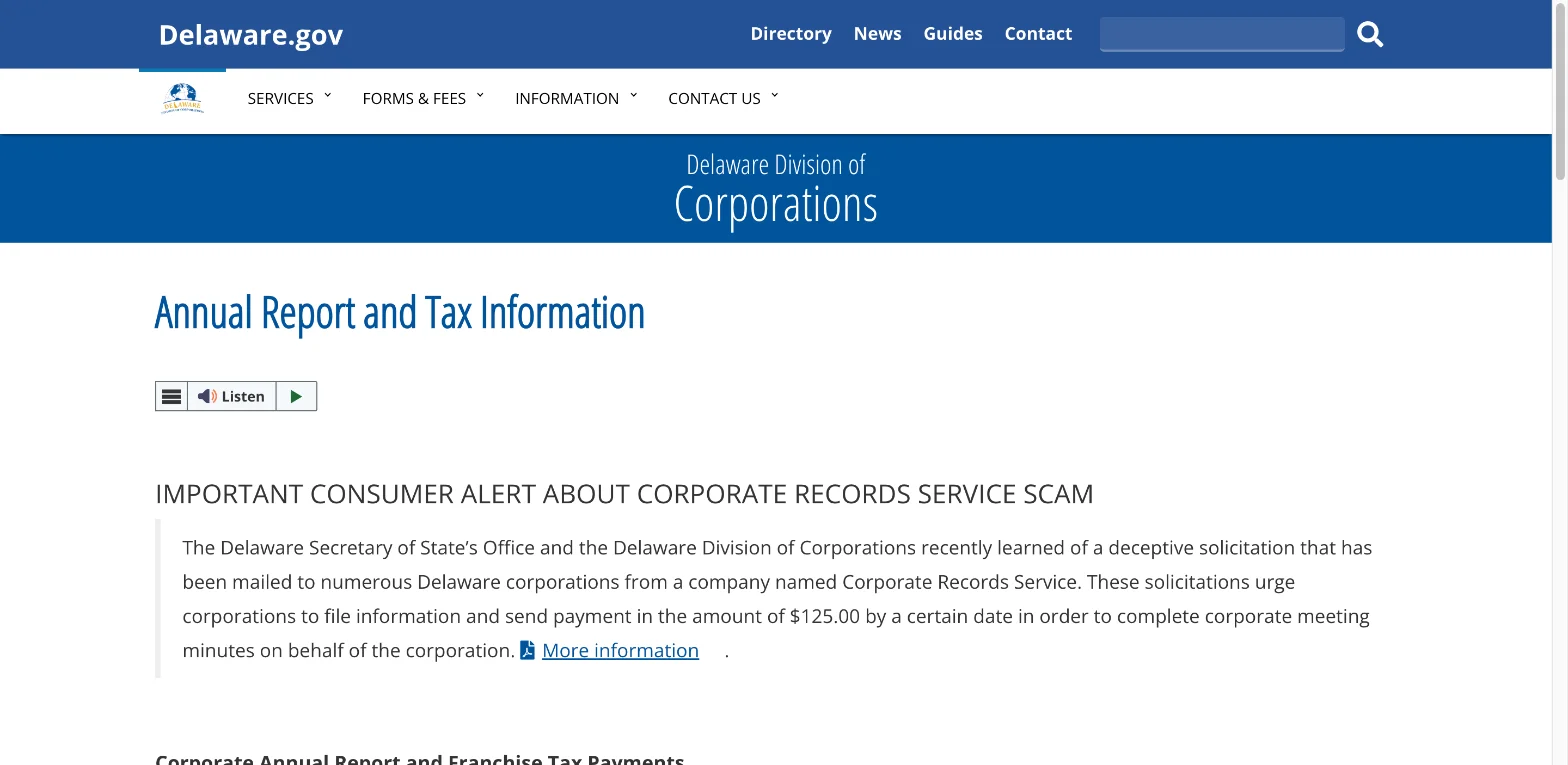
The Delaware franchise tax trap. Delaware calculates franchise tax in two ways, and the default can produce a scary bill for a startup with millions of authorized shares. The Delaware Division of Corporations sets these terms:
| Item | Amount |
|---|---|
| Minimum tax, Authorized Shares method | $175 |
| Minimum tax, Assumed Par Value Capital method | $400 |
| Maximum tax | $200,000, or $250,000 for Large Corporate Filers |
| Annual report fee (non-exempt domestic corporation) | $50 |
| Penalty for missing the March 1 annual report | $200, plus 1.5% interest a month on unpaid tax |
| LLC annual tax, due June 1 | $400 |
Many startups receive a five-figure franchise tax notice under the Authorized Shares method. Recalculating under the Assumed Par Value Capital method, which uses your total gross assets, often cuts the bill to a few hundred dollars. So always check both methods before you pay.
What Changed: BOI Reporting Is Gone for US Startups
Older checklists tell founders to file a Beneficial Ownership Information (BOI) report with FinCEN. You can now cross that off. On 11 August 2026, FinCEN issued a final rule that permanently exempts US companies and US persons from BOI reporting under the Corporate Transparency Act. FinCEN also deletes BOI that US persons reported earlier.
The rule still applies to foreign companies registered to do business in the US. If your startup is a foreign parent company with a US registration, ask your lawyer whether you need to file.
The Startup Compliance Checklist at a Glance
Copy this into your task tool and assign an owner to each line:
Formation
- Entity formed and registered agent appointed
- Bylaws, board and founder share issuance signed
- EIN obtained
- Business bank account opened
- Foreign qualification filed in your operating state
- Local licenses obtained
First 30 days
- 83(b) elections filed and proof kept
- IP assignment agreements signed
- Cap table set up
Fundraising
- Form D filed within 15 days of the first sale
- State securities notices filed
- Board consents and cap table updated
Hiring
- I-9, W-4 and new hire reporting for each employee
- Payroll provider set up with tax deposits
- Workers’ compensation and unemployment insurance in place
- Required posters and handbook in place
Every year
- 1099-NEC and W-2 by January 31
- Delaware annual report and franchise tax by March 1
- Federal and state tax returns filed
- State annual reports filed
- Insurance and licenses renewed
How to Stay on Top of It
A few habits keep compliance light:
- Put every deadline in a shared calendar with two reminders: one a month ahead and one a week ahead.
- Use a payroll provider from the first hire. It files the payroll forms for you.
- Keep a single compliance folder with formation documents, 83(b) proofs, Form D filings and board consents. Investors will ask for it during due diligence.
- Review the list each quarter with your accountant or lawyer.
This checklist explains common US requirements. It is not legal or tax advice, and your obligations depend on your state, industry and structure. So confirm the details with a startup lawyer or accountant.