
A stock split and a bonus issue both hand you more shares at a lower price, and on the day they happen your holding is worth exactly the same. The difference sits inside the company and in your tax file. A split cuts the face value of each share and leaves reserves alone. A bonus issue keeps the face value, turns part of the company’s reserves into share capital, and gives you new shares that the income tax law treats as costing nothing.
That last point is where Indian investors most often get caught. Sell bonus shares within a year of allotment and almost the entire sale value can be a short-term capital gain, even if your overall position is in loss. This guide explains both actions with worked arithmetic, uses Bajaj Finance’s 2025 split-plus-bonus as a live case, and shows how the tax rules play out, with a short comparison to how US companies do it.
Face Value, Reserves and Tax Treatment in Splits and Bonuses
- A split lowers face value (say ₹10 to ₹2) and multiplies the share count; reserves and paid-up capital do not change.
- A bonus issue keeps face value, moves money from free reserves, securities premium or capital redemption reserve into share capital under Section 63 of the Companies Act, 2013.
- Market cap and your holding’s value stay the same; price per share and EPS fall in the same proportion, so the P/E ratio does not move.
- Bonus shares have a nil cost of acquisition for tax, and their holding period starts on the allotment date.
- After a split, your original cost is spread across the larger number of shares.
Face Value and Reserves: Where a Split and a Bonus Part Ways
Every Indian share has a face value printed in the company’s memorandum, usually ₹10, ₹5, ₹2 or ₹1. Face value has nothing to do with the market price; it is the accounting unit of share capital, and it is the cleanest way to tell the two actions apart.
In a stock split (a sub-division of shares under Section 61 of the Companies Act), the company cuts each share into smaller pieces, so one ₹10 share becomes five ₹2 shares. Paid-up capital stays at the same rupee amount because five times ₹2 is still ₹10. Nothing moves on the balance sheet apart from the number of shares and their face value.
In a bonus issue, the company creates new fully paid shares at the existing face value and hands them to shareholders free. To pay for them on paper, it transfers an equal amount out of reserves into share capital. Section 63 of the Companies Act, 2013 allows only three sources: free reserves, the securities premium account and the capital redemption reserve account. Reserves created by revaluing assets cannot be used, and bonus shares cannot be issued in place of a dividend.
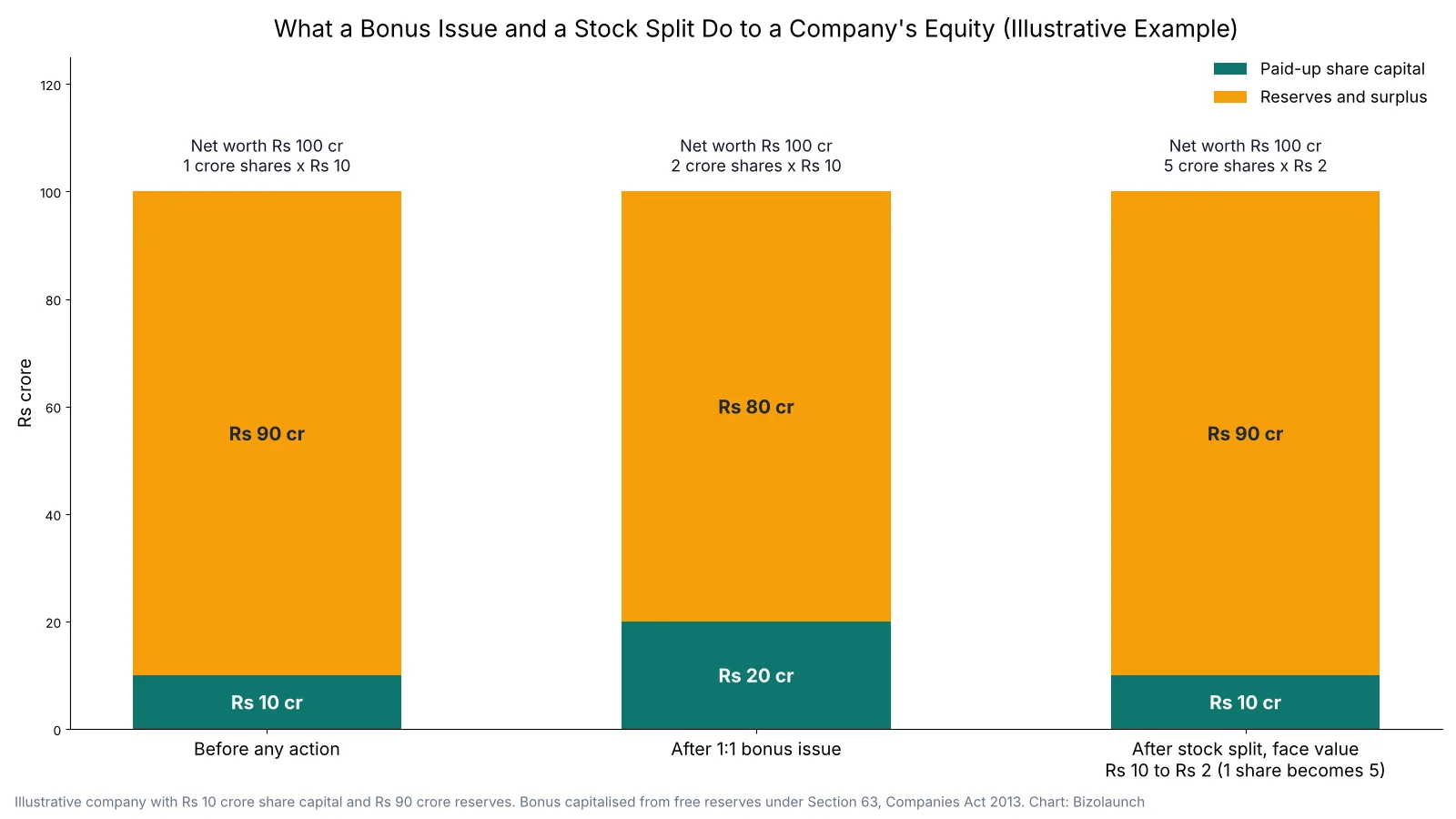
The chart shows that net worth stays at ₹100 crore in every case: a bonus only relabels part of the reserves as capital, while a split changes nothing but the size of each slice. Section 63 also sets conditions a split does not face: the articles must permit the issue, shareholders must approve it on the board’s recommendation, the company must not be in default on fixed deposits, debt securities or statutory employee dues such as provident fund and gratuity, and partly paid shares must be made fully paid first. Once the board announces a bonus, the rules bar it from withdrawing the announcement.
Those conditions are why many investors read a bonus as a sign of healthy reserves and clean books. A split carries no such message, since it is mainly a tool to bring a high share price down to a level more small investors can buy.
Share Count, Price and Market Cap: A Worked Example
Take a company with 1 crore shares of ₹10 face value, trading at ₹1,200, and annual profit of ₹50 crore. Its market cap is ₹1,200 crore and its earnings per share (EPS) is ₹50. An investor, Priya, holds 200 shares worth ₹2,40,000. The table tracks what each action does to her position, assuming the price adjusts exactly in line with the ratio.
| Item | Before | After 1:1 bonus | After split, ₹10 to ₹2 |
|---|---|---|---|
| Face value | ₹10 | ₹10 | ₹2 |
| Company’s shares | 1 crore | 2 crore | 5 crore |
| Priya’s shares | 200 | 400 | 1,000 |
| Price per share | ₹1,200 | ₹600 | ₹240 |
| Priya’s holding value | ₹2,40,000 | ₹2,40,000 | ₹2,40,000 |
| Market cap | ₹1,200 crore | ₹1,200 crore | ₹1,200 crore |
| Paid-up capital | ₹10 crore | ₹20 crore | ₹10 crore |
| EPS | ₹50 | ₹25 | ₹10 |
| P/E ratio | 24 | 24 | 24 |
The arithmetic for any ratio follows two simple rules. For a split, divide the old face value by the new one to get the multiplier: ₹10 to ₹2 gives five shares for each one held, so the price divides by five. For a bonus quoted as “A:B”, you get A new shares for every B you hold. The theoretical price after the ex-date is the old price multiplied by B and divided by (A + B). A 3:2 bonus on a ₹1,200 stock gives ₹1,200 × 2 ÷ 5 = ₹480, and 200 shares become 500. Our percentage calculator helps if you want to see the size of the drop.
Real prices rarely land exactly on the theoretical figure, because the stock keeps trading on news and market mood, but the adjustment itself creates no value. A shareholder who feels richer with 1,000 shares at ₹240 than with 200 at ₹1,200 is reacting to the count, not the worth.
What Happens to EPS, P/E and Dividend Per Share
Profit does not change, so EPS falls in the same ratio as the share count rises, and accounting standards stop this from distorting comparisons. Under IAS 33, which India’s Ind AS 33 follows, EPS for every period presented is restated for bonus issues and splits as if they had always been in place. That is why a company’s past EPS on a results page can look different from the figure it reported at the time.
The P/E ratio stays the same, as the table shows, since both price and EPS shrink by the same factor. Dividends per share work the same way. If the company paid ₹20 a share before a 1:1 bonus, a ₹10 dividend afterwards keeps Priya’s total dividend unchanged at ₹4,000. Any rise in the per-share dividend after a bonus is a real increase in payout, which is a separate board decision.
Bajaj Finance Did Both on the Same Day
Bajaj Finance gave investors a textbook case in 2025. The company announced both actions with its March 2025 quarter results and set Monday, 16 June 2025 as the record date. First came a split that cut the face value from ₹2 to ₹1, doubling the share count. A 4:1 bonus followed on the new ₹1 shares, adding four shares for every one held.
The combined effect was ten shares for every one held before, so an investor with 10 shares had 20 after the split and 100 after the bonus. The stock traded at ₹9,408.05 on 11 June 2025, so the theoretical price after both actions works out to about ₹940.81, one-tenth of that level. The same investor’s holding value would not change, yet the per-share price became far easier for small investors to buy in round lots.
Doing both in sequence matters for tax. The split shares carry the original cost divided by two, while the bonus shares carry a nil cost and a fresh holding period from their allotment date. One corporate action event therefore leaves Bajaj Finance holders with two kinds of shares that behave very differently when sold.
Record Date, Ex-Date and When the New Shares Arrive
Eligibility for a split or bonus works like eligibility for a dividend: you must hold the shares at the close of the record date, and under India’s T+1 settlement the ex-date and record date now usually fall on the same day. In practice, you have to buy by the trading day before the record date. Our guide to record date vs ex-date walks through the timeline and the exceptions caused by holidays.

Bonus shares now reach you quickly. A SEBI circular effective from 1 October 2024 set the deemed allotment date as the working day after the record date, with bonus shares credited by that day and tradable from the second working day after the record date. In that short gap, the price has already adjusted while the new shares have not shown up, so your portfolio may look as though it lost half its value. It has not, because the missing shares are already on their way.
On the ex-date, the stock opens in the normal pre-open session with its reference price adjusted for the new share count. It does not go through the separate call auction that new listings use, which is described in our explainer on the IPO special pre-open session.
How Bonus Shares Are Taxed in India
The core rule is short: bonus shares allotted to you without any payment have a cost of acquisition of nil. Under the Income-tax Act, 1961, this sat in Section 55(2)(aa). The Income-tax Act, 2025, which replaced it from 1 April 2026, keeps the same rule in Section 90(6)(d). Your original shares keep their own purchase cost and are not averaged with the bonus shares.
The holding period of the bonus shares starts on the date of allotment, not on the date you bought the original shares. Listed shares become long-term after 12 months, and since the Union Budget changes that took effect on 23 July 2024, short-term gains on listed equity are taxed at 20%, and long-term gains at 12.5% above an annual exemption of ₹1.25 lakh.
The Bonus Share Tax Trap, With Numbers
Rohan buys 100 shares at ₹1,000 on 10 January 2025, paying ₹1,00,000. The company issues a 1:1 bonus, and he receives 100 more shares on 12 May 2025. The price settles near ₹520. On 20 February 2026 he sells all 200 shares at ₹520 each, receiving ₹1,04,000 and making ₹4,000 overall, yet the tax picture looks very different.
| Lot | Cost | Held from | Sale value | Result |
|---|---|---|---|---|
| Original 100 shares | ₹1,00,000 | 10 Jan 2025 (over 12 months) | ₹52,000 | Long-term capital loss of ₹48,000 |
| Bonus 100 shares | Nil | 12 May 2025 (under 12 months) | ₹52,000 | Short-term capital gain of ₹52,000 |
A long-term loss can be set off only against long-term gains, and the unused part can be carried forward for up to eight years. So Rohan’s ₹48,000 loss cannot cancel his ₹52,000 short-term gain. At 20%, he owes ₹10,400 before surcharge and cess on a trade that made him ₹4,000.
Waiting would have changed the result. If Rohan holds the bonus shares past 12 May 2026 and sells everything in the same year at the same price, both lots are long-term. The ₹48,000 loss offsets the ₹52,000 gain, leaving ₹4,000 of net long-term gain, which falls inside the ₹1.25 lakh exemption, so his tax would be zero. Order also matters, since sales are matched first in, first out, as our guide on how FIFO and bonus shares change your average price shows.
Grandfathering for Bonus Shares Allotted Before February 2018
Before the 2018 Budget, long-term gains on listed shares were exempt from tax. To protect gains built up until 31 January 2018, the law lets you use a stepped-up cost for equity shares acquired before 1 February 2018, including bonus shares. This was Section 55(2)(ac) of the 1961 Act and is now Section 90(7) of the 2025 Act. The cost is the higher of your actual cost and the lower of two numbers: the share’s highest price on a recognised exchange on 31 January 2018, and your sale price.
| Bonus shares allotted in 2017, actual cost nil | Sold at ₹700 | Sold at ₹350 |
|---|---|---|
| Highest price on 31 Jan 2018 | ₹400 | ₹400 |
| Lower of that price and sale price | ₹400 | ₹350 |
| Cost used (higher of nil and the figure above) | ₹400 | ₹350 |
| Long-term gain per share | ₹300 | Nil |
Grandfathering only removes gains up to the 2018 price and cannot create a loss, which is why the second column shows nil rather than a negative figure. For bonus shares received before 1 April 2001, the law also lets you use the fair market value on 1 April 2001 as cost instead of actual cost.
How a Stock Split Changes Your Cost Per Share
A split creates no new cost and no income, because your total purchase cost stays the same and is simply spread across more shares. If you bought 200 shares at ₹1,500, for ₹3,00,000, and the company splits each ₹10 share into five ₹2 shares, you now hold 1,000 shares with a cost of ₹300 each. Sell 400 of them at ₹350 and your gain is ₹50 a share, or ₹20,000.
That is why a split is far simpler at tax time than a bonus: it creates no nil-cost lot, so the short-term trap above does not arise. Brokers update the quantity and per-share cost in your holdings statement after the ex-date, and the total cost figure should not change. If it does, raise it with your broker before you file. Other restructurings, such as a demerger, split your cost in a different way, as our guide on how a demerger works in India shows.
Stock Split vs Bonus Issue: Side-by-Side Comparison
| Feature | Stock split | Bonus issue |
|---|---|---|
| What happens | Each share is divided into smaller shares | New free shares are issued from reserves |
| Face value | Falls (for example, ₹10 to ₹2) | Unchanged |
| Paid-up share capital | Unchanged | Rises by the amount capitalised |
| Reserves | Unchanged | Fall by the same amount |
| Legal basis | Section 61, Companies Act, 2013 | Section 63, Companies Act, 2013 |
| Share count and price | Count multiplied, price divided by the split factor | Count rises by the ratio, price falls to B ÷ (A + B) of the old price |
| Market cap and net worth | Unchanged | Unchanged |
| EPS | Falls by the split factor; past periods restated | Falls by the bonus ratio; past periods restated |
| Tax cost of new shares | Original cost spread across all shares | Nil for bonus shares; originals keep their cost |
| Holding period of bonus shares | Not applicable | Starts on the allotment date |
| Usual signal | Make a high-priced share easier to buy | Reserves are large enough to capitalise |
How US Companies Handle Splits and Stock Dividends
US markets have splits but rarely use the term “bonus issue”. The closest match is a stock dividend, where a company distributes extra shares instead of cash. Ratios are also written the other way around. A US “2-for-1 split” means two new shares for each one held, which an Indian announcement would usually describe by the change in face value.
Timing differs as well. For US distributions worth 25% or more of the share value, which includes most splits, the US ex-date is the first business day after the payment date. In India, the ex-date and record date for a split or bonus generally coincide. On tax, the IRS treats an ordinary stock split as non-taxable and spreads your basis across the new shares.
Questions Shareholders Ask About Splits and Bonus Shares
Which Is Better for Shareholders, a Split or a Bonus Issue?
Neither adds value on the day it happens. A bonus tends to be read as a sign of strong reserves, while a split mainly makes the share cheaper to buy. For tax, a split is simpler, since bonus shares carry a nil cost and a fresh holding period.
Why Did My Share Price Fall After a Bonus Issue?
The price adjusts for the larger number of shares. After a 1:1 bonus, the price roughly halves while your share count doubles, so your holding value stays the same. Bonus shares can take a day to appear in your demat account.
What Is the Cost of Acquisition of Bonus Shares?
Nil, under Section 90(6)(d) of the Income-tax Act, 2025, which carried over Section 55 of the 1961 Act. For bonus shares acquired before 1 February 2018, grandfathering can raise the cost to the 31 January 2018 price, capped at your sale price.
Does a Stock Split Change My Average Buy Price?
Yes. The average falls by the split factor, while your total cost of the holding stays exactly the same. A ₹1,500 average becomes ₹300 after a ₹10 to ₹2 split.
Can a Company Issue Bonus Shares Instead of a Dividend?
No. Section 63(3) of the Companies Act, 2013 says bonus shares cannot be issued in lieu of dividend.
Companies Act Section 63 and Income-Tax Rules on Bonus Cost
- Companies Act, 2013, Section 63: Issue of Bonus Shares
- Income Tax Department: Section 90, Income-tax Act, 2025
- Income Tax Department: Section 55, Income-tax Act, 1961
- Deloitte: India Budget 2024 Changes to Capital Gains
- Dalal Street Investment Journal: Bonus Shares and Stock Splits, Different Tax Maths
- ClearTax: Capital Gains Tax in India
- Business Today: Bajaj Finance Stock Split and Bonus Issue (June 2025)
- Taxscan: SEBI Circular on T+2 Trading of Bonus Shares
- IAS Plus: IAS 33 Earnings per Share
- Investor.gov: Ex-Dividend Dates
- IRS: Publication 550, Investment Income and Expenses
This article is for information and education only and is not investment, tax or financial advice. Figures were checked on 1 November 2026; confirm current details with the official source or a registered adviser before acting.