
A master’s degree in artificial intelligence in the US can cost as little as $10,000 or well over $100,000, and the gap has little to do with the letters on the diploma. The University of Texas at Austin sells its online MS in Artificial Intelligence for $10,000 plus fees, while Northwestern estimates about $125,000 all-in for its on-campus MS in AI. Between them sit Carnegie Mellon, Johns Hopkins, Penn, Purdue, the University of Colorado Boulder and dozens of newer programs.
This guide covers universities in the USA offering a master’s in AI as a named degree (artificial intelligence in the title, not a computer science degree with an AI track). We checked tuition, format and length on each university’s own program or tuition page in October 2026, and marked the few figures that come from Fortune Education’s national roundup instead. Then come admission requirements, STEM OPT rules for international students, and a framework for choosing.
UT Austin at $10,000 to Carnegie Mellon at $32,400 a Semester
- The cheapest named AI master’s we verified is UT Austin’s online MSAI at $10,000 plus fees, followed by CU Boulder’s online MS in AI at $15,750 (30 credits at $525).
- The priciest are full-time campus programs: Northwestern charges $23,662 a quarter in 2026-27 for four quarters, and Carnegie Mellon’s MSAII bills $32,400 a semester.
- Johns Hopkins now runs a full-time, in-person MS in AI at its Washington, DC building, alongside its long-running part-time online version. The DC program requires no GRE and charges no application fee.
- Artificial Intelligence has its own code, CIP 11.0102, on the DHS STEM Designated Degree Program List, which makes graduates eligible for the 24-month STEM OPT extension if the I-20 carries a STEM code.
- Fully online programs suit working professionals in the US. International students who need an F-1 visa should look at the campus programs.
Universities in USA Offering Masters in AI: Verified Comparison
Figures as published on each program’s official page, data as of October 2026. Rows marked (F) use the cost published in Fortune Education’s guide to AI master’s programs because the university page does not show a total.
| University | Degree | Format | Credits or courses | Published tuition | Length |
|---|---|---|---|---|---|
| Carnegie Mellon University | MS in Artificial Intelligence and Innovation (MSAII) | On campus, Pittsburgh | Full-time load of at least 36 units a semester; courses are typically 12 units | $32,400 per semester (fall 2026 and spring 2027) | Full-time, multi-semester |
| University of Pennsylvania | Master of Science in Engineering in AI (MSE-AI Online) | Online | Part-time course load | $36,560 total (F) | 16 to 40 months (F) |
| Northwestern University | MS in Artificial Intelligence (MSAI) | On campus, Evanston | Four quarters of full-time tuition | $23,662 per quarter (2026-27), about $94,648 in tuition | Fall to the following fall, with a summer internship quarter |
| Johns Hopkins University | MS in Artificial Intelligence (Engineering for Professionals) | Online part-time; full-time in person in Washington, DC | 10 courses in the published DC curriculum | DC: $68,680 for fall 2026 and spring 2027; online $52,700 total (F) | DC: fall 2026 to fall 2027 |
| University of Texas at Austin | MS in Artificial Intelligence (MSAI) | Online | 10 courses | $10,000 plus fees | 18 to 36 months |
| Purdue University | MS in Artificial Intelligence (two tracks) | Online | Two tracks: AI and Machine Learning; AI Management and Policy | $28,000 total (F) | Part-time, three intakes a year |
| University of Colorado Boulder | MS in Artificial Intelligence | Online (Coursera) | 30 credit hours | $525 per credit, $15,750 total | Self-paced, several terms a year |
The Best AI Master’s Programs in the US, Program by Program
Our order weighs three things: how central AI is to the degree, the strength of the school’s computer science and engineering faculty, and value for the published price. A different weighting (lowest cost, or online only) would reorder the list, and the decision section further down shows how.
1. Carnegie Mellon University: MS in AI and Innovation
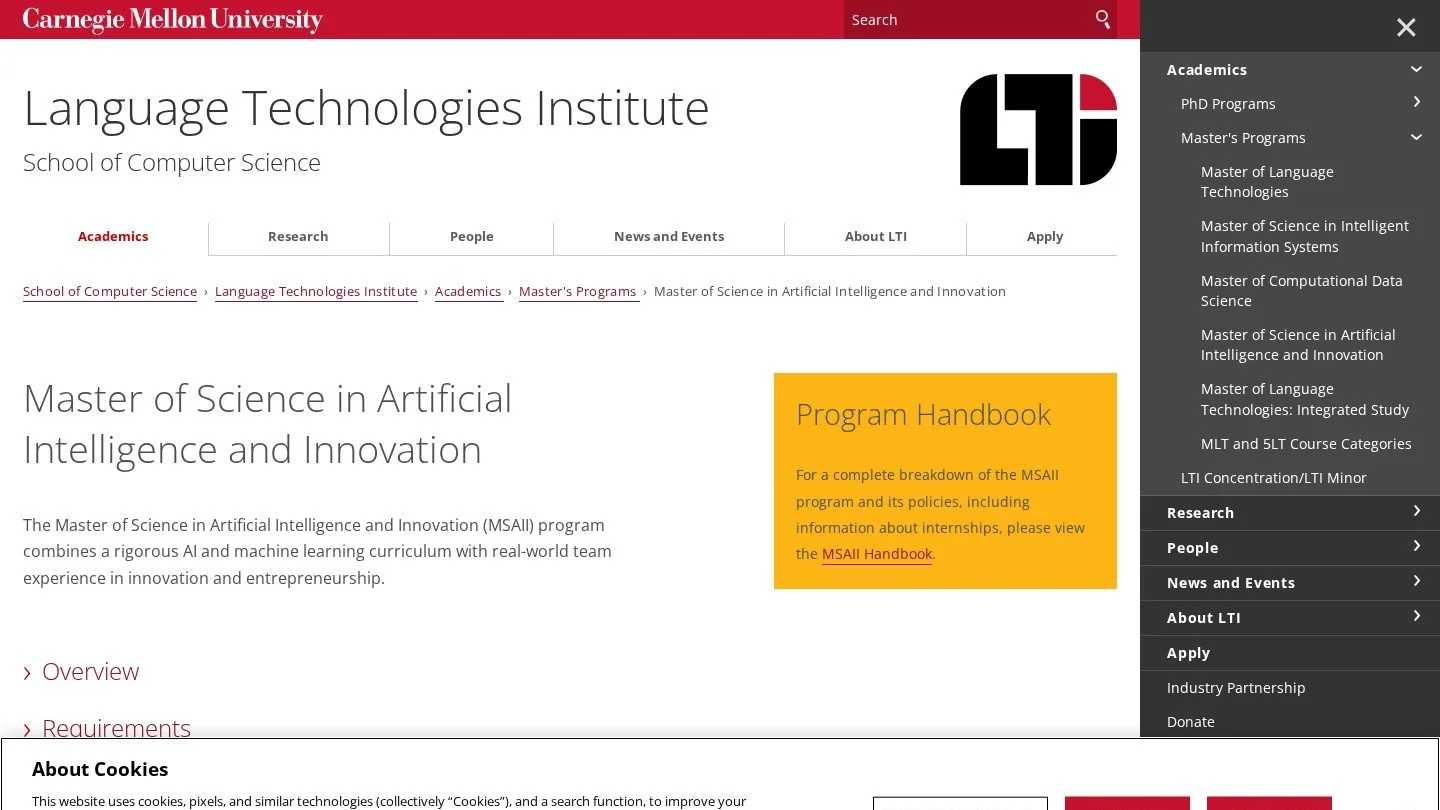
Carnegie Mellon’s School of Computer Science runs the Master of Science in Artificial Intelligence and Innovation through its Language Technologies Institute. The degree pairs graduate AI coursework with building a product, which makes it attractive to students who want to start a company or lead an AI product team rather than do pure research.
The program fee page lists tuition of $32,400 a semester for fall 2026 and spring 2027, so a single academic year comes to $64,800 before fees, books and insurance. The program does not offer its own financial aid, and teaching assistantships, when available in later semesters, cover only a small part of tuition. Admitted students must also take and pay for a distance course, 15-503 Introduction to Computer Systems, before arriving, and bring their own laptop. CMU tells students to budget for costs rising about 5% a year.
CMU offers more than one AI master’s. Alongside MSAII, Fortune lists AI engineering master’s programs and an AI program at the CMU-Africa campus in Rwanda, priced from about $57,435 at the low end.
2. University of Pennsylvania: MSE in AI (Online)
Penn Engineering’s MSE-AI Online gives an Ivy League engineering degree in AI without relocating. Fortune puts the total at $36,560 and the completion window at 16 to 40 months, which makes it one of the better-value names on the list. Penn also lists a dual-degree option for the online MSE-AI. Check current per-course pricing on Penn’s tuition page before you apply.
3. Northwestern University: MS in Artificial Intelligence
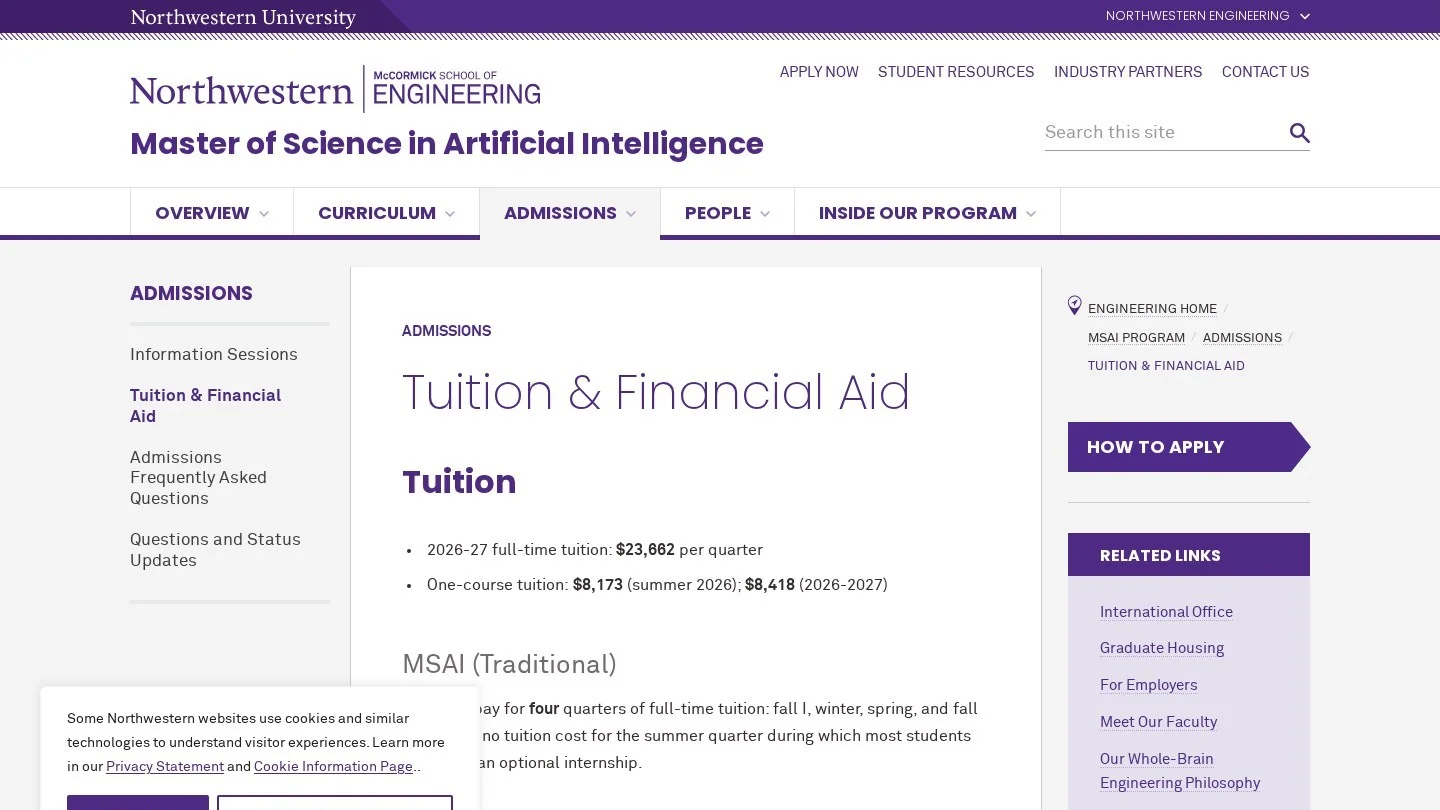
Northwestern’s McCormick School of Engineering runs one of the older dedicated AI master’s degrees in the US. In 2026-27, full-time tuition is $23,662 a quarter, according to the MSAI tuition page. The traditional track bills four quarters (fall, winter, spring and a second fall), with summer tuition-free so students can take an internship. That is $94,648 in tuition. Add the $125 activity fee and $298 health services fee each quarter and the total reaches $96,340 before housing.
A second route, MSAI+X, starts in summer with one course and then three full-time quarters, which suits students who want to combine the degree with another field. Northwestern estimates the all-in cost, including about $24,000 a year for on-campus living, at around $125,000, and it offers no program-level scholarships or teaching assistantships.
4. Johns Hopkins University: MS in Artificial Intelligence

Johns Hopkins Engineering for Professionals has offered a part-time online MS in AI for working engineers, which Fortune prices at $52,700. The newer option is a full-time, in-person version at the Hopkins Bloomberg Center at 555 Pennsylvania Avenue in Washington, DC, starting fall 2026.
The DC program page lays out 10 courses across three terms: three core courses in fall 2026, one core and three electives in spring 2027 and three electives in fall 2027. Resident tuition for fall and spring is $68,680, and fall 2026 entrants receive a standard 10% tuition fellowship each semester, bringing that figure to about $61,812. The estimated 2026-27 cost of attendance, including housing and food, is $106,646. Applicants skip the GRE and pay no application fee.
5. University of Texas at Austin: Online MSAI
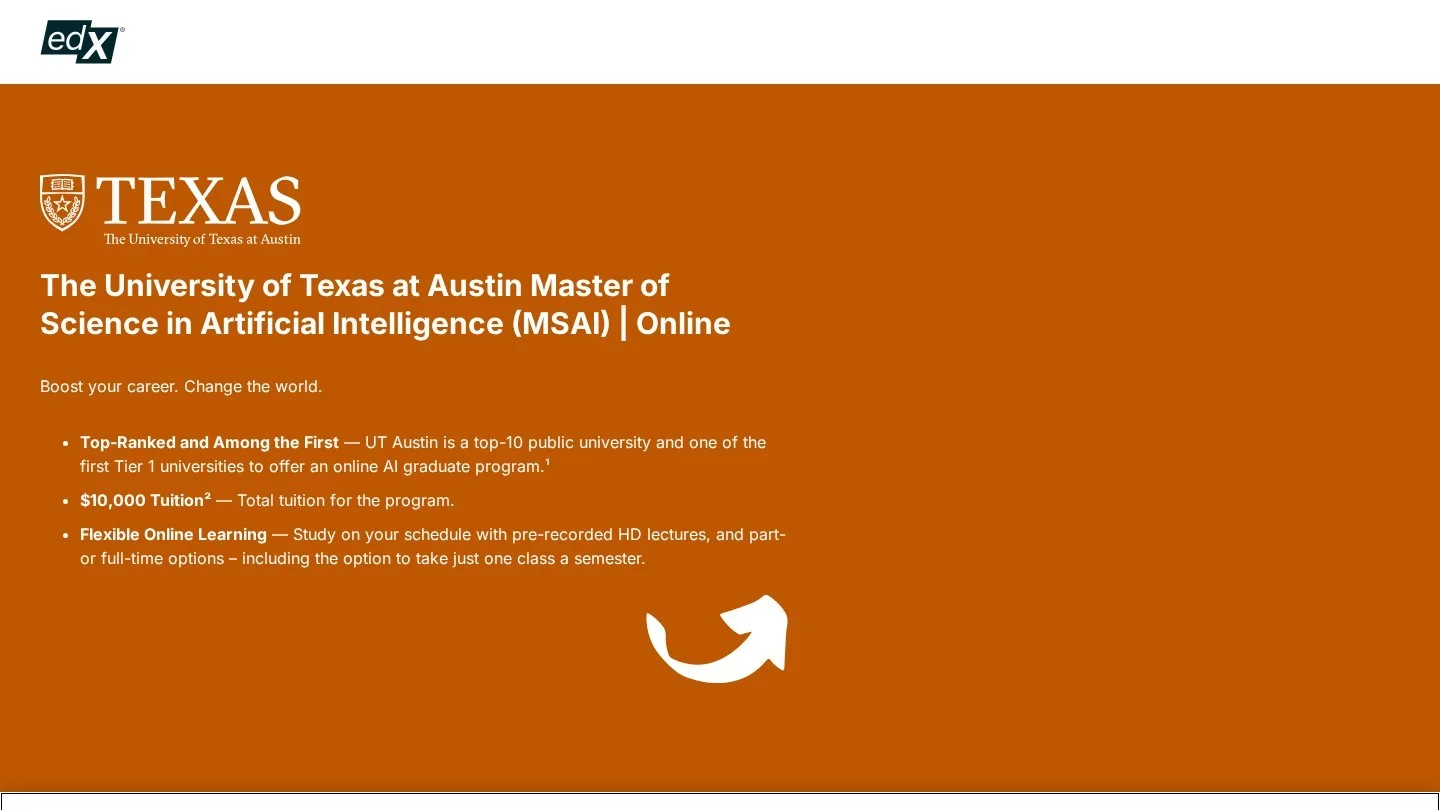
UT Austin’s online MSAI is the price outlier: $10,000 for the program, with additional fees possible, and 18 to 36 months to finish. Lectures are pre-recorded and students can take a single class a semester. Fortune lists the degree at 10 courses. For a working software engineer in the US who wants a recognized AI master’s without leaving a job, few programs come close on value.
6. Purdue University: Online MS in Artificial Intelligence

Purdue’s online MS in AI splits into two tracks: AI and Machine Learning for technical builders, and AI Management and Policy for people who will govern and deploy AI rather than code it. Fortune lists the cost at $28,000 and application deadlines of August 1, December 1 and April 1. The policy track is unusual among AI master’s degrees, and it maps closely to the work of writing an AI acceptable use policy or running AI governance inside a company. Current rates are on Purdue’s tuition page.
7. University of Colorado Boulder: Online MS in AI
CU Boulder’s MS in Artificial Intelligence runs on Coursera and costs $525 a credit hour, or $15,750 for 30 credits (15 breadth credits and 15 electives), whatever your state of residence. Admission is performance-based: you complete three one-credit pathway courses in statistics or computer science with a 3.0 GPA or better, with no transcripts or traditional application. That makes it the easiest program here to test before committing real money.
More Universities Offering a Master’s Degree in AI
The named AI master’s has spread fast beyond the big research schools. The programs below appear in Fortune Education’s guide with the costs it lists; treat them as a starting point and confirm current rates on each university’s site.
| University | Degree (as listed) | Format | Cost listed by Fortune |
|---|---|---|---|
| Duke University | Master of Engineering in AI for Product Innovation | Online or on campus | $98,970; as little as 12 months |
| Drexel University | Master’s in AI and Machine Learning | Online or on campus | $64,710; 2 to 4 years |
| Arizona State University | Master’s in AI in Business | In person | $60,035 |
| Syracuse University | Master’s in AI | In person | $60,000 |
| Illinois Tech | Master’s in AI | Online or in person | $53,400 |
| Yeshiva University | MS in AI | In person | $48,924; 12 courses |
| DePaul University | MS in Artificial Intelligence | Online or in person | $45,840 |
| University of Washington | MS in AI and Machine Learning Engineering | In person | $41,250 to $43,500 |
| East Texas A&M University | MS in Artificial Intelligence | Online | $41,344; 2 years |
| Penn State | Master’s in AI | Online (also Great Valley campus) | $38,415 |
| University of North Texas | MS in AI | Online or in person | $36,000; about 33 credit hours |
| Kennesaw State University | MS in AI | Online or in person | $33,984; thesis or capstone |
| University of San Diego | MS in Applied AI | Online | $28,950 ($965 per unit, 30 units); 20 months |
| Auburn University | MS in AI Engineering | Online or in person | $28,470 to $46,470 |
| Maryville University | MS in Artificial Intelligence | Online | $27,225; 2 years part-time |
| University of Houston-Downtown | MS in AI | In person or hybrid | $24,000; about 31 credit hours |
| University of Michigan-Dearborn | MS in AI | Online or in person | $20,000 to $51,000 |
Tuition per Credit Across Online and Campus AI Degrees
Sticker prices are hard to compare because schools quote per credit, per quarter, per semester or per program. Converting to a common base helps. The figures below use the published tuition only (no fees, insurance or living costs) and divide by 30 credits, the size of a typical US master’s degree, to give a rough per-credit equivalent.
| Program | Tuition basis | Tuition | Rough cost per credit (30-credit basis) |
|---|---|---|---|
| UT Austin MSAI (online) | Whole program | $10,000 | About $333 |
| CU Boulder MS in AI (online) | 30 credits x $525 | $15,750 | $525 |
| Purdue MS in AI (online) | Whole program (F) | $28,000 | About $933 |
| Penn MSE-AI Online | Whole program (F) | $36,560 | About $1,219 |
| Johns Hopkins MS in AI (online) | Whole program (F) | $52,700 | About $1,757 |
| Johns Hopkins MS in AI (DC) | Fall 2026 and spring 2027 after 10% fellowship | $61,812 | Not comparable: excludes the fall 2027 term |
| Carnegie Mellon MSAII | One academic year (2 x $32,400) | $64,800 | Not comparable: one year only |
| Northwestern MSAI | 4 quarters x $23,662 | $94,648 | About $3,155 |
Two lessons stand out. Online programs at strong public universities cost a fraction of private campus degrees, often a tenth. And the campus premium buys things a recorded lecture cannot: research labs, recruiting on campus, a cohort, and for international students, a visa.
Admission Requirements for a Master’s in AI in the USA
Requirements vary by school, but most programs look for the same foundation:
- A bachelor’s degree in computer science, engineering, mathematics, statistics or a related field. Applicants from other fields usually need to show the math and programming below.
- Mathematics: calculus, linear algebra and probability and statistics are the usual prerequisites for machine learning coursework.
- Programming: working fluency in Python and data structures; CMU also requires admitted MSAII students to complete a computer systems course before starting.
- Test scores: many AI master’s programs have dropped the GRE. Johns Hopkins’ DC program states that no GRE is required.
- English proficiency: international applicants from non-English-speaking systems are generally asked for TOEFL, IELTS or a similar score.
- Statement, resume and recommendations: standard for the campus programs; a strong statement explains what you want to build with AI.
Two programs break the mold. CU Boulder admits on performance in its pathway courses, with no transcripts. UT Austin’s online MSAI and Purdue run multiple intakes, and Purdue’s deadlines are August 1, December 1 and April 1, per Fortune.
STEM OPT Eligibility for International Students in AI Master’s Programs
For an international student, the most valuable feature of a US AI master’s is often the right to work afterward. The DHS STEM Designated Degree Program List, last updated on July 22, 2024, includes CIP code 11.0102, Artificial Intelligence, and the list governs eligibility for the 24-month STEM optional practical training extension under 8 CFR 214.2(f). Data Science (30.7001) and the computer engineering codes in series 14 are on it too.
- The CIP code decides, not the degree name. STEM OPT eligibility follows the CIP code printed on your I-20. Ask the international student office which code the program uses before you accept an offer.
- Online programs do not fit F-1 study. F-1 rules count only a limited amount of online coursework toward full-time study, so the fully online degrees above (UT Austin, CU Boulder, Purdue, Penn Online, JHU online) are aimed at people already living and working in the US or studying from abroad without a visa.
- Campus programs are the visa route. CMU’s MSAII, Northwestern’s MSAI and the new Johns Hopkins DC program are full-time, in person and built for international cohorts.
- Internships need CPT. Northwestern’s summer internship quarter and similar placements usually run on Curricular Practical Training authorized by the school.
How to Choose Between AI Master’s Programs
| If you are… | Look at | Why |
|---|---|---|
| A working engineer in the US on a budget | UT Austin MSAI, CU Boulder MS in AI | Lowest published tuition, part-time, recorded lectures |
| Wanting an Ivy or top-ten name without moving | Penn MSE-AI Online, Johns Hopkins online | Brand-name engineering schools at mid-range prices |
| An international student needing F-1 and STEM OPT | CMU MSAII, Northwestern MSAI, Johns Hopkins DC | Full-time, in person, built-in internship or cohort |
| Moving into AI management, policy or governance | Purdue (AI Management and Policy track) | Non-coding track focused on deploying and governing AI |
| Planning to start an AI product company | CMU MSAII, Duke AI for Product Innovation | Degrees built around product and innovation |
| Unsure whether graduate AI is for you | CU Boulder pathway courses | Three one-credit courses decide admission, low cost to test |
A few more filters worth applying:
- Read the course list, not the brochure. A strong AI master’s covers machine learning theory, deep learning, natural language processing or computer vision, and responsible AI. Our explainer on retrieval augmented generation is a good test of whether a program teaches current applied methods.
- AI master’s or CS master’s with an AI track. A named AI degree signals focus. A computer science MS with AI electives can be broader and is sometimes cheaper. Employers hiring ML engineers care more about projects than about the diploma’s title.
- Count the full cost. Northwestern’s own estimate is about $125,000 all-in, and Johns Hopkins puts its DC cost of attendance at $106,646 for one year.
- Check thesis and capstone options if a PhD is a possibility later. Kennesaw State, for example, requires a thesis or capstone, according to Fortune.
- Compare with certifications. If the goal is a job switch rather than a credential, our list of high-paying certifications shows cheaper routes into technical work.
Masters in AI in the USA: Common Questions
Which US University Has the Cheapest Master’s in AI?
Among the programs we verified, UT Austin’s online MSAI is the cheapest at $10,000 plus fees, followed by CU Boulder’s online MS in AI at $15,750, according to the UT Austin and CU Boulder program pages.
Is a Master’s in AI STEM OPT Eligible?
Artificial Intelligence (CIP 11.0102) is on the DHS STEM list, so a program classified under that code qualifies for the 24-month STEM OPT extension. Eligibility depends on the CIP code on your I-20, so confirm it with the school.
Can You Get a Master’s in AI Without a Computer Science Degree?
Yes, if you can show the math and programming. CU Boulder admits through pathway courses rather than transcripts, and Purdue’s AI Management and Policy track is designed for people who will manage AI rather than build models.
How Long Does a Master’s in AI Take in the US?
Full-time campus programs run about 12 to 18 months; Northwestern’s MSAI runs from one fall to the next with a summer internship. Part-time online programs take longer: 18 to 36 months at UT Austin and 16 to 40 months at Penn.
Is the GRE Required for a Master’s in AI?
Often not. Johns Hopkins’ DC program states that no GRE is required, and CU Boulder uses pathway course grades instead of an application. Check each program, because policies change by year.
Tuition Notices From CMU, Northwestern, UT Austin and Others
- Carnegie Mellon University: Master of Science in Artificial Intelligence and Innovation
- Carnegie Mellon MSAII: Fees and financial aid
- Northwestern University McCormick: MS in AI tuition and financial aid
- Johns Hopkins Engineering: MS in AI in Washington, DC
- University of Texas at Austin: Online MS in Artificial Intelligence (edX)
- University of Colorado Boulder: Online MS in Artificial Intelligence
- Penn Engineering Online: MSE-AI Online
- Penn Engineering Online: MSE-AI Online dual degree
- Penn Engineering Online: Tuition and financial aid
- Purdue University: Online AI degree tuition and cost
- Fortune Education: Master’s in artificial intelligence programs
- US Immigration and Customs Enforcement: DHS STEM Designated Degree Program List (July 2024)