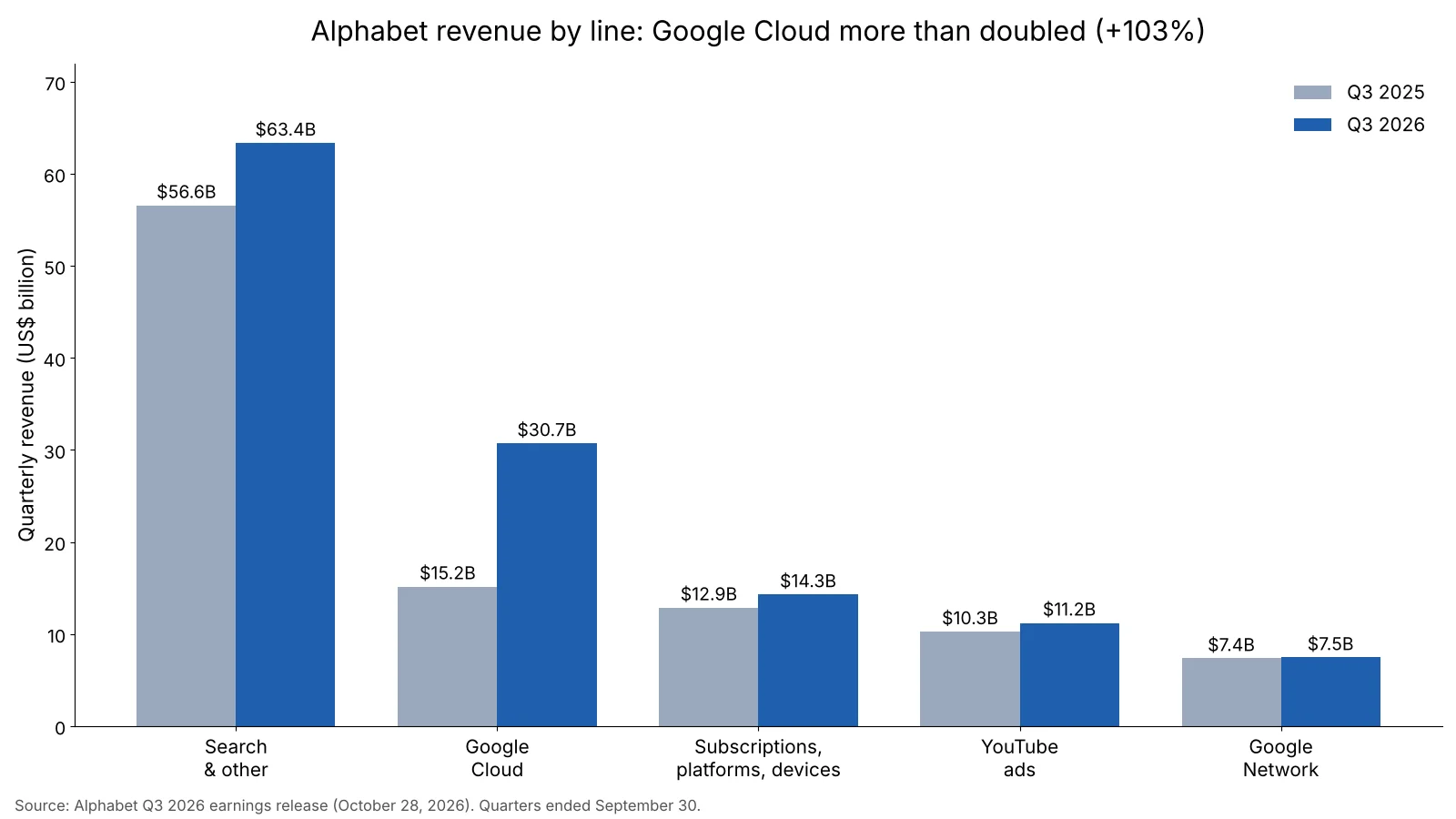
Google Cloud now earns more in a quarter than YouTube ads and Google’s subscriptions business combined. In Alphabet’s third-quarter results released on October 28, 2026, cloud revenue more than doubled, rising 103% to $30.7 billion, while its operating income tripled to $11.1 billion. The same report showed Search growth slowing to 12%, capital spending of $51.4 billion and negative free cash flow, and the shares fell more than 11% in after-hours trading.
Google Cloud’s Quarter in Brief
- Cloud revenue rose from $15.2 billion to $30.7 billion, and its operating margin widened from 23.7% to 36.2%.
- The cloud backlog reached $561 billion, and Alphabet expects to book just over 55% of it as revenue within 24 months.
- Alphabet’s total revenue grew 25% to $127.6 billion, but Search grew only 12%.
- Capital spending of $51.4 billion left free cash flow at minus $9.1 billion for the quarter.
How Google Cloud Went From $15 Billion to $31 Billion in a Year
A year ago, Google Cloud brought in $15.2 billion in the September quarter. This year it brought in $30.7 billion, close to a quarter of Alphabet’s revenue. The earnings call pointed to two drivers: heavy demand from companies running AI workloads on Google’s infrastructure, and sales of complete systems built on Google’s own AI chips, called TPUs.
Google Cloud chief Thomas Kurian said on the earnings call that growth was “again very, very strong” even without TPU system sales. He said more than 2,600 customers had used at least 100 billion tokens each over the past 12 months. Tokens are the small units of text that AI models read and write, so that number is a rough measure of heavy AI use.
Profit grew even faster than sales. Cloud operating income rose from $3.6 billion to $11.1 billion, which lifted the margin from 23.7% to 36.2%.
| Alphabet Revenue Line | Q3 2025 | Q3 2026 | Growth |
|---|---|---|---|
| Google Search and other | $56.6B | $63.4B | 12% |
| Google Cloud | $15.2B | $30.7B | 103% |
| Subscriptions, platforms and devices | $12.9B | $14.3B | 11% |
| YouTube ads | $10.3B | $11.2B | 9% |
| Google Network | $7.4B | $7.5B | 1% |
| Total Alphabet revenue | $102.3B | $127.6B | 25% |
The $561 Billion Cloud Backlog and the Capacity Squeeze
The backlog is the clearest sign of what comes next. Chief financial officer Anat Ashkenazi said Google Cloud ended the quarter with $561 billion in contracted work, and she expects a little more than 55% of it to turn into revenue over the next two years. Customers have already signed for that money; Google now has to build the capacity to deliver it.
That is the hard part. Alphabet began renting third-party computing capacity at the end of the quarter and will use more of it in the fourth quarter, which Ashkenazi said will weigh on margins in the near term. Kurian put it plainly: “we could obviously serve a lot more demand with capacity.” Ashkenazi also said TPU system sales should keep growing this quarter, “followed by a meaningful revenue ramp in 2027.”
Business buyers are also adopting Google’s AI tools at scale. Kurian said nearly 90% of the Fortune 100 use Gemini Enterprise, and that Alphabet has sold more than 100 million seats for knowledge work across its AI services. Chief executive Sundar Pichai said in the release that the Gemini app “has reached one billion users” and that Google’s own model APIs are processing nearly 32 billion tokens per minute.
Search Slows as AI Mode Grows
The weaker part of the report was Search. Revenue from Search and other grew 12% to $63.4 billion. Analysts had expected about 15%, and growth had been 17% in the second quarter and 19% in the first.
Philipp Schindler, Google’s chief business officer, said currency moves were the largest cause of the slowdown. He also pointed to AI Mode, Google’s conversational search, saying “the strong growth in AI Mode queries had an impact because of the lower monetization.” In plain terms, more people are asking AI questions, and Google earns less per AI answer than per classic search page for now. Ashkenazi warned that Search growth in the fourth quarter will face a tougher comparison with late 2025.
For marketers and website owners, that shift matters as much as the revenue figure. If AI answers take a bigger share of searches, organic traffic patterns change too. Small teams tracking this with lower-cost SEO tools can compare options in our guide to Ahrefs alternatives without a subscription.

Capex, the SpaceX Loss and Negative Cash Flow
Alphabet spent $51.4 billion on property and equipment in the quarter, and free cash flow came in at minus $9.1 billion. The company kept its 2026 capital spending guidance at $195 billion to $205 billion, and Ashkenazi said spending will rise significantly in 2027, with details due on the next call.
Earnings per share fell to $2.12 from $2.87 even though operating income rose about 30% to $40.6 billion. The gap came from an $8.7 billion loss on equity securities, which Ashkenazi said was mainly an unrealized loss on Alphabet’s stake in SpaceX after a fall in its share price. Alphabet also raised $84.8 billion in equity in June, including $10 billion from Berkshire Hathaway, to help fund the AI buildout.
What Google’s Cloud Surge Means for Businesses and Job Seekers
For companies buying cloud services, the message is that AI capacity is still tight at the largest providers. Teams planning large AI projects on Google Cloud should talk to their account managers about capacity and pricing early. Usage-based billing is common for AI services, so it helps to understand how that differs from flat seat pricing; our explainer on SaaS pricing models walks through the trade-offs. If your project connects a model to company documents, our guide to retrieval-augmented generation explains how that works.
For job seekers, Alphabet ended the quarter with 204,757 employees, up from 190,167 a year earlier. That is a net gain of 14,590 people in a year, a useful signal for anyone applying to Google’s cloud and AI teams.
What Google Cloud’s Quarter Shows About Its AI Bet
This quarter Google Cloud posted growth well ahead of the 48% that Microsoft reported for Azure the same day, with a margin above 36% and a backlog that covers years of work. Owning its own chips is paying off, because Google can sell TPUs as well as rent them.
The market’s reaction shows the other side of the ledger. Search, still about half of Alphabet’s revenue, is growing more slowly while Google moves users to AI answers that earn less today. Capital spending is now larger than operating cash flow. Alphabet’s bet is that cloud and AI revenue will grow fast enough to pay for both, and the backlog suggests customers are, for now, willing to sign up.
This article is for information and education only and is not investment, tax or financial advice. Figures were checked on November 2, 2026; confirm current details with the official source or a registered adviser before acting.
Common Questions on Google Cloud’s Results
How Much Revenue Did Google Cloud Make in Q3 2026?
Google Cloud made $30.7 billion in the quarter to September 30, 2026, up 103% from $15.2 billion a year earlier.
Why Did Alphabet’s Earnings Per Share Fall?
An $8.7 billion loss on equity securities, mainly an unrealized loss on its SpaceX stake, cut EPS to $2.12 from $2.87.
What Is Google Cloud’s Backlog?
Alphabet reported a cloud backlog of $561 billion at the end of September, with just over 55% expected to become revenue within 24 months.