A John Deere sprayer moving at 15 mph covers 22 feet every second. If its cameras had to send each weed photo to a distant data center and wait for an answer, the boom would be well past the weed before the nozzle fired. So the computers ride on the sprayer itself. That, in one example, is edge computing: processing data where it is created, because sending it away is too slow, too costly or too risky.
Edge computing is now used in almost every industry that runs machines, cameras or sensors. Retail and services spend the most on it, manufacturing comes second, and financial services is growing fastest. Below, we walk through real deployments industry by industry, with the numbers each company has published and our own math on why the work has to happen locally.

Why Distance Forces Some Computing to the Edge
Two physical limits push work out of the cloud. The first is the speed of light in glass. Light in optical fiber adds about five microseconds of delay per kilometer. That sounds tiny until you add up a round trip.
We worked out the best possible round-trip time for several distances, counting only travel through fiber. Real networks add routing, queuing and processing on top, so actual delays are always longer.
| One-way distance to the data center | Round trip in fiber (minimum) | How far a sprayer at 15 mph travels in that time |
|---|---|---|
| 50 km (nearby metro site) | 0.5 ms | 0.1 inch |
| 300 km (regional cloud zone) | 3 ms | 0.8 inch |
| 1,000 km | 10 ms | 2.6 inches |
| 2,000 km | 20 ms | 5.3 inches |
| 4,000 km (across the US) | 40 ms | 10.6 inches |
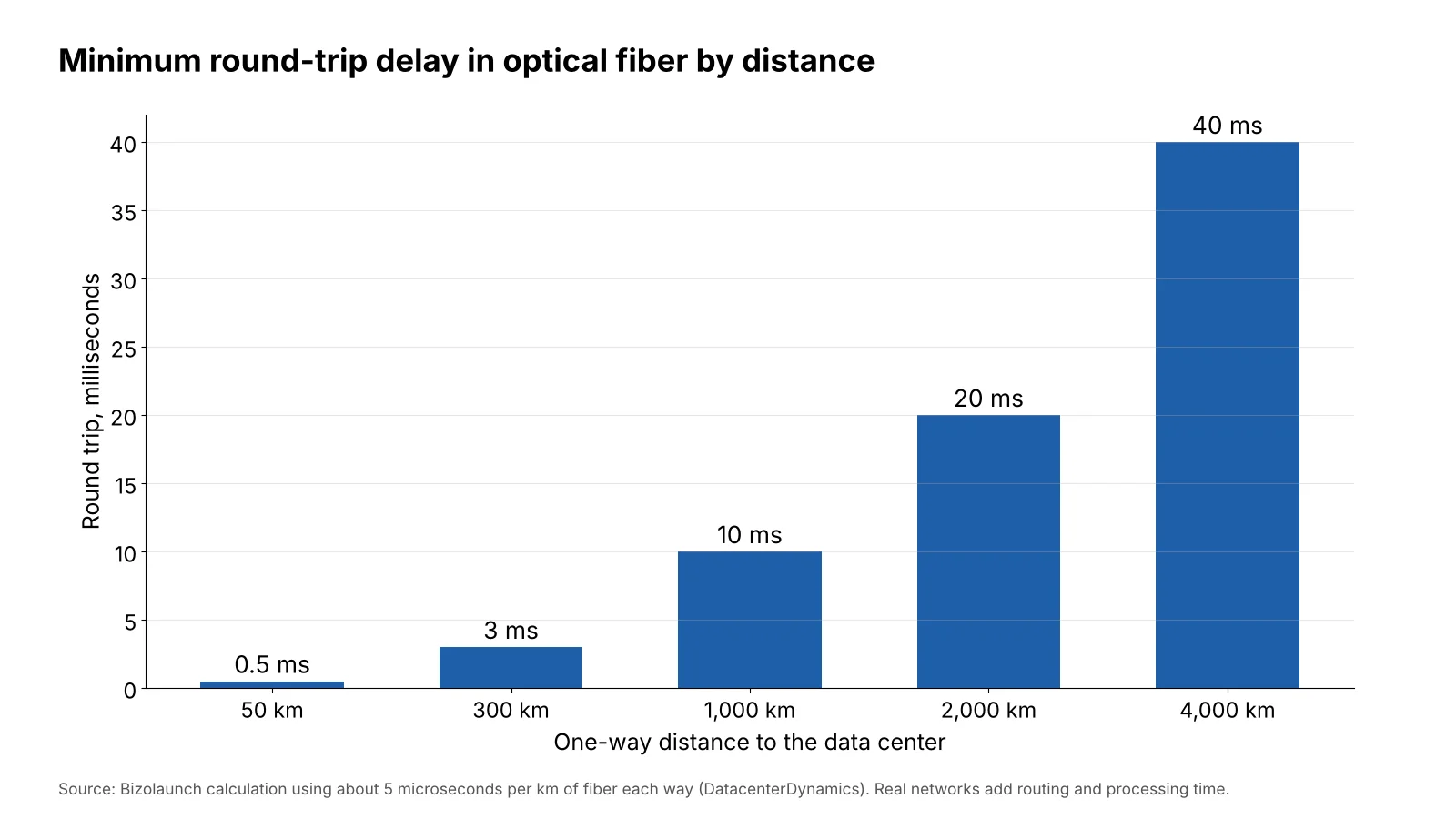
The method: round trip in milliseconds = one-way kilometers x 5 microseconds x 2, divided by 1,000. The sprayer column multiplies that time by 22 feet per second, which is 15 mph. Even in the perfect case, a cross-country round trip lets the machine roll almost a foot. Add a real network and an AI model’s run time, and the gap grows.
The second limit is bandwidth. Video is heavy. A 1080p live stream at 30 frames per second needs at least 5 Mbps, and we used that as a floor for one camera. At 5 Mbps, one camera produces 5,000,000 bits x 86,400 seconds / 8 = 54 GB a day. A store or plant with 20 cameras would push about 1.08 TB a day, or 32.4 TB in a 30-day month, and would need a steady 100 Mbps upload just for video. Analyzing the footage on site and sending only alerts or short clips cuts that to a sliver.
If your sites already struggle with upload speed, our data on internet speed by country shows how much the baseline differs from place to place, which is one reason the same app may run in the cloud in one country and at the edge in another.
Retail and Restaurants: The Biggest Edge Spenders
Retail and services made up nearly 28% of global edge spending in 2025, the largest share of any industry group. The biggest use cases there are video analytics and optimized operations.
The best-documented restaurant example is Chick-fil-A. Chick-fil-A runs a Kubernetes cluster in every store across more than 2,000 restaurants. Each cluster has three nodes with 8 GB of RAM per node. Hundreds of connected devices, including fryers, grills and refrigeration, send data to that cluster, which uses it to keep stations stocked and running during rushes. At peak, a store serves a sandwich every 16 seconds, so a cloud outage cannot be allowed to stop the kitchen.
The lesson for a smaller operator is about failure, not speed. A restaurant cannot close because the internet line drops. Keeping the order flow, kitchen screens and payment terminals working offline is a form of edge computing, even when the hardware is a single box under the counter. Owners choosing tills should check offline mode first, which is a point we make in our review of the best POS systems for food trucks.
Common retail edge jobs include:
- Checkout and shelf cameras: Video models count stock, spot empty shelves or flag items left in a cart, then send a short alert instead of hours of footage.
- Store-level inventory: Local servers keep inventory and prices in sync with tills when the link to headquarters is slow.
- Kitchen and equipment telemetry: Fryers, ovens and coolers report temperatures to a local system that reacts in seconds.
Agriculture: Machines That Decide in the Field
Farm machines work far from fast networks, and they move. That makes agriculture one of the clearest cases for edge computing.
Deere’s See & Spray system mounts cameras along the sprayer boom. Onboard processors identify weeds and trigger individual nozzles, so herbicide lands only where a weed is. Deere says the system scans more than 2,500 square feet per second at up to 15 mph. Customers used it on more than five million acres in the 2025 season and cut non-residual herbicide use by nearly 50% on average, saving close to 31 million gallons of herbicide mix.
Our table above shows why the processing has to be on the machine. Even a perfect 10 ms round trip would let the sprayer move 2.6 inches, and a field has no fiber line anyway. The cloud still has a job: it is where the weed models are trained and where season data ends up for the farmer’s records. The split between training in the cloud and deciding at the edge is the pattern you will see again and again.
Manufacturing: Data That Never Leaves the Plant
Manufacturing and resources took roughly a quarter of worldwide edge spending in 2025. Factories have three reasons to keep computing on site. Machines produce constant streams of sensor data, many plants have strict rules about data leaving the building, and a production line cannot wait for a slow network.
One clear example comes from BSH Home Appliances in Türkiye. BSH used Siemens Industrial Edge apps on a line that makes plastic tubs for washing machines. The edge apps collected shop-floor data, organized it into a standard OPC UA model, and passed it to BSH’s manufacturing execution system. Each tub got a unique ID linked to its process settings, so engineers could trace a quality problem back to the exact cycle. Analytics apps watched performance, energy and machine behavior. Siemens says equipment effectiveness rose by 20% and energy use fell by 25%.
How it works step by step on a line like this:
- Sensors and machine controllers send readings to a small industrial computer next to the line.
- Edge apps clean and label the data, so the same reading means the same thing on every machine.
- Local models flag odd patterns, such as an injection machine running hot, within seconds.
- Only summaries, alerts and traceability records go up to central systems or the cloud.
Factories that add robots raise the stakes further, because a robot arm or mobile robot must react to its surroundings in real time. Our weekly robotics and automation news roundup tracks many of these deployments, and the same edge logic applies in warehouse automation systems, where sorters and robots run on local controllers.
Telecom and 5G: The Network Becomes the Edge
Telecom carriers are both users and sellers of edge computing. Service provider edge infrastructure, which covers multi-access edge computing, content delivery networks and virtual network functions, is expected to reach almost $100 billion by 2028.
Cloud companies have built products that sit inside or next to carrier networks. AWS Wavelength places AWS compute at the edge of 5G networks and is aimed at real-time gaming, AR and VR streaming and connected vehicles. Its Outposts Rack is the opposite approach: a fully managed 42U rack of AWS hardware installed in the customer’s own building, for data residency and local processing.
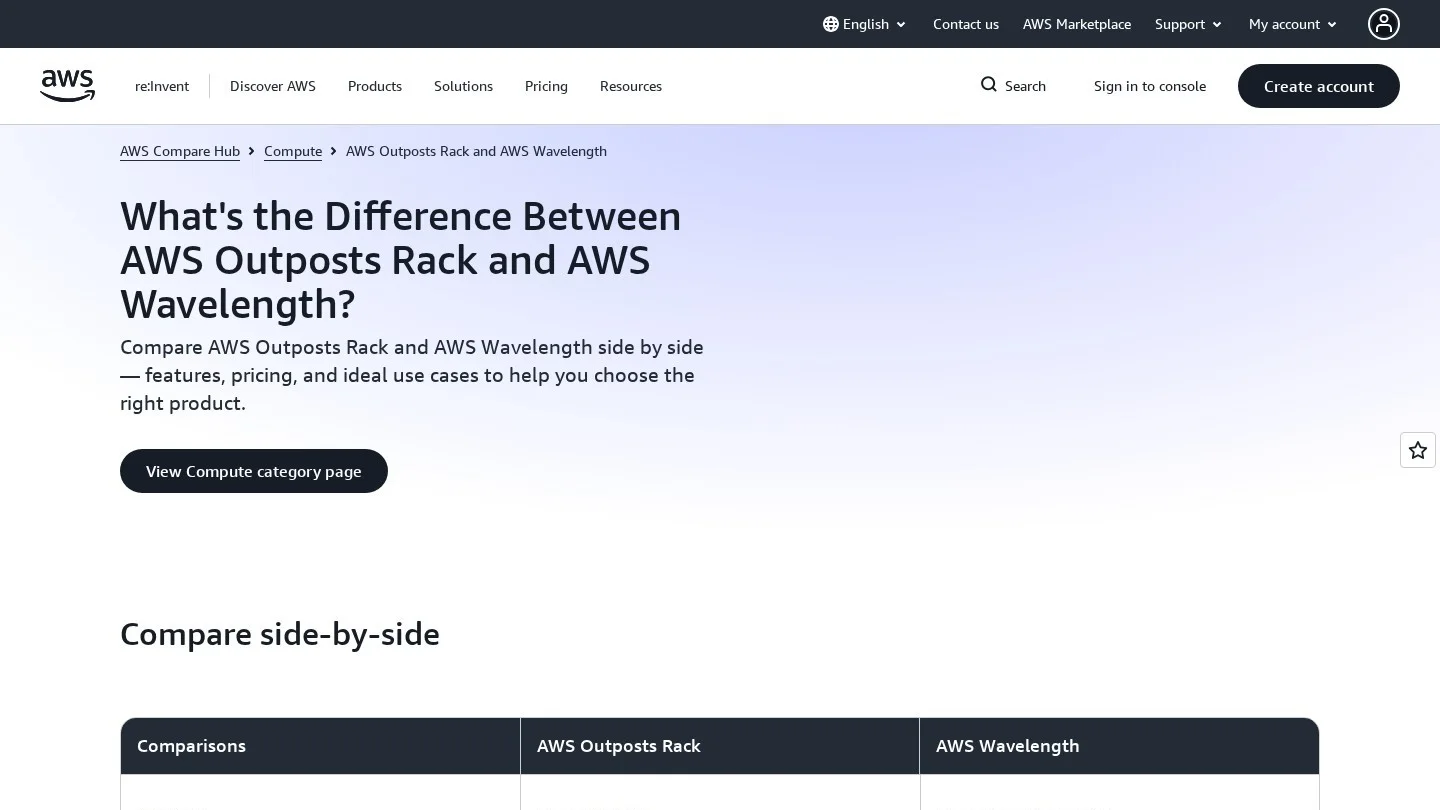
The choice between these two models is a useful way to think about any edge project:
- Carrier edge (Wavelength style): Best when users are mobile and spread out, such as phones, vehicles and headsets. You rent capacity near the cell network.
- On-premises edge (Outposts style): Best when the data comes from one fixed site, such as a factory, hospital or store, and must stay there.
- Device edge: Best when even the local network is too slow or absent, as on a sprayer, drone or car.
Wi-Fi matters inside buildings too. Newer standards cut delay on the local hop, as our explainer on what Wi-Fi 7 is covers.
Financial Services: The Fastest-Growing Edge Market
Banks might not seem like an edge industry, but financial services is the fastest-growing sector, with spending growth forecast above 15% a year. Most of that growth is tied to fraud analysis and investigation powered by AI.
The logic is speed and privacy. A card payment must be approved or declined in a moment, so fraud checks run as close to the transaction as possible. Branches and ATMs also handle data that banks prefer not to move around. Running models locally and sending only scores or flagged events reduces both delay and exposure.
When sensitive data has to be processed on shared hardware, banks increasingly pair edge setups with hardware-sealed processing. Our explainer on what confidential computing is shows how that protection works and what it costs.
Healthcare: Keeping Patient Data Close
Healthcare and life sciences are among the industries whose processes and buying habits need specialist understanding. Hospitals generate large imaging files and constant streams from bedside and wearable monitors, and they work under strict privacy rules.
Edge computing helps in three ways. Imaging AI can run on a server in the hospital, so large scans do not have to leave the building before a result comes back. Bedside and home monitors can filter readings locally and send only alerts. And a clinic can keep working through an internet outage. Our article on AI in remote patient monitoring looks at the home side of that picture, where devices decide what is worth sending to a nurse.
Edge Computing Uses by Industry, Matched to Evidence
The table pairs each industry with its main edge job, the reason the work stays local, and a published figure.
| Industry | Main edge job | Why it stays local | Published figure |
|---|---|---|---|
| Retail and services | Video analytics, store operations | Bandwidth, offline resilience | Nearly 28% of 2025 global edge spending |
| Quick-service restaurants | Kitchen device data, order flow | Store must run during outages | Kubernetes cluster in each of 2,000+ Chick-fil-A restaurants |
| Agriculture | Weed detection on sprayers | Machine speed, no field network | 5 million+ acres, nearly 50% less herbicide in 2025 |
| Manufacturing | Line data, quality tracing, energy | Data rules, real-time control | 20% higher equipment effectiveness, 25% less energy at BSH |
| Telecom | Carrier edge for apps and video | Latency for mobile users | Service provider edge near $100 billion by 2028 |
| Financial services | Fraud scoring | Speed of approval, privacy | Fastest-growing, above 15% yearly |
| Healthcare | Imaging AI, monitor alerts | Privacy, large files, uptime | Named a specialist edge industry |
How to Decide What Belongs at the Edge
Not everything should move out of the cloud. Edge hardware has to be bought, secured, patched and replaced across many sites, which is harder than running one cloud account. We suggest four questions for any workload.
- Does the answer need to arrive faster than the network allows? Use the round-trip table above. If the job needs a reply in a few milliseconds and your nearest cloud region is far away, it belongs at the edge.
- Is the raw data too large to ship? Work out the daily volume, as we did for cameras. If most of it is never needed, filter it locally.
- Must the site keep working offline? Kitchens, tills, factories and clinics usually say yes.
- Are there rules about where the data may go? Privacy and industry rules often settle the question on their own.
If two or more answers are yes, plan for edge processing. If none are, the cloud is usually cheaper and simpler. Most mature systems end up as a mix: models are trained centrally and run at the edge, and summaries flow back up.
Edge AI chips are also changing what is possible on small devices. Some designs copy the way the brain uses short spikes of activity to save power, and our list of neuromorphic computing companies covers the firms building them for sensors and wearables.
The Market Numbers Behind Edge Growth
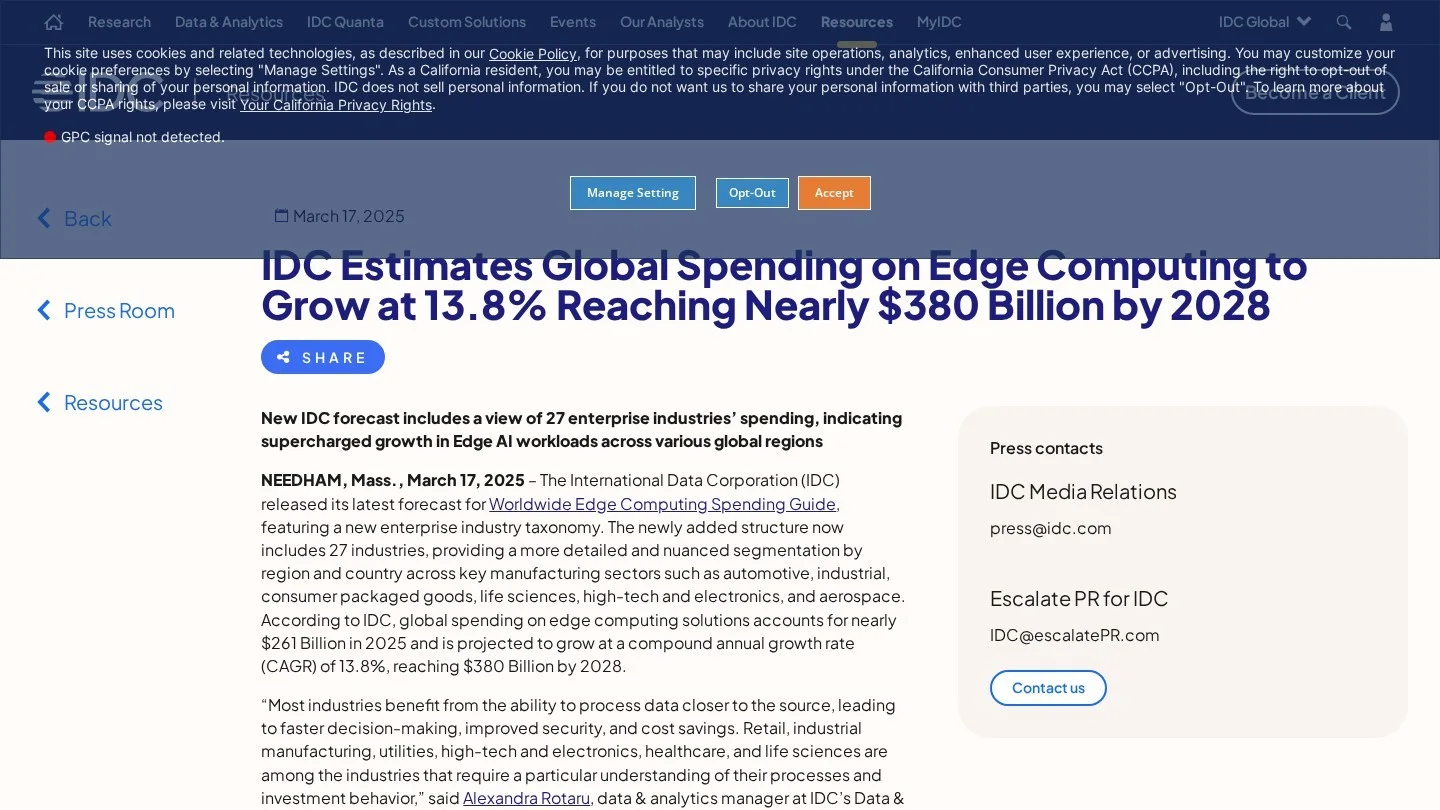
Global edge computing spending is estimated at nearly $261 billion in 2025 and is expected to reach about $380 billion by 2028, a compound annual growth rate of 13.8%. The forecast covers 27 industries and more than 1,000 named use cases across AI, IoT, augmented and virtual reality, drones and robotics.
Three details in that forecast stand out for planning. North America is the largest region throughout, with Western Europe and China next. Augmented reality is the fastest-growing segment, followed by AI. And services, both managed and professional, are expected to overtake hardware’s share by 2028, which suggests many companies will rent edge capacity and expertise rather than build everything themselves.
Questions Readers Ask About Edge Computing Uses
What Is a Simple Example of Edge Computing?
A smart camera that detects a person and sends only an alert, instead of streaming all its video to the cloud, is edge computing. So is a restaurant kitchen system that keeps running when the internet drops.
Which Industry Uses Edge Computing the Most?
By spending, retail and services lead, with nearly 28% of the 2025 global total. Manufacturing and resources come second with about a quarter.
Is Edge Computing Replacing the Cloud?
No. In almost every case we looked at, the cloud still trains models, stores long-term records and manages the fleet. The edge handles the fast, local decisions.
How Is Edge Computing Different from Fog Computing?
The terms overlap. Fog computing usually describes a middle layer of local servers or gateways between devices and the cloud. Many vendors now call all of that the edge.
Why Does Latency Matter So Much?
Because some machines act in real time. Our math shows that a 40 ms round trip, the physical minimum across the US, lets a 15 mph sprayer travel more than ten inches before a reply comes back.
Company and Research Pages We Used
- IDC: Global Spending on Edge Computing Forecast, March 17, 2025.
- Red Hat: From Cloud to Edge, with Chick-fil-A details.
- Deere: See and Spray across five million acres, November 2025, and the CropLife report.
- Siemens: BSH Industrial Edge success story.
- AWS: Outposts Rack and Wavelength compared.
- DatacenterDynamics: latency of about five microseconds per kilometer of fiber.
- YouTube Help: live encoder bitrates, used for our 5 Mbps per camera floor.