
The largest neuromorphic computer on record, Intel’s Hala Point, packs 1.15 billion artificial neurons into a box six rack units tall and draws at most 2.6 kilowatts. A smartwatch-scale chip from the Dutch firm Innatera runs radar presence detection on about 600 microwatts. Those two machines sit at opposite ends of the same idea: computers that copy how the brain uses brief electrical spikes, so they spend energy only when something changes.
The top neuromorphic computing companies today are Intel, IBM, BrainChip, SynSense, Innatera, SpiNNcloud Systems, Prophesee and Applied Brain Research. We compared them on what they actually ship or run, the scale and power figures each has published, and how a business can get access.
What Neuromorphic Chips Do Differently
A normal processor runs on a clock. On every tick it moves data between memory and compute units, whether anything useful is happening or not. Much of the energy in AI work goes into that shuttling of data back and forth.
Neuromorphic chips change two things. First, many of them use spiking neural networks, where an artificial neuron sends a signal only when its input crosses a threshold. If a camera sees a still room, almost nothing fires, and the chip uses little power. Second, they place memory right next to the compute, often spread across many small cores, which cuts the cost of moving data.
The result is hardware that can be very efficient on certain jobs, such as reacting to sensor data, spotting a keyword in audio, or tracking motion. It is not a general replacement for GPUs. Most of these chips do best on small, always-on tasks at the edge, which is why they show up in sensors, wearables and research systems. For the wider picture of why processing is moving onto devices, see our guide to edge computing applications by industry.
Neuromorphic Companies Compared on Published Figures
This is our own comparison table. We list the headline product and the one published figure that best shows scale or power use.
| Company | Base | Main product | Type | Headline published figure | How to get access |
|---|---|---|---|---|---|
| Intel | Santa Clara, US | Loihi 2, Hala Point | Research chip and system | 1.15 billion neurons, 2.6 kW max (Hala Point, 2024) | Intel Neuromorphic Research Community |
| IBM | Armonk, US | NorthPole | Research inference chip | 22 billion transistors, 256 cores, 12 nm (2023) | Research partnerships |
| BrainChip | Laguna Hills, US | Akida (AKD1000, AKD1500, Akida 2 IP) | Commercial chips and IP | 20 neural processing cores, 0.7 TOPS (AKD1000) | Chips, modules, IP licences, Akida Cloud |
| SynSense | Chengdu, China and Zurich | Speck, Xylo | Commercial vision and signal chips | 320,000-neuron processor in Speck | Dev kits and volume supply |
| Innatera | Delft, Netherlands | Pulsar | Commercial microcontroller | About 400 to 600 microwatts on example tasks | Available since May 2025 |
| SpiNNcloud Systems | Germany | SpiNNaker2 systems | Large-scale systems | 4,320 chips and 650 million+ neurons at Leipzig | System sales to labs |
| Prophesee | Paris, France | Metavision event sensors | Neuromorphic vision sensors | HD event sensor made with Sony (IMX636) | Evaluation kits and sensors |
| Applied Brain Research | Waterloo, Canada | TSP1 | Commercial edge AI chip | Speech-to-text and text-to-speech under 30 mW | Edge voice products |
Two notes on reading the table. Neuron counts are not comparable with transistor counts or power ratings, so do not rank the companies on one column. And research systems such as Hala Point are not for sale off a shelf, while chips from BrainChip, SynSense and Innatera are sold to product makers.
Intel: Loihi 2 and the Hala Point System
Intel runs the best-known neuromorphic research program. Its second-generation chip, Loihi 2, is built on the Intel 4 process. It measures 31 square millimeters and holds 2.3 billion transistors.
Hala Point joins 1,152 Loihi 2 chips, each with about a million neurons, into one system for Sandia National Laboratories. It reaches 1.15 billion neurons, fits in six rack units and draws up to 2.6 kW. Intel claims efficiency of up to 15 trillion operations per second per watt at 8-bit precision, measured on sparse workloads. It offers slightly more neurons than the British SpiNNaker machine while using under 3% of that system’s 100 kW.

What a business can learn from Intel’s approach: Loihi is a research platform. Companies and universities get access by joining Intel’s research community, not by buying chips in volume. It is the right door for teams that want to test whether spiking networks can solve an optimization or sensing problem before any product exists.
IBM: NorthPole and Memory Next to Compute
IBM’s NorthPole is less about spikes and more about the second neuromorphic idea, putting memory beside compute. It holds 22 billion transistors on an 800 square millimeter die built at 12 nm, with 256 cores that each do 2,048 operations per cycle at 8-bit precision. IBM unveiled it in October 2023.
All of its memory sits on the chip. IBM says that on the ResNet-50 image benchmark, NorthPole was 25 times more energy efficient than common 12 nm GPUs and 14 nm CPUs, measured in frames per joule. The trade-off is that it works best on models small enough to fit in that on-chip memory. Bigger networks must be split across several chips.
IBM’s earlier chip, TrueNorth, was one of the first large spiking processors. NorthPole shows how the company has moved toward inference hardware that borrows brain-like layout without requiring spiking models.
BrainChip: The Listed Pure Play
BrainChip is the clearest pure-play neuromorphic company that investors can follow. It trades on the Australian Securities Exchange as BRN and in the US as BRCHF on OTCQX. In a December 10, 2025 release, the Laguna Hills, California company announced a $25 million capital raise ahead of CES.
Its first chip, the AKD1000, is built on a 28 nm digital process. It has 20 neural processing cores with 2,560 small multiply-accumulate units at 300 MHz, for 0.7 TOPS, plus an Arm Cortex-M4 host processor. It converts camera pixels and other data into spikes on the chip. The December release also named the AKD1500 chip for sensors and wearables, the Akida 2 platform, and on-device language model work based on its TENNs models.

BrainChip sells in several ways: physical chips, modules and boards, and licences to put Akida designs inside another company’s chip. For a device maker, the IP route is often the practical one, because it adds a low-power AI block to a chip that already handles the rest of the product.
SynSense: Vision and Signal Chips from Zurich Roots
SynSense began in 2017 as a spin-off from the University of Zurich’s Institute of Neuroinformatics and ETH Zurich. It moved its headquarters to Chengdu, China, in 2020 and kept an office in Zurich. In March 2023 it raised $10 million in a Pre-B+ round.
Its flagship, Speck, pairs an event-driven vision sensor with a 320,000-neuron AI processor on one device and runs real-time vision at milliwatt power. Its Xylo family targets low-dimensional signals, such as audio and body sensors. Speck is a good example of where neuromorphic chips fit best: a camera that only reacts when something moves, such as a presence sensor or a gesture control.
Innatera: A Neuromorphic Microcontroller
Innatera, founded in 2018 and based in Delft, launched Pulsar on May 22, 2025, and said it was available from that day. Pulsar combines spiking neural network hardware with a RISC-V processor and accelerators for standard convolutional networks and fast Fourier transforms.
The power numbers are the selling point. Innatera cites about 600 microwatts for radar-based presence detection and about 400 microwatts for audio scene classification. It also claims up to 100 times lower latency and up to 500 times lower energy than conventional AI processors, though Innatera does not name the comparison chips. Its Talamo software kit lets developers build spiking models in a PyTorch-based workflow.
To put 600 microwatts in context, we did a simple calculation. A coin-cell battery holds energy in milliwatt-hours, and at 0.6 milliwatts a chip would use 0.6 x 24 = 14.4 milliwatt-hours a day for that one task. That is why always-on sensing, which drains a phone-class chip quickly, becomes realistic on small batteries.
SpiNNcloud Systems: Brain-Scale Machines for Labs
SpiNNcloud Systems is the German company that sells machines built on SpiNNaker2, a chip that grew out of the SpiNNaker research line. Each SpiNNaker2 chip has 152 Arm-based cores plus accelerators.
The company is deploying a system at Leipzig University with about 4,320 chips, 48 per server board, for 656,640 cores in total. It is designed to simulate at least 650 million neurons, and Leipzig plans to use it for drug discovery research. SpiNNcloud delivered an earlier system to Sandia National Laboratories in June 2025 that simulates 150 to 180 million neurons. The company claims its systems are 18 times more energy efficient than current GPUs.

Prophesee: Event Cameras That See Change
Prophesee works on the sensing side of neuromorphic computing. Its event-based vision sensors do not capture full frames at a fixed rate. Each pixel reports only when the light it sees changes, which cuts data and power and captures fast motion without blur.
The Paris company calls the Sony Prophesee IMX636 and IMX637 the first commercial HD stacked event-based sensors. Recent news includes a new €20 million financing phase announced in June 2026, a move into counter-drone uses, and a demo with IDS planned for the VISION 2026 trade show in October. Event cameras pair naturally with spiking processors such as Speck or Akida, because both work on changes rather than frames.
Applied Brain Research: Low-Power Voice on a Chip
Applied Brain Research builds the TSP1, which it calls a state space accelerator for real-time time-series work at the edge. State space models are a newer family of AI models that handle streams such as audio efficiently, and ABR’s patented approach is designed around them.
In a January 21, 2026 announcement of an oversubscribed seed round led by Two Small Fish Ventures, the company said TSP1 runs full-vocabulary speech-to-text and text-to-speech on under 30 milliwatts. It claims that is 10 to 100 times less power than other options. That makes ABR a fit for voice control in devices that cannot send audio to the cloud, whether for privacy or because they lack a connection.

Scale of Neuromorphic Systems on One Chart
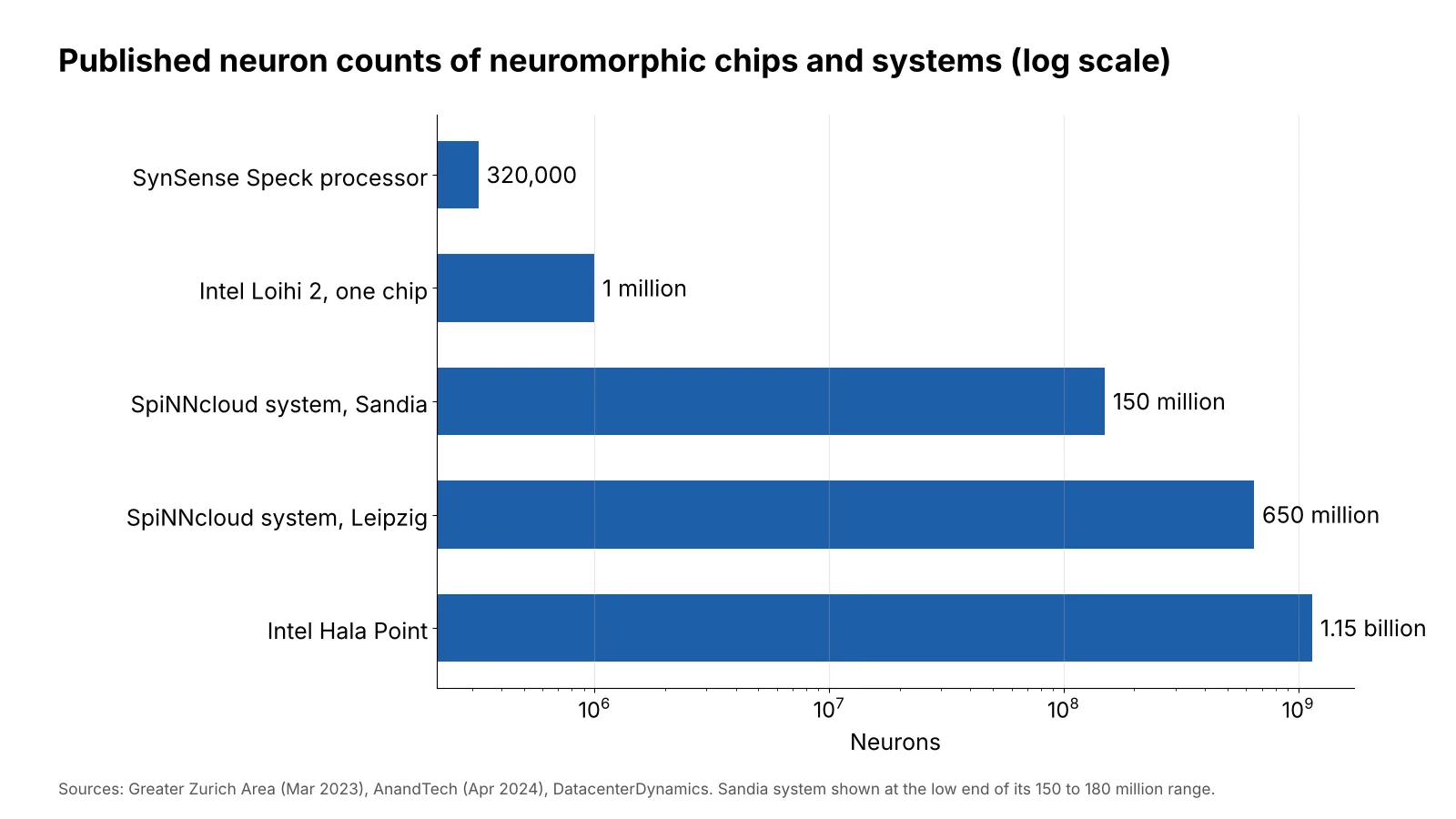
The chart below uses only the neuron counts quoted in this article. We used a log scale, because the systems differ by a factor of more than 3,000.
| System | Neurons (as published) |
|---|---|
| SynSense Speck processor | 320,000 |
| Intel Loihi 2 (one chip) | About 1 million |
| SpiNNcloud system at Sandia | 150 to 180 million |
| SpiNNcloud system at Leipzig | At least 650 million |
| Intel Hala Point | 1.15 billion |
For a sense of scale, Hala Point holds about 3,600 times the neurons of a single Speck processor (1,150,000,000 / 320,000 = 3,594). The two products are built for very different jobs, though. One is a room-sized research tool. The other sits inside a sensor.
Picking a Neuromorphic Partner for a Real Project
The right company depends on what you are building. We grouped the options by the job a buyer usually has in mind.
- Always-on sensing in a battery device: Look at Innatera, SynSense Xylo or BrainChip’s AKD1500. Ask for the power draw on your exact task, not a headline figure.
- Vision that reacts to motion: Pair an event sensor from Prophesee with a spiking processor, or use SynSense Speck, which combines both.
- Voice on a device with no cloud link: Applied Brain Research’s TSP1 targets this case directly.
- Adding AI to your own chip: BrainChip’s IP licensing lets a chip designer add an Akida block.
- Research at large scale: Intel’s research community for Loihi, or a SpiNNcloud system if your lab needs its own machine.
Three questions are worth asking any vendor. Which software tools turn a normal trained model into one that runs on the chip, and how much accuracy is lost? What does the evaluation kit include, and how long is the path from kit to volume supply? And which customers have shipped products with it? Funding news for these firms appears in our weekly startup funding roundup, and young hardware companies often show up first in our list of new startups to watch.
How Neuromorphic Hardware Fits Next to Other Chip Bets
Neuromorphic computing is one of several attempts to get past the energy cost of today’s AI chips. Quantum computing is another, aimed at very different problems such as chemistry and optimization, and our guide on how to access quantum computers through the cloud covers how businesses can try it today. Robots are a third area where efficient on-board AI matters, as our robotics and automation news coverage shows week to week.
A fair read of the evidence is that neuromorphic chips win clear power savings on narrow, always-on tasks, while GPUs still dominate large model training and most data center inference. The companies above are betting that the number of sensors and small devices will grow faster than data centers, and that every one of them will need a little intelligence on very little power.
Questions About Neuromorphic Computing Companies
What Is the Biggest Neuromorphic Computer?
Intel’s Hala Point, built for Sandia National Laboratories and announced in April 2024, has 1.15 billion neurons across 1,152 Loihi 2 chips. SpiNNcloud’s planned Leipzig system is designed for at least 650 million neurons.
Can You Buy Neuromorphic Chips Today?
Yes. BrainChip, SynSense and Innatera sell chips, modules or development kits to product makers, and Innatera said Pulsar was available from its May 2025 launch. Intel’s Loihi is offered to researchers through its community rather than sold in volume.
Is There a Neuromorphic Stock?
BrainChip is listed on the ASX as BRN and trades in the US as BRCHF. Intel and IBM run neuromorphic programs, but those are small parts of much larger businesses. This is not investment advice.
How Is Neuromorphic Computing Different from a GPU?
A GPU runs huge numbers of operations every clock cycle and moves data between separate memory and compute. Neuromorphic chips keep memory beside compute and, in spiking designs, do work only when inputs change. That saves power on sparse, real-time data but suits fewer types of models.
Which Industries Use Neuromorphic Chips?
Published uses include presence and gesture sensing, audio and voice control in wearables, event-based vision for fast motion and drones, and research in areas such as drug discovery.
Company Releases and Reports Behind This List
- AnandTech: Intel and Sandia roll out Hala Point, April 2024.
- eeNews Europe: IBM NorthPole, October 24, 2023.
- BrainChip: $25 million funding release, December 10, 2025, and the AKD1000 product brief.
- Greater Zurich Area: SynSense raises $10 million, March 27, 2023.
- HPCwire: Innatera unveils Pulsar, May 22, 2025.
- DatacenterDynamics: SpiNNcloud system at Leipzig University.
- Prophesee: news and launches page.
- Raptor Group: Applied Brain Research seed round, January 21, 2026.