Tools for Finding Guest Post Opportunities, Ranked by Job
Guest post prospecting is three jobs: finding sites that publish outside writers, checking whether those sites are worth a pitch, and finding the right editor’s email. No single tool does all three cheaply, so most people combine a free search method with one paid tool for each gap. We compared eight tools for these jobs, with prices taken from each company’s own pricing page.
A lean paid setup for one person costs about $163 a month, with Ahrefs Lite for site checks, Hunter Starter on yearly billing for emails and Google searches doing the prospecting. A free setup can cover the first few months. A team that sends hundreds of pitches a month will spend $300 a month or more on a dedicated outreach platform such as Pitchbox, BuzzStream or Respona.

| Tool | Main job | Free option | Lowest listed paid price | Billing notes |
|---|---|---|---|---|
| Google search operators | Finding sites that accept guest posts | Free | None | Not applicable |
| Google Alerts | Spotting new posts and topics on target sites | Free | None | Not applicable |
| Ahrefs | Checking a site’s traffic and links; finding sites by topic | Ahrefs Free, limited Site Explorer | Starter, $29 a month | Content Explorer from Standard ($249) |
| Hunter | Finding and verifying editors’ emails | 50 credits a month | Starter, $49 a month or $34 on yearly billing | 2,000 credits a month on Starter |
| BuzzStream | Prospecting, outreach and relationship tracking | Free trial | Starter, $49 a month | No contract; one month free on yearly payment |
| BuzzStream ListIQ | Building media and author lists | Free tier of about 50 contacts | $49 a month for about 200 contacts | Chrome extension |
| Respona | Finding prospects and sending personalized outreach | None listed | Starter, $198 a month | Unlimited plan billed yearly |
| Pitchbox | High-volume outreach for agencies and teams | Trial through a demo | Pro, $300 a month or $210 on yearly billing | One-year commitment on all plans |
Google Search Operators: The Free Starting Point
Every guest post search starts with Google. Combine a topic word with phrases that sites use on their contributor pages, and you get a raw list of publishers in minutes. These are the patterns we use, with “budgeting” as the example topic.
| Search pattern | What it finds |
|---|---|
| budgeting “write for us” | Pages that openly invite contributors |
| budgeting “guest post guidelines” | Editorial rules, which usually name the editor or the pitch email |
| budgeting intitle:”contribute” | Pages with “contribute” in the title |
| budgeting “this is a guest post by” | Posts already written by outside authors |
| budgeting inurl:author -site:pinterest.com | Author archive pages on blogs with several writers |
| site:example.com budgeting | Whether a target site already covers your topic |
Google documents the `site:` operator for checking which pages it has indexed, and it notes that operators are bound by indexing and retrieval limits. Treat the results as a prospect list to check by hand. A site that appears for “write for us” may have stopped accepting pitches years ago, so open each guidelines page and look for a recent date. Our list of guest posting sites covers publishers that already state their submission rules.
Google Alerts: Catching New Posts on Target Sites
Google Alerts is free and sends an email when new pages match a query. Set an alert for `site:targetblog.com` plus your topic, and you learn when a target publishes on your subject, which is a natural moment to pitch a follow-up angle. Alerts for phrases like “guest post by” in your niche also surface new contributor-friendly sites as they appear.
Ahrefs: Checking Whether a Site Is Worth the Pitch
Ahrefs is a search data tool that shows a site’s estimated organic traffic, the sites that link to it and the topics it ranks for. For guest posting, its main use is weeding out sites with no search traffic, since a link from a page nobody visits does little for readers or brand reach.
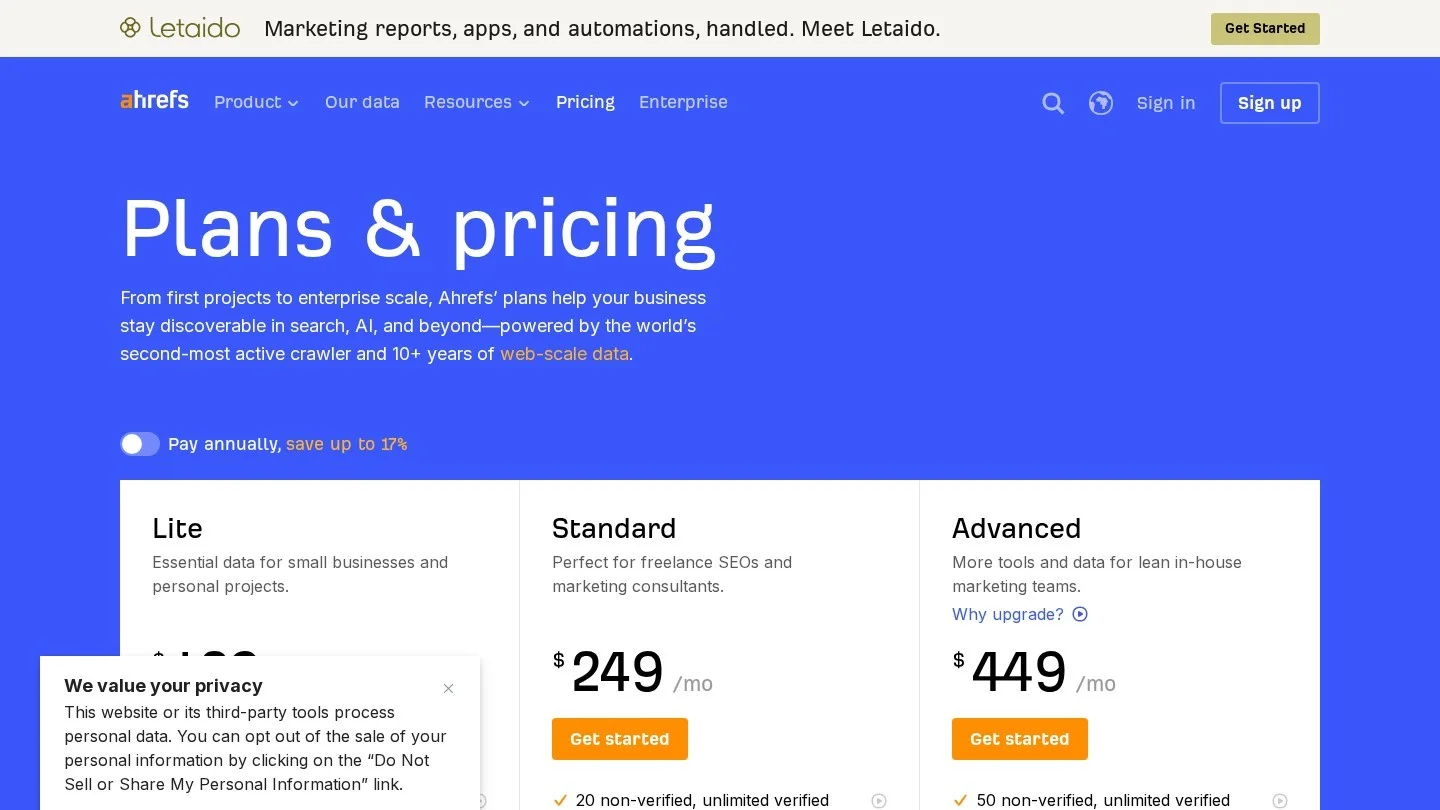
Ahrefs lists five plans: Starter at $29 a month, Lite at $129, Standard at $249, Advanced at $449 and Enterprise at $1,499 with an annual commitment. Yearly billing saves up to 17%. Site Explorer is included from Lite. Content Explorer, which finds published articles on a topic across the web and is useful for finding blogs that cover your subject, starts on Standard. Batch Analysis, which checks up to 200 URLs at once on Standard, also starts there. Ahrefs Free gives limited access to Site Explorer and Site Audit at no cost.
A one-person team checking a few dozen sites a month may manage with Ahrefs Free, moving to Lite when it needs full Site Explorer access. Teams building prospect lists by topic may find Standard the more practical tier because of Content Explorer. If you want to compare it with cheaper data tools, our review of Ahrefs alternatives without a subscription and our breakdown of Semrush pricing against its competitors cover the options.
Hunter: Finding the Editor’s Email
Hunter finds email addresses linked to a website’s domain, checks whether an address is likely to deliver, and can send simple outreach sequences. For guest posting, its job is to turn a list of blogs into a list of named editors.
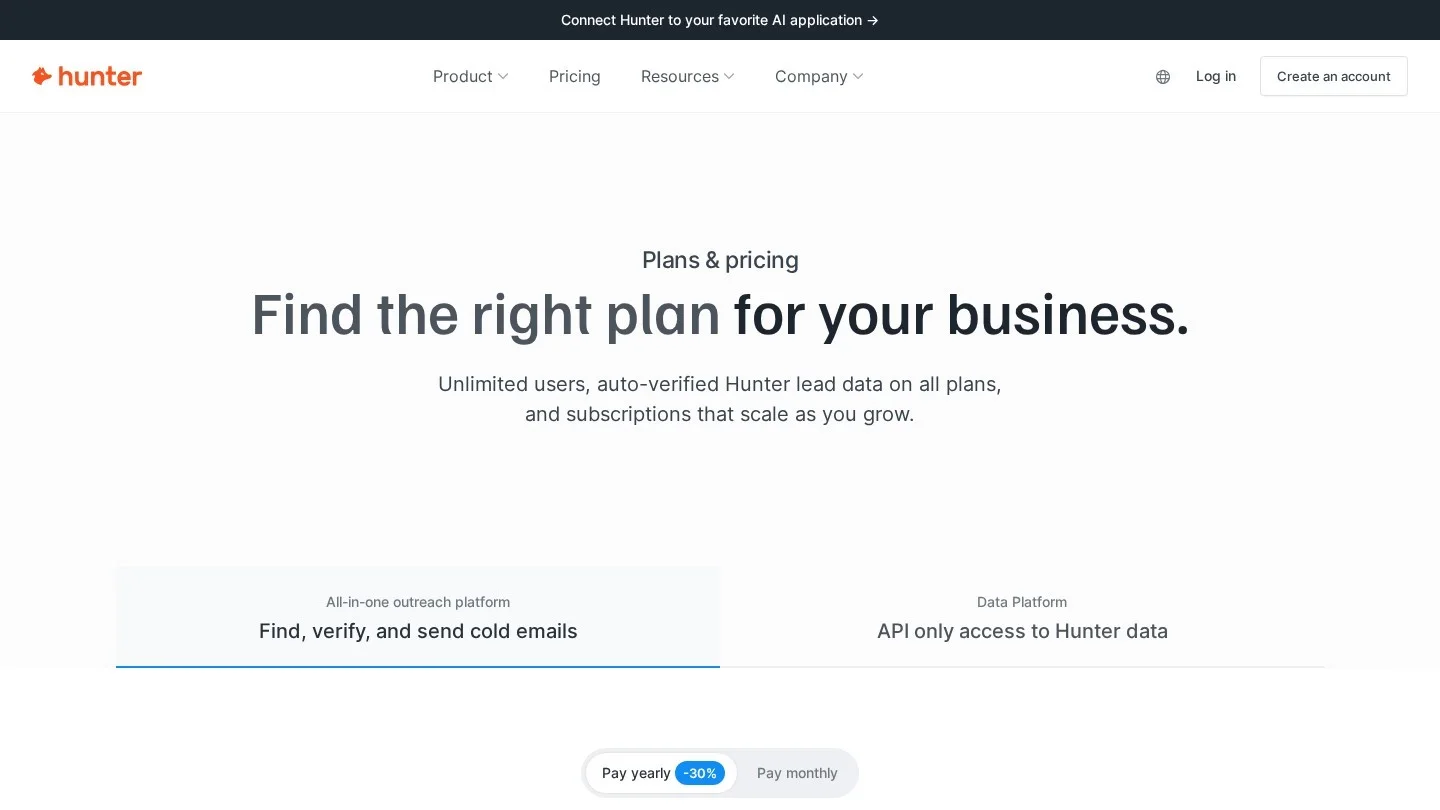
The Free plan gives 50 credits a month, one connected email account and up to 500 recipients per sequence. Starter costs $49 a month or $34 a month on yearly billing and includes 2,000 credits a month. Growth costs $149 a month ($104 yearly) for 10,000 credits, and Scale costs $299 a month ($209 yearly) for 25,000 credits. Yearly billing saves 30%.
At Starter’s yearly price, each of the 2,000 monthly credits costs about 1.7 cents. Most small teams will not use that many, which is why the free plan suits people who pitch fewer than a few dozen sites a month. Our roundup of email extractor tools covers other ways to find contact details.
BuzzStream: Outreach With a Relationship History
BuzzStream combines prospecting searches, contact discovery and an outreach inbox, and it keeps a history of every conversation with each site. That history matters in guest posting, where the same editor may accept a second pitch months after the first.
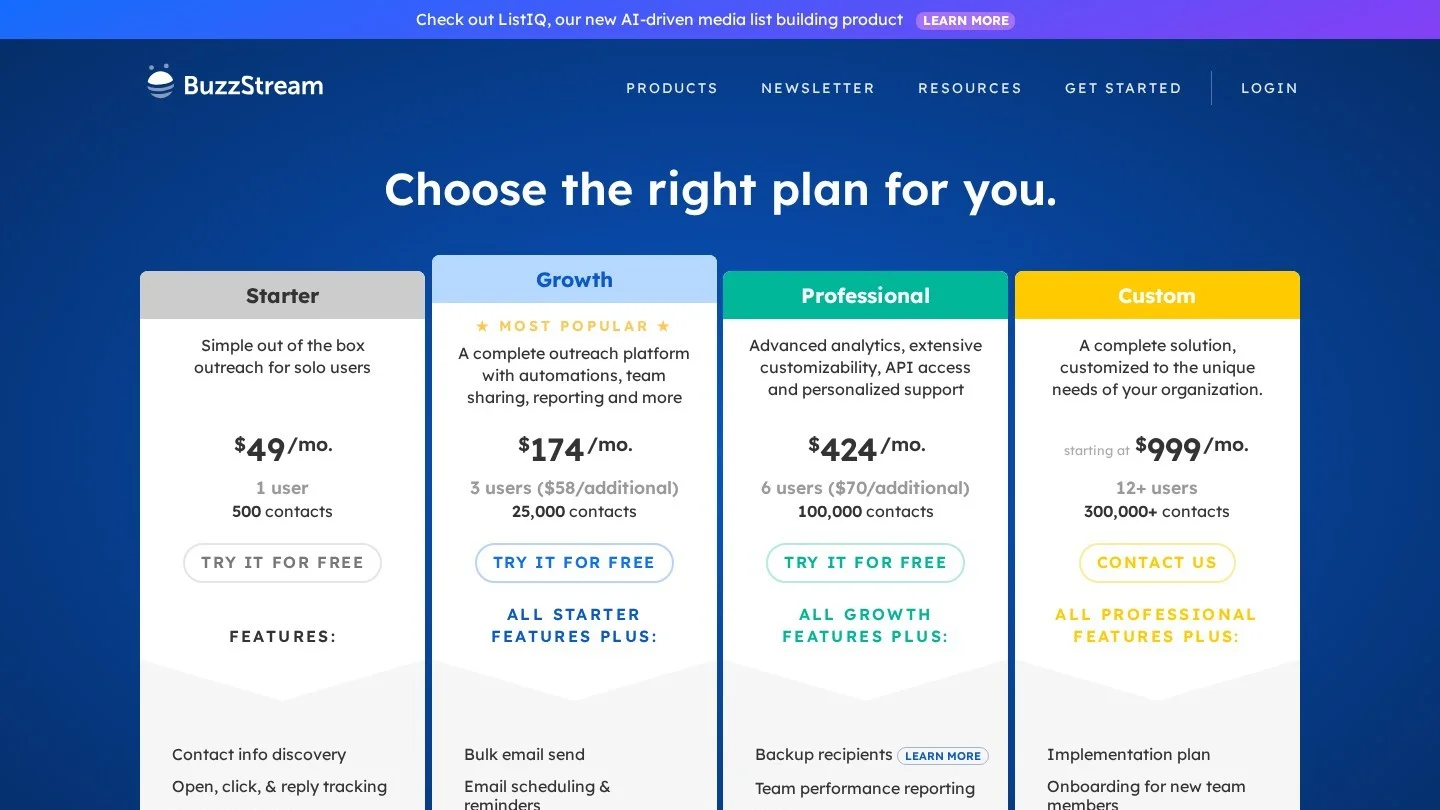
Its plan cards list Starter at $49 a month for one user and 500 contacts, with 30 prospecting searches. Growth costs $174 a month for three users and 25,000 contacts, and adds bulk sending, automated follow-ups, reporting and an Ahrefs integration. Professional costs $424 a month for six users and 100,000 contacts, and Custom starts at $999 a month. Plans run month to month with no contract, and paying for 12 months in advance includes one month free.
BuzzStream also sells ListIQ, a Chrome extension that builds researched lists of journalists and authors from a news search or from competitor articles. Its free tier covers about 50 contacts, and paid tiers run $49 a month for about 200 contacts, $99 for about 500 and $199 for about 2,000. It suits digital PR pitches more than classic guest posts.
Respona: Prospecting and Personalized Pitches in One Place
Respona searches for prospects by keyword, pulls the author or editor for each page, and drafts personalized emails. It connects with Ahrefs and Semrush for site metrics.
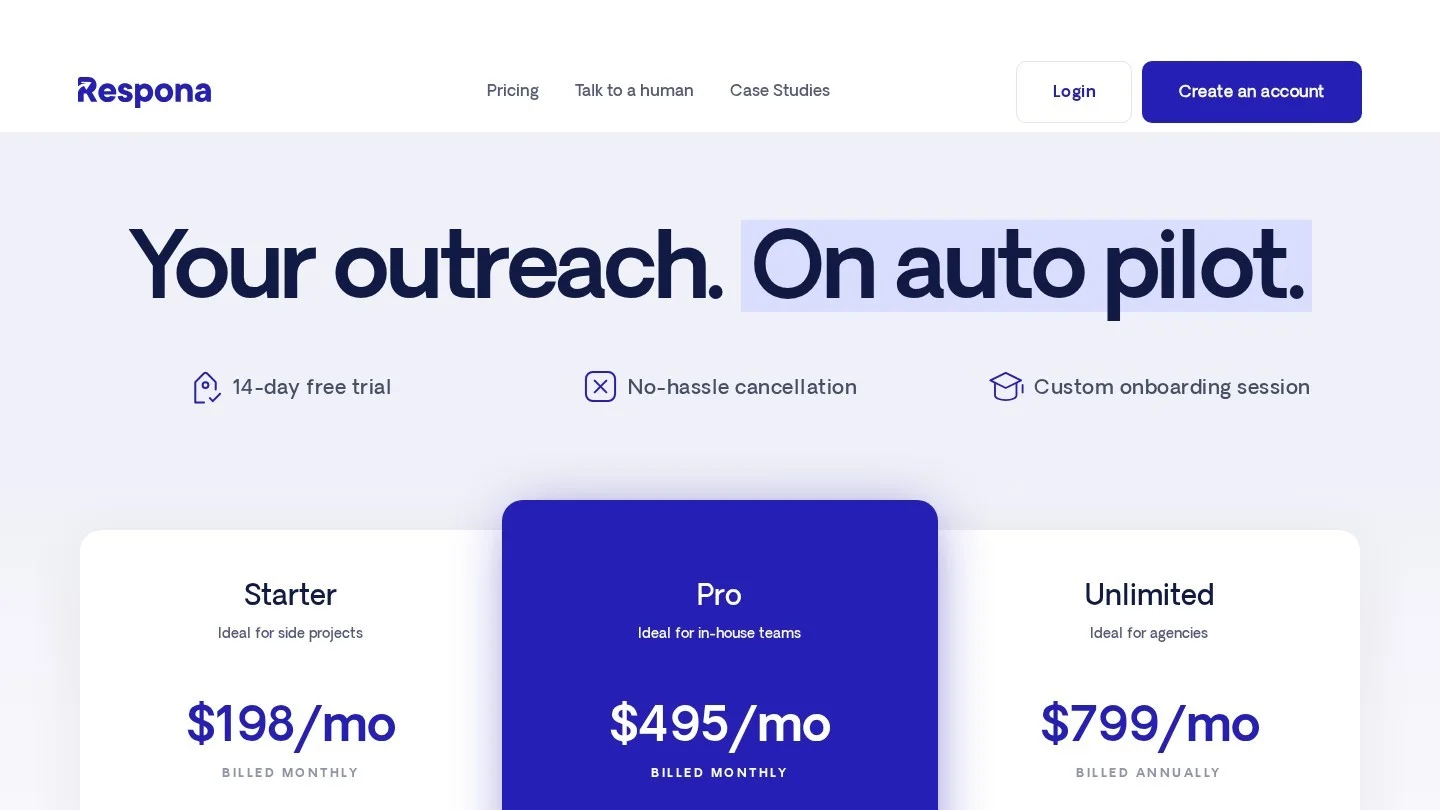
Starter costs $198 a month with two email accounts and 10,000 credits a month. Pro costs $495 a month with five email accounts, 25,000 credits and AI email personalization, recurring searches and advanced reporting. Unlimited costs $799 a month on annual billing with unlimited email accounts and 600,000 credits a year. Every plan includes unlimited emails, campaigns and team members. Extra email accounts cost $49 each and extra credits cost $0.01 each.
Respona may suit small teams that want one tool for both finding and pitching. Solo bloggers may find the Starter price high for the volume they send.
Pitchbox: Built for Agencies Running Many Campaigns
Pitchbox is an outreach platform for agencies and in-house teams that run many link campaigns at once. Every plan includes an email finder and verifier, a CRM, a unified inbox, AI personalization and link monitoring.
Pro costs $300 a month or $210 a month on yearly billing, with two users, 2,000 outreach emails and 1,000 prospecting searches a month. Advanced costs $600 a month ($420 yearly) with unlimited users and adds email rotation, an API and recurring campaigns. Scale costs $1,200 a month ($825 yearly). All plans need a one-year commitment, and expert-led setup costs $2,000 to $4,000 unless you pay yearly, in which case it is included.
The commitment means Pitchbox suits teams with steady outreach volume. A freelancer testing guest posting for the first time may find the month-to-month tools above easier to start with.
What a Guest Post Tool Stack Costs Per Year
We priced three setups using the listed prices above. Yearly figures use yearly billing where the company offers it, and monthly prices times 12 where it does not.
| Setup | Tools | Yearly cost (our calc) | Fits |
|---|---|---|---|
| Free | Google operators, Google Alerts, Ahrefs Free, Hunter Free | $0 | Testing guest posting with 10 to 20 pitches a month |
| Solo | Ahrefs Lite ($1,548), Hunter Starter yearly ($408), Google operators | $1,956 | One writer or consultant |
| Small team | Ahrefs Standard ($2,988), BuzzStream Growth (11 months paid, $1,914) | $4,902 | Two or three people pitching weekly |
| Agency | Ahrefs Advanced ($5,388), Pitchbox Advanced yearly ($5,040) | $10,428 | Agencies running many client campaigns |
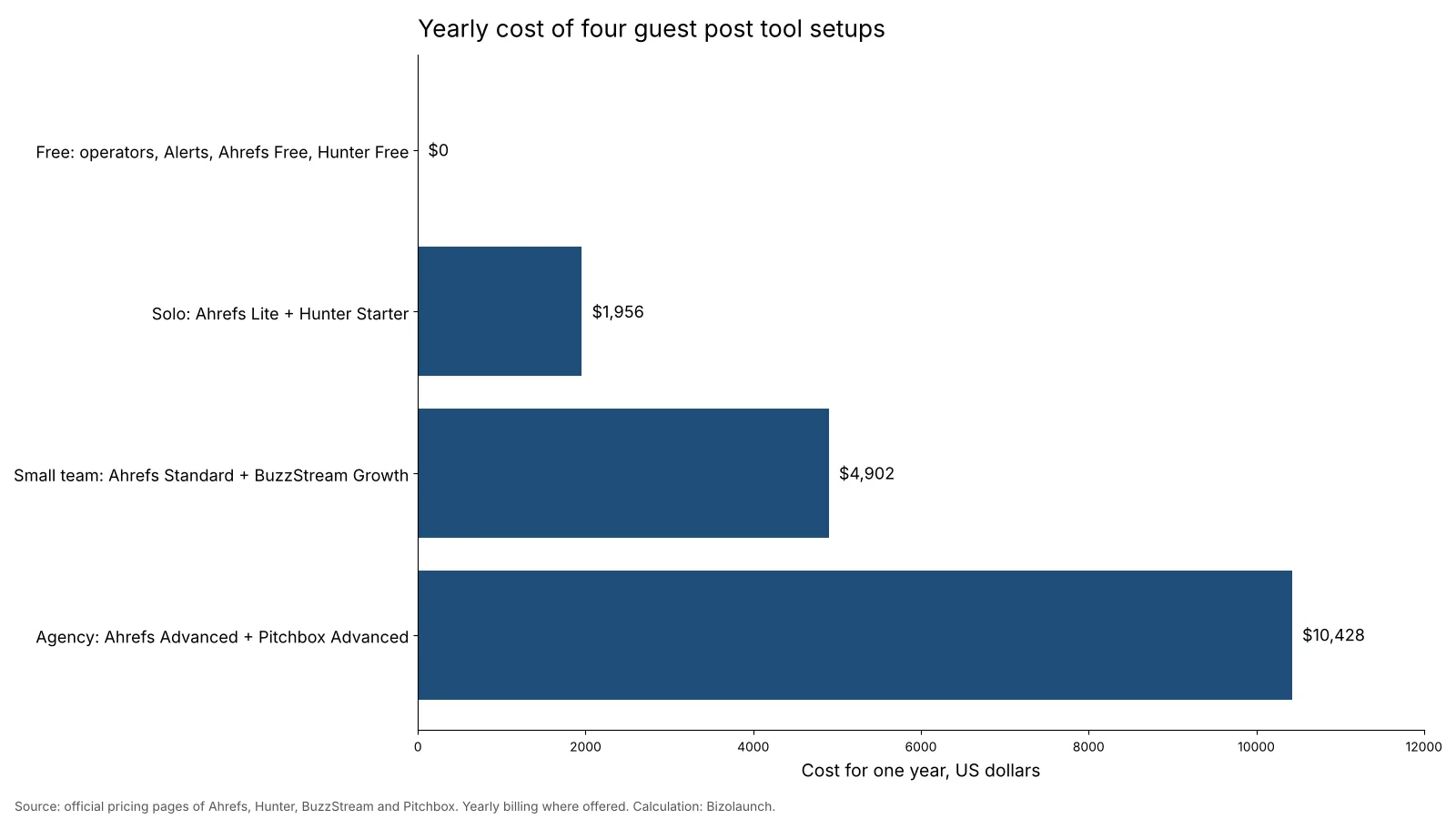
The jump between setups comes from the outreach platform, not from the search data. A solo writer can do the same prospecting as an agency with search operators and a spreadsheet. What the paid platforms add is volume, follow-up automation and shared records across a team.
To judge whether a paid stack pays off, divide its yearly cost by the number of posts you expect to land. At $1,956 a year and two published posts a month, the solo setup costs about $82 per post. Our CAC payback period guide shows how to weigh that against the customers a post brings in.
Our Guest Post Prospecting Workflow, Step by Step
This is the order we follow with the tools above. It keeps the paid steps for sites that have already passed the free checks.
- Run three to five search patterns for your topic and paste every result into a spreadsheet with columns for site, guidelines URL, date of the latest post and contact.
- Remove sites whose guidelines page or latest post is more than a year old.
- Check each remaining site’s organic traffic in Ahrefs and drop those with almost none.
- Read two recent posts on each site and note one gap your article could fill.
- Find the editor’s name on the guidelines page or author archive, then use Hunter or your outreach tool to confirm the email.
- Send one short, specific pitch per site with your proposed title and two lines on what readers will learn.
- Follow up once after a week, then mark the site and move on.
The pitch matters more than the tool. Editors reply to ideas that fit their readers. Bloggers in India who want local publishers can start with our list of top SEO blogs in India, and podcast appearances follow a similar pitching process covered in our guide to podcast guest booking websites.
Google’s Rules on Guest Posts and Paid Links
Google’s spam policies list guest posting campaigns with keyword-rich anchor text links among the examples of link spam, along with paying for articles that contain links passing ranking credit. Buying or selling links for advertising is allowed when the links carry `rel=”sponsored”` or `rel=”nofollow”`.
For guest posting, that means three practical rules. Write for the publisher’s readers first. Use plain anchor text, such as your brand name or the article title, and avoid exact-match keyword anchors. If any money changes hands for a placement, the link should be marked as sponsored. A tool can find opportunities quickly, but it cannot make a paid or keyword-stuffed link safe.
Guest Post Tool Questions From Marketers
What Is the Best Free Tool for Finding Guest Post Sites?
Google search with operators such as “write for us” plus your topic. Pair it with Ahrefs Free for basic site checks and Hunter’s free plan for 50 email credits a month.
Do I Need Ahrefs to Find Guest Post Opportunities?
No, but it saves time when checking whether a site gets search traffic. Starter costs $29 a month, and Content Explorer, the most useful feature for topic searches, starts on Standard at $249.
Which Outreach Tool Has No Long Contract?
BuzzStream runs month to month with no contract, and Hunter offers monthly billing. Pitchbox requires a one-year commitment on every plan.
Is Guest Posting Still Allowed by Google?
Yes, when the article is written for the site’s readers. Google’s spam policies target guest posting campaigns built around keyword-rich anchor text and paid links that are not marked as sponsored.