
A Fed rate change hits variable-rate debt within weeks. Credit cards and home equity lines move first, because their rates track the prime rate. Savings rates and fixed mortgages follow their own path. Federal student loans and existing fixed loans do not move at all.
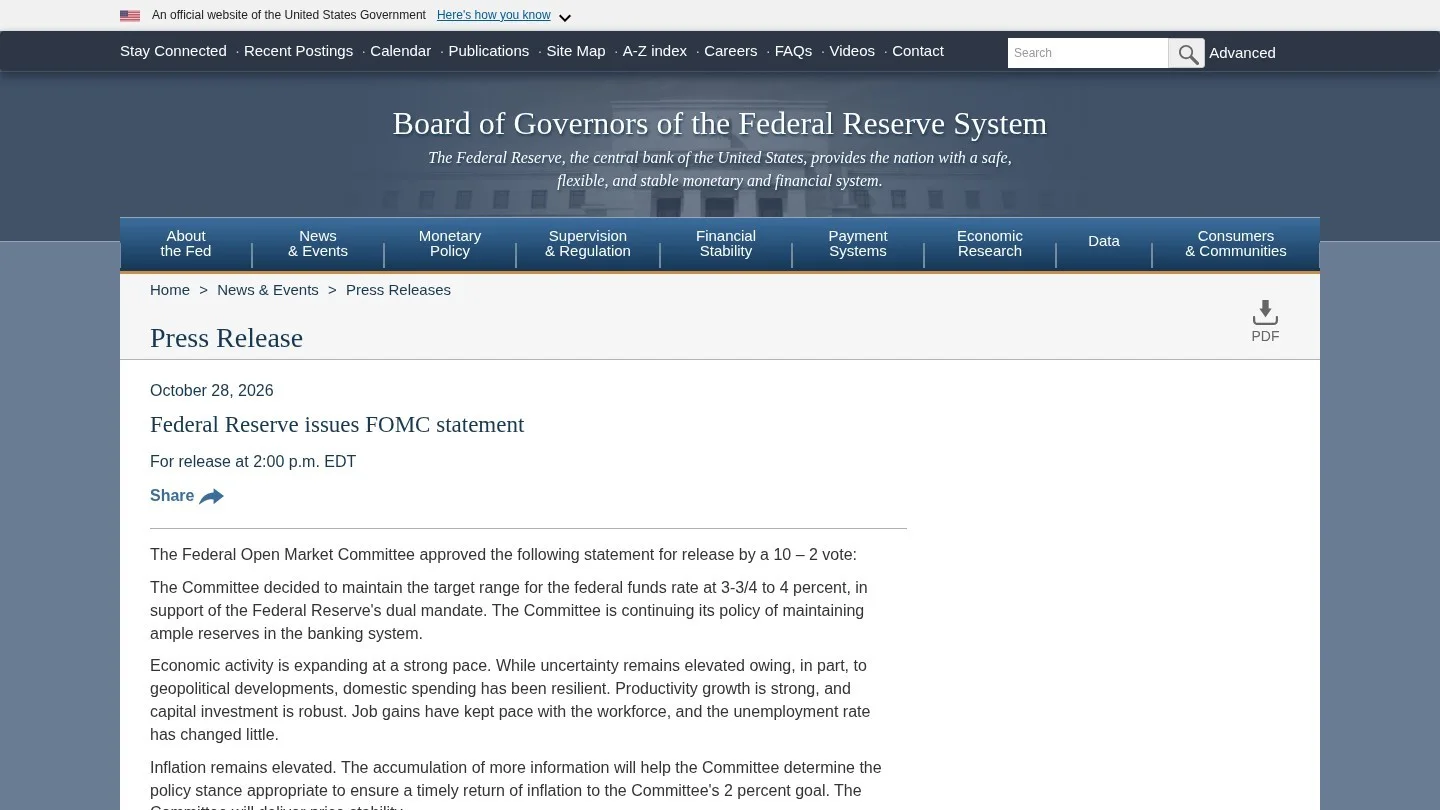
The latest example came on October 28, 2026. That day the Federal Open Market Committee kept its target range at 3.75% to 4%. The vote was 10 to 2. In fact, the two dissenters, Lisa Cook and Beth Hammack, wanted another quarter-point increase. The statement also noted that inflation is still running high.
That pause came after a hike. On September 16, 2026, the Fed raised the range by 0.25 points, from 3.5%-3.75% to 3.75%-4%, in a 12 to 0 vote. So borrowers have already felt one increase this autumn. Savers, however, have barely seen a change.
We compiled the official numbers that show where each product stands now. Then we worked out what one quarter point means in dollars. The method and inputs sit next to every figure, so you can redo the math for your own balances.
Follow the Chain From the Fed Funds Rate to Your Bank
First, know what the Fed actually sets. The federal funds rate is the rate banks charge each other for overnight loans. The Fed sets a target range for it and steers it with tools such as the rate it pays banks on reserves. After the September hike, that reserve rate went to 3.90%, and the Fed’s discount rate went to 4.0%.
Next, banks reset the prime rate. Prime is the base rate banks use for many consumer and business loans. Wells Fargo, for example, raised its prime rate to 7.00% from 6.75% on the day of the September decision, effective September 17. That puts prime exactly 3 points above the top of the Fed’s range (4% plus 3 points).
After that, the change flows into any loan priced as “prime plus a margin.” Your margin stays fixed in your contract. Only the prime part moves. That is why a quarter-point Fed hike usually means a quarter-point rise on those loans.
| Product | What sets its rate | How fast a Fed move shows up |
|---|---|---|
| Credit card (variable APR) | Prime rate plus your card’s margin | Soon after prime changes, on the timing in your agreement |
| Home equity line of credit | Prime rate plus a margin | At the next rate reset in your agreement |
| Small business line of credit | Often prime plus a margin | At the next reset date |
| Savings and money market accounts | The bank’s own choice | Slowly, and sometimes not at all |
| New 30-year fixed mortgage | Long-term bond yields and lender pricing | Indirectly; can move before or against the Fed |
| Existing fixed mortgage or car loan | Locked at signing | Never, unless you refinance |
| New federal student loan | 10-year Treasury auction each May plus a fixed add-on | Once a year, for new loans only |
Expect Credit Card and HELOC Rates to Rise Within Weeks
Credit cards feel a Fed hike first. Most US cards carry a variable APR, written in the cardholder agreement as the prime rate plus a margin. So when prime went from 6.75% to 7.00%, those APRs rose by the same 0.25 points.
The starting level matters more than the hike, though. The Fed’s own survey of commercial banks put the average rate on credit card accounts that paid interest at 22.36% in August 2026. It was 22.15% in May and 21.52% in February. Next to a rate that high, a quarter point is a small step.
For example, take a $6,000 balance carried for a full year. At 22.36%, the interest comes to about $1,341.60. A 0.25-point increase adds $15 a year. So the hike is real money, but paying down $1,000 of the balance saves far more than any Fed pause would.
Home equity lines work the same way. Because most HELOCs are priced off prime, a $50,000 balance costs about $125 more a year after a quarter-point increase ($50,000 x 0.25%). Check your agreement for the reset date and any rate cap.

Don’t Wait for Your Savings Rate to Catch Up
Banks raise loan rates fast. Savings rates are different, because each bank decides what it pays. The FDIC’s national average savings rate shows this gap clearly. It stood at 0.38% in June, July and August 2026. Then it slipped to 0.37% in September, the month of the hike. In October it was back at 0.38%.
So a Fed hike did not lift the typical savings account at all. On $10,000, a 0.38% rate pays about $38 a year. Meanwhile, the Fed pays banks 3.90% on their reserves. That spread is why many savers move cash elsewhere. Money market funds and short-term Treasury bills tend to track the Fed more closely.
Before you move money, compare the posted rate, any balance rules and whether the account is FDIC-insured. Also check if the rate is an introductory offer. Then use our percentage calculator to compare the yearly interest on each option.
For long-term goals, the rate on cash matters less than how much you put away. Our retirement savings calculator shows how contributions and return rates add up over decades.

Watch the 10-Year Treasury When You Shop for a Mortgage
Fixed mortgage rates do not follow the Fed directly. Instead, lenders price them off long-term bond yields, such as the 10-year Treasury, plus their own costs and risk. As a result, mortgage rates can fall while the Fed holds, or even after it hikes.
October showed this well. Freddie Mac’s weekly survey put the average 30-year fixed rate at 7.40% on October 8 and October 15. Then it fell to 7.32% on October 22, to 7.24% on October 29 and to 7.18% on November 5. In fact, those drops came while the Fed kept its range unchanged.
We calculated what that drift means on a $300,000, 30-year loan. At 7.40%, the monthly principal and interest payment is about $2,077.14. At 7.18%, it is about $2,032.30. That is roughly $44.83 a month, or $538 a year, from a move the Fed did not make.
Adjustable-rate mortgages are another matter. Their rate resets after the fixed period, based on an index plus a margin. So if you hold an ARM, find your index, your margin and your next reset date in the loan papers.

Know Which Loans Never Move With the Fed
Fixed-rate loans you already hold stay put. That covers most car loans, personal loans and fixed mortgages. A Fed hike cannot raise them, and a Fed cut cannot lower them. The only way to get a new rate is to refinance.
Federal student loans follow a yearly formula. The current rates cover loans first disbursed from July 1, 2026 to June 30, 2027. The Education Department set the rates from the May 12, 2026 auction of 10-year Treasury notes. That auction’s high yield was 4.468%.
| Federal loan type | Add-on | Rate for 2026-27 | Legal cap |
|---|---|---|---|
| Undergraduate Direct Subsidized and Unsubsidized | 2.05% | 6.52% | 8.25% |
| Graduate Direct Unsubsidized | 3.60% | 8.07% | 9.50% |
| Direct PLUS (parents and graduate students) | 4.60% | 9.07% | 10.50% |
Each rate is fixed for the life of that loan. So the September hike changed nothing for these borrowers. The next reset comes with the May auction, and it applies only to new loans.
If you are comparing loan offers, note how the rate is quoted too. Our guide to flat rate versus reducing rate explains why two loans with the same headline number can cost very different amounts.

Price a Quarter-Point Fed Move in Dollars
Headlines talk in basis points. Your budget runs in dollars. So we built one table that turns a 0.25-point change into yearly costs for common balances.
The method is plain. For revolving debt, we multiplied the balance by 0.25% to get the yearly change, assuming the balance stays the same all year. For the mortgage, we used the standard amortization formula on a 30-year loan. For savings, we multiplied the balance by the rate.
| Balance | Rate basis | Yearly effect of a 0.25-point move | Notes |
|---|---|---|---|
| $6,000 credit card balance | Prime plus margin (avg. 22.36% in Aug 2026) | About $15 | Interest at 22.36% is about $1,341.60 a year |
| $15,000 credit card balance | Prime plus margin | About $37.50 | Same method |
| $50,000 HELOC | Prime plus margin | About $125 | Check your reset date and cap |
| $100,000 business line of credit | Prime plus margin | About $250 | Check how often your line resets |
| $300,000 new 30-year mortgage | Market rate (7.18% on Nov 5) | About $612 | Payment at 7.18% vs 7.43%: $2,032.30 vs $2,083.28 a month |
| $10,000 in savings | Bank’s own rate (avg. 0.38%) | $0 to $25 | Depends on whether your bank passes the move on |
Two things jump out. First, the dollar effect on a credit card is small next to the interest you already pay. Second, the mortgage line is the largest, yet it depends on bond markets more than on the Fed. For loans with fixed payments, our EMI calculation guide shows the same formula step by step.
Business owners with prime-linked credit lines feel these moves on every draw. If you are weighing a bank line against other options, our overview of types of company funding compares debt and equity routes.
Prepare Your Balances Before the Next Fed Decision
The Fed meets eight times a year and publishes its dates in advance. Instead of reacting to each headline, run through these steps once. Then you only need to act when your own numbers change.
- List every variable-rate balance: credit cards, HELOCs, ARMs and business lines. Note the margin over prime for each one.
- Find your reset dates: cards often reset each billing cycle, while HELOCs and ARMs reset on dates in the contract.
- Pay off the highest APR first: at 22% or more, extra payments beat any rate cut you might wait for.
- Compare your savings rate with the national average: if you earn close to 0.38%, look at insured accounts that pay more.
- Track the 10-year Treasury if you plan to buy a home: mortgage quotes follow it more closely than the Fed.
- Leave fixed loans alone: refinance only when a new rate saves more than the closing costs.
- Read the statement and the dissents: votes for a hike, like the two in October, hint at the direction of the next move.
Quick Answers on Rate Hikes, Cuts and Your Bills
Does a Fed hike raise my existing mortgage payment?
No, a fixed-rate mortgage stays at the rate you signed. However, an adjustable-rate mortgage or a HELOC can rise at its next reset.
How long does a Fed change take to reach my credit card?
Soon after prime changes. In September, Wells Fargo moved its prime rate the next day, and your APR then follows the timing set in your card agreement.
Why did mortgage rates fall in October when the Fed did not cut?
Mortgage rates follow long-term bond yields and lender pricing. Those markets moved on their own, so the 30-year average fell from 7.40% to 7.18% while the Fed held.
Will my savings rate go up after a hike?
Not always. The national average savings rate stayed at 0.38% around the September hike. Money market funds, which hold short-term government debt, tend to track the Fed more closely.
Does the Fed set student loan rates?
No. Federal student loan rates come from the May 10-year Treasury auction plus a fixed add-on set by law. They are fixed for the life of each loan.
This article is for information and education only and is not financial advice.