
Let Subscribers Leave the Same Way They Joined
Auto-renewal laws in the US come down to three duties. First, show the price, the billing cycle and the way out before you take a card number. Second, get clear consent to the renewal itself. Third, let people cancel through the same channel they used to sign up, with no hoops. A business that does all three meets the core of federal law and most state and city rules.
Still, the details now vary by place. New York City’s own click-to-cancel rule took effect on October 1, 2026, and it adds reminder windows and fines of its own. So we researched the four rule sets a US subscription business is most likely to face. Then we compiled them into one table, a penalty schedule and a checklist you can run on your own sign-up flow.

This article explains general rules for business owners. It is not legal advice, so ask a lawyer about your own plans and customers.
Read What Changed in New York City on October 1
New York City’s Department of Consumer and Worker Protection (DCWP) announced the rule on July 10, 2026. It then took effect on October 1, 2026. As a result, New York City now works as its own compliance zone. In fact, a business that already meets New York State’s automatic renewal law can still fall short of the city rule.
The rule covers auto-renewal and continuous-service subscriptions for goods and services offered to New York City consumers. However, some sellers are exempt. Banks and credit unions are out. So are firms regulated by the state’s Department of Financial Services and licensed security alarm operators. Sellers of service contracts under state insurance law are exempt as well. On the other hand, DCWP chose not to exempt wireless and telecom providers regulated by the FCC.
The city’s own summary for shoppers lists the key promises. Companies must explain subscription terms clearly. Also, they must offer cancellation through the same method used to sign up. Finally, they cannot make a customer pay to ship back items that were sent for free.
Compare the Four Rule Sets Behind US Subscriptions
Most subscription sellers deal with several layers at once. For example, an online gym membership sold to a Brooklyn customer falls under federal law, New York State law and the city rule. So we built one table from the statute text, the FTC notice and the city rule summaries.
| Rule | Who it reaches | Disclosure and consent | Cancellation | Reminders |
|---|---|---|---|---|
| ROSCA (federal, 2010) | Online sales with a negative option feature | All material terms before billing details; express informed consent before charging | “Simple mechanisms” to stop recurring charges | None set in the statute |
| New York State automatic renewal law | Sellers to New York consumers | Broadly in line with the city rule | Same medium as sign-up; phone or online allowed for in-person sign-ups | Windows differ in places from the city’s |
| New York City rule (from October 1, 2026) | Subscriptions offered to NYC consumers | Material terms before consent or billing details | Same avenues as sign-up; online option required for in-person sign-ups | Renewal 15 to 45 days; changes 5 to 30 days; trials 3 to 21 days |
| California automatic renewal law (AB 2863 update) | Sellers to California consumers | Express affirmative consent to the renewal itself; keep proof | Online “click to cancel” link if you show save offers online | Yearly reminder; price change notice 7 to 30 days before the new fee |
Watch the Federal Rule That Is Still Being Written
Right now, ROSCA is the main federal law. It became law on December 29, 2010. Its Section 4 has three duties. Sellers must disclose all material terms before taking billing details. Next, they must get express informed consent before charging. Then they must give “simple mechanisms” to stop the charges.
The FTC tried to go further. It finalized a broader click-to-cancel rule in October 2024. But the Eighth Circuit court of appeals vacated that rule in July of last year on procedural grounds. After that, the FTC asked for public comment on a new advance notice of proposed rulemaking on March 11, 2026. The agency cited more than 100,000 complaints in five years. So a new federal rule may come, but no date has been set.
Show the Terms Before You Ask for a Card Number
Put the material terms on the same screen as the payment form. Under the New York City rule, those terms include the amount of each charge and how often it repeats. They also include the deadline to cancel before the next charge and every way the customer can cancel.
Free trials need one more line. If the price will change after a trial or an intro offer, say how and when it changes. For instance, “Free for 14 days, then $19 a month, billed on day 15” covers it. That one line gives the amount, the timing and the switch.
Also, keep the terms out of fine print. All four rule sets expect clear and visible wording. A grey footnote under a bright “Start trial” button invites a complaint.
Record Consent to the Renewal Itself
California asks for “express affirmative consent” to the automatic renewal, separate from agreeing to the rest of the contract. In practice, that means an unticked box or a clear button that names the renewal. For example: “Yes, renew my plan at $19 a month until I cancel.”
Next, save the proof. California requires you to keep consent records for three years, or one year after the contract ends, whichever is longer. So log the date, the exact wording the customer saw and the price shown. Store a screenshot or version number of the checkout page too. Then, if a customer disputes a charge, you can show what they agreed to.
Send Reminders Inside the Legal Windows
New York City sets three notice windows. California adds its own. We placed them side by side, because the windows overlap only in part.
| Notice | New York City | California |
|---|---|---|
| Renewal of a term of one year or more | 15 to 45 days before the cancellation deadline (renewal of six months or more) | Yearly reminder in the medium the customer used to join, or one they use often |
| Price rise or other material change | 5 to 30 days before the change | 7 to 30 days before the new fee applies |
New York City adds a third window for free trials or gifts that last more than one month. In that case, the reminder must go out 3 to 21 days before the cancellation deadline for the first paid period.
The overlap between the two tables is useful. For instance, a price-change email sent 15 days ahead lands inside both windows. The city asks for 5 to 30 days, and California asks for 7 to 30. Likewise, an annual renewal notice sent 30 days before the cancellation deadline meets the city window. Also, that email can carry what California wants in its yearly reminder. Just name the product, the charge, how often it repeats and how to cancel.
Build a Cancel Flow With No Dead Ends
Match the exit to the entry. If customers join online, let them cancel online. If they join in a store, New York City requires an online option too, such as a web form or an email address. By contrast, New York State lets those customers cancel by phone or online.
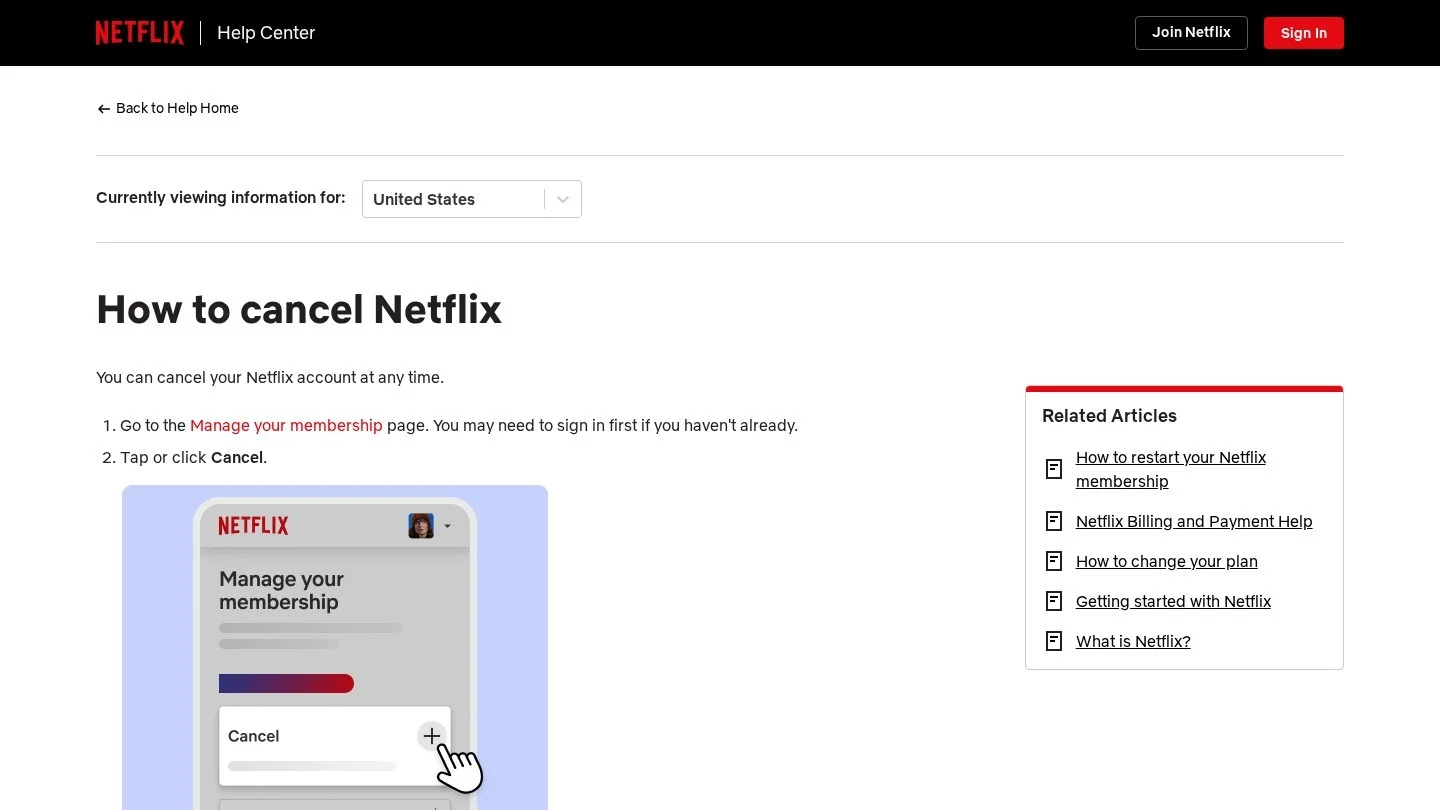
Netflix shows how short an online exit can be. A member opens the “Manage your membership” page, clicks Cancel and then “Finish Cancellation.” After that, Netflix sends a confirmation email. Access also runs to the end of the paid period.
Keep Save Offers Short
You can still offer a discount when someone tries to leave. However, New York City bars save offers that impose unreasonable conditions, block the exit or delay it. California is more exact. Online, you may show a save offer only if a clearly labeled “click to cancel” link or button stays on screen next to it. By phone, you must tell the caller they can cancel at any time by saying “cancel.”
Confirm Every Request
The city rule also bans hanging up on callers, hiding the steps and failing to acknowledge a request. So send a written confirmation for each cancellation. Then keep a log of every request, including chat transcripts and abandoned online attempts. That record matters because refunds under the city rule run from the customer’s first attempt to cancel.
Price Your Exposure Under the City Rule
DCWP treats violations as deceptive trade practices under the city’s Consumer Protection Law. Fines climb with repeat cases. Also, each deceptive statement, description or omission may count as a separate violation.
| Violation | Civil penalty |
|---|---|
| First | $525 |
| Second | $1,050 |
| Third and later | $3,500 each |
Besides fines, DCWP can seek refunds of every charge made after the customer’s first cancellation attempt. We worked through a small example. Say one checkout page leaves out the cancellation deadline and the trial end date. Those are two omissions, so the fines alone could reach $525 plus $1,050, or $1,575. Then a third issue, such as a phone line that drops callers, could add $3,500 more. That totals $5,075 before any refunds.
Customers can complain to DCWP online, by mail to 42 Broadway, New York, NY 10004, or by fax. The forms come in 12 languages. A DCWP mediator may then send the complaint to the business for a written reply.
Run Our 12-Point Subscription Compliance Check
We compiled this list from the four rule sets. Then walk through it on your live checkout and your account pages.
- List where your subscribers live, because New York City, New York State and California each add duties.
- Show the price, billing cycle, cancel deadline and cancel methods next to the payment form.
- Explain any price change after a free trial or intro offer, with the date.
- Use an unticked box or a named button for consent to the renewal.
- Save consent records for at least three years, or one year after the contract ends if that is later.
- Send renewal reminders 15 to 45 days before the cancel deadline.
- Send price-change notices 7 to 30 days ahead, which also meets the city’s 5-to-30-day window.
- Remind trial users 3 to 21 days before a trial of more than a month ends.
- Offer online cancellation for every customer, including in-store sign-ups.
- Keep any save offer short, with a visible “click to cancel” option.
- Confirm every cancellation in writing and log every attempt.
- Never charge for returning items you shipped without the customer’s request.
Subscription pricing and retention also shape this work. Our guides to SaaS pricing models and SaaS churn rate show how plan design affects cancellations. Clear return terms matter in the same way, as our ecommerce return policy examples show.
Answer Owners’ Questions on Auto-Renewal Rules
Does the New York City rule apply to a business based outside the city?
Yes, it can. The rule covers subscriptions offered to New York City consumers, so the customer’s location matters. A seller in Texas with subscribers in Queens should follow it for those customers.
Can I require customers to call to cancel?
Under the city rule, not if they joined online. New York City requires cancellation through the same avenues as sign-up. Also, lawyers who track the rule flag phone-only exits for online customers as likely to draw scrutiny.
Is there a federal click-to-cancel rule in force?
No, not a broad one. A federal appeals court vacated the FTC’s 2024 rule, and the FTC reopened rulemaking on March 11, 2026. Meanwhile, ROSCA still applies to online sales with a negative option feature.
Do these rules cover B2B software plans?
The city and state rules focus on consumers. Still, many SaaS tools sell to freelancers and sole traders on consumer-style checkouts. If a person can sign up with a personal card, treat the plan as covered and follow the checklist. Sign-up forms often run through e-signature tools as well, and our list of DocuSign alternatives for small business covers those options.
What records should I keep?
Keep the checkout wording, the consent click, every reminder email and every cancellation request with its date. Also store data safely, because these logs hold personal details. Our small business cybersecurity checklist covers the basics of protecting customer records.