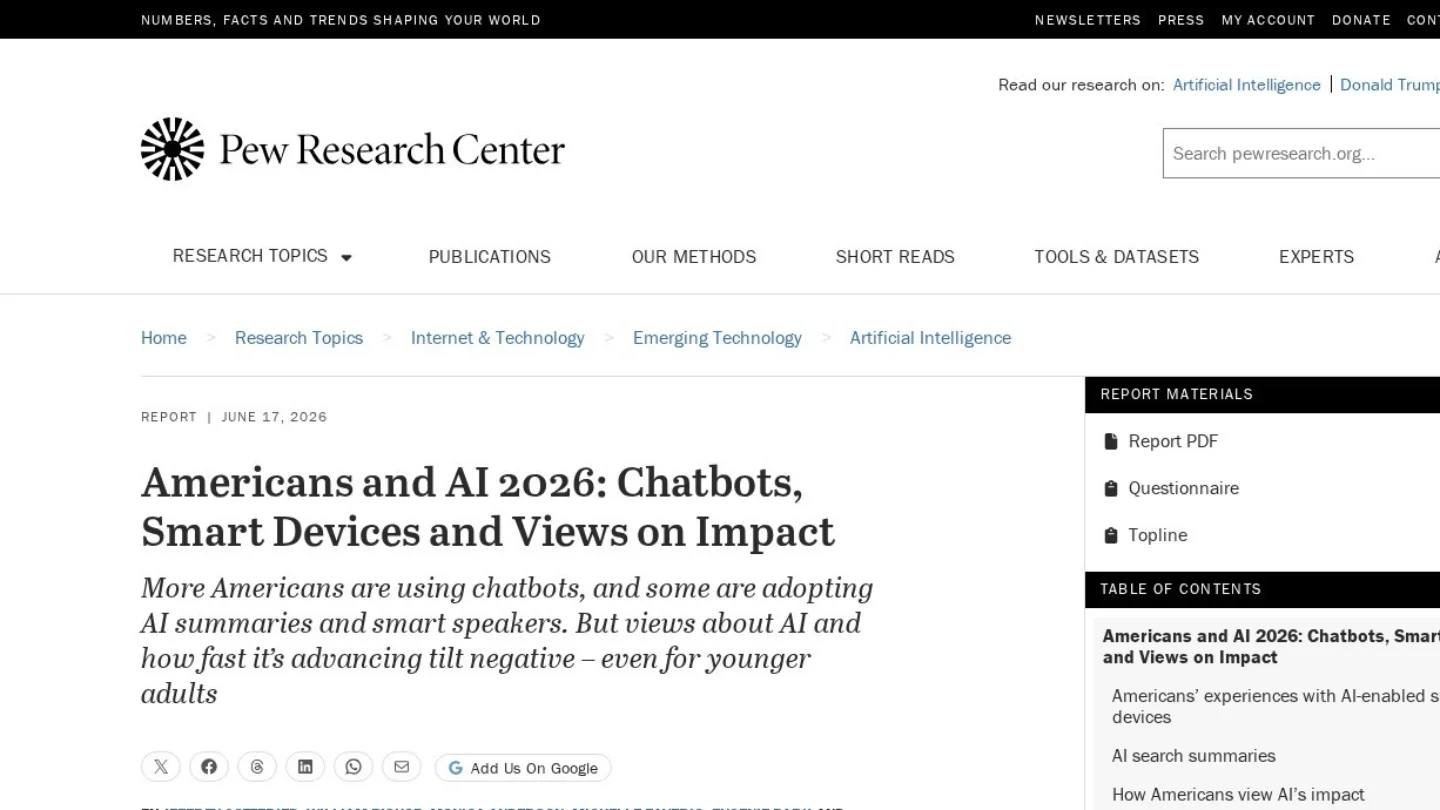
About half of US adults (49%) now use an AI chatbot, and nearly one in four (24%) uses one every day. ChatGPT leads, at 44% of US adults. These AI chatbot usage statistics come from Pew Research Center’s survey of 5,119 US adults in February 2026.
We opened every original survey and company statement we could find, then did our own math where they left gaps. Divide Pew’s two numbers and a pattern appears. Roughly half of US chatbot users open one every day. So the habit is already set for many people, even though half the country still does not use these tools.
AI Chatbot Usage Statistics We Put in One Table
First, we pulled the main numbers into a single view. Each row names who ran the survey. Also, the bases differ, so a US figure and a six-country figure do not measure the same group.
| Statistic | Figure | Source and base |
|---|---|---|
| US adults who use AI chatbots | 49% | Pew Research Center, 5,119 US adults |
| US adults who use a chatbot daily | 24% | Pew Research Center |
| US adults who have used ChatGPT | 44% | Pew Research Center |
| US adults who have used Gemini | 24% | Pew Research Center |
| US adults who have used Claude | 6% | Pew Research Center |
| Weekly generative AI use, six countries | 51% | Reuters Institute, about 2,000 people per country |
| Daily generative AI use, six countries | 28% | Reuters Institute |
| Weekly use of chatbots for news | 10% | Reuters Institute Digital News Report |
| US workers using AI at least weekly | 28% | Gallup, 17,874 working adults |
| Gen Z using AI at least weekly | 51% | Gallup, 1,572 people aged 14 to 29 |
| ChatGPT weekly active users worldwide | 900 million+ | OpenAI says |
| Gemini app monthly active users | 1 billion+ | Google says |

How Many US Adults Use AI Chatbots Now
Pew Research Center found that 49% of US adults use AI chatbots. In 2024, the same figure was 33%. So use rose by 16 points in two years. By our math, that is a jump of nearly half in the number of users.
However, the 2024 question went only to people who had heard of chatbots. Pew notes that change in wording. So treat the trend as a direction, and do not read it as an exact growth rate.
Daily use is the bigger story. Pew found that 24% of US adults use a chatbot every day. That includes 12% who use one several times a day and 4% who use one almost constantly. Then we divided 24% by 49%. As a result, about 49% of chatbot users in the US are daily users.
ChatGPT Use Has More Than Doubled Since 2023
Pew has tracked ChatGPT for four years. In 2023, 18% of US adults said they had used it. That rose to 23% in 2024 and to 34% a year later. Now it stands at 44%. So the share has more than doubled in three years.
Which Chatbots Americans Use: ChatGPT, Gemini, Copilot and Claude
ChatGPT leads by a wide margin. Pew Research Center asked about seven chatbots by name, and the results differ a lot.
| Chatbot | US adults who have used it | Share of all chatbot users (our math) |
|---|---|---|
| ChatGPT | 44% | About 90% |
| Gemini | 24% | About 49% |
| Copilot | 17% | About 35% |
| Meta AI | 14% | About 29% |
| Grok | 8% | About 16% |
| Claude | 6% | About 12% |
| Character.ai | 3% | About 6% |
We made the last column ourselves. We divided each chatbot’s share by the 49% who use any chatbot. So about nine in ten US chatbot users have tried ChatGPT. Also, many people use more than one tool, so the column adds up to more than 100%.
Across six countries, the US among them, the gap is closing. The Reuters Institute surveyed six countries in both of the last two years. Weekly ChatGPT use rose from 22% to 34%. Gemini did even better, with weekly use more than doubling from 11% to 24%. Claude, the chatbot from the company run by Dario Amodei, went from 1% to 7%. Copilot rose from 6% to 11%.
Chatbot Use by Age Group and Gender
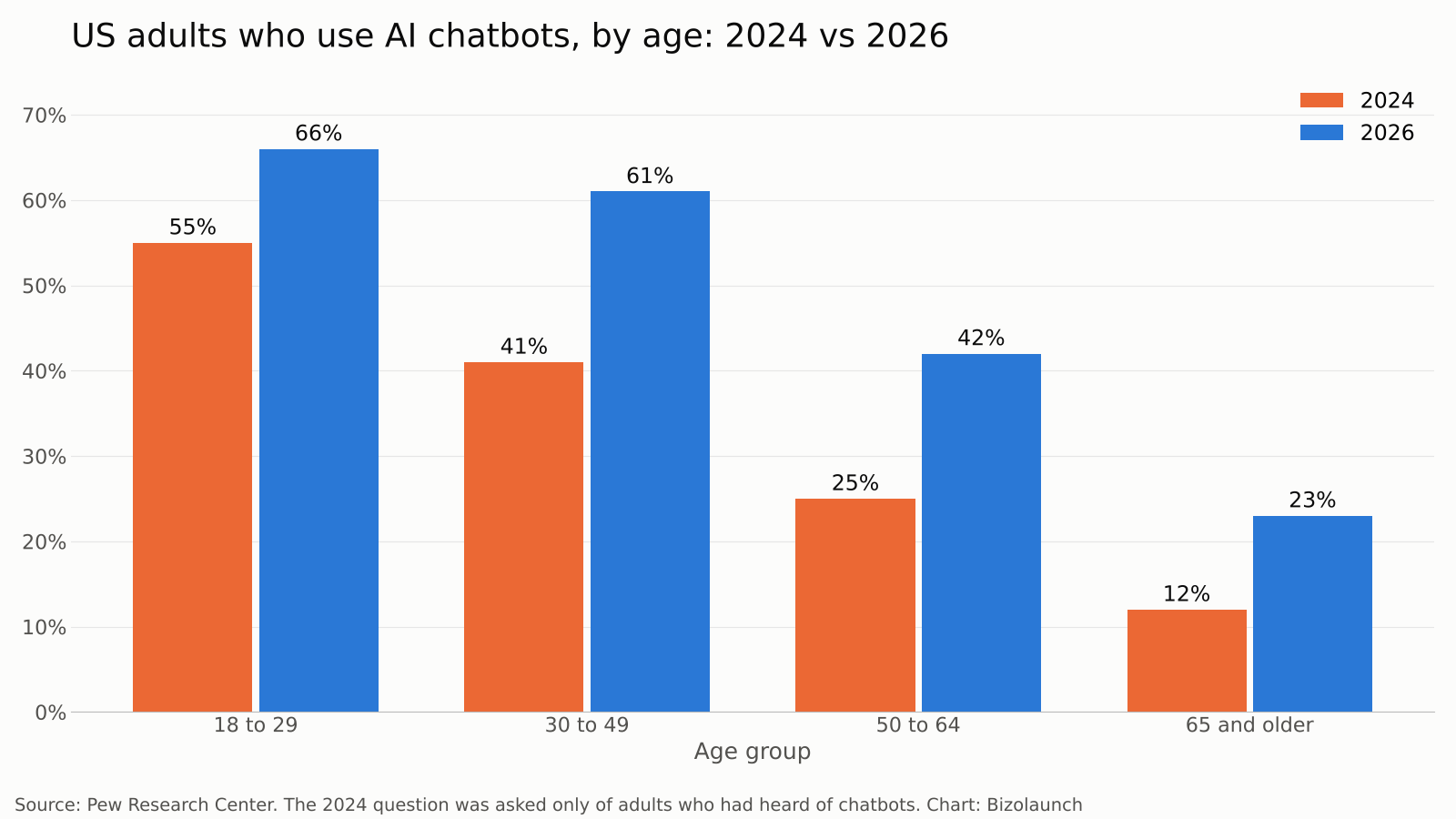
Age is the clearest dividing line. Pew’s age breakdown found that 66% of adults under 30 use chatbots. However, only 23% of adults 65 and older do. Still, the oldest group nearly doubled its use since 2024.
| Age group | Use chatbots (2026) | Use chatbots (2024) | Use daily (2026) | Have used ChatGPT |
|---|---|---|---|---|
| 18 to 29 | 66% | 55% | 31% | 61% |
| 30 to 49 | 61% | 41% | 34% | 55% |
| 50 to 64 | 42% | 25% | 19% | 37% |
| 65 and older | 23% | 12% | 7% | 19% |
| All US adults | 49% | 33% | 24% | 44% |
Adults aged 30 to 49 are the most frequent users. Pew found that 34% of them use a chatbot daily. That is a little higher than the 31% of adults under 30. So the heaviest daily use sits with people in their working prime.
Claude and Character.ai skew young, too. For example, 10% of adults under 30 have used Claude. Only 1% of adults 65 and older have.
Men and Women Use Chatbots at Nearly the Same Rate
The gender gap has almost closed. In 2024, Pew found that 39% of men and 28% of women used chatbots. Now the figures are 50% and 47%. Also, men and women use ChatGPT at the same rate, 44% each. However, men are still more likely to use a chatbot daily, at 27% versus 20%.
What People Use AI Chatbots For
Search is the top job. Pew found that 42% of US adults have used a chatbot to look up information. Then come work tasks, fun and image editing.
| Use | All US adults | Ages 18 to 29 | Ages 65 and older |
|---|---|---|---|
| Searching for information | 42% | 54% | 20% |
| Tasks at work (employed adults) | 38% | 41% | 18% |
| Fun or entertainment | 25% | 33% | 7% |
| Creating or editing images or videos | 24% | 34% | 5% |
| Medical advice | 20% | 27% | 11% |
| Diet and fitness information | 20% | 30% | 7% |
| News | 13% | 15% | 8% |
| Emotional support or advice | 10% | 20% | 2% |
| Companionship | 4% | 7% | 1% |
Emotional support shows the widest age gap. One in five adults under 30 have turned to a chatbot for it. Yet only 2% of those 65 and older have. Women are also a bit more likely than men to use chatbots this way, at 11% versus 8%.

Daily Generative AI Use Across Six Countries
The habit is growing fast abroad too. The Reuters Institute’s Generative AI and News Report 2026 polled about 2,000 people in each of nine countries. YouGov ran the fieldwork in August and September 2026.
In six countries tracked since 2024, weekly use of generative AI reached 51%. A year earlier it was 34%. Daily use climbed even faster. It went from 7% in 2024 to 28% in 2026. So daily use has quadrupled in two years.
Country results vary. Norway reached 57% weekly use, second only to Argentina. However, the UK was lowest of the nine, at 42%. Also, the US saw a 13-point rise in weekly use, while France rose 21 points.
Using AI to find information is now common, too. The share who did so weekly rose from 11% in 2024 to 38% in 2026. Besides, 18% of people now pay for AI access, either with their own money or through work or school.

Chatbots Are Still a Small News Source
News is one area where chatbots lag. The Reuters Institute Digital News Report 2026 found that weekly use of AI chatbots for news rose from 7% to 10%. Yet only 1% say AI is their main source of news.
Young people lead here as well. In the youngest age group, 17% use chatbots for news each week. That is about three times the 5% in the oldest group. The biggest relative growth, though, came from people aged 25 to 34.
Trust is the hurdle. Only 20% of the general public trust news from AI chatbots. However, among people who use them for news, trust rises to 44%. Also, just 4% always or often click through from a chatbot to the original source. For search, the figure is 19%.
AI at Work and Among Gen Z
Work use is lower than many headlines suggest. Gallup surveyed 17,874 working US adults in early 2026. It found that 28% use AI in their role at least weekly. Over half, 54%, have never used AI at work.
Role and education matter a lot. For example, 37% of managers use AI daily or weekly, compared with 25% of individual contributors. Also, 40% of college graduates are regular users, against 17% of workers without a degree. If your team wants a low-risk place to try AI, our list of AI tools for meeting notes shows what teams pick.
Gen Z uses AI more, but its mood has cooled. Gallup surveyed 1,572 people aged 14 to 29 in February and March 2026. It found that 51% use AI at least weekly and 22% use it daily. Yet only 22% now feel excited about AI, down from 36% a year earlier. In fact, “curious” was the most common feeling, at 49%.
User Counts From OpenAI and Google
Company figures are bigger, because they count the whole world. On February 27, 2026, OpenAI said ChatGPT had more than 900 million weekly active users. OpenAI also says it has more than 50 million consumer subscribers. By our math, that means about one in 18 weekly users pays.
OpenAI added that more than 9 million paying business users rely on ChatGPT for work. Also, weekly Codex users more than tripled to 1.6 million since the start of 2026.
Google reported its own count in its Q3 2026 earnings remarks on October 28, 2026. Sundar Pichai said the Gemini app has reached one billion users. Google’s chart labels it as more than 1 billion monthly active users. However, a monthly figure and a weekly figure are not the same measure. So you cannot rank the two apps from these numbers alone.

How We Read These Numbers for a Small Business
Your customers are likely already asking chatbots about products. Pew found that 42% of US adults use chatbots to search for information. So a business that only plans for Google search misses part of the picture. Our guide to ChatGPT rank trackers covers how to see where your brand shows up.
Next, look at your staff. Gallup found that more than half of US workers have never used AI on the job. That leaves many teams using these tools without rules. A written AI acceptable use policy sets limits on client data and accuracy checks.
Also, think about age. If your buyers are over 65, fewer than one in four use chatbots. However, if they are under 50, most do. For example, a marketing team using AI agents should weigh who it is trying to reach.
What Readers Want to Know About Chatbot Use
What Percentage of People Use AI Chatbots?
In the US, 49% of adults use AI chatbots, Pew Research Center found. Across six countries tracked by the Reuters Institute, 51% use generative AI weekly.
How Many People Use ChatGPT Every Week?
OpenAI says ChatGPT has more than 900 million weekly active users worldwide. In the US, 44% of adults have used it, Pew found.
Which AI Chatbot Is Most Popular?
ChatGPT is the most used chatbot in the US, at 44% of adults. Gemini is second, at 24%, and Copilot is third, at 17%.
Which Age Group Uses AI Chatbots the Most?
Adults aged 18 to 29 are most likely to use chatbots, at 66%. However, adults aged 30 to 49 are the most likely to use one daily, at 34%.
Do People Trust News From AI Chatbots?
Mostly not. The Reuters Institute found that only 20% of the public trust news from AI chatbots. Among people who use them for news, trust rises to 44%.
How Many Workers Use AI at Work?
Gallup found that 28% of US workers use AI in their role at least weekly. Meanwhile, 54% have never used it at work.
Pew, Reuters Institute, Gallup and Company Sources We Used
- Pew Research Center: Americans and AI 2026, Chatbots, Smart Devices and Views on Impact
- Pew Research Center: How opinions and use of AI differ by age
- Pew Research Center: The gender gap in AI
- Reuters Institute: Generative AI and News Report 2026
- Reuters Institute: Emerging uses of AI chatbots for news, Digital News Report 2026
- Gallup: AI Benefits at Work Unevenly Distributed
- Gallup: Gen Z’s AI Adoption Steady, but Skepticism Climbs
- OpenAI: Scaling AI for everyone
- Google: Q3 2026 earnings call, remarks from our CEO