The home robots worth buying in late 2026 are the ones built for a single chore: a robot vacuum and mop for floors, a robot mower for the lawn, a robotic pool cleaner and a self-cleaning litter box. Each does one job on its own schedule, and each costs from under $1,000 to about $3,000. General-purpose help is arriving too, with 1X’s NEO humanoid priced at $20,000 or $499 a month, but it is still an early-adopter product.
We picked the robots below by matching them to the chores Americans spend the most time on, using the Bureau of Labor Statistics’ American Time Use Survey. For each robot we read the maker’s own product page for price, coverage and limits, then worked out what each spec means in a real home.
Home Robots by Chore, at a Glance From Official Pages
- Floors: Roborock Saros Z70 vacuums, mops and uses a folding arm to move socks and slippers up to 300 g out of its way.
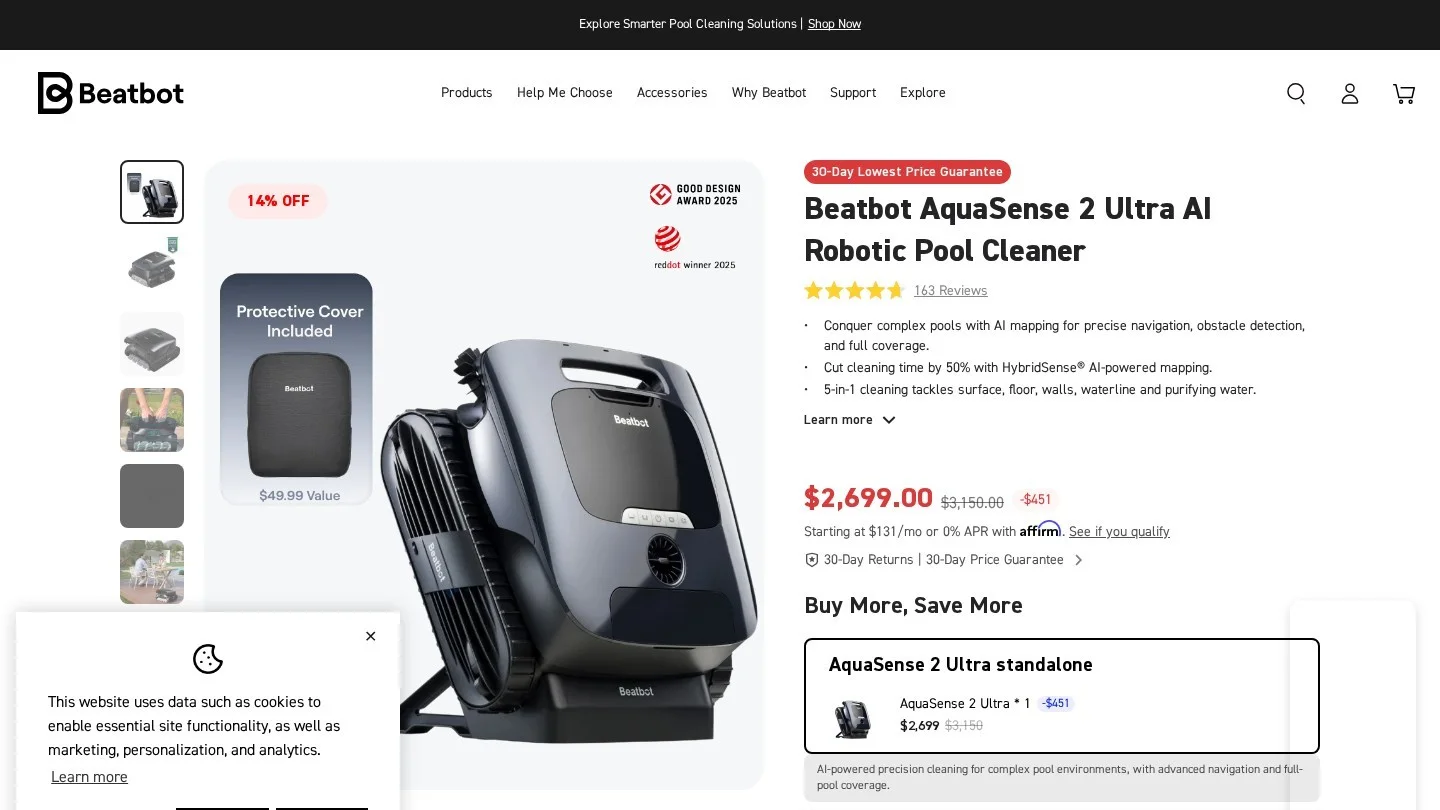
- Pool: Beatbot AquaSense 2 Ultra cleans the floor, walls, waterline and surface, at $2,699 on sale from a $3,150 list price.
- Cat litter: Litter-Robot 4 sifts waste after each visit and suits up to four cats; its starter bundle is $886.
- Lawn: Segway Navimow X330 covers up to 1 acre for $2,299, and Mammotion’s LUBA 3 AWD 3000 covers 0.75 acre for $2,799.
- Everything else: 1X NEO is the first humanoid sold for homes, at $20,000 or $499 a month.
Where Household Time Goes and Which Robots Help
In 2025, people aged 15 and over in the US spent an average of 1.99 hours a day on household activities. We multiplied each daily average by 365 to see the yearly load, then marked the chores where robots already do real work.
| Chore | Hours per day (2025) | Hours per year | Robots that help today |
|---|---|---|---|
| Food preparation and cleanup | 0.71 | 259 | Dishwashers, but no widely sold cooking robots |
| Interior cleaning | 0.33 | 120 | Robot vacuums and mops, window robots |
| Lawn and garden care | 0.19 | 69 | Robot lawn mowers |
| Laundry | 0.17 | 62 | None in wide sale |
| Household management | 0.17 | 62 | None in wide sale |
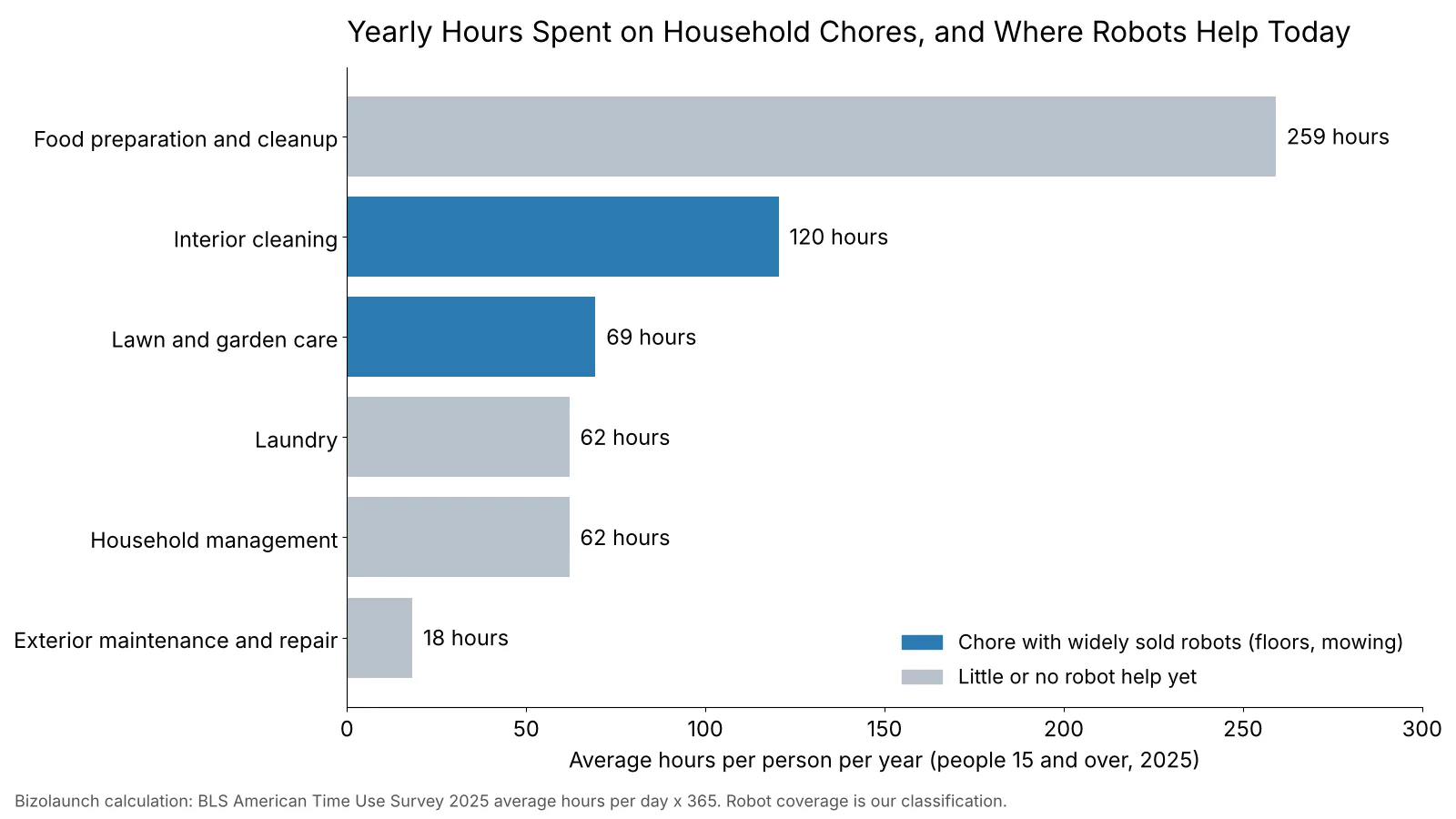
The split is uneven across households. The same survey shows women averaging 0.45 hours a day on interior cleaning, or about 164 hours a year, and men averaging 0.26 hours a day on lawn and garden care, or about 95 hours a year. That makes floor robots and robot mowers the two purchases most likely to give back meaningful time, and it is why they lead this list.
Best Robot for Floors: Roborock Saros Z70
Most premium robot vacuums now mop as well, empty their own bins and map every room of the house, so what sets the Saros Z70 apart is the problem it tackles, which is clutter on the floor. Roborock’s OmniGrip is a five-axis folding arm that picks up small items such as socks, slippers and towels and moves them to a set spot, as long as each item weighs under 300 grams. It has 22,000 Pa of suction. The US launch offer in March 2025 was $1,899 against a $2,299 regular price, and the Australian price is A$3,999.
The Saros Z70 belongs to a crowded category, and most mid-priced robot vacuums from the major brands now share the same basic features of LiDAR mapping, room-by-room schedules and self-emptying docks. The reason to pay for a flagship model is the extra hardware that handles the problems cheaper robots leave behind, such as clutter, deep carpet and dried-on kitchen spills.
Why it matters: the biggest reason robot vacuums fail to finish a room is stuff on the floor. A robot that clears socks and slippers covers more floor without a person tidying first. The arm is limited to light objects, so cords, toys heavier than 300 g and pet messes still need avoiding or picking up by hand.
One way to frame the value is cost per hour of chore time. If a $2,299 floor robot handled every hour of the 120 hours of yearly interior cleaning, it would cost about $6.36 per hour of chore time over three years. In practice it covers floors only, not dusting or bathrooms, so treat that as a best-case figure.
Best Pool Robot: Beatbot AquaSense 2 Ultra
Pool robots have moved on from floor-only cleaners to machines that also skim leaves and debris from the surface. Beatbot’s AquaSense 2 Ultra lists at $3,150 with a sale price of $2,699, and Beatbot says it cleans the floor, walls, waterline and water surface. It also releases a clarifying agent to help keep water clear.
- Runtime: Up to 10 hours skimming the surface, 5 hours on the floor and 4.5 hours on walls and waterline.
- Pool size: Recommended pool floor area of up to 360 m² (3,875 sq ft), with up to 320 m² cleaned in a single cycle.
- Warranty: 3-year full replacement warranty listed on the page.
Who it suits: owners of large in-ground pools who skim by hand most days. Smaller above-ground pools can be served by cheaper floor-only robots, so check your pool’s floor area against the rated size before paying for surface skimming.
Best Robot for Cat Owners: Litter-Robot 4
Scooping litter is a small daily chore that adds up over a year, and the Litter-Robot 4 is designed to automate it completely. Whisker’s starter bundle costs $886, down from $1,011, including the robot, liners, a litter mat, odor packs, a 20 lb bag of litter, six months of the Whisker+ membership and an extended warranty. Whisker says the design suits up to four cats.
- How it works: The globe rotates to sift waste into a sealed drawer after each visit, so you empty a drawer instead of scooping.
- Health tracking: A built-in scale records each cat’s weight, and the app logs visits, which can flag changes worth raising with a vet.
- Setup note: It needs a 2.4 GHz Wi-Fi network for app features, which some newer mesh routers hide by default.
- Trial: Whisker offers a 90-day in-home trial.
Best Robot Mowers for Typical Yards
Robot mowers have dropped the boundary wire that once had to be buried around a lawn. Most new models find their way using satellite positioning, cameras or LiDAR instead, which makes installation far quicker. The two models below suit a typical suburban yard.
| Model | Rated lawn size | List price | Navigation |
|---|---|---|---|
| Segway Navimow X330 | Up to 1 acre | $2,299 (spec table MSRP $2,799) | EFLS 3.0 locating system with RGB and ToF object detection |
| Mammotion LUBA 3 AWD 3000 | Up to 0.75 acre | $2,799 | 360-degree LiDAR, network RTK and dual-camera AI vision |
Connectivity is part of the price as well. Navimow’s spec page lists Bluetooth, Wi-Fi and 4G on the X3 series, with two years of free 4G service on the X330, three years on the X350 and five years on the X390, so owners of the smaller model should budget for a data plan after the second season if they want remote control away from home Wi-Fi.
Mammotion lists a 38.6-degree (80%) maximum slope for its LUBA 3 AWD series, which matters on hilly lots, while Navimow lists 27 degrees (50%) for the X3 series. A $2,299 mower covering all 69 hours of an average person’s yearly lawn and garden time would work out to about $11 per hour over three years, although mowing is only part of garden care. For lots of 1.5 acres and more, see our separate guide to robot lawn mowers for large properties.
The First General-Purpose Home Robot: 1X NEO
Every robot above handles one chore, while NEO is the first humanoid sold to households that aims to handle many different tasks. Early Access costs $20,000 with priority delivery in 2026, or a $499 monthly subscription that ships later. The robot weighs 66 lb, can lift over 150 lb and carry 55 lb, and is sold first in the US, with other markets from 2027.
It is the most expensive item on this list by a wide margin, and its skills are designed to grow through software updates over time. Our breakdown of what humanoid robots cost runs the buy-versus-subscribe math and compares the price with paid household help.
Window-Cleaning Robots and Coated Glass
A few smaller categories round out the home robot shelf. Window-cleaning robots such as the Ecovacs Winbot W2 Omni cling to glass with suction and come with a station and a multi-level safety system. They suit large picture windows and glass doors but still need a person to move them between panes. If you would rather avoid the chore altogether, our guide to self-cleaning windows for homes covers coated glass that sheds dirt with rain.
What We Compared on Each Robot’s Official Page
A spec sheet only helps if you know which lines matter. These are the six lines we checked for every robot on this list, along with the reason each one counts when you compare models.
- Price on the maker’s own store. Sale prices change weekly, so we list the list price and the sale price where both appear.
- Rated coverage. Floor area for vacuums and pool robots, lawn area for mowers, number of cats for litter boxes. Buying below your home’s size means unfinished jobs.
- Runtime and recharge. A robot that runs out of charge midway has to dock and resume, which stretches the job.
- Limits stated by the maker. The Saros arm’s 300 g limit and the mowers’ slope limits are good examples.
- Connectivity. Wi-Fi band, app needs and cloud features affect setup and privacy.
- Warranty and trial terms. Longer warranties and in-home trials lower the risk on a first robot.
Making Home Robots Work With Your Network and Routine
Most problems with home robots come from setup and daily routine rather than from the robot itself, and a few simple habits help them run smoothly for years.
- Give robots a stable network. Litter boxes and some vacuums need 2.4 GHz Wi-Fi. If your router merges bands, create a separate 2.4 GHz network for smart devices.
- Keep control local where you can. If you worry about cloud outages or data sharing, our guide to running a smart home without internet access explains local control options.
- Pair cleaning robots with leak sensors. Mopping robots and pool robots mean water around the house. A smart water leak detection system can warn you early if a dock or hose leaks.
- Schedule around power prices. Robots that charge at night can take advantage of off-peak rates, and a smart home energy management system can shift that load automatically.
- Check the maker’s support future. Roomba maker iRobot went through Chapter 11 and was taken over by its manufacturer Picea, which reminds buyers to favor brands with clear app and parts support.
Budgeting for a Robot-Assisted Home
Few households buy every robot at once, so it helps to price a few realistic combinations. We added up the official prices quoted earlier in this article and spread each total over three years, a common planning window for consumer electronics, to get a rough monthly cost. Accessories, replacement brushes, blades and filters are extra and vary by brand.
| Robot set | Robots included | Upfront total | Spread over 36 months |
|---|---|---|---|
| Indoor starter | Roborock Saros Z70 ($2,299 regular price) and Litter-Robot 4 bundle ($886) | $3,185 | About $88 a month |
| House and yard | Saros Z70 and Segway Navimow X330 ($2,299) | $4,598 | About $128 a month |
| Full set | Saros Z70, Navimow X330, Litter-Robot 4 bundle and Beatbot AquaSense 2 Ultra ($2,699 sale) | $8,183 | About $227 a month |
| General-purpose humanoid | 1X NEO on subscription | $17,964 over 36 months | $499 a month |
The comparison shows why single-task robots remain the sensible starting point for most families. The full set of four specialists costs less than half of three years of a NEO subscription, and each one already does its job without supervision. A humanoid makes more sense once it can reliably take on the chores no specialist robot handles today, such as laundry and tidying, which together with interior cleaning make up the bulk of the hours in the time use data.
Home Robot Questions From First-Time Buyers
Which Home Robot Saves the Most Time?
For most households it is a robot vacuum and mop, because interior cleaning takes about 120 hours a year per person. For homes with a large lawn, a robot mower can rival it, since lawn and garden care averages about 69 hours a year.
Can a Robot Vacuum Pick Up Clutter?
Most cannot, which is why they are programmed to steer around objects instead. The Roborock Saros Z70 is an exception, with an arm that moves items under 300 g, such as socks and slippers, out of the way.
Are Robotic Pool Cleaners Worth It?
For large pools cleaned often by hand, yes. The Beatbot AquaSense 2 Ultra adds surface skimming and waterline cleaning to floor cleaning, and lists a 3,875 sq ft recommended floor area.
Is There a Robot That Does Laundry?
There is no laundry robot in wide sale for homes yet. Laundry takes about 62 hours a year per person, and general-purpose robots like NEO are the first products aiming at tasks of this kind.
Do Home Robots Work Without Wi-Fi?
Many run basic schedules without it, but maps, app control and updates usually need Wi-Fi. Check whether a robot supports local control before buying if this matters to you.
Maker Pages Behind the Home Robot Picks
- BLS American Time Use Survey: household activities
- Tom’s Guide: Roborock Saros Z70 with robotic arm on sale
- EFTM: Roborock Saros Z70 Australian preorder
- Beatbot AquaSense 2 Ultra
- Litter-Robot 4 starter bundle
- Segway Navimow X3 series specs
- Mammotion LUBA AWD US store
- 1X NEO home robot
- Ecovacs Winbot W2 Omni support
- Automate: iRobot files for bankruptcy