
Bitcoin was trading at $77,926 on the morning of Monday, November 2, 2026, about 2% above the low it hit after the biggest theft in crypto history. On October 30, 2026, Binance disclosed that hackers had drained more than $6 billion from its hot wallets. The same day, US spot bitcoin ETFs saw about $643 million in net outflows. By Sunday, Binance had reopened withdrawals and said it had covered about 95% of the losses with its own money. Bitcoin dipped, but it did not crash.
For holders, the episode tests two things at once: how the largest exchange handles a breach, and how much one exchange’s trouble still moves the price of bitcoin itself.
What Happened at Binance and to Bitcoin
- About $6.36 billion left Binance wallets across ten blockchains, most of it in roughly 20 minutes.
- The FBI attributed the attack on October 31 to TraderTraitor, a hacking group tied to North Korea.
- Binance says it has replaced about 95% of the stolen assets and that “these losses will not be passed on to users.”
- Bitcoin fell to about $76,141 on Coinbase on October 30, then recovered to near $78,000 by November 2.
- US spot bitcoin ETFs lost about $643 million in net outflows on October 30, led by BlackRock’s IBIT and Fidelity’s FBTC.

How $6.3 Billion Left Binance’s Hot Wallets
Binance announced the breach on Friday, October 30. Co-CEO Richard Teng confirmed that the exchange’s own hot wallet, the online wallet used to pay out withdrawals, was affected. Teng said most user funds sit in offline cold wallets and move to hot wallets only when someone requests a withdrawal.
Binance’s first internal review pointed to a compromised laptop. A later review found further “points of breach.” Blockchain analysts linked the attack with high confidence to TraderTraitor. On October 31 the FBI issued an alert naming the same North Korean group and said the funds were being converted mainly into Ethereum.
For scale, the Bybit hack of February 2025, also blamed on TraderTraitor, cost about $1.5 billion. The Binance theft is roughly four times larger in dollar terms. Binance worked with partners to freeze about $3 billion of the affected assets and set aside more than $6.34 billion of company funds to cover losses.
Binance’s Withdrawal Restart, Hour by Hour
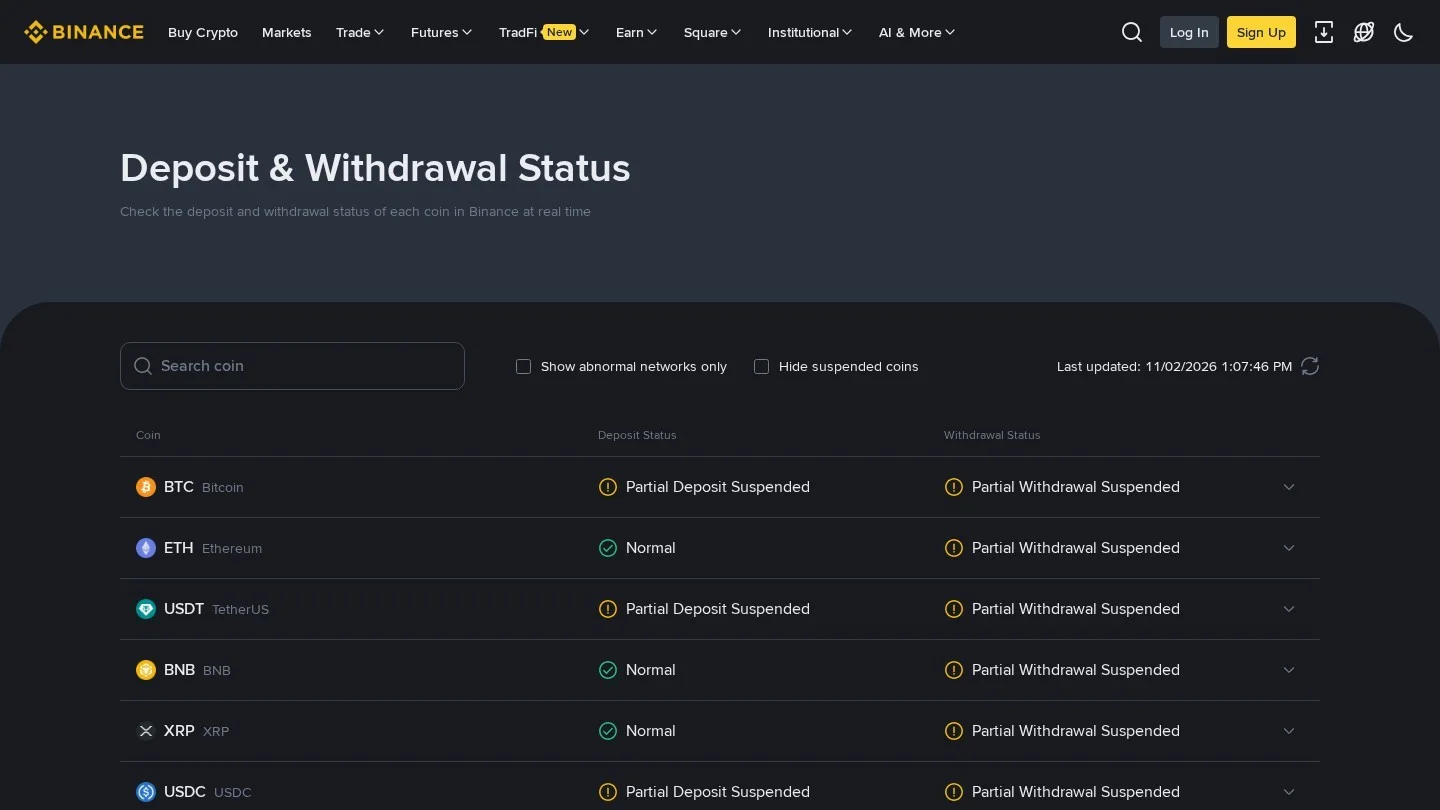
Withdrawals were frozen after the attack and came back in stages. Phase one was set for 06:00 to 09:00 UTC on November 1. Bitcoin, ether, USDT, USDC, BNB and XRP were among the first assets reopened.
The first day brought the expected rush, and between 06:00 and 15:30 UTC, users withdrew $4.649 billion and deposited $1.01 billion, a net outflow of about $3.64 billion. Binance said that was 2.1% of the $171 billion in user assets shown in its October 28 proof-of-reserves report. It added that withdrawals “have declined and are stabilising as expected.”
| Date (2026) | Event |
|---|---|
| October 30 | Binance discloses the hot wallet breach and pauses withdrawals |
| October 30 | Bitcoin touches about $76,141 on Coinbase; US spot bitcoin ETFs post about $643 million in net outflows |
| October 31 | FBI attributes the attack to North Korea’s TraderTraitor group |
| November 1 | Binance reopens withdrawals in phases from 06:00 UTC, starting with major assets |
| November 2 | Bitcoin trades at $77,926 at 11:02 UTC |
Binance also said all its balances in BTC, ETH, USDT, BNB, SOL, USDC, XRP, USD1, RLUSD and ZEC are fully backed. The remaining 5% of losses it has not yet replaced are in less liquid tokens outside the top ten. The exchange has promised a full proof-of-reserves report and a detailed incident report once its investigation ends.
Bitcoin’s Price Through the Hack Week
The damage to bitcoin’s price was real but limited, as Coinbase’s BTC-USD market touched $76,141 at 18:50 UTC on October 30, a six-week low. By 11:02 UTC on November 2, bitcoin was at $77,926 on CoinGecko. Ether traded at $2,285.83.
On Binance, bitcoin closed the week of October 26 to November 1 at about $78,354, down 2.25% from about $80,154 the week before. More than $1.3 billion in leveraged positions were liquidated during the selloff.
The comparison with November 2022 is the useful one, because bitcoin fell about 23% in the week FTX collapsed. The difference this time is that Binance said, within a day, that it would absorb the loss, and it then reopened withdrawals. FTX was unable to do either of those things.
What the $643 Million ETF Outflow Says
US spot bitcoin ETFs had net outflows of about $643 million on October 30, the first trading session after the hack. BlackRock’s IBIT accounted for $233.7 million and Fidelity’s FBTC for $201.0 million.
ETF investors never touched Binance, so the outflow reflects mood rather than direct exposure. Big daily flows can come from many sources, including portfolio rebalancing. Still, a $643 million exit on the day of the news shows that some ETF holders cut risk first and waited for details later.
Steps Bitcoin Holders Can Take This Week
Check before you move funds: Binance’s network status page shows which blockchains are open for withdrawals. Some networks reopened later than others.
Use withdrawal address whitelisting: Lock withdrawals to addresses you have saved and verified in advance. Our explainer on crypto address whitelisting covers how it works on major exchanges.
Expect fake support messages: Big hacks usually bring a wave of scam emails and direct messages offering “refunds” or “verification,” and no genuine support agent needs your password or seed phrase. These phishing email examples show the patterns to look for.
Watch stablecoin balances: USDT and USDC were among the first assets Binance reopened, and both are listed as fully backed. If stablecoin pricing ever looks off on any exchange, our guide to stablecoin depegs explains what is happening.
Businesses holding crypto: Binance’s first review of this attack pointed to a compromised laptop. A basic small business cybersecurity checklist covers device security and access controls that apply to anyone holding keys.
Why Bitcoin Held Up Through the Breach
The market treated this as an exchange failure rather than a bitcoin failure, and that reading looks right, because the bitcoin network itself was never attacked. What failed was a company’s security around its hot wallet.
The bigger lesson is about concentration, since one exchange held $171 billion of user assets before the attack. Binance had the money to cover a $6 billion loss, and that is why a 2022-style panic did not follow. A smaller exchange could not have done the same. Holders who keep large balances on any single platform should weigh that risk alongside price.
Binance’s promised incident report is the next document to read. It should explain how one breach opened access to so much money in about 20 minutes.
Questions About Bitcoin and the Binance Hack
Was Bitcoin Itself Hacked?
No. The attackers broke into Binance’s hot wallets, so the attack targeted one company’s systems, not the bitcoin network itself.
Did Binance Users Lose Money?
Binance says users will not bear the losses, and it reports covering about 95% of the stolen assets with company funds and says it is buying the rest.
Who Was Behind the Binance Hack?
The FBI attributed the attack to TraderTraitor, a hacking group linked to North Korea, and the blockchain analytics firms TRM Labs and Chainalysis reached the same view.
Can I Withdraw Bitcoin From Binance Now?
Binance began reopening withdrawals in phases on November 1, 2026, starting with bitcoin and other major assets. Check its network status page for each blockchain before you move funds.
How Much Did Bitcoin Fall After the Binance Hack?
Bitcoin fell to about $76,141 on Coinbase on October 30, a six-week low, before recovering to about $77,926 by November 2.
Reporting and Data Used for This Article
- Binance on X: phased withdrawal restart and loss coverage
- FBI: alert attributing the Binance attack to North Korea
- Associated Press via PBS NewsHour: What to know about the $6.3B hack on Binance
- TechCrunch: Binance resumes withdrawals following $6.3 billion breach
- CoinDesk: Binance opens withdrawals in phases
- Unchained: Bitcoin steadies near $78,000 as withdrawals resume
- The Crypto Basic: Bitcoin weekly close and liquidations
- SoSoValue: US spot bitcoin ETF flows
- Binance network status
This article is for information and education only and is not investment, tax or financial advice. Figures were checked on November 2, 2026; confirm current details with the official source or a registered adviser before acting.