Japan wants proof of ¥10 million a year before it lets a remote worker stay for six months, and it will not extend the stay. Mauritius asks for $1,500 a month, charges nothing to apply and hands out a renewable one-year visa. Those two programs sit at opposite ends of a market that now spans about 50 countries and territories.
A digital nomad visa lets you live in a country while you keep working for an employer or clients based somewhere else. The main programs open in 2026 are in Spain, Portugal, Estonia, Croatia, Greece, Italy, Malta, Hungary, Cyprus, Romania and Iceland in Europe; Thailand, Malaysia, Indonesia, Japan, South Korea and the UAE in Asia and the Gulf; Costa Rica, Brazil, Colombia, Argentina, Uruguay and Panama in Latin America; a string of Caribbean islands led by Barbados; and Mauritius, Seychelles, Cape Verde, Namibia and South Africa in Africa. Each one is compared below by income bar, length of stay, fee and tax treatment, using official immigration pages wherever they publish the numbers.
The Short Version for Remote Workers
- The cheapest entry points are Mauritius and Brazil at $1,500 a month, followed by Colombia at three times the local minimum wage (COP 5,252,715 a month in 2026).
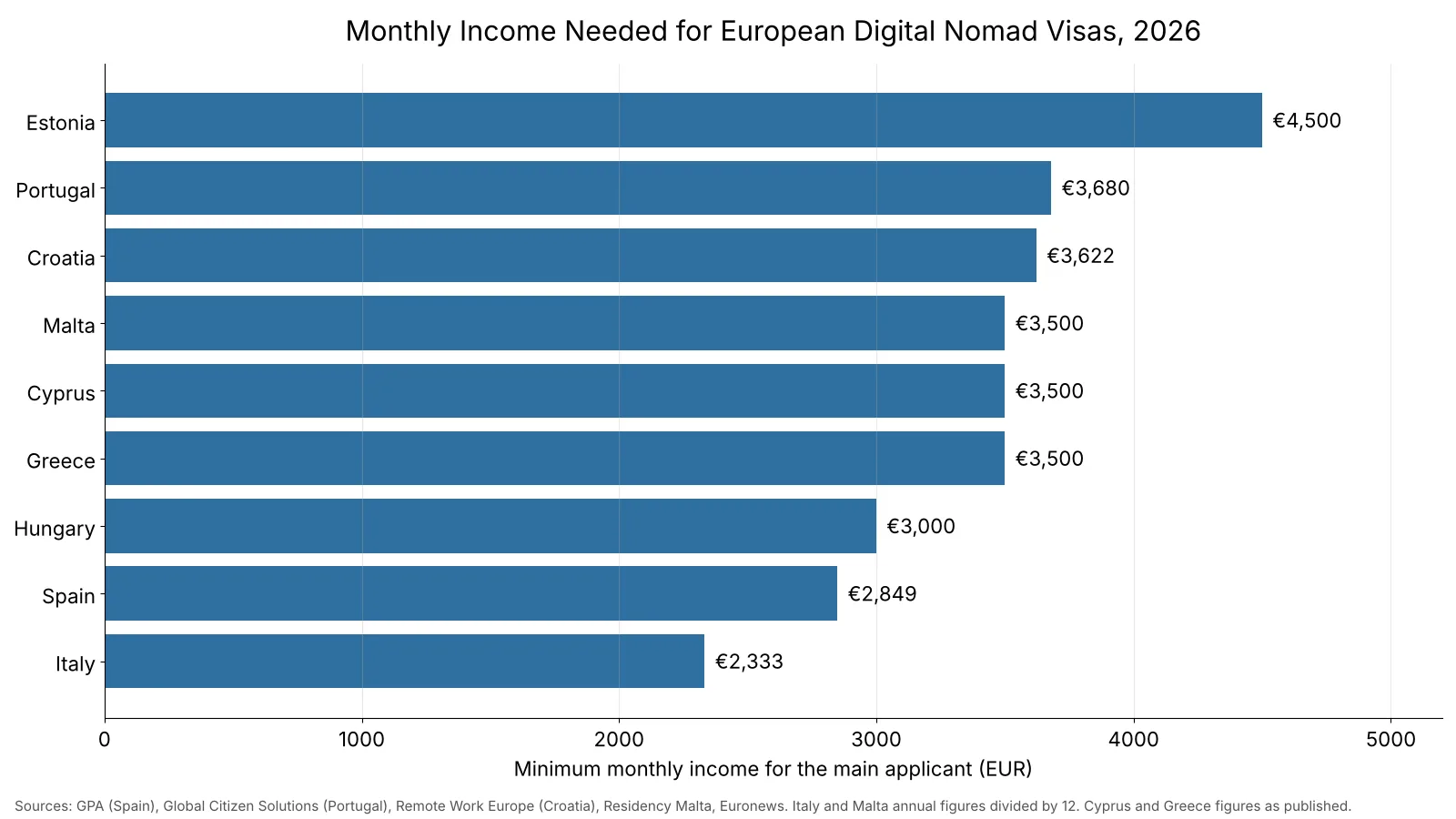
- Europe asks for more: Spain now wants €2,849 a month, Portugal €3,680 and Estonia €4,500 gross.
- South Korea made its workation visa permanent on June 30, 2026, and cut the income bar for under-35s who live outside Seoul.
- Thailand’s DTV is valid for five years with stays of up to 180 days per entry, but holders cannot work for Thai companies or clients.
- A nomad visa is not a tax plan. Many countries treat you as a tax resident after 183 days, and only a few, such as Croatia, spell out an exemption.
Income Thresholds, Fees and Visa Lengths by Country
The table puts all 34 programs side by side. Income figures are for 2026, in the currency the country uses. Fees cover the main applicant only. Where a fee or tax rule is not shown, the country sets it case by case or by nationality, so check the official page before you budget.
| Country | Visa name | Income requirement | Length of stay | Fee | Tax note |
|---|---|---|---|---|---|
| Europe | |||||
| Spain | Digital nomad visa | €2,849 a month | 1 year visa, then residence permit | – | Tax resident after 183 days |
| Portugal | D8 remote work visa | €3,680 a month (4x minimum wage) | 1 to 2 years | – | Tax resident after 183 days |
| Estonia | Digital nomad visa | €4,500 gross a month | 1 year | €100 | Tax resident after 183 days |
| Croatia | Digital nomad temporary stay | €3,622.50 a month or €43,470 savings | 1 year | – | No Croatian tax on foreign income |
| Greece | Digital nomad visa | €3,500 a month | 1 year, extendable via permit | €75 | Tax resident after 183 days |
| Italy | Digital nomad visa | €28,000 a year | 1 year, renewable | €116 | Must be tax compliant in Italy |
| Malta | Nomad Residence Permit | €42,000 a year gross | 1 year, up to 4 years | €300 + €100 card | Not taxed automatically |
| Hungary | White Card | €3,000 a month | 1 year, extendable | €110 | Exempt for first 6 months |
| Cyprus | Digital nomad visa | €3,500 a month net | 1 year, plus 2-year renewal | €70 | Tax resident after 183 days |
| Romania | Digital nomad visa | 3x average gross salary | 1 year | €120 | Exempt under 183 days |
| Iceland | Remote work long-term visa | ISK 1,000,000 a month | 6 months | €86 | Not tax resident on the visa |
| Asia and the Gulf | |||||
| UAE (Dubai) | Virtual work residence | $3,500 a month | 1 year, renewable | AED 240 from abroad | No personal income tax |
| Thailand | Destination Thailand Visa (DTV) | 500,000 baht in funds | 5-year visa, 180 days per entry | €350 in Budapest (varies) | – |
| Malaysia | DE Rantau Nomad Pass | $24,000 a year (tech), $60,000 (non-tech) | 3 to 12 months, max 24 | RM1,080 + pass fee + 8% SST | Remote workers untaxed up to 60 days |
| Indonesia | E33G remote worker visa | $60,000 a year | 1 year, plus 1 renewal | – | – |
| Japan | Designated Activities (digital nomad) | ¥10 million a year | 6 months, no extension | – | – |
| South Korea | F-1-D workation visa | 1x to 2x GNI per capita | 1 year, up to 3 | – | – |
| Latin America | |||||
| Costa Rica | Digital nomad stay | $3,000 a month ($4,000 with family) | 1 year, renewable once | – | Foreign income not taxed |
| Brazil | Digital nomad visa (VITEM XIV) | $1,500 a month or $18,000 savings | 1 year | – | Tax resident after 183 days |
| Colombia | Visa V digital nomad | COP 5,252,715 a month | Up to 2 years | About $178 + ID card | – |
| Argentina | Digital nomad visa | Proof of foreign income | 180 days | – | – |
| Uruguay | Digital nomad visa | No set minimum | 6 to 12 months | – | – |
| Panama | Short-stay remote worker visa | About $3,000 a month | 9 months, renewable | – | – |
| Caribbean | |||||
| Barbados | Welcome Stamp | $50,000 a year | 1 year | – | – |
| Antigua and Barbuda | Nomad Digital Residence | $50,000 a year | Up to 2 years | – | Must be tax resident elsewhere |
| Dominica | Work in Nature (WIN) | $50,000 a year | Up to 18 months | – | – |
| Montserrat | Remote Worker Stamp | About $70,000 a year | 1 year | – | – |
| Bermuda | Work From Bermuda | Proof of means | 1 year | – | – |
| Curaçao | @Home in Curaçao | Proof of means | 6 months | – | – |
| Africa and Indian Ocean | |||||
| Mauritius | Premium Visa | $1,500 a month | 1 year, renewable | Free | – |
| Seychelles | Workcation Retreat Programme | No fixed minimum | 1 year | – | – |
| Cape Verde | Remote Working Program | €1,500 a month | – | – | – |
| Namibia | Digital nomad visa | $2,000 a month | Up to 6 months | – | – |
| South Africa | Remote work visa | ZAR 650,976 a year | – | – | Must register with SARS |
Two patterns jump out. Countries that tie the bar to a local wage, such as Spain, Portugal, Croatia and Colombia, raise it almost every year, so an old blog post can understate it by hundreds of euros. And the Caribbean and Gulf programs ask for more income but tend to have simpler, faster online applications.
Europe: Nomad Visas From Spain to Malta
Europe has the densest cluster of programs, and the gap between them is wider than most lists suggest. Italy’s €28,000 a year works out to about €2,333 a month, while Estonia wants nearly double that. If you are still picking a base, our guide to the best European cities for digital nomads compares rent, internet and coworking costs city by city.
Spain
Spain sets its bar at 200% of the national minimum wage. After the 3.1% minimum wage rise in Royal Decree 126/2026, the threshold for a single applicant rose to €2,849 a month, up from €2,763 in 2025. That is €34,188 a year. Dependants add to the figure, so a couple with a child needs more.
Spain suits people who want a long runway. The first visa covers a year, and the status is renewable for up to five years in total. Spain treats you as a tax resident once you spend more than 183 days there in a calendar year, so plan your tax position before you go.
Portugal
Portugal’s D8 remote work visa asks for four times the minimum wage. With the 2026 minimum wage at €920, that is €3,680 a month, and the stay runs one to two years depending on the route you pick. Because the bar moves with the minimum wage, older guides often quote a lower figure, so check the current one before you gather bank statements. Portugal also applies the 183-day tax residency test.
Estonia
Estonia was one of the first countries to launch a nomad visa, and it is still one of the strictest. You need €4,500 a month gross, the fee is €100, and the visa lasts a year. Stay longer than 183 days in a year and Estonia counts you as a tax resident.
Croatia
Croatia indexes its bar to 2.5 times the average net salary. For 2026 that comes to €3,622.50 a month, up from €3,295. Each family member adds about €145 a month. You can instead show €43,470 in savings for the year.
A worked example shows how the family add-on stacks up. A remote worker with a spouse and one child needs €3,622.50 plus two add-ons of €144.90, or about €3,912 a month. The big draw is tax: holders pay no Croatian income tax on foreign earnings during the stay. To renew, you must apply again from outside the country.
Greece
Greece asks for €3,500 a month, charges a €75 visa fee and grants a year, which can be turned into a residence permit for a longer stay. The usual 183-day tax residency rule applies.
Italy
Italy opened its digital nomad visa in April 2024. The bar is €28,000 a year and the fee is €116. Italy is the one European country on this list that makes you show you are tax compliant there before you apply, so expect to deal with an Italian tax code early in the process.
Malta
Malta’s Nomad Residence Permit needs €42,000 a year in gross income, or €3,500 a month. The application fee is €300 per person, and the residence card costs a further €100. The permit lasts a year and can be renewed three times, up to four years in all, but each renewal requires at least five months in Malta during the previous year.
Malta is also strict about health cover. Your policy must cover the EU and the UK, pay at least €100,000, and be paid up front for the whole year. Travel insurance and monthly-paid policies are refused. On tax, the agency says the permit does not by itself make you liable for Maltese tax, but the conditions of the relevant rule (S.L. 123.210) must all be met.
Hungary, Cyprus, Romania and Iceland
Hungary’s White Card needs €3,000 a month and costs €110. Holders are exempt from Hungarian tax for the first six months. Cyprus asks for €3,500 a month after tax and charges €70, with a one-year visa that can be renewed for two more years. Romania sets its bar at three times the average gross salary and charges €120. Iceland grants six months for ISK 1,000,000 a month, and holders are not treated as tax residents during the visa.
Germany’s Freelance Visa Is Not a Nomad Visa
Germany is often listed as a nomad country, but it has no nomad visa. What it offers is a residence permit for freelancers (Freiberufler) and the self-employed. You must show that your business can support you, and applicants over 45 must also show adequate pension plans. The permit starts at up to three years, and after five years you can apply to settle. The visa fee is generally €90 and a residence permit up to €100.
The difference matters. A nomad visa assumes your income comes from abroad and usually keeps you out of the local job market. The German permit expects you to build a business in Germany and pay German tax on it. It suits a freelancer who wants to settle, not someone passing through for a year.

Asia and the Gulf: From Dubai to Seoul
Asian programs vary more than European ones. Some are true long-stay visas, while others, like Japan’s, are closer to an extended tourist stay with a remote work clause. Time zones matter here too. A worker in Bangkok serving clients in New York loses most of the overlap, so test the hours with a time zone converter before you commit.
United Arab Emirates
Dubai’s virtual work residence permit needs a salary of at least $3,500 a month and proof that you work for an organization outside the UAE. Fees total AED 240 if you apply from abroad and AED 740 from inside the country. You need health insurance and a medical fitness test. The permit runs for a year, can be renewed and needs no local sponsor. The UAE has no personal income tax, which is the main reason high earners choose it.
Thailand
The Destination Thailand Visa (DTV) covers digital nomads, freelancers and remote workers, along with people taking long courses in Muay Thai, cooking and similar activities. You must show at least 500,000 baht through a six-month bank statement, payslips or a sponsor letter. Crypto and investment statements are not accepted, at least at the Thai embassy in Budapest.
The visa is valid for five years, and each entry allows up to 180 days, with extensions handled by immigration in Thailand. The embassy in Budapest charges €350, and other embassies set their own fees. The hard limit is work: DTV holders cannot get a Thai work permit, work for Thai companies or take Thai freelance clients.
Malaysia
Malaysia’s DE Rantau Nomad Pass has two income bars. Tech workers in fields such as software, cloud, data and digital marketing need $24,000 a year, or $2,000 a month. Senior non-tech roles need $60,000 a year. The pass runs for 3 to 12 months and can be renewed once for 12 more months, up to 24 months in total.
Costs add up in layers. The processing fee is RM1,080 for the main applicant and RM540 per dependant, the pass fee is RM360 a year, and 8% SST applies on top. For one person on a one-year pass, that comes to about RM1,555 before visa charges. Tax is unusually clear: a remote worker who stays 60 days or less is not taxed on foreign income, while freelancers face withholding on income during their first 182 days.
Indonesia
Indonesia’s E33G remote worker visa, often called the Bali nomad visa, launched on April 1, 2024. You need at least $60,000 a year, a bank balance of $2,000 for the past three months and a work contract with a company outside Indonesia. It lasts a year and can be renewed once.
Japan
Japan’s program needs ¥10 million a year, proven by a tax or income certificate. You can stay up to six months, with no extension, and you must wait six months before applying again. You also need private medical insurance of at least ¥10 million.
Eligibility is narrow. You must hold a passport from a country that has both visa-free entry to Japan and a tax treaty with it. Indian passport holders do not get visa-free entry to Japan, so they cannot use this route. Our list of countries Indians can visit visa-free is a better starting point for short scouting trips.
South Korea
South Korea’s F-1-D workation visa started as a pilot. On June 30, 2026, it became permanent, and the income bar now depends on your age and where you live. The Ministry of Justice announced the change on July 7. The bar is set as a multiple of per capita GNI, which stands at ₩52.41 million.
| Applicant | In Seoul metro area | Outside Seoul metro area |
|---|---|---|
| Age 18 to 34 | 1.5x GNI (about ₩78.62 million) | 1x GNI (about ₩52.41 million) |
| Age 35 and over | 2x GNI (about ₩104.83 million) | 1.5x GNI (about ₩78.62 million) |
| With family | 2x GNI | 1.5x GNI |
You need at least a year in the same industry, a foreign employer and private health cover of at least ₩100 million. The visa now runs a year at a time, up to three years, compared with two under the pilot.
Latin America: The Lowest Income Bars
Latin America is where a modest freelance income goes furthest. Several programs ask for less than $2,000 a month, and the time zones line up well with North American clients.
Costa Rica
Costa Rica asks for $3,000 a month for a single applicant and $4,000 with family. The stay is a year and can be renewed once. Costa Rica does not treat holders as tax residents, and you can bring in the equipment you need for remote work without paying import taxes.
Brazil
Brazil’s visa needs $1,500 a month or $18,000 in savings, which ties it with Mauritius as the cheapest fixed bar of any program listed here. It lasts a year, and the 183-day tax residency rule applies, so a long stay can pull you into the Brazilian tax system.
Colombia
Colombia asks for three times the legal minimum wage. With the 2026 minimum wage at COP 1,750,905, the bar is COP 5,252,715 a month, about $1,640 at the July 30, 2026 rate. The visa can be granted for up to two years. The fee is about $178, charged only on approval, and the foreigner ID card (cédula de extranjería) costs about $79 more.
Argentina, Uruguay and Panama
Argentina’s visa grants 180 days and asks for proof of foreign income. Uruguay does not set a minimum income and grants 6 to 12 months. Panama’s short-stay remote worker visa needs about $3,000 a month and lasts nine months, with renewal possible.
Mexico’s Temporary Residence Is Not a Nomad Visa
Mexico has no visa built for nomads. Remote workers use temporary residency instead, which can run for up to four years. The income or savings bar is set by each consulate, and it is typically above $4,600 a month. Since it is a residence status rather than a visitor permit, long stays raise real tax questions. It is a better fit for someone moving to Mexico than for a one-year stint.
Caribbean Remote Work Stamps
The Caribbean programs came out of the pandemic, when islands that relied on tourism wanted long-stay visitors. They tend to ask for higher incomes, and some move quickly: Montserrat says processing can take as few as seven working days. Barbados’s Welcome Stamp needs $50,000 a year for a one-year stay. Antigua and Barbuda also asks for $50,000, grants up to two years and requires you to stay a tax resident somewhere else. Dominica’s Work in Nature program asks for $50,000 and allows up to 18 months, and Montserrat’s Remote Worker Stamp wants about $70,000 a year.
Bermuda and Curaçao do not set a fixed figure. Both ask for proof that you can support yourself. Bermuda grants a year, and Curaçao grants six months. Living costs on small islands are high, so the real bar is often your rent, not the visa rule.
Africa and the Indian Ocean
Mauritius
The Mauritius Premium Visa is the easiest program on this list to apply for. It needs $1,500 a month, the application is fully online and free, and the visa lasts a year and can be renewed. Holders may not take jobs in the local labor market.
Seychelles and Cape Verde
The Seychelles Workcation Retreat Programme grants a year and sets no fixed income level. Cape Verde’s Remote Working Program asks for €1,500 a month. Both suit people who want a quiet island base. Check our data on internet speed by country before you sign a lease anywhere remote.
Namibia and South Africa
Namibia’s visa asks for $2,000 a month for the main applicant, plus $1,000 for a spouse and $500 per child, and allows up to six months. South Africa’s remote work visa, reshaped by amended regulations that Home Affairs gazetted in October 2024, needs ZAR 650,976 a year and registration with the South African Revenue Service.

Which Digital Nomad Visa Fits Your Income
Start with what you can prove, not what you earn in a good month. Most consulates want three to twelve months of bank statements or payslips, and many look at the average. One example shows how a single income maps against the bars set in US dollars.
Take a freelance designer who averages $2,500 a month, or $30,000 a year. She clears Mauritius and Brazil ($1,500), Colombia (about $1,640), Malaysia’s tech track ($2,000 a month) and Namibia ($2,000). She falls short of Costa Rica ($3,000), Dubai ($3,500), the Caribbean stamps ($50,000 a year), Indonesia ($60,000) and Japan. Euro-based bars such as Spain’s €2,849 depend on the exchange rate on the day you apply, so leave a buffer of at least 10%. If you are still building income, a freelance hourly rate calculator shows what you would need to bill to clear a given bar.
| Monthly income you can prove | Programs within reach (USD bars) | Also consider |
|---|---|---|
| Under $2,000 | Mauritius, Brazil, Colombia, Uruguay, Argentina | Malaysia (tech) at $2,000 |
| $2,000 to $3,500 | Malaysia (tech), Namibia, Costa Rica, Panama | Spain, Italy, Hungary, Croatia (euro bars) |
| $3,500 to $5,000 | Dubai, Barbados, Antigua and Barbuda, Dominica | Greece, Cyprus, Malta, Portugal, Estonia |
| $5,000 and over | Malaysia (non-tech), Indonesia, Montserrat | Japan (¥10 million a year) |
Then think about what you want from the stay. If you want a path to settling, Spain, Portugal and Germany’s freelance permit can lead to longer residence. If you want low tax, Dubai and Croatia are the clearest. If you want flexibility, Thailand’s five-year DTV is hard to beat for people who travel in and out.
How to Apply for a Digital Nomad Visa
The steps are similar almost everywhere, even though the forms differ. Most rejections come from paperwork, not from income.
- Check eligibility first: confirm that your passport qualifies (Japan, for example, only takes visa-exempt nationals from tax treaty countries) and that your work fits the category.
- Gather income proof: collect bank statements, payslips or tax returns for the period the country asks for, usually three to twelve months.
- Get a remote work letter: employees need a letter or contract confirming that they can work from abroad. Freelancers usually need client contracts.
- Buy compliant insurance: read the rules closely. Malta wants €100,000 of annual, prepaid cover, Japan ¥10 million and South Korea ₩100 million.
- Apply and pay: submit through the embassy, an online portal or an agency such as Residency Malta or MDEC, and pay the fee.
- Register on arrival: collect your residence card, register your address and, where required, register with the tax office.
Budget time as well as money. Malaysia quotes six to eight weeks just for a DE Rantau renewal, and European consulates can be slower in peak season. Remote jobs that allow work from abroad are the base of all of this, and our list of remote jobs you can get without experience is a starting point if you are not there yet.
Tax Residency: Where Nomad Visas Catch People Out
A digital nomad visa gives you the right to stay. It says nothing, in most cases, about where you pay tax. The common test is 183 days: spend more than about half a year in Spain, Portugal, Greece, Cyprus, Estonia or Brazil, and you can become a tax resident there, with your worldwide income in scope.
Only a handful of programs spell out relief. Croatia does not tax foreign income during the stay. Hungary exempts White Card holders for six months, and Romania exempts nomads who stay less than 183 days in a year. Malaysia does not tax remote workers who stay 60 days or less, but taxes them after that. Malta says its permit does not automatically make you taxable, but only if all the conditions of its rule are met.
Your home country matters as much as your host country. Some countries tax citizens or residents on worldwide income no matter where they live, and leaving one tax system without entering another can trigger questions from both. Speak to a tax adviser in your home country before you leave, and keep a record of the days you spend in each place.
Remote Worker Questions About Nomad Visas
Which Country Has the Easiest Digital Nomad Visa?
Mauritius is the simplest. It needs $1,500 a month, the application is online and free, and the Premium Visa lasts a year. Brazil has the same income bar and also accepts $18,000 in savings instead.
Which Digital Nomad Visa Has the Lowest Income Requirement?
Uruguay sets no minimum income. Among programs with a fixed bar, Mauritius and Brazil ask for $1,500 a month, and Colombia asks for about $1,640 in 2026.
Can Indians Apply for a Digital Nomad Visa?
Most programs set their rules by income and type of work rather than by passport, so Indian citizens can apply to many of them. Japan is the clear exception, because its nomad route is only open to nationals of visa-exempt countries and India is not on that list.
Do You Pay Tax on a Digital Nomad Visa?
Often, yes. Most countries apply a 183-day tax residency test. Croatia, Hungary (for six months), Romania (under 183 days) and the UAE, which has no personal income tax, are among the few with clear relief.
Can a Digital Nomad Visa Lead to Permanent Residency?
Germany’s freelance permit can lead to a settlement permit after five years, but most nomad visas are capped. Malta stops at four years, South Korea at three, Malaysia at two and Japan at six months.
Government and Embassy Pages We Used
- Global Citizen Solutions: Digital Nomad Visa 2026 Guide (updated October 15, 2026)
- GPA: Spain Digital Nomad Visa Income Threshold Rises After Minimum Wage Increase (February 2026)
- Euronews: All the Digital Nomad Visas Available in Europe (updated January 2026)
- Residency Malta: Nomad Residence Permit FAQs
- Remote Work Europe: Croatia Digital Nomad Income Threshold 2026
- Make it in Germany: Visa for Freelance Business
- Royal Thai Embassy Budapest: Destination Thailand Visa (DTV)
- MDEC: DE Rantau Pass FAQ v10 (August 2026)
- EY: Indonesia Implements New Visa for Remote Workers
- Immigration Services Agency of Japan: Designated Activities (Digital Nomad)
- KLAWGURU: Update on South Korea’s F-1-D Workation Visa (July 2026)
- GDRFA Dubai: Issuance of the Virtual Work Residence Permit
- Invest in Dubai: Work Remotely From Dubai
- VisaDB: Digital Nomad Visas Complete List 2026
- Colombia Move: Colombia Digital Nomad Visa Income Requirement 2026
- Xpatweb: South Africa Remote Work Visa