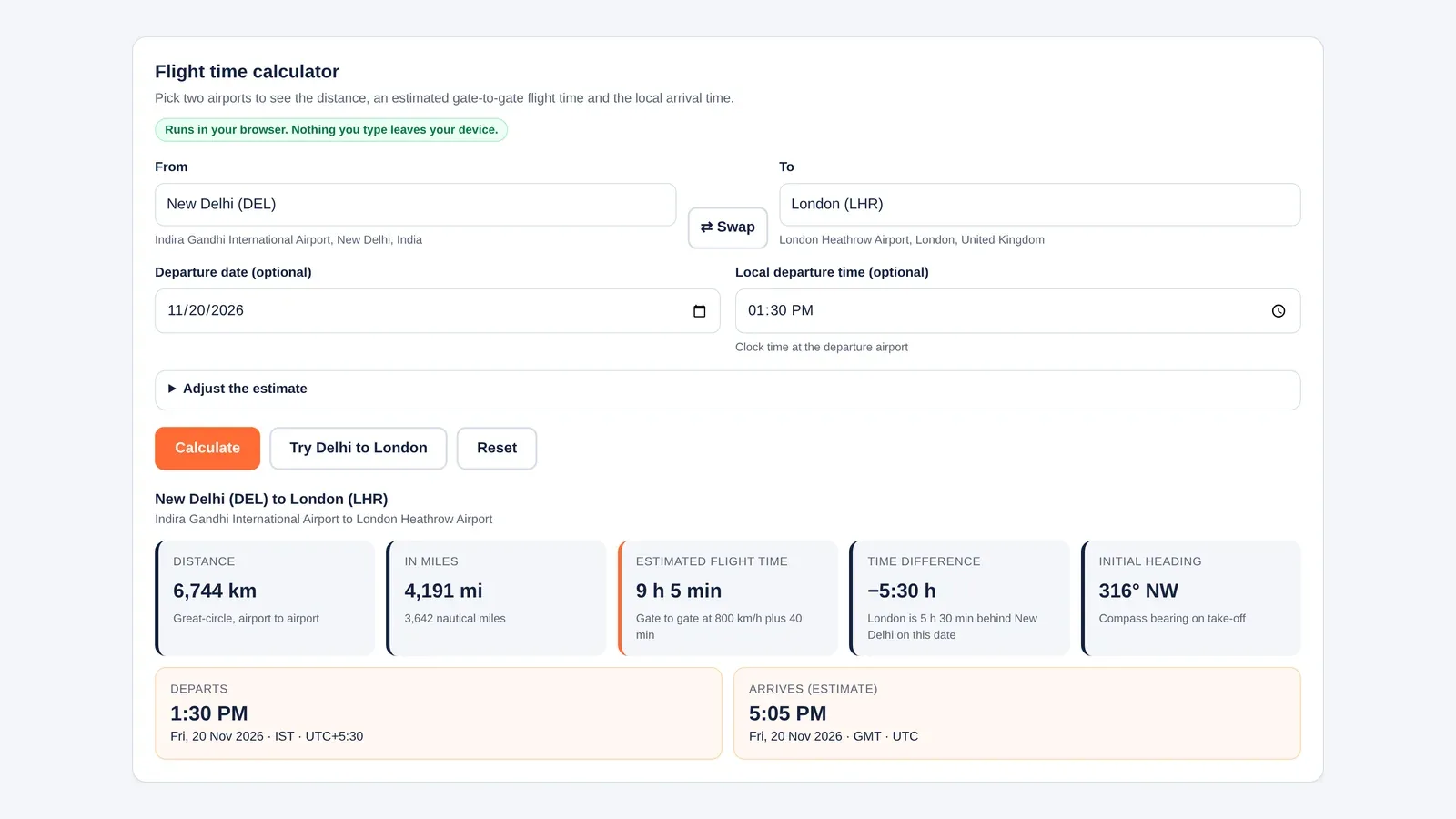
Delhi to London Heathrow is 6,744 km along the shortest path over the Earth’s surface, and a flight that long takes about nine hours gate to gate. The free flight time calculator below works that out for any pair of roughly 420 major airports: type a city, an airport name or a three-letter IATA code, and it returns the great-circle distance in kilometres, miles and nautical miles, an estimated flight time, the time difference between the two cities and, if you add a departure time, the local clock time when you land.
We also tested the method against more than 70,000 real scheduled flights; the results are further down this page.
Distance Over 800 km/h Plus 40 Minutes, and Where It Runs Short
- Estimated flight time = distance ÷ 800 km/h + 40 minutes for taxiing, climb and descent, rounded to the nearest five minutes. Both numbers can be changed.
- Distances are measured on the WGS84 ellipsoid. New York JFK to Los Angeles comes out at 2,475 miles, the same figure the US Bureau of Transportation Statistics uses for that route.
- Against 2013 schedules from the three New York airports, the default estimate ran 1 to 40 minutes short, because those flights mostly head west into the wind and start with long taxi queues.
- Arrival times follow daylight saving rules for the chosen date, even when clocks change mid-flight.
Flight time calculator
Pick two airports to see the distance, an estimated gate-to-gate flight time and the local arrival time.
Runs in your browser. Nothing you type leaves your device.
Adjust the estimate
Distance
–
Great-circle, airport to airport
In miles
–
–
Estimated flight time
–
–
Time difference
–
–
Initial heading
–
Compass bearing on take-off
Departs
–
–
Arrives (estimate)
–
–
Estimates use a fixed average speed plus a taxi, climb and descent allowance. Airline schedules differ with winds, routing, aircraft and airport congestion. Time zone rules come from your browser, so daylight saving time is applied for the date you choose. Airport data: OurAirports (public domain) and mwgg/Airports.
Finding an Airport by City, Name or IATA Code
Start typing in the From and To boxes and pick from the list. An exact code wins, so typing IST puts Istanbul Airport first even though “ist” also appears inside other names. City names bring up every listed airport that serves the city: “new york” lists JFK, Newark and LaGuardia. Old names such as Bombay and Bangalore work too, and accents are optional.
The date and departure time are optional. Leave them blank and you still get distance, flight time and today’s time difference. Fill them in and two extra panels show the departure and estimated arrival in each airport’s local time, with a +1 day or +2 days tag when you land on a later calendar date.
How the Flight Time Estimate Is Built
Aircraft follow great-circle routes where airspace and winds allow, so the calculator starts with the geodesic distance between the two airports’ reference points. It uses Vincenty’s formula on the WGS84 ellipsoid, the same Earth model GPS uses, which is more precise than treating the planet as a perfect sphere. It also shows the initial compass heading.
- Cruise portion: distance ÷ 800 km/h. That is about 497 mph or 432 knots, an average ground speed for a modern jet across a whole flight.
- Fixed allowance: 40 minutes for pushback, taxiing at both ends, and the slower climb and descent phases.
- Rounding: the total is rounded to the nearest five minutes, because quoting a minute-level figure would suggest more precision than the method has.
Open “Adjust the estimate” to change either number, for example a lower speed for a turboprop or a longer allowance at a congested hub.
Calculator Estimates Against Real Scheduled Block Times
A block time is the gate-to-gate time an airline prints in its schedule. To test the method we used the nycflights13 dataset, which packages US Bureau of Transportation Statistics on-time records for every domestic flight that left JFK, Newark and LaGuardia in 2013. For each route below we took the median scheduled departure-to-arrival time across the year, converted for time zones, and set it next to the calculator’s default estimate.
| Route | Distance | Calculator estimate | Median scheduled block, 2013 | Flights |
|---|---|---|---|---|
| JFK to Boston (BOS) | 300 km / 187 mi | 1 h 05 min | 1 h 15 min | 5,898 |
| LaGuardia to Chicago O’Hare (ORD) | 1,180 km / 733 mi | 2 h 10 min | 2 h 40 min | 8,857 |
| JFK to San Juan (SJU) | 2,571 km / 1,598 mi | 3 h 55 min | 3 h 56 min | 4,752 |
| Newark to Denver (DEN) | 2,583 km / 1,605 mi | 3 h 55 min | 4 h 22 min | 2,859 |
| JFK to Los Angeles (LAX) | 3,983 km / 2,475 mi | 5 h 40 min | 6 h 15 min | 11,262 |
| JFK to San Francisco (SFO) | 4,162 km / 2,586 mi | 5 h 50 min | 6 h 30 min | 8,204 |
| JFK to Honolulu (HNL) | 8,020 km / 4,983 mi | 10 h 40 min | 11 h 00 min | 342 |
Two patterns stand out. The calculator’s distances match the BTS route distances to within a few miles on every line, so the geometry is sound. The time estimates, though, are short on every route, and the gap is widest on the long westbound runs to California (35 to 40 minutes) and smallest on JFK to San Juan, which flies south-east (one minute). Westbound jets fly into the prevailing westerly winds at cruise height, and every schedule from a busy New York airport has to absorb the taxi queue before take-off.
Fitting a straight line through all 13 New York routes in the data gives an average speed of 779 km/h plus a fixed 59 minutes. Set the advanced fields to roughly 780 and 60 and the calculator reproduces those New York schedules closely. For a flight in the opposite direction, eastbound with a tailwind, the default settings are the better starting point.
Flight Distances Between India, the US and Major Hubs
Calculator figures at the default settings:
| Route | Kilometres | Miles | Nautical miles | Estimated flight time |
|---|---|---|---|---|
| Delhi (DEL) to Mumbai (BOM) | 1,133 | 704 | 612 | 2 h 5 min |
| Delhi (DEL) to Dubai (DXB) | 2,186 | 1,358 | 1,180 | 3 h 25 min |
| New York (JFK) to London (LHR) | 5,555 | 3,452 | 2,999 | 7 h 35 min |
| Delhi (DEL) to London (LHR) | 6,744 | 4,191 | 3,642 | 9 h 5 min |
| Dubai (DXB) to New York (JFK) | 11,023 | 6,849 | 5,952 | 14 h 25 min |
| Mumbai (BOM) to New York (JFK) | 12,551 | 7,799 | 6,777 | 16 h 20 min |
| Bengaluru (BLR) to San Francisco (SFO) | 14,003 | 8,701 | 7,561 | 18 h 10 min |
On ultra-long-haul routes, airlines often fly well away from the pure great circle to use winds or avoid closed airspace, so the distance flown can be longer.
Local Arrival Times, Time Differences and Daylight Saving
The arrival panel adds the estimated flight time to your departure and shows the result on the destination’s clock, using your browser’s time zone rules for that date:
- The March gap: on 20 March 2026 London is only four hours ahead of New York, because US clocks went forward on 8 March and UK clocks on 29 March. A 10:00 departure from Heathrow lands at about 1:35 PM in New York. A month later the gap is back to five hours.
- Clocks changing mid-flight: leave Delhi at 22:00 on 28 March 2026 and you land in London after the UK has switched to British Summer Time. The calculator shows the arrival in BST and says that the clocks changed during the flight.
- Crossing the date line: a 22:00 departure from Los Angeles on 10 November 2026 reaches Sydney at about 8:45 AM on 12 November, tagged +2 days, because Sydney is 19 hours ahead at that time of year.
- Times that do not exist: 2:30 AM on 8 March 2026 never happens in New York. The calculator flags it, and also flags clock times that occur twice when clocks go back.
Setting up a call for the day you land? Our time zone converter lines up several cities and highlights shared working hours. If you bill clients for travel days, the freelance hourly rate calculator prices those hours and the free invoice generator lists them as a separate line. More free tools are on the Bizolaunch tools page.
The Airport List Behind the Search Box
The list starts from the large-airport entries with scheduled service in OurAirports’ open data, a public-domain dataset updated daily. We kept the 400 with the largest route networks in the OpenFlights route table, then added 23 more Indian airports, including Navi Mumbai and Goa’s Mopa airport. Each airport’s IANA time zone comes from the open mwgg/Airports collection. The list is embedded in the page, so nothing you type is sent anywhere.
Block Time vs Air Time and Nautical Miles
How Is Flight Time Calculated From Distance?
Divide the great-circle distance by an average speed and add a fixed allowance for taxiing, climb and descent. This calculator uses 800 km/h and 40 minutes by default, so a 4,000 km flight works out to 5 hours plus 40 minutes, or about 5 h 40 min.
Why Is My Airline’s Scheduled Time Longer Than the Estimate?
Schedules include headwinds, the actual routing, taxi queues and a punctuality buffer. In the 2013 New York data, westbound coast-to-coast flights were scheduled 35 to 40 minutes longer than the default estimate.
What Is the Difference Between Block Time and Air Time?
Block time runs from gate to gate; air time runs from take-off to touchdown. The calculator estimates block time, the figure printed in schedules.
How Far Is a Nautical Mile?
Exactly 1.852 km, or about 1.15 statute miles. Aviation measures distance in nautical miles and speed in knots.
Does the Calculator Handle Daylight Saving Time?
Yes. It applies the time zone rules your browser holds for the date you enter, at both airports, and it notes when the clocks change during the flight or when your chosen departure time does not exist on that date.