Pet insurance is worth it for most dog owners who could not pay a $4,000 vet bill without borrowing, especially if they buy accident and illness coverage while the pet is young and healthy. If you already keep several thousand dollars set aside for your pet, or you own a cat with lower average costs, a dedicated savings fund can work just as well. The average US accident and illness policy cost $836 a year for a dog and $435 for a cat in 2025, according to the North American Pet Health Insurance Association (NAPHIA).
Meanwhile, a single stomach blockage surgery with two nights in the hospital can pass $4,300 when you add up average US prices. This guide puts real premiums and real vet costs side by side, works through the math for a dog and a cat, and ends with a checklist by pet age and breed. Figures were checked in November 2026.
Premiums Up 11.5%, Accident-Only Limits and a $4,322 Vet Bill
- The average US accident and illness premium rose 11.5% to $836 a year for dogs and 12.6% to $435 for cats in 2025, NAPHIA data shows.
- Accident-only plans are far cheaper, at $190 for dogs and $112 for cats, but they pay nothing for illnesses such as stomach upsets, infections or cancer.
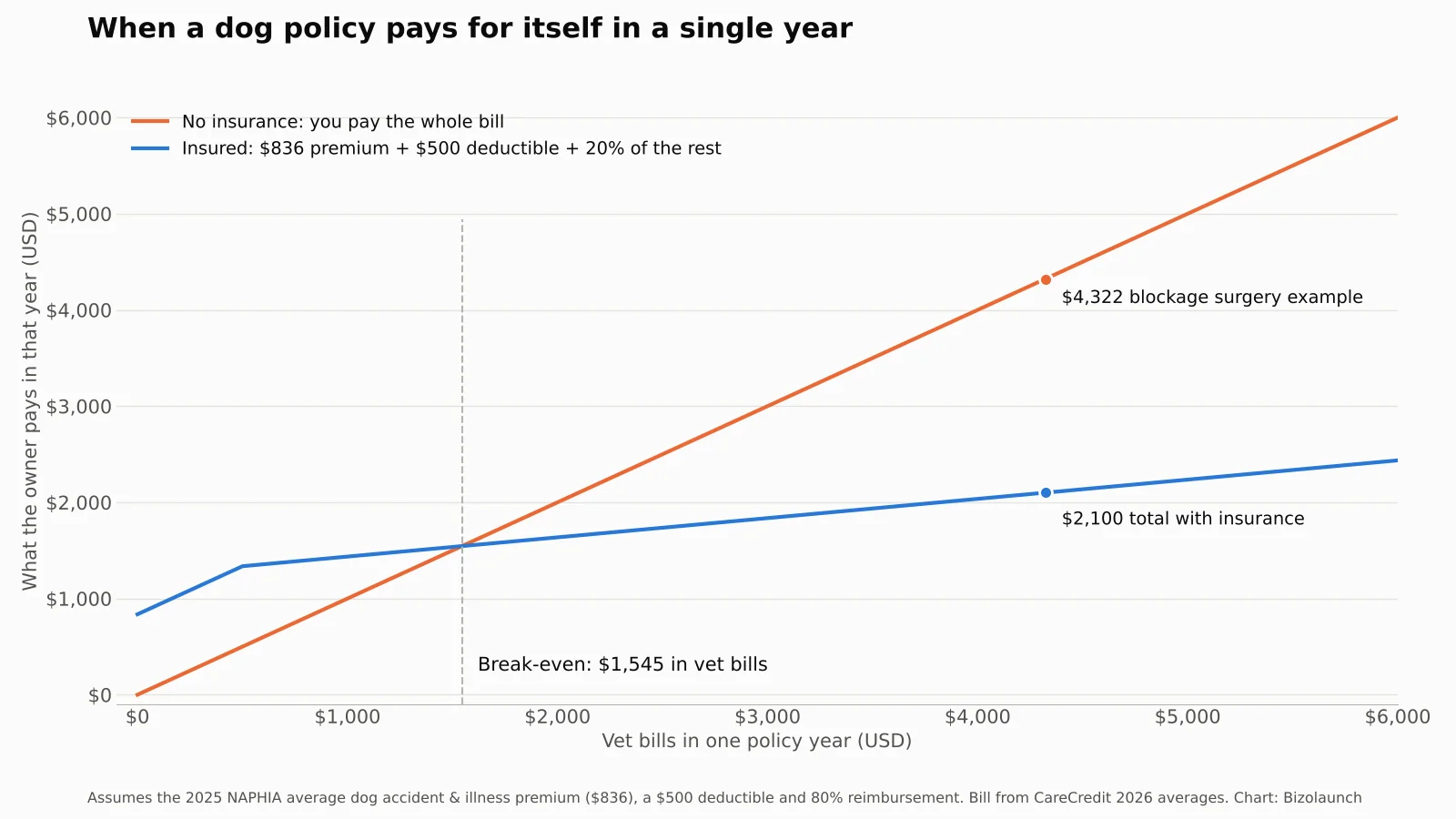
- An emergency stomach blockage case built from CareCredit’s 2026 national averages costs about $4,322 for a dog. With a typical $500 deductible and 80% reimbursement, the owner’s total cost for the year falls to about $2,100, premium included.
- With those policy terms, an average dog policy pays for itself in any year when vet bills top $1,545.
- No policy covers pre-existing conditions, and the NAIC model law allows illness waiting periods of up to 30 days, so the best time to buy is before problems appear.
What Pet Insurance Costs in the US
NAPHIA’s State of the Industry Report 2026 counts about 7 million insured pets in the US at the end of 2025: 5.23 million dogs and 1.75 million cats. That is still only 4.27% of the country’s 163.6 million pets. About 6% of dogs and just over 2% of cats have a policy. Total US premiums reached about $5.7 billion, up 19.7% in a year.
The prices people pay have climbed quickly. The average dog accident and illness premium went from $625 in 2021 to $836 in 2025, a rise of about 34% in four years. Cat premiums were flat for several years and then jumped in 2025.
| Plan Type | Dogs, 2025 Average | Cats, 2025 Average | Change From 2024 |
|---|---|---|---|
| Accident and illness | $836 a year (about $70 a month) | $435 a year (about $36 a month) | Dogs +11.5%, cats +12.6% |
| Accident only | $190 a year (about $16 a month) | $112 a year (about $9 a month) | Dogs -1.6%, cats +1.4% |
Source: NAPHIA State of the Industry Report 2026, US data as of December 31, 2025. Monthly figures are the annual average divided by 12.
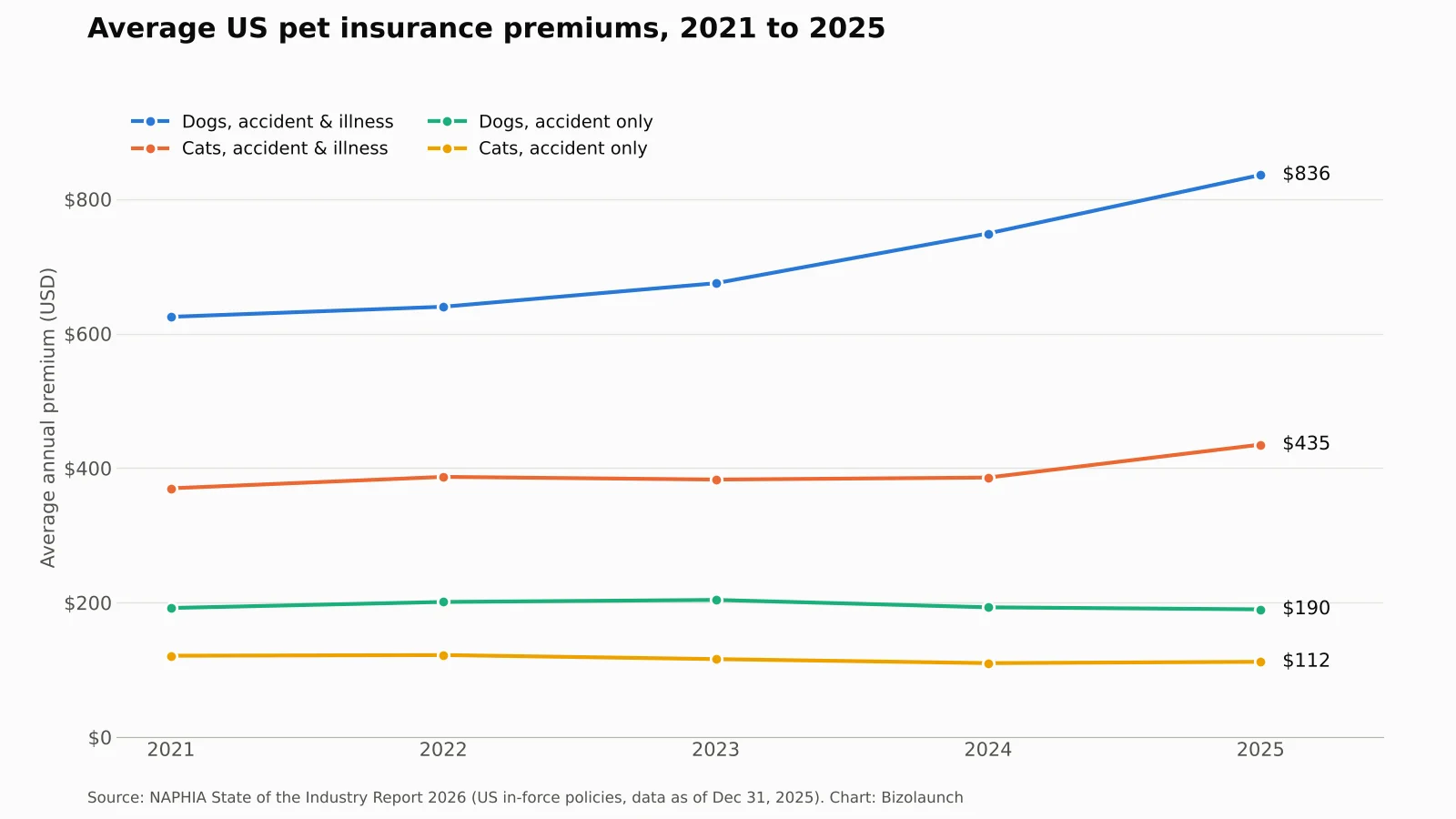
Keep in mind that these are averages across all ages, breeds and locations. Your quote can be well above or below them. Premiums go up as a pet ages and can change with where you live, as insurers such as AKC Pet Insurance state in their required California disclosures.
Accident and Illness vs Accident-Only Coverage
An accident-only plan pays for injuries: a broken leg, a bite wound, a cut paw, a swallowed sock. An accident and illness plan covers all of that plus sickness, from ear infections and diarrhea to diabetes and cancer. That gap explains why the dog version costs more than four times as much.
The cheaper plan sounds tempting, but illness is where many large bills come from. Pumpkin’s claims data from 2022 to 2025 put the average cost of seizure treatment for dogs at $1,788, and cancer-related emergency care ran from a few hundred dollars to more than $4,000 for both dogs and cats, according to the insurer’s guide to emergency vet costs. An accident-only policy would pay none of that.
Accident-only coverage makes the most sense in two cases. The first is an owner with a solid savings fund who mainly fears a sudden, expensive injury. The second is an owner of an older pet who cannot find, or cannot afford, a full policy. For most young pets, accident and illness coverage is the better buy.
Most policies also leave out routine care. Vaccines, yearly checkups and dental cleanings are usually sold as an optional wellness add-on. Under the NAIC model law, a wellness program sold alongside pet insurance must be priced separately and cannot be required, and it must state in bold type that it is not insurance.
What Common Vet Emergencies Cost Without Insurance
Emergency care is where pet owners feel the bill most. CareCredit, the medical credit card from Synchrony, publishes national average prices from its cost studies. Its May 2026 guide to emergency vet costs lists these averages across all 50 states and Washington, D.C.
| Service or Treatment | Dog Average | Cat Average |
|---|---|---|
| Emergency exam | $135 | $143 |
| X-rays (2 to 3 views) | $334 | $310 |
| Ultrasound | $483 | $323 |
| Blood test, CBC | $104 | $79 |
| Blood test, chemistry panel | $164 | $144 |
| IV catheter and one bag of fluid | $130 | $121 |
| Hospital stay, per night | $619 | $582 |
| Stomach blockage surgery | $2,217 (non-emergency) | $2,367 (emergency) |
| Bladder stone removal surgery | $2,331 | $2,096 |
| Pyometra surgery | $1,218 | $2,116 |
| Puncture wound treatment | $857 | $173 |
| Severe diarrhea treatment | $1,455 | $945 |
Source: CareCredit, How Much Does an Emergency Vet Visit Cost? (May 2026), based on Synchrony cost studies.
Location matters too. CareCredit found the average emergency exam for a dog ranged from $108 in Mississippi to $241 in Hawaii. Pumpkin’s claims data adds a few more reference points: the average emergency claim was $653 for dogs and $919 for cats, and the average fractured leg cost $1,098 for a dog.
Few of these bills arrive alone. A pet that swallowed something will usually need an exam, X-rays, bloodwork, fluids, surgery and at least one night in the hospital. That stacking effect is the real case for insurance.

Is Pet Insurance Worth It? Out of Pocket vs Insured in Three Examples
The examples below use the 2025 NAPHIA average premiums and CareCredit’s 2026 average prices. For the policy, we assumed a $500 annual deductible and 80% reimbursement, two common choices. Pumpkin, for example, reimburses 50% to 90% of eligible bills depending on the plan. Under an annual deductible, the insurer subtracts the deductible from covered costs first and then pays its share of the rest, up to the policy’s limit.
Example 1: A Young Dog Swallows a Toy
A two-year-old dog eats part of a toy and needs surgery. The bill adds up to $4,322: an emergency exam ($135), X-rays ($334), two blood panels ($268), an IV and fluids ($130), stomach blockage surgery ($2,217) and two nights in the hospital ($1,238).
| Cost | Uninsured | Insured |
|---|---|---|
| Vet bill | $4,322 | $4,322 |
| Deductible paid by owner | n/a | $500 |
| Insurer pays 80% of remaining $3,822 | $0 | $3,057.60 |
| Owner’s share of the bill | $4,322 | $1,264.40 |
| Annual premium | $0 | $836 |
| Owner’s total cost for the year | $4,322 | $2,100.40 |
In this year, insurance saves the owner $2,221.60. Just as important, the owner pays $1,264 at the clinic instead of $4,322, which is the difference between using savings and putting a pet’s surgery on a high-interest card. If you do end up financing a vet bill, our guide to calculating monthly installments shows what the payments will cost.
Example 2: A Quiet, Healthy Year
The same dog has a good year. It needs only a checkup and vaccines, which the policy does not cover. The insured owner spends $836 on premiums and gets nothing back. The uninsured owner keeps that money.
This is the most common outcome in any single year, and it is why some owners feel cheated by insurance. Pet insurance works the way home insurance does. You pay a known, smaller cost every year to avoid a large one in a bad year.
Example 3: An Indoor Cat With a Stomach Problem
A cat needs emergency surgery for a stomach blockage. The bill comes to $4,328: an emergency exam ($143), X-rays ($310), blood tests ($223), fluids ($121), emergency surgery ($2,367) and two nights in the hospital ($1,164). With the average cat accident and illness premium of $435 and the same policy terms, the insurer pays $3,062.40 and the owner pays $1,265.60 at the clinic, or $1,700.60 for the year with the premium included. Without insurance, the owner pays all $4,328.
If the same cat instead needed severe diarrhea treatment at $945, an accident-only policy would pay nothing, because that is an illness. The accident and illness policy would pay $356 after the $500 deductible.
The Break-Even Point
With an annual premium of $836, a $500 deductible and 80% reimbursement, a dog policy pays for itself in any year when covered vet bills exceed $1,545. For a cat at $435, the break-even point is about $1,044. Below that line, you pay more with insurance. Above it, every extra dollar of vet bills costs you only 20 cents. To test your own quote, divide the premium by the reimbursement rate and add the deductible. Our percentage calculator can handle the reimbursement step.
What Pet Insurance Will Not Cover
The fine print decides whether a policy is worth it. The National Association of Insurance Commissioners (NAIC) adopted a Pet Insurance Model Act in 2022 to set common rules, and states that adopt it apply its standards. Read these sections of any policy before you buy.
Pre-Existing Conditions
Insurers may exclude pre-existing conditions. Under the NAIC model, a condition counts as pre-existing if a vet gave advice about it, the pet was treated for it, or the pet showed signs of it before coverage began or during a waiting period. The insurer carries the burden of proving the exclusion applies. Once a condition has been covered, it cannot be called pre-existing at renewal.
Some insurers are more generous with conditions that can be cured. In AKC Pet Insurance’s California disclosure, a curable condition that has had no treatment or symptoms for 180 days is treated as a new occurrence. Chronic conditions, which can be managed but not cured, do not fit that rule.
Waiting Periods
Coverage does not start the day you pay. The NAIC model caps illness and non-accident orthopedic waiting periods at 30 days, bans waiting periods for accidents and lets owners waive the waiting period after a vet exam. AKC Pet Insurance, for example, sets a 14-day illness waiting period in the first policy year. Anything that shows up during the waiting period is treated as pre-existing, so buying a policy after your dog starts limping will not help.
Knee, Hereditary and Other Exclusions
Read the orthopedic and hereditary sections closely. AKC Pet Insurance treats ligament and knee conditions as bilateral. If one knee had a problem before coverage, the other knee is excluded too. The same disclosure says hereditary and congenital conditions may be excluded. Large breeds, such as the German Shepherd profiled in our Alsatian dog breed guide, are where these clauses matter most.
A 15-Day Window to Change Your Mind
In states that follow the NAIC model, you have 15 days after receiving the policy to return it for a refund of the premium, as long as you have not filed a claim. Use that time to read the full policy document, including every exclusion.
The Pet Savings Fund Alternative
Some owners skip insurance and save the premium instead. Putting the average dog premium of about $70 a month into a separate savings account builds $836 a year. At that pace, it would take more than five years to cover the $4,322 blockage surgery in Example 1. A cat owner saving $36.25 a month would need even longer to reach a similar bill.
That timing is the main weakness of a savings fund. Insurance pays from day one, after the waiting period. A fund only works once it is full, and an emergency in year one or two drains it. The fund also has strengths. You keep the money if your pet stays healthy, it covers routine care and pre-existing conditions, and no claims form is involved.
A hybrid approach often works well. Buy accident-only coverage for about $190 a year for a dog, which protects against a sudden injury, and put the difference from a full policy into savings for illness and routine care. As the fund grows past a few thousand dollars, you can decide whether to keep any policy at all.
If you have neither insurance nor savings, CareCredit and similar lenders offer veterinary financing. Check the interest terms carefully, because the rate after any promotional period decides the true cost. Our explainer on flat versus reducing interest rates shows why the quoted rate can mislead.
Is Pet Insurance Worth It for Your Pet? A Checklist by Age and Breed
Use this table to decide which option fits your pet today. Revisit it each year at renewal, because the answer can change as your pet ages and your savings grow.
| Your Situation | Best Fit | Why |
|---|---|---|
| Puppy or kitten with no health issues | Accident and illness policy, bought now | Nothing is pre-existing yet, and waiting periods pass before most problems appear |
| Adult dog, less than $2,000 in savings | Accident and illness policy | A single emergency can cost more than $4,000 |
| Adult pet, $5,000 or more set aside for vet bills | Savings fund, or accident-only plus savings | You can absorb a large bill without debt |
| Indoor cat, healthy, owner has savings | Savings fund or cat accident and illness plan | The average cat policy is $435 a year, and break-even is about $1,044 in bills |
| Large or purebred dog | Accident and illness, with close reading of hereditary and knee clauses | Knee and inherited conditions may be excluded, and the wording varies by insurer |
| Senior pet with existing conditions | Compare quotes with accident-only and savings | Premiums rise with age, and existing conditions will be excluded |
| Pet that travels or spends time outdoors | At least accident-only coverage | Accident coverage is cheap and has no waiting period under the NAIC model |
Before you sign, ask each insurer four questions. Is the deductible annual or per condition? Is there an annual or lifetime payout limit? Are exam fees covered? How are hereditary and knee conditions handled? If you take your dog on road trips, our list of dog-friendly hotels in national parks is a good reminder to check whether your policy pays emergency vets in other states.
This article is for information and education only and is not investment, tax or financial advice. Figures were checked on November 1, 2026; confirm current details with the official source or a registered adviser before acting.
Pre-Existing Conditions, Older Dogs and Indoor Cats
How Much Is Pet Insurance a Month?
In 2025, the average US accident and illness policy cost about $70 a month for a dog and about $36 a month for a cat, based on NAPHIA’s annual averages of $836 and $435. Accident-only plans averaged about $16 a month for dogs and $9 for cats.
Does Pet Insurance Cover Pre-Existing Conditions?
Generally, no. Insurers may exclude any condition a vet treated or noted, or that showed signs, before coverage started or during a waiting period. Some insurers will cover a cured condition after a symptom-free period, such as 180 days at AKC Pet Insurance.
Is Pet Insurance Worth It for an Older Dog?
It can be, but it costs more because premiums rise with age, and any existing conditions will be excluded. For a senior dog, compare a full policy with accident-only coverage plus a savings fund.
Is Pet Insurance Worth It for an Indoor Cat?
For a healthy indoor cat whose owner has savings, a dedicated fund may be enough. If a $4,000 surgery would put you in debt, the average $435 policy is worth considering, since it pays for itself once yearly bills pass about $1,044 under typical terms.
When Does Pet Insurance Start Covering My Pet?
Accident coverage usually starts quickly, and the NAIC model law bans accident waiting periods in states that adopt it. Illness coverage can have a waiting period of up to 30 days under the same model, and some insurers use shorter periods, such as 14 days.
NAPHIA Industry Data, CareCredit Vet Costs and NAIC’s Model Act
- NAPHIA: State of the Industry Report 2026 Highlights (US data as of December 31, 2025)
- CareCredit: How Much Does an Emergency Vet Visit Cost? (May 2026)
- Pumpkin: The Average Cost of Emergency Vet Care (August 2025)
- NAIC: Pet Insurance Model Act (#633, 2022)
- AKC Pet Insurance: California Insurer Disclosure of Important Policy Provisions