Digital content provenance is a signed, checkable record of where a photo, video, audio clip or document came from and what was done to it. The main open standard for it comes from the Coalition for Content Provenance and Authenticity, known as C2PA, and the records it defines are called Content Credentials. When a camera, phone or app adds a Content Credential, anyone can later check who signed it, which device or tool made the file, and whether it was edited, including with AI.
Provenance does not judge whether a picture is true. It answers a narrower question: is this file the same one its signer vouched for, and what history did they record? That narrow answer is useful, because fakes are getting harder to spot by eye while a broken or missing signature is easy for software to see.

How a Content Credential Is Built
A Content Credential is a small package of data, called a manifest, attached to the file or stored in the cloud and linked to it. In plain terms it has four parts.
| Part of the manifest | What it holds | Example |
|---|---|---|
| Assertions | Statements about the content | “Captured on a Pixel 10,” “Cropped,” “Generated with an AI model,” the date and time |
| Ingredients | Links to earlier versions the file was made from | The original camera photo behind an edited image |
| Claim | A summary that ties the assertions to this exact file | Includes a cryptographic hash of the file’s contents |
| Signature | A digital signature over the claim, with the signer’s certificate | Signed with a key held in the phone’s security chip |
The hash is what makes tampering visible. A hash is a short fingerprint calculated from the file’s bytes. Change one pixel and the fingerprint changes. When a viewer checks the credential, it recomputes the hash and compares it with the one in the signed claim. If they differ, the credential shows the file was altered after signing.
The signature answers who vouched for the record. Like a website certificate, it chains back to an organization that issued the signer’s key. A C2PA-aware viewer can then say “signed by Google” or “signed by Adobe,” and warn if the certificate is unknown or revoked.
Following One Photo from Camera to Feed
A worked example shows how the pieces stack up. Suppose a reporter takes a photo on a phone that supports Content Credentials, edits it, and posts it.
- Capture: the camera app records the device, time and capture details as assertions, hashes the image, and signs the claim with a key stored in the phone’s security hardware.
- Edit: the reporter crops and brightens the image in an editor that supports C2PA. The editor creates a new manifest that lists the crop and exposure change, names the original as an ingredient, and signs it.
- AI touch-up: if an AI tool removes a stray object, the editor records that a generative AI action took place.
- Publish: a platform that reads Content Credentials displays a small “cr” icon. A reader who taps it sees the chain: captured on this device, edited with these tools, AI used for one step.
- Copy and strip: if someone screenshots the image and reposts it, the screenshot carries no credential at all. The absence is itself a signal, but it proves nothing about whether the scene was real.
That last step is the plain limit of provenance. It works when the chain is kept, and it goes quiet when it is broken.
What Changed in Content Credentials 2.3
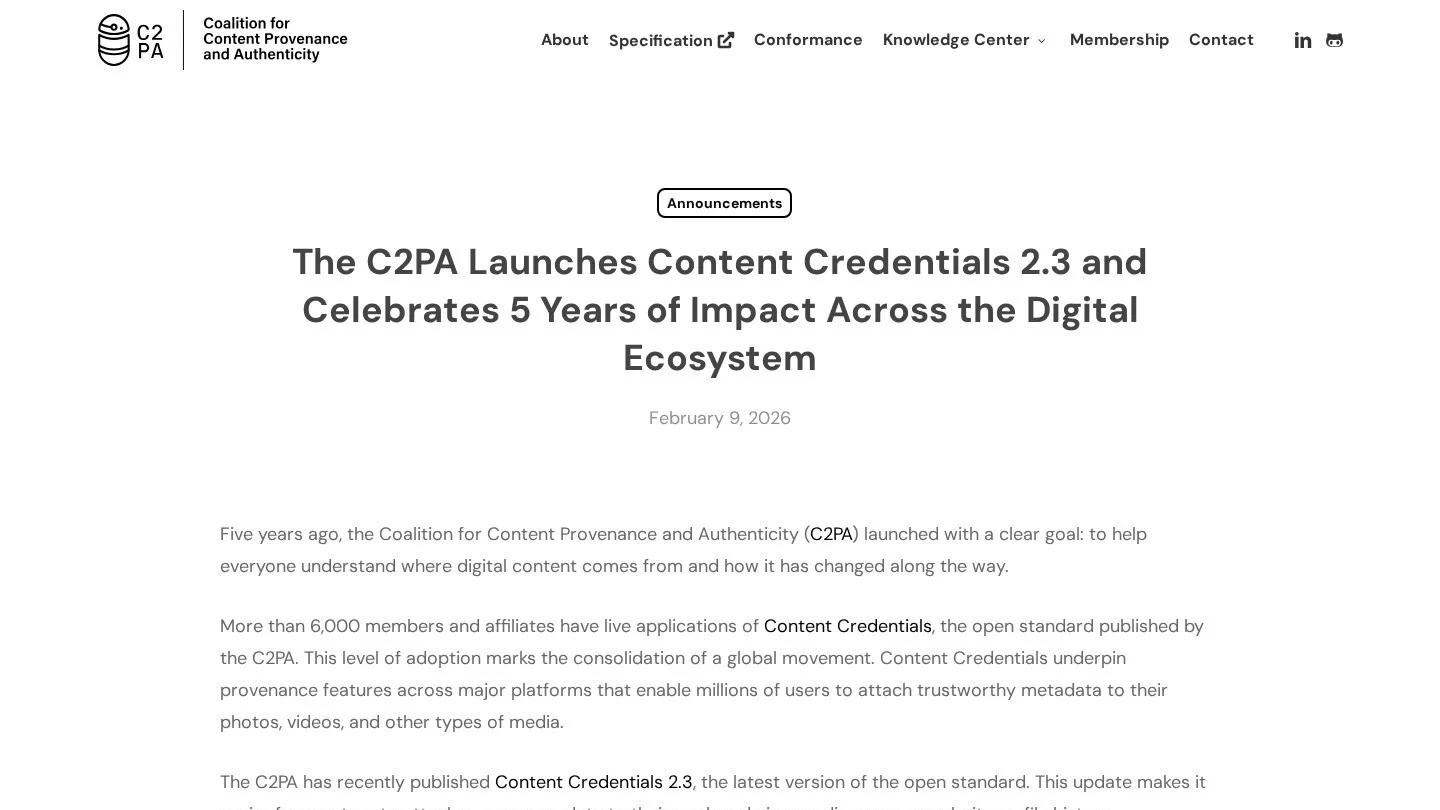
C2PA announced version 2.3 in February 2026, on the coalition’s fifth anniversary. The update extends credentials to live video for broadcast and streaming. It adds support for plain text documents, OGG Vorbis audio, large AVI video files and EXIF original preservation images. Editing history can now record finer changes such as resizing, markup and redaction, and credentials can point to trusted information stored in the cloud.
The coalition also says more than 6,000 members and affiliates have live applications of Content Credentials, and that its Conformance Program, launched in late 2025, checks that products showing a Content Credential badge handle the data correctly. In July 2026 C2PA published its first deployment guidance for organizations rolling out credentials.
Who Uses Content Credentials Today
We compiled the adoption milestones below from company announcements. The list is not complete, but it shows that support now spans cameras, phones, AI tools and social platforms.
| Date | Company and product | What it does with Content Credentials |
|---|---|---|
| October 2021 | Adobe Photoshop | Announced Content Credentials for edits in Photoshop |
| May 2024 | Adopted the C2PA standard for content shown on its platform | |
| May 2024 | TikTok | Announced “AI-generated” labels on videos whose credentials show AI creation |
| October 2024 | YouTube | Began a “captured with a camera” label for unedited footage from compatible cameras |
| June 2025 | Sony Camera Verify | Authenticity checks for news photos from selected high-end cameras |
| August 2025 | Nikon Z6III firmware | Added credentials to photos; suspended in September 2025 after a flaw |
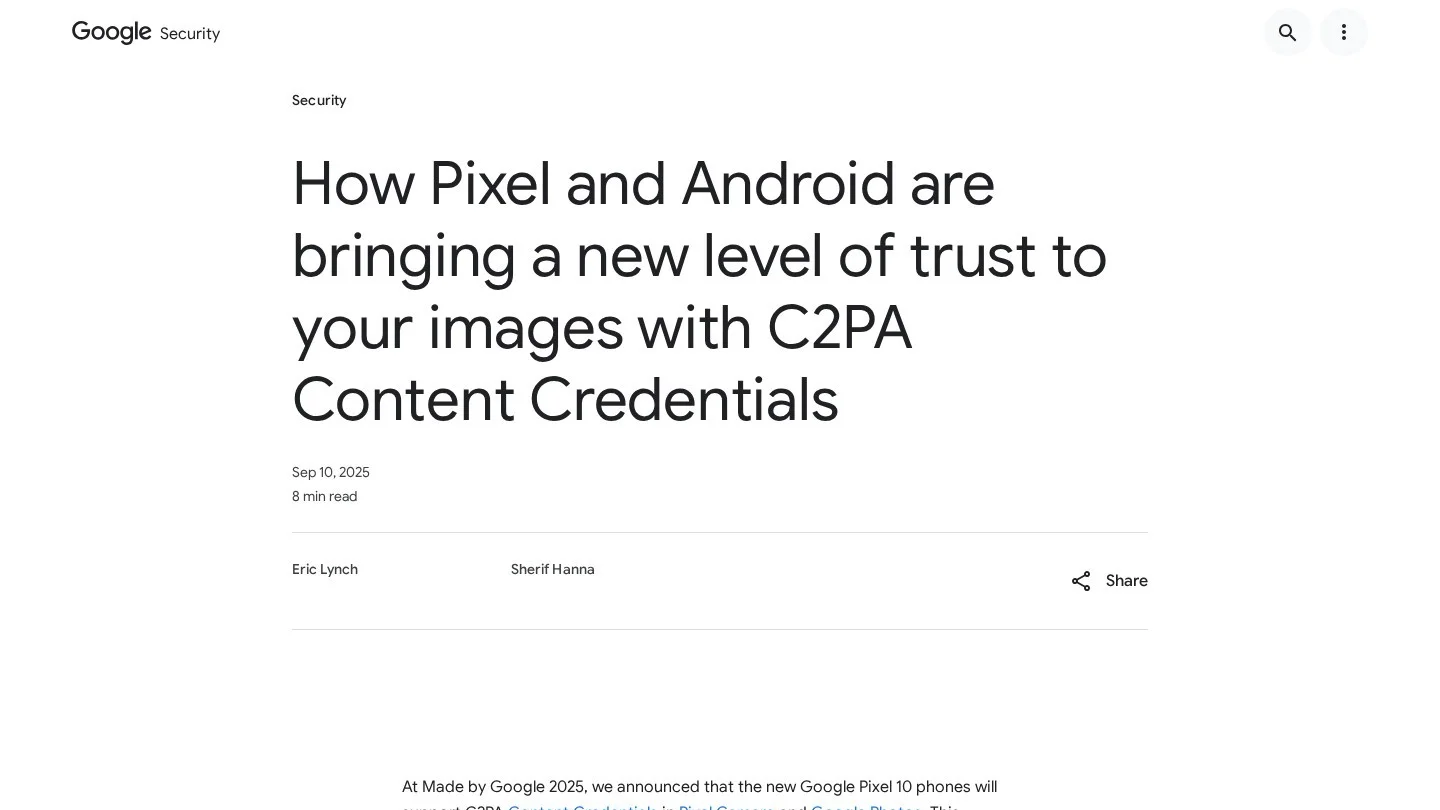
| September 2025 | Google Pixel 10 | Credentials on every JPEG from Pixel Camera and on edits in Google Photos |
| Ongoing | OpenAI ChatGPT images and Sora | Embeds credentials showing AI creation in generated images and video |

Google Pixel 10: A Close Look at a Phone Rollout
Google’s Pixel 10, announced in September 2025, has the most detailed public setup for provenance on a phone. Pixel Camera attaches credentials to any JPEG it captures, and Google Photos adds them when it edits an image that already has credentials or uses AI tools on any image. Google says Pixel Camera reached Assurance Level 2, the highest level the C2PA Conformance Program defines so far.
The privacy design is worth learning from. Signing keys are made and stored in the Titan M2 security chip. Certificate requests are authenticated anonymously, and Google says its certificate authorities do not log details such as IP addresses. Each key and certificate signs only one image, so two photos cannot be linked to each other or to the person who took them. An on-device clock keeps time-stamps trustworthy even when the phone is offline.
That last point matters for anyone who worries that provenance means tracking. A credential can say “a genuine Pixel camera took this at this time” without saying “this person took it.”
Reading the Result of a Credential Check
A C2PA viewer gives one of a few outcomes, and each calls for a different response. A valid credential from a known signer, with a hash that matches, means the file is unchanged since that signer recorded its history, so the next question is whether you trust the signer. A credential whose hash no longer matches means someone changed the file after signing, which deserves a closer look before you use it. A credential signed by an unknown or revoked certificate, as happens when a camera maker revokes its keys, should be treated like no credential at all. And a file with no credential is simply unproven, which describes most of the internet today.
Laws That Now Require Provenance or Labels
Provenance moved from a voluntary feature to a legal tool in 2026, on both sides of the Atlantic.
| Law | Who it covers | What it requires | Key dates |
|---|---|---|---|
| EU AI Act, Article 50 | Providers and deployers of AI systems in the EU | Machine-readable marking of AI-generated content and a way to detect it; disclosure of deepfakes | Applied from August 2, 2026; generative systems already on the market have until December 2, 2026 for marking |
| California AI Transparency Act, as amended by AB 853 | Large generative AI providers, then large platforms and device makers | Latent disclosures in AI content; platforms must detect provenance data and show it; new cameras must offer it | Providers August 2, 2026; large online platforms January 1, 2027; capture devices made from January 1, 2028 |
Under the EU rules, fines for breaking the transparency duties can reach €15 million or 3% of worldwide annual turnover, whichever is higher. The European Commission adopted guidelines on Article 50 on July 20, 2026, and its AI Office published a voluntary code of practice on marking and labelling AI-generated content. Signing the code gives providers a recognized route to show they comply.
California’s law was first due to take effect on January 1, 2026, before AB 853 pushed it to August 2, 2026. For capture devices first sold in California from 2028, the hidden disclosure must include the maker’s name, the device name and version, and the time and date the content was created or changed. Those are exactly the fields a C2PA capture assertion already holds, which is why device makers have a head start.
Provenance, Watermarks and Detection Compared
Three tools are often mixed up. They answer different questions and fail in different ways.
| Method | Question it answers | How it works | Main weakness |
|---|---|---|---|
| Provenance (Content Credentials) | Who signed this file and what history did they record? | Signed metadata manifest with a hash of the content | Removed by screenshots and some uploads; absent on most existing files |
| Invisible watermark | Was this made by a particular AI system? | A hidden pattern mixed into pixels or audio | Each vendor’s mark needs its own checker; heavy edits can weaken it |
| Deepfake detection | Does this file look synthetic? | A trained model scores signs of manipulation | Gives a probability, and new generators can fool it |
The C2PA specification links the first two through what it calls soft bindings, where a watermark or fingerprint helps find a stripped credential again in a cloud store. In practice, a newsroom can use all three: check the credential first, look for a known watermark next, and send unsigned files to a detector. Our comparison of deepfake detection software covers the third layer, and our list of websites that detect AI-generated images includes quick free checks.
Where Provenance Helps a Business Day to Day
Most talk about Content Credentials centers on elections and news. The everyday uses for a business are more mundane, and they are where the payoff shows up first.
Press and communications teams. A company that publishes product photos, executive portraits or event footage can sign them at the source. If a doctored version spreads, the team can point to the signed original and its recorded history, which is faster than arguing about pixels. The same team can check incoming images from agencies or freelancers before they go on the website.
Claims and inspections. Insurers, property managers and repair firms all rely on photos sent in by customers or field staff. A photo with a valid capture credential from a phone camera carries a recorded device and time, which makes a reused or edited picture easier to catch. A photo without one simply gets the normal manual review.
Marketplaces and listings. Sellers on marketplaces and agents on property sites increasingly use AI to tidy or stage images. Credentials that record an AI step let a platform label those images clearly, which is close to what California’s law will expect from large platforms from 2027.
Impersonation and fraud. Fake videos of executives asking for urgent payments are a growing risk. Provenance helps in the reverse direction: if your genuine announcements always carry credentials, staff and partners learn to treat an unsigned clip of the boss with suspicion. That habit pairs well with call-back checks and detection tools.
The underlying idea is the same one behind the mobile driver’s licenses now stored in phone wallets. A trusted issuer signs a record, and anyone can check it with software instead of eyeballing it. Our guide to digital identity wallets in the USA shows that model at work for state IDs.
Known Weak Spots in Content Credentials
Provenance is only as good as the keys behind it. Nikon’s experience in 2025 shows the risk. Soon after the Z6III gained Content Credentials, researchers found a flaw that let fake images be combined with authentic ones while keeping a valid signature, and Nikon revoked the certificates. Revocation worked as designed, but every photo signed with those certificates lost its trusted status.
The second weak spot is coverage. Most images online carry no credential, and many sites still strip metadata on upload. Until platforms read and keep credentials, a missing credential tells you little.
The third is meaning. A valid credential proves that a signer stands behind a file and its recorded history. It does not prove the scene was shown fairly, that a caption is accurate, or that a signer is trustworthy. Readers still need judgment.
The last is the cryptography itself. Content Credentials use today’s public-key signatures, which a future quantum computer could forge. Long-lived archives will need to move to new signature schemes over the next decade, a shift we cover in our guide to preparing for post-quantum encryption.
Adding Content Credentials to Your Own Work
A small business, agency or newsroom can start without building anything.
- Turn it on where you already work: many creative tools and phones now support Content Credentials, so check your camera, phone and editing software settings first.
- Keep the original: archive the signed original file, since later edits create new manifests that point back to it.
- Disclose AI use on purpose: if you sell into the EU or California, map where your team uses generative AI and make sure outputs carry the required marks. Our template for an AI acceptable use policy includes a section on labelling.
- Check before you publish: inspect incoming images with a C2PA viewer before running them, and treat a broken signature as a reason to ask questions.
- Choose platforms that keep credentials: when you have a choice, publish where the “cr” icon survives the upload.
Common Questions About Content Provenance
What Is the Difference Between C2PA and Content Credentials?
C2PA is the coalition and the technical standard. Content Credentials is the public name for the signed records the standard defines, shown with a “cr” icon.
Can Content Credentials Be Removed?
Yes. A screenshot or a platform that strips metadata can drop them. The C2PA specification allows soft bindings, such as watermarks, to help recover a credential stored in the cloud.
Do Content Credentials Identify the Photographer?
Not necessarily. Google’s Pixel design signs each image with a one-time key so photos cannot be linked to a person. Whether a name appears depends on the tool and on what the signer chooses to record.
Is Content Provenance Required by Law?
In the EU, Article 50 of the AI Act requires machine-readable marking of AI-generated content from August 2, 2026. California’s AI Transparency Act applies to large AI providers from August 2, 2026, platforms from 2027 and new capture devices from 2028.
C2PA Specs, Company Notices and Legal Updates on Provenance
- C2PA: Technical Specification 2.3 (PDF)
- C2PA: Content Credentials 2.3 Launch and Five Years of Impact (February 2026)
- C2PA: Content Credentials Deployment Guidance (July 2026)
- Google: Pixel and Android Trusted Images With C2PA Content Credentials (September 2025)
- Cooley: EU AI Act Transparency Obligations Take Effect (August 2026)
- Orrick: California Delays Its AI Transparency Act (October 2025)
- PetaPixel: Nikon Suspends C2PA Functionality on the Z6III (September 2025)