
Six months of work rights is a lot to lose after paying for a UK degree. That was the prospect for international graduates who apply from January 2027, when the Graduate visa is due to shrink from two years to 18 months. On October 28, 2026, the UK Budget softened the cut: graduates of universities with strong compliance records and good job outcomes will keep a two-year Graduate visa, according to Times Higher Education and The PIE News, which both reported the measure from the Budget 2026 document.
Everyone else still faces 18 months. The government has not yet said which universities qualify or when the change starts, so students choosing a course for 2027 need to read the fine print before they pay a deposit.
Before You Pay a Deposit for a 2027 UK Course
- Graduate visa applications made on or before December 31, 2026 still get two years under current GOV.UK rules.
- From January 1, 2027 the standard stay drops to 18 months, while PhD graduates keep three years.
- The Budget restores two years only for “high compliance” universities with strong labour market outcomes, and the criteria are still being designed.
- The High Potential Individual visa will widen to graduates of the top 150 global universities.
- A £925-a-year levy per international student starts in 2028/29, and the government expects universities to pass some of it on in fees.

What the 2026 Budget Said About the Graduate Route
Chancellor John Healey presented the Budget in the House of Commons. Its wording on post-study work is short. The two-year visa will apply to “graduates from high compliance universities where there are strong labour market outcomes,” as Times Higher Education quoted it. The PIE News reports that the Home Office and the Department for Education will design the policy and that more details are expected “in due course.”
That makes this a partial reversal, a term law firm Pinsent Masons also used. The cut to 18 months, announced earlier, stays in place for most graduates. No new Immigration Rules have been laid yet, so the current rules on GOV.UK are the ones that apply today.
| Graduate’s situation | Graduate visa length | Status |
|---|---|---|
| Applies on or before December 31, 2026 | 2 years | Current GOV.UK rule |
| Applies on or after January 1, 2027 | 18 months | Current GOV.UK rule |
| PhD or other doctoral graduate | 3 years | Current GOV.UK rule |
| Graduate of a qualifying “high compliance” university | 2 years | Budget proposal, start date and criteria to come |
Which Universities Could Count as High-Compliance
No list exists yet, and the Budget does not explain how “strong labour market outcomes” will be measured. What we do know is the starting point. Under the current Graduate visa rules, every university that sponsors international students must already be a licensed sponsor with a “track record of compliance.” The new test sits above that floor, so being a licensed sponsor will not be enough on its own.
The PIE News reports that the Budget does not say how many universities will qualify. Until the Home Office publishes the criteria, any ranking of “safe” universities is a guess, and students should treat agent claims about guaranteed two-year visas with care.
What a Graduate Visa Costs at 18 Months Versus Two Years
The length of the visa changes the bill as well as the work window, because the Immigration Health Surcharge is charged per year of stay. GOV.UK lists a £937 application fee and a surcharge of usually £1,035 a year. We worked out the totals for one applicant without dependants.
| Visa length | Application fee | Health surcharge | Total |
|---|---|---|---|
| 18 months | £937 | £1,552.50 | £2,489.50 |
| 2 years | £937 | £2,070 | £3,007 |
| 3 years (PhD) | £937 | £3,105 | £4,042 |
A two-year visa costs £517.50 more than the 18-month version. For most graduates the extra six months of salary is worth far more than that, since it buys time to find an employer willing to sponsor a Skilled Worker visa. Each dependant applies separately and pays the same fees, so a family’s costs rise quickly.
The International Student Levy Arrives in 2028
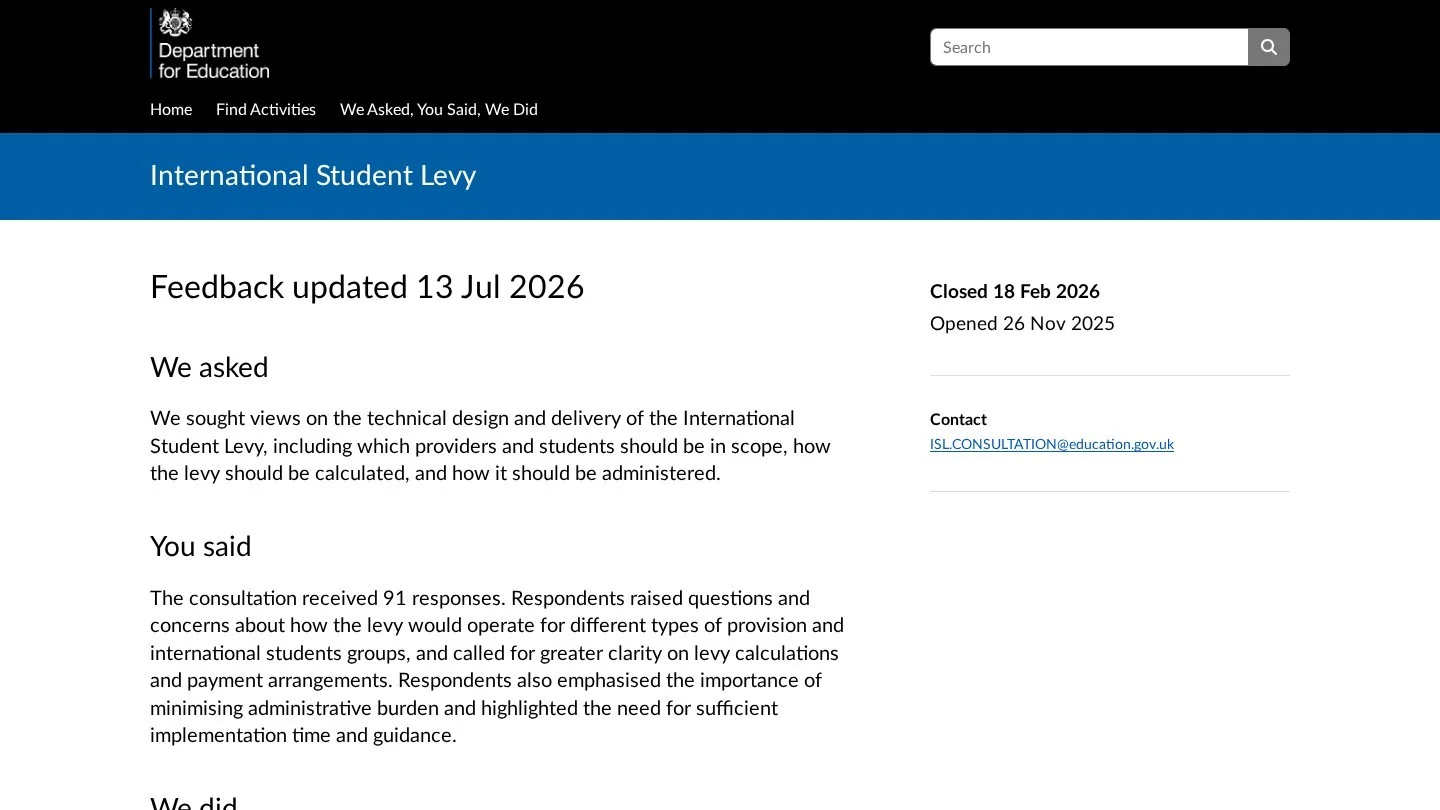
The same week brought numbers on the levy. The government’s impact analysis, published in October 2026, sets the charge at £925 per international student per year from 2028/29, rising with inflation. Each university gets an allowance of 220 international students a year before the levy applies.
| Financial year | Levy revenue | Income lost by universities |
|---|---|---|
| 2028-29 | £400m | £280m |
| 2029-30 | £460m | £350m |
| 2030-31 | £480m | £380m |
| Three-year total | £1,340m | £1,010m |
The PIE News notes the £1,010m loss is £110m more than the government predicted last year. The analysis expects most universities to pass some of the cost on to students through higher fees, with Oxford, Cambridge, Imperial and the rest of the top 20 better placed than others. It projects about 11,500 fewer international students in later years.
Other Budget Changes Graduates Should Read
- High Potential Individual visa: eligibility widens to graduates of the top 150 global institutions, with a matching rise in the scheme’s cap, Times Higher Education reports.
- PhD salary discount removed: the lower Skilled Worker salary rate for PhD holders goes, following advice from the Migration Advisory Committee.
- Longer grace period: sponsored workers who lose their job will get up to six months to find a new sponsor instead of 60 days, according to Pinsent Masons.
- Salary thresholds: the general Skilled Worker threshold of £41,700 will rise with 2026 wage data, while occupation-specific rates will be reviewed and cut from spring 2027.
How UK Universities Reacted to the Graduate Visa Move
University groups welcomed the change but asked for clear rules. Hollie Chandler of the Russell Group said it was “encouraging to see the government recognising the benefits,” The PIE News reported. Vivienne Stern, chief executive of Universities UK, said “the rules need to be stable and fair.” Research bodies were cooler on the wider Budget, with the British Academy’s Hetan Shah calling it “a missed opportunity” for university funding.
What Students Starting in 2026 and 2027 Should Do Now
If you finish your course this year, apply for the Graduate visa as soon as your university reports your completion and before December 31, 2026. You do not need to wait for graduation day, and an application made in time still gets two years.
If you are choosing a course for 2027, ask each shortlisted university in writing whether it expects to qualify and how it reports graduate outcomes. Compare total costs, not tuition alone, since the levy may push fees up from 2028. Students also comparing the US can look at our list of US universities offering a master’s in AI.
If you plan to stay and work, start the job search early. Eighteen months passes fast, and employers need time to arrange sponsorship. A study timetable that leaves room for applications in your final term helps, and when an offer comes, our salary negotiation email templates can help you reach a pay level that clears the Skilled Worker threshold.
A Two-Tier Graduate Visa Will Reshape University Choices
The measure helps students, but in our view it also creates a two-tier system that will shape where they apply. If two years of work rights depend on a university’s compliance and job record, that label becomes a selling point in recruitment, and smaller universities that rely on international fees may struggle to compete. Pairing the change with a £925 levy pulls the other way on cost. The fair test will be whether the criteria are published early, before the 2027 intake commits, and whether they stay stable for students already enrolled.
Graduate Route Answers for 2027 Applicants
Is the UK Graduate Visa Still Two Years?
Yes, for applications made on or before December 31, 2026. From January 1, 2027 it falls to 18 months, except for PhD graduates and, once the Budget measure takes effect, graduates of qualifying high-compliance universities.
When Will the Two-Year Rule for High-Compliance Universities Start?
The government has not given a date. The Home Office and Department for Education are designing the policy, and it needs new Immigration Rules before it applies.
How Much Does the UK Graduate Visa Cost?
GOV.UK lists a £937 application fee plus the Immigration Health Surcharge of usually £1,035 a year. That comes to £2,489.50 for 18 months or £3,007 for two years.
Will the International Student Levy Raise Tuition Fees?
The government’s own analysis assumes universities will pass some of the £925-a-year levy on through higher fees, though the share will vary by university.
Budget Papers and Reports Behind This Article
- HM Treasury: Budget 2026 document
- GOV.UK: Graduate visa
- Department for Education: International Student Levy impact analysis (October 2026)
- Times Higher Education: Budget brings longer graduate visas at high compliance universities (October 28, 2026)
- The PIE News: UK to extend graduate visa to two years for high-compliance universities
- The PIE News: UK universities to take £1,010m hit over international student levy
- Pinsent Masons Out-Law: UK Budget 2026 immigration measures