No single deepfake detector fits every job, so the best choice depends on what you need to screen. For developers who want a free start across audio and images, Reality Defender’s free API tier covers 50 scans a month. For high-volume image checks with clear prices, Sightengine starts at $29 a month. Pindrop Pulse is built for phone calls into contact centers, Resemble AI focuses on voice and publishes benchmark results, and Hive and Sensity serve government, forensic and trust-and-safety teams that need video, audio and on-premise options.
We compared six products on facts their makers publish: what media they check, how they are deployed, what they cost, and what accuracy claims they make and where those claims come from. Every accuracy figure below is labelled as the vendor’s or a named benchmark’s.

How Deepfake Detection Software Reaches a Verdict
Detection tools look for traces that generators leave behind. The vendors in this comparison describe several families of signals, and most products combine more than one.
For voice, the clues sit in the sound itself. The signs include frequency distortions, odd variation in the voice, unnatural pauses and timing glitches that are hard for a machine to reproduce at scale. A model learns these patterns from millions of real and fake samples and outputs a score for how likely the audio is to be synthetic.
For images and video, detectors examine pixels, faces and motion. Sensity lists the main manipulation types it hunts for, including face swaps, lip-sync edits, face reenactment, morphing and fully generated faces. Some systems also try to name the generator. Hive says its model returns the AI model that most likely created a piece of content, which helps investigators link several fakes to one source.
The output is almost always a probability or a score, plus, in better tools, an explanation of what triggered it. Reality Defender lists explainability on its Enterprise plan, Pindrop gives reasons for each detection, and Resemble pairs a verdict with an explanation and a chain-of-custody record. Those explanations matter when a fraud team has to justify blocking a customer or a court has to weigh evidence.
Detection is the opposite approach to provenance. A detector studies the file for signs of fakery. A provenance system checks for a signed record of where the file came from. The two work best together: a valid signature from a trusted camera is strong evidence of a real photo, and a detector covers the many files that carry no record at all.
Six Deepfake Detection Tools on Their Published Facts
| Tool | Media it checks | How you use it | Published price | Accuracy claim |
|---|---|---|---|---|
| Reality Defender | Audio, image, video; text and livestream on Enterprise | API with open-source SDKs, web platform | Free: 50 scans a month (audio, image). Growth from $399 a month. Enterprise custom | None published |
| Hive | Image, video, audio, plus text and documents for related checks | Cloud API, on-premise or private cloud via NVIDIA NIM | Contact sales | Returns the likely source model for AI images (company description) |
| Sightengine | Images (all plans), video (paid plans) | API | Free 2,000 operations a month; Starter $29; Pro $99; $0.002 per extra operation | None published |
| Resemble AI (Resemble Detect) | Audio, image, video | API, meetings tool, browser extension | Credit packs, pay as you go from $5 | 99.47% audio accuracy on the independent Podonos benchmark (Resemble says) |
| Pindrop Pulse | Audio from phone calls and meetings | Built into Pindrop’s contact center platform | Quote-based | About 99% on known deepfake engines, over 90% on unseen ones, under 1% false positives (company claims) |
| Sensity | Image, video, audio | Web app, API, SDK; cloud or on-premise, including a USB dongle | Quote-based | No benchmark figure published |
The table shows two different kinds of product. Sightengine, Reality Defender and Resemble sell detection as an API that a developer calls file by file. Pindrop and Sensity sell a finished system for a specific team, a call center or a forensic lab. Hive sits in between, with APIs plus large on-premise deployments.
Reality Defender for Developers Starting Small
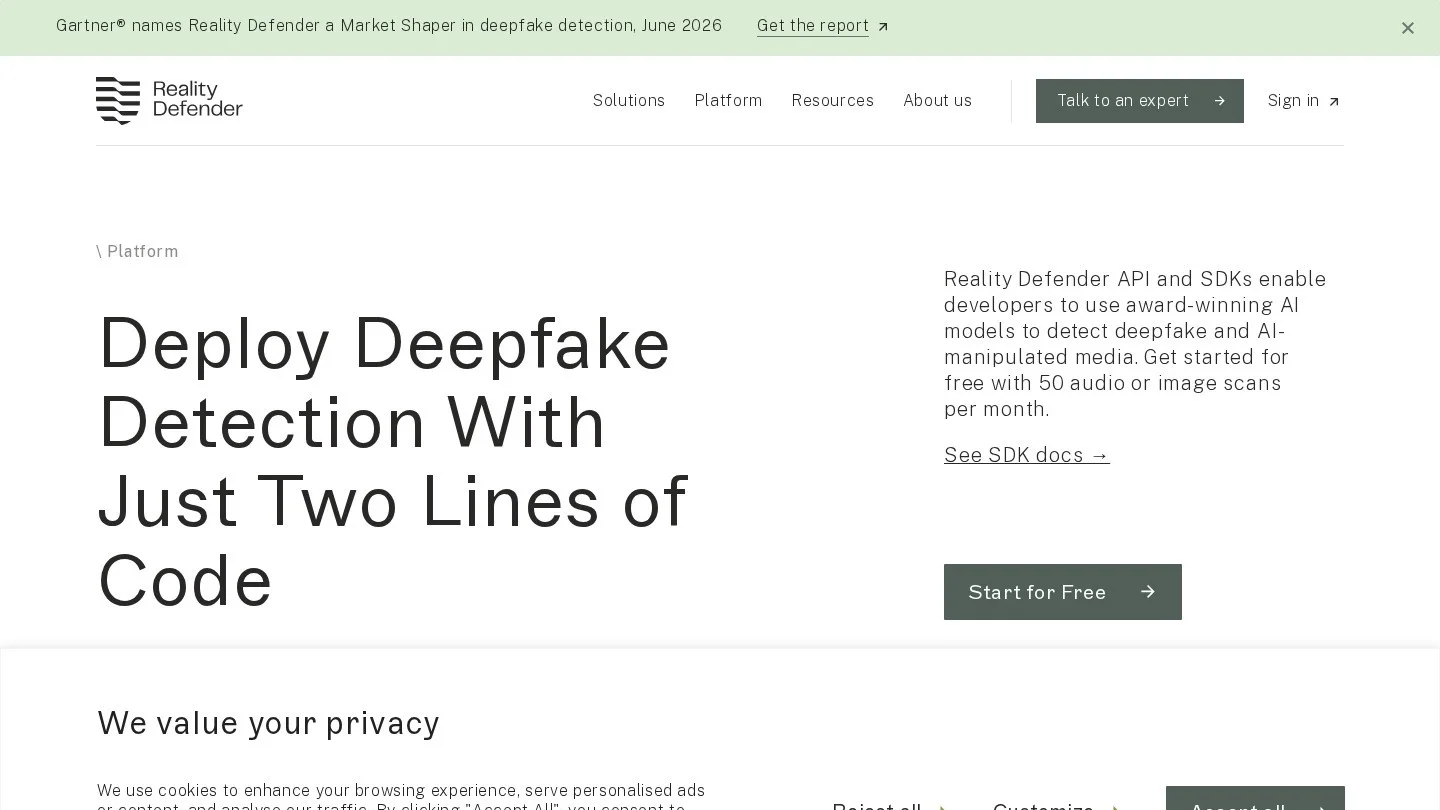
Reality Defender has the most generous free start for multi-format detection in our group. The free tier allows up to 50 scans a month for audio or images with no credit card, one seat and result scores. The Growth plan starts at $399 a month and adds video detection and live chat. Enterprise adds text detection, livestream analysis, explainability, export and multiple seats.
The SDK list is long: Python, TypeScript, Java, Go and Rust, all described as open source. That makes Reality Defender easy to test inside an existing app before any purchase. The free tier is small, since 50 scans works out to fewer than two a day in a 30-day month, so it suits proof-of-concept work rather than live screening at scale.
Hive for Government and Large Platforms
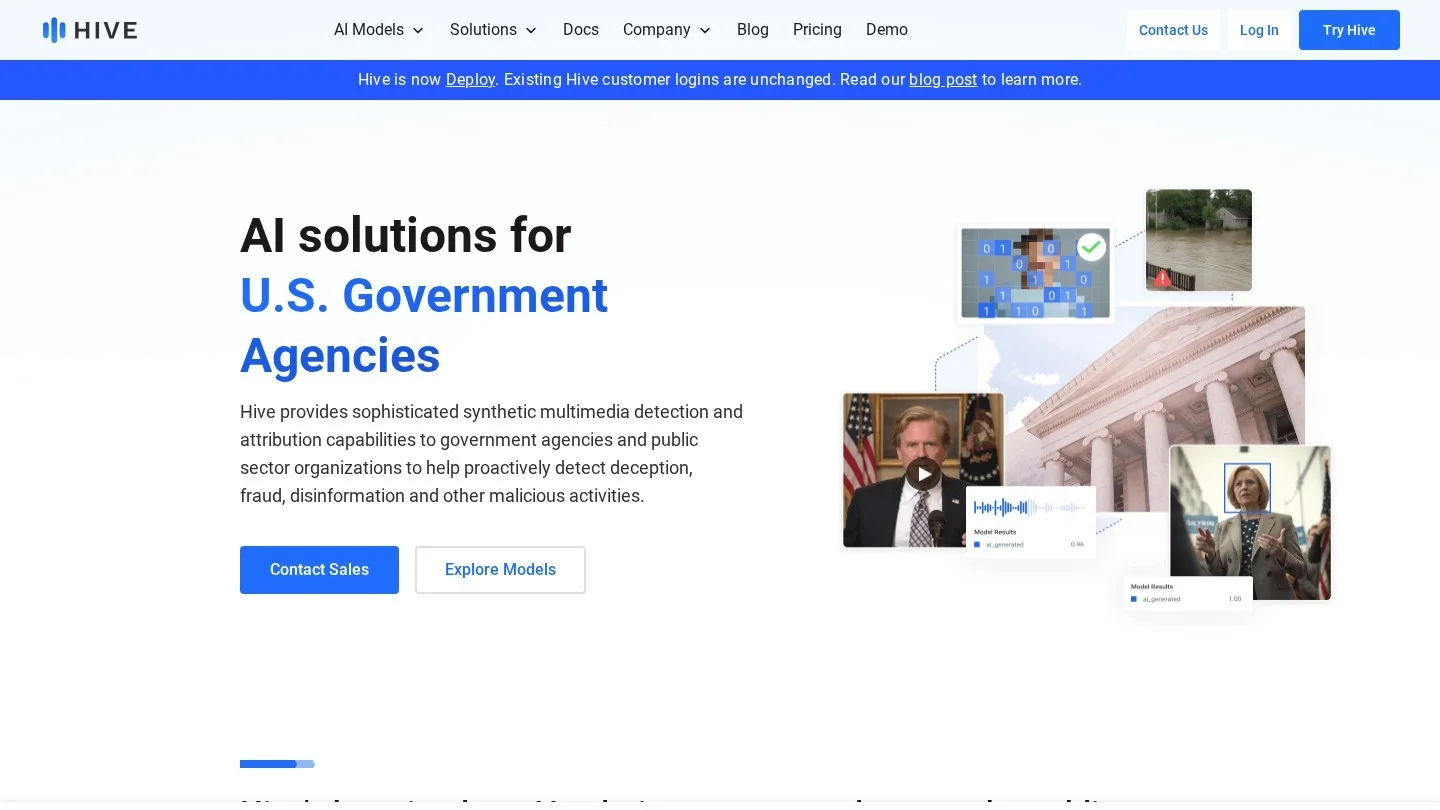
Hive is best known for content moderation, and it has carried that scale into deepfake detection. In December 2024 it announced a two-year Department of Defense contract with the Defense Innovation Unit to support the intelligence community. The amount was not disclosed. The models detect AI-made video, images and audio, and they can run offline on-premise, in a private cloud through NVIDIA NIM, or through Hive’s cloud APIs.
Hive adds a feature that matters for investigators: for AI-generated content, the model returns the generator that most likely made it. It also lists voice-clone audio detection and identity document checks. Pricing is by sales contact, which fits a buyer with large volumes and procurement rules.
Sightengine for Predictable Image Volumes
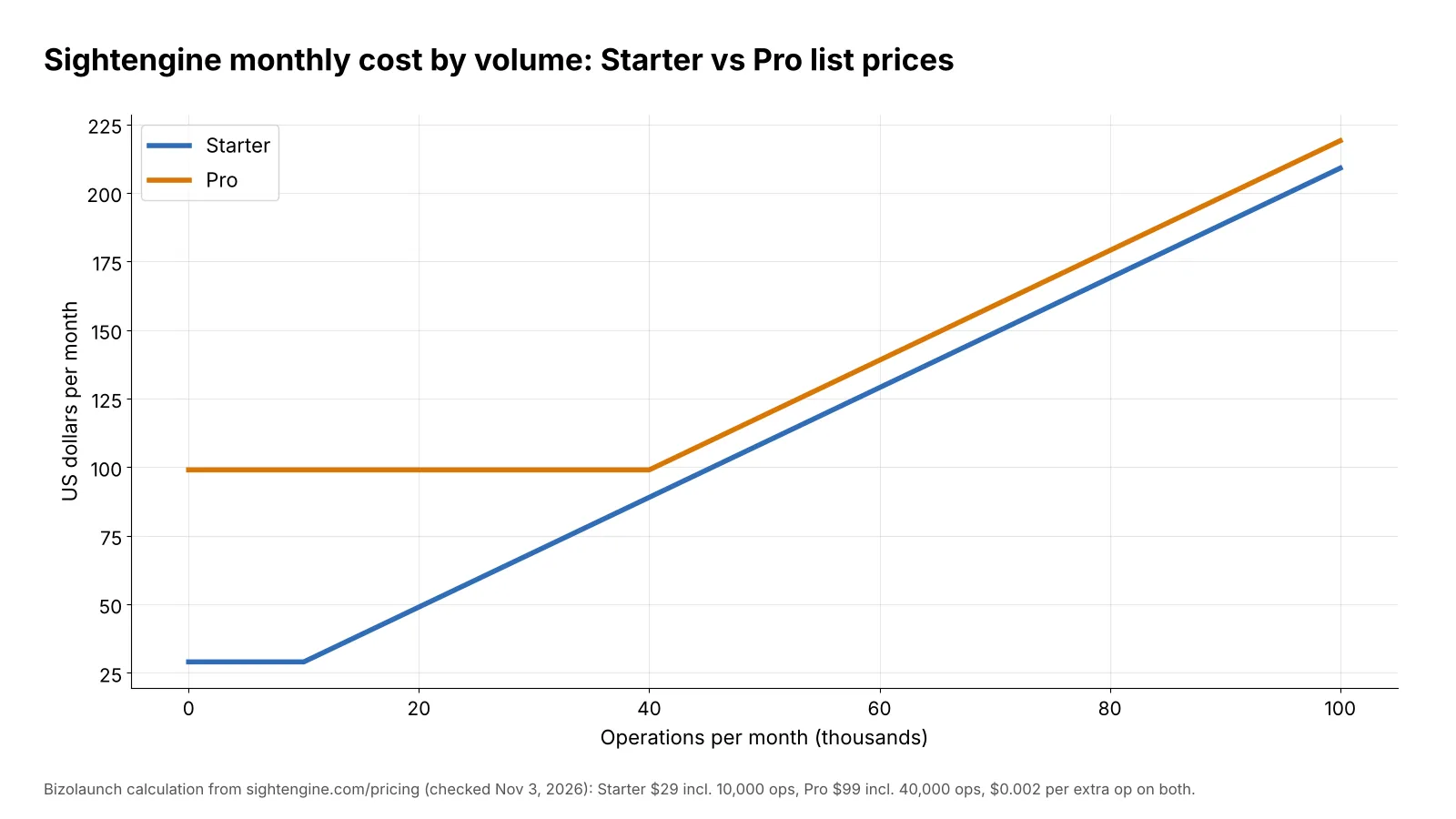
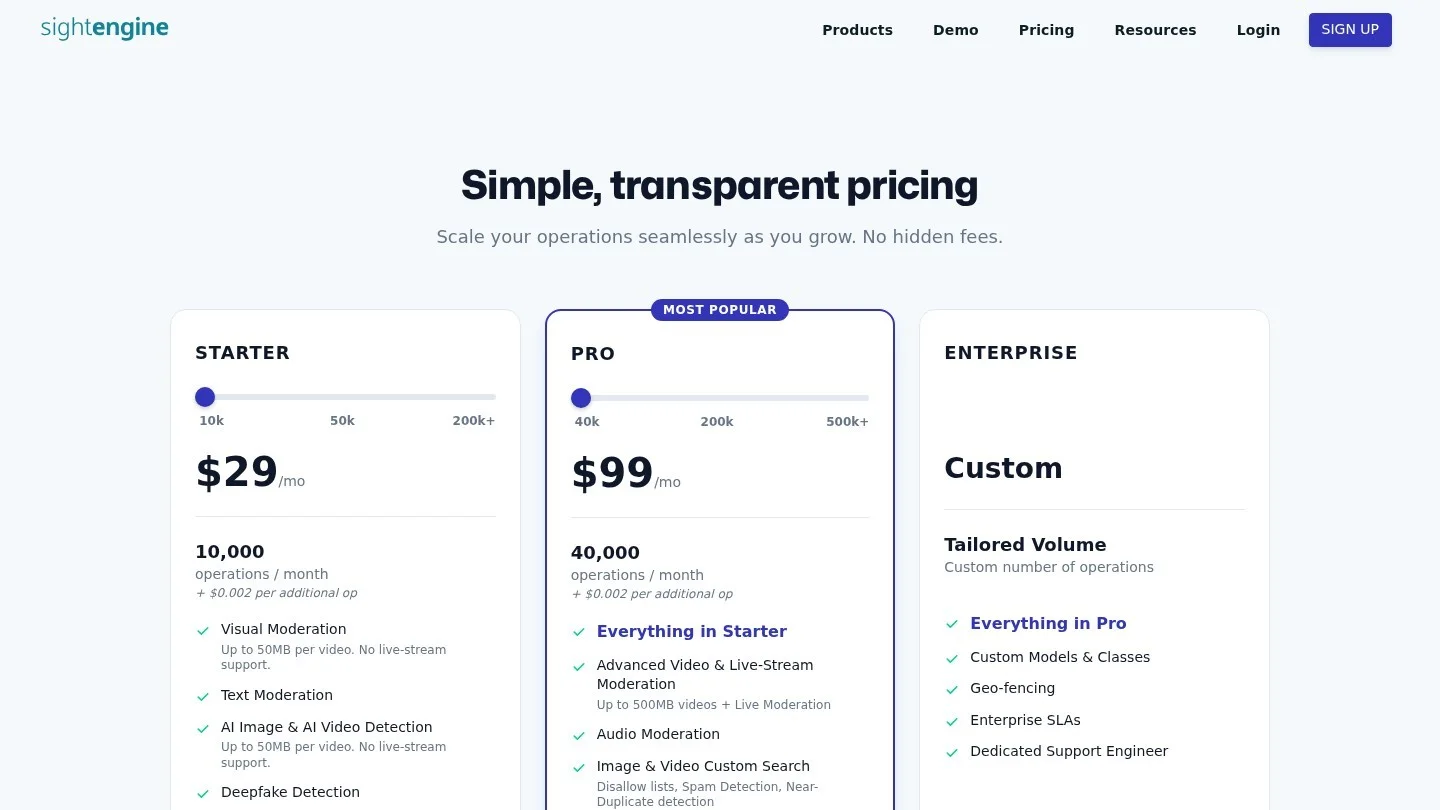
Sightengine is the only tool here with a full public price list for detection. It has a Free plan with 2,000 operations a month, capped at 500 a day, that includes AI image detection covering AI-generated and deepfake images. Starter costs $29 a month for 10,000 operations and adds AI video detection. Pro costs $99 for 40,000 operations. Both paid plans charge $0.002 for each extra operation.
The Free plan’s two caps work together. A site that receives most of its uploads on one busy day can hit the 500-a-day limit long before it reaches 2,000 for the month, so a launch day or a viral post is the moment to have a paid plan in place.
Our Cost Math for Sightengine Plans
We ran the list prices at four monthly volumes. One image check counts as one operation, so the table assumes image checks.
| Image checks per month | Free | Starter ($29, 10,000 included) | Pro ($99, 40,000 included) |
|---|---|---|---|
| 1,000 | $0 | $29 | $99 |
| 10,000 | Over limit | $29 | $99 |
| 40,000 | Over limit | $89 | $99 |
| 100,000 | Over limit | $209 | $219 |
The result surprised us. Because both paid plans charge the same overage rate, Starter with overage stays $10 a month cheaper than Pro at every volume above 40,000. Above that point the two lines run in parallel. Pro may carry other benefits, such as higher limits or support terms, so it is worth asking Sightengine what the extra $10 buys before you choose. On price alone, Starter wins, at about $0.0022 per image at 40,000 checks.
Resemble AI for Voice Deepfakes
Resemble AI makes voice-cloning tools and sells detection alongside them. Its current detection model, DETECT-World, covers audio, images and video. For audio, Resemble says it reached 99.47% accuracy and first place on the independent Podonos audio deepfake benchmark, with a 0.4% false negative rate, a 0.7% false positive rate and a mean latency of 399 milliseconds across 4,524 files. Resemble says its image and video accuracy figures are internal for now, with outside testing in progress.
Pricing is by credit packs shared across detection, watermarking and identity products, with pay as you go from $5 and enterprise discounts. Resemble also offers a meetings tool for live calls and a browser extension, which makes it one of the easier options to put in front of staff who take a lot of video calls. The benchmark itself is public on GitHub.
Pindrop Pulse for Call Centers
Voice is where many deepfake frauds start, because a cloned voice on a phone line is hard for a person to judge. Pindrop Pulse listens for signs of machine-made speech, such as frequency distortions, unnatural pauses and timing anomalies, and turns them into what Pindrop calls a “fakeprint.” It gives each call a liveness score that feeds the company’s wider fraud and authentication system.
Pindrop says Pulse needs about two seconds of net speech and works in real time during the call or after it. It claims about 99% detection for known deepfake engines and over 90% for new ones, with a false positive rate under 1%, based on its own dataset of 20 million audio samples from more than 120 voice generators. First National Bank of Omaha is named as an early adopter. Pindrop does not publish prices.
Sensity for Forensic and Investigative Work
Sensity covers images, video and audio, including face swaps, lip-sync fakes, reenactment, face morphing, avatars and voice clones. It runs in the cloud or on-premise, with options for a GPU server, a single workstation or a portable USB dongle for air-gapped work. Users can drag files into a web app or call an API or SDK.
The use cases Sensity lists lean toward investigation: government and court verification, forensic evidence, disinformation research, child-abuse material and non-consensual intimate images. For those teams, offline deployment and a report that can stand up to scrutiny matter more than a low price per scan. Pricing is by consultation.
Picking a Detector by the Fraud You Face
The right tool follows the attack. We matched common scenarios to the products whose published features fit them.
| Your situation | Tools that fit on published features | Why |
|---|---|---|
| Bank or fintech checking selfies and ID photos at sign-up | Reality Defender, Hive, Sightengine | Image and video APIs that slot into an onboarding flow |
| Contact center taking calls from customers | Pindrop Pulse | Real-time voice scoring inside the call platform |
| Staff targeted by fake executive calls or video meetings | Resemble AI, Reality Defender | Meeting tools, audio detection, browser extension |
| Platform moderating user uploads at volume | Sightengine, Hive | Public per-operation pricing or large-scale APIs |
| Police, courts or newsroom verifying evidence | Sensity, Hive | On-premise and offline options, model attribution |
| Developer testing an idea with no budget | Reality Defender free tier, Sightengine Free | Free monthly allowances |
Banks have a regulatory reason to care. In November 2024, FinCEN issued an alert on deepfake fraud that lists red flags such as a customer using a third-party webcam plug-in during live verification, an ID photo that matches a gallery of AI-made faces, and media flagged by deepfake detection software. It asks institutions to use the key term FIN-2024-DEEPFAKEFRAUD in suspicious activity reports, and it lists detection software among recommended practices, next to phishing-resistant MFA and live verification checks.

What Deepfake Detectors Cannot Do Alone
Every detector in this comparison returns a score, not a certainty. Vendors publish accuracy on test sets, and those sets may not match the fakes you will meet next month. Pindrop’s own figures show the gap: about 99% on engines it has seen versus over 90% on new ones. A tool that misses one fake in ten still needs a human process behind it.
Three habits make detection far more useful. First, verify through a second channel, such as calling a known number back before any payment change. Second, add provenance checks, which look for signed records of where a file came from instead of hunting for flaws. Our explainer on digital content provenance covers how Content Credentials work and where they fall short. Third, write rules for staff about AI media, which our template for an AI acceptable use policy can help with.
For quick checks on single images, the free tools in our list of websites that detect AI-generated images are a reasonable first look. For identity checks at payment time, our guide to how biometric payment systems work explains the liveness tests that sit underneath. And deepfake scams often arrive by email first, so the patterns in our phishing email examples are worth sharing with any team that approves payments.
Running a Fair Pilot Before You Sign
Because public accuracy figures come from each vendor’s own tests, the most useful number is the one you measure on your own traffic. A short pilot can produce it without much cost.
- Collect real samples: gather a few hundred genuine files from your own channel, such as recorded calls, onboarding selfies or uploaded images, with consent and in line with your privacy rules.
- Add known fakes: create or source synthetic versions that match your channel, such as cloned voices over a phone line rather than studio audio.
- Run every tool on the same set: use the free tiers where they exist, and ask quote-based vendors for a trial.
- Count both kinds of error: a missed fake costs money, but a false alarm blocks a real customer, and the second is often the one that sinks a rollout.
- Time the response: a call center needs a score in seconds, while a forensic lab can wait.
- Price the winner at your real volume: use the cost math above for Sightengine, and ask the others for a quote at the same monthly volume.
Write the results down with the date and model version. Detectors are retrained often, so a pilot from last year says little about the product you are buying today.
What Security Teams Ask About Deepfake Detectors
Is There Free Deepfake Detection Software?
Yes, with limits. Reality Defender’s free API tier covers 50 audio or image scans a month, and Sightengine’s Free plan covers 2,000 operations a month, up to 500 a day, including AI image detection.
How Accurate Are Deepfake Detectors?
Published figures are vendor claims or vendor-reported benchmarks. Resemble says it scored 99.47% on the independent Podonos audio benchmark, and Pindrop claims about 99% on known voice engines and over 90% on unseen ones.
Can Deepfake Detection Software Check Live Calls?
Some can. Pindrop Pulse scores calls in real time, Reality Defender lists livestream analysis on Enterprise, and Resemble offers a meetings tool.
Which Deepfake Detector Works Offline?
Hive offers on-premise and private cloud deployment, and Sensity offers on-premise servers, workstations and a USB dongle for air-gapped use.
Vendor Pages Behind the Detector Comparison
- Reality Defender API plans
- Hive: Department of Defense deepfake detection contract
- Hive for government agencies
- Sightengine pricing
- Resemble Detect product page
- Podonos audio deepfake detection benchmark on GitHub
- Pindrop Pulse for audio deepfake detection
- Sensity deepfake detection
- FinCEN alert on deepfake fraud schemes