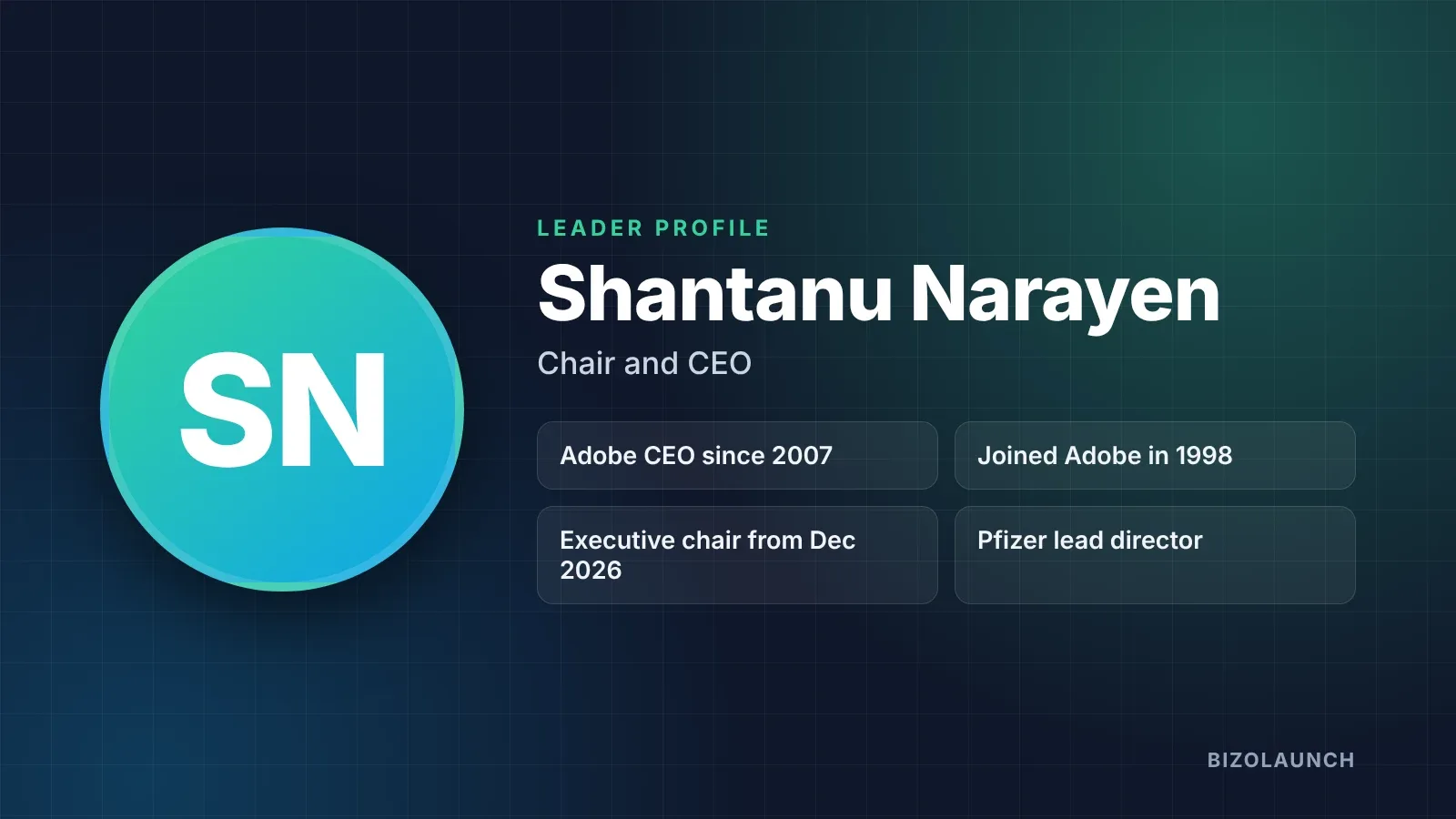
Shantanu Narayen became Adobe’s chief executive at the start of December 2007, after the company finished a fiscal year with $3.16 billion in revenue. Eighteen years later, Adobe reported $23.77 billion for fiscal 2025. On December 1, 2026, Narayen will pass the CEO title to Anil Chakravarthy and become executive chair. He has been Adobe’s chair since 2017 and joined the company in 1998.
That makes him one of the longest-serving CEOs of a large US software company. His record covers the move of Photoshop and Acrobat to subscriptions, a large push into marketing software, a $20 billion deal for Figma that was called off, and the arrival of Firefly, Adobe’s generative AI models.
| Detail | Record |
|---|---|
| — | — |
| Current roles | Chair and CEO of Adobe; executive chair from December 1, 2026 |
| Age | 62 in Adobe’s 2026 proxy statement |
| Joined Adobe | 1998 |
| CEO since | December 2007 |
| Education | B.S., electronics engineering, Osmania University; M.S., computer science, Bowling Green State University; MBA, Haas School of Business, UC Berkeley |
| Other public company board | Pfizer, as lead independent director |
| Successor as CEO | Anil Chakravarthy |
An Engineer From Hyderabad Who Went West for Graduate School
Narayen grew up in Hyderabad and studied electronics engineering at Osmania University there. He moved to the United States for a master’s in computer science at Bowling Green State University in Ohio. He later earned an MBA from the Haas School of Business at the University of California, Berkeley.
He started his career in 1986 at Measurex Automation Systems. From 1989 to 1995 he worked at Apple in product development, and he later ran desktop and collaboration products at Silicon Graphics. In 1996 he co-founded Pictra, one of the early startups built around sharing digital photos online. That mix of engineering and product work was the background he brought to Adobe in 1998.
Shantanu Narayen’s Career Timeline
| Years | Role | Company |
|---|---|---|
| — | — | — |
| 1986 | Starts his career | Measurex Automation Systems |
| 1989 to 1995 | Product development roles | Apple |
| After Apple | Director of desktop and collaboration products | Silicon Graphics |
| 1996 | Co-founds the photo-sharing startup Pictra | Pictra |
| 1998 | Joins Adobe as vice president and general manager of the engineering technology group | Adobe |
| 2005 | President and chief operating officer | Adobe |
| December 2007 | President and CEO, succeeding Bruce Chizen | Adobe |
| 2017 | Adds the chair role | Adobe |
| 2019 | Receives the Padma Shri from the Government of India | Government of India |
| March 12, 2026 | Says he will leave the CEO role once a successor is named | Adobe |
| December 1, 2026 | Becomes executive chair as Anil Chakravarthy takes over as CEO | Adobe |
| Ongoing | Lead independent director | Pfizer |
The Adobe Narayen Took Over in 2007
Adobe’s fiscal 2007 ended on November 30, 2007, the day before Narayen’s first day as CEO. Revenue that year was $3.16 billion, up 23% from $2.58 billion. Net income was $723.8 million, up 43%. Bruce Chizen stepped down at the end of the year as part of a planned handover.
Adobe then sold most of its software as boxed or downloaded licenses, with big upgrade cycles every couple of years. The Creative Suite 3 release and Acrobat had driven that strong final year. The question for the new CEO was how to grow past the upgrade cycle.
Three Big Decisions of the Narayen Years
Moving Creative Software to Subscriptions
Narayen’s best-known decision was to stop selling Photoshop, Illustrator and the other creative apps as one-time licenses and sell them as a monthly or yearly subscription through Creative Cloud. Today Adobe sells most of its products through a software subscription model. Recurring revenue made Adobe’s income steadier and let it ship updates all year. Many software companies later copied the model, which our guide to SaaS pricing models explains in plain terms.
Building a Marketing Software Business
Under Narayen, Adobe built a second business that sells software to marketing teams. It bought Marketo, Workfront and Frame.io, which now sit inside Adobe’s product lines. In 2026 this side of Adobe sells AI agents and data tools that run campaigns and customer journeys. Anil Chakravarthy, the incoming CEO, ran it for years.
Agreeing to Buy Figma, Then Walking Away
On September 15, 2022, Adobe agreed to buy Figma, the web-based design tool, for about $20 billion. Regulators in Europe and the UK raised concerns. On December 17, 2023, the two companies agreed to end the deal, and Adobe paid Figma a $1 billion termination fee within three business days. It was the most expensive setback of Narayen’s tenure. Adobe kept its cash and its shares, but a fast-growing rival stayed independent.
Adobe Revenue in Fiscal 2007, 2025 and 2026
| Fiscal year | Revenue | Growth |
|---|---|---|
| — | — | — |
| 2006 | $2.58 billion | Not used here |
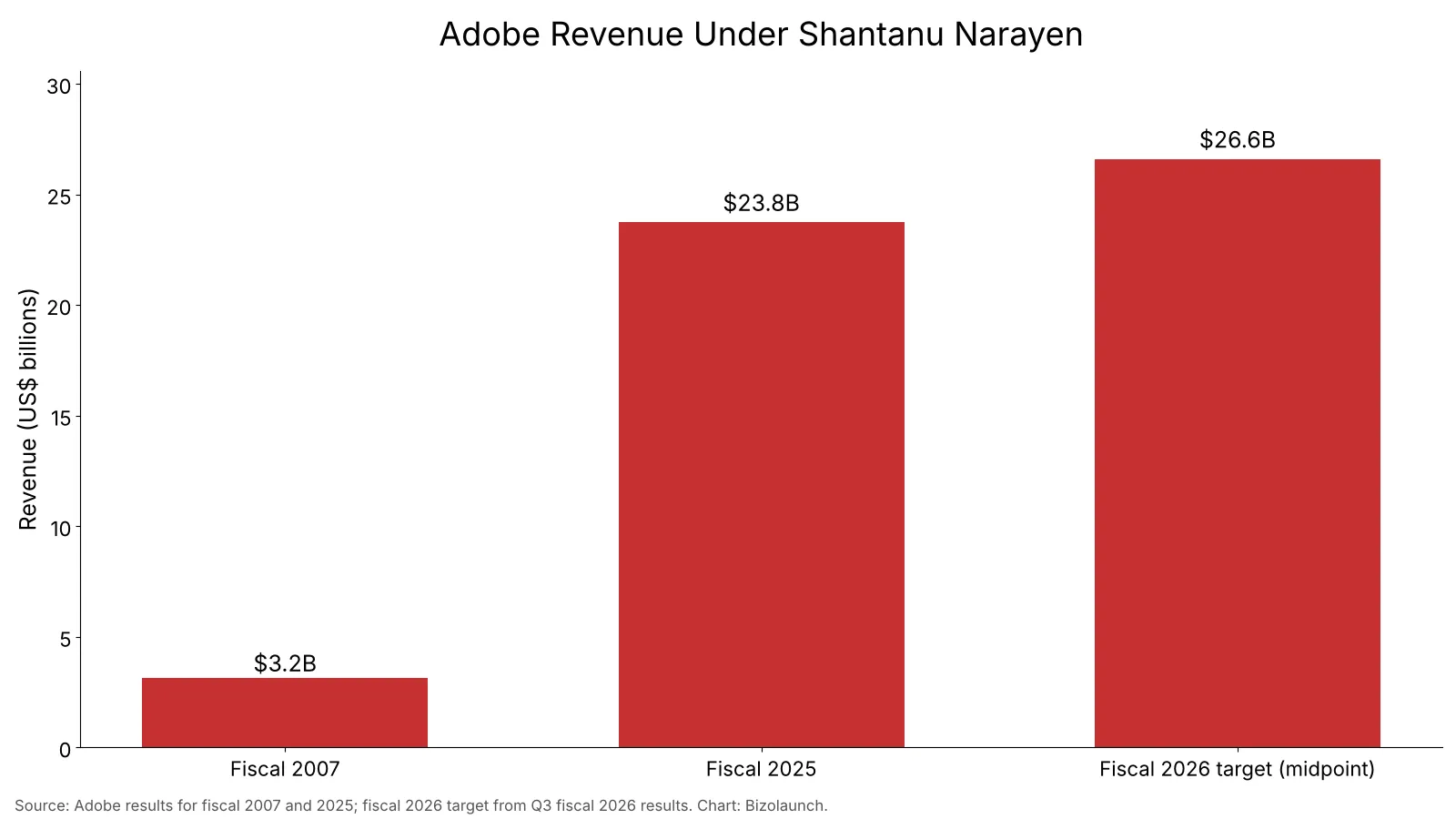
| 2007 | $3.16 billion | 23% |
| 2025 | $23.77 billion | 11% |
| 2026 (Adobe’s raised target) | $26.58 billion to $26.63 billion | About 12% at the midpoint (our calculation) |
We worked out the long-run rate ourselves. Revenue in fiscal 2025 was about 7.5 times the fiscal 2007 figure. Over 18 years, that is a compound growth rate of about 11.9% a year. If Adobe hits the midpoint of its fiscal 2026 target, about $26.6 billion, revenue will have grown about 8.4 times during Narayen’s time as CEO.
Headcount grew too. Adobe employed 29,945 people on December 1, 2023, split about evenly between the United States and other countries.
Firefly and Adobe’s AI Products
Adobe launched Firefly as its family of generative AI models for images and design, and it now builds AI into most of its apps. In June 2026 it put a Firefly AI assistant into public beta in Premiere, Photoshop, Illustrator, InDesign and Frame.io. The assistant runs multi-step jobs, such as renaming clips or resizing a design for several platforms. On October 28, 2026, Adobe gave enterprise admins a single switch to turn those assistants off, which our report on Firefly AI assistant admin controls covers.
Adobe says its AI-first products grew annual recurring revenue by more than 150% in the third quarter of fiscal 2026. It has also backed content credentials, a way to label how an image was made. Our explainer on digital content provenance covers that standard, and designers testing AI tools can compare options in our list of AI tools for interior designers.
How Adobe Pays Narayen
Adobe’s board ties most of Narayen’s pay to results. His reported total pay was about $51.2 million for fiscal 2025, down about 2% from about $52.4 million for fiscal 2024. About 97% of his target pay for fiscal 2025 was at risk, and about 70% depended on performance. More than 90% came as long-term equity.
- Equity mix: 70% performance-based awards and 30% restricted stock units that vest over four years.
- Annual cash incentive: paid out at 104% of target for fiscal 2025.
- 2023 performance share program: paid out at 83% of target when its three-year cycle ended in 2025.
- Board pay: none, because he is an employee director.
The 2026 Succession, Step by Step
On March 12, 2026, Adobe said Narayen had decided to leave the CEO job once a successor was in place. He would stay as chair. Lead independent director Frank Calderoni chaired a special committee that looked at internal and external candidates. Calderoni called Narayen the “architect of Adobe’s transformation over the past 18 years.” Adobe shares fell about 7% after the news.
In September 2026 the board named Anil Chakravarthy as president and CEO, effective December 1, 2026. Narayen becomes executive chair on the same day.
| Item | Anil Chakravarthy |
|---|---|
| — | — |
| Joined Adobe | January 2020, to run Digital Experience |
| Later Adobe roles | Added worldwide field operations in 2020; president from December 2021; now president of Customer Experience Orchestration and worldwide field operations |
| Earlier career | CEO of Informatica for four years; senior roles at Symantec, VeriSign and McKinsey |
| Education | B.Tech, Institute of Technology, Varanasi; master’s and PhD, MIT |
The choice of an internal candidate points to continuity. Chakravarthy built the business that sells to marketers, while Narayen will keep the chair and stay close to strategy.
Board Seats and Public Service
Narayen sits on Pfizer’s board as lead independent director, the senior outside director who leads the board’s independent members. He was previously a director of Dell, and he is vice chairman of the US-India Strategic Partnership Forum. At Adobe, he has chaired the board since 2017. In 2019 the Government of India awarded him the Padma Shri, its fourth-highest civilian honor. He is part of a group of India-born executives who run large US companies, alongside Sundar Pichai, profiled in our piece on Google’s CEO.
Where Adobe Stands Before the Handover
Adobe’s third quarter of fiscal 2026 brought record revenue of $6.76 billion, up 13%. Subscription revenue in its customer groups was $6.56 billion, up 14%. Total Adobe annual recurring revenue reached $27.50 billion. Operating cash flow was $2.52 billion, and Adobe bought back about 9.5 million shares in the quarter.
| Measure | Q3 fiscal 2026 |
|---|---|
| — | — |
| Revenue | $6.76 billion, up 13% |
| GAAP earnings per share | $4.62 |
| Non-GAAP earnings per share | $6.13 |
| Total Adobe ARR | $27.50 billion |
| Operating cash flow | $2.52 billion |
| Shares repurchased | About 9.5 million |
Adobe also raised its fiscal 2026 targets to revenue of $26.576 billion to $26.626 billion and GAAP earnings of $18.12 to $18.17 a share. Adobe MAX, its yearly creative conference, runs November 10 to 12, 2026, a few weeks before the handover.
Chakravarthy inherits a profitable subscription business that is growing in the low teens. His task is to prove that AI products can lift that growth, while design and video tools from AI-native rivals compete for the same creative budgets.
What Founders Can Take From Narayen’s Eighteen Years
The subscription switch is the clearest lesson. Adobe gave up large one-time license sales in exchange for smaller monthly payments that repeat, and it accepted a slower stretch while customers moved over. A founder weighing the same change should track how many subscribers cancel each month, which our explainer on SaaS churn rate walks through with worked numbers.
The Figma episode teaches a different point. A large deal can fail for reasons outside the buyer’s control, and the cost of failure is written into the contract in advance. Adobe’s $1 billion fee was set when the deal was signed in 2022 and paid within days of the termination in December 2023.
The handover itself is worth studying too. Adobe announced the transition in March 2026, ran a search that looked at internal and external candidates, named an internal successor in September and set a December start date. Narayen stays on as executive chair, which keeps his knowledge of customers and products inside the company during the first months of the new CEO’s term.
What People Ask About Shantanu Narayen
Is Shantanu Narayen Still the CEO of Adobe?
Yes, until November 30, 2026. Anil Chakravarthy becomes president and CEO on December 1, 2026, and Narayen becomes executive chair.
When Did Shantanu Narayen Become Adobe’s CEO?
He became CEO in December 2007, at the start of Adobe’s fiscal 2008, after Bruce Chizen stepped down. He had joined Adobe in 1998.
Where Did Shantanu Narayen Study?
He earned a B.S. in electronics engineering at Osmania University, an M.S. in computer science at Bowling Green State University and an MBA at UC Berkeley’s Haas School of Business.
What Happened to Adobe’s Figma Deal?
Adobe agreed to buy Figma on September 15, 2022. The deal was ended on December 17, 2023, and Adobe paid Figma a $1 billion termination fee.
Adobe Filings and Newsroom Pages Behind This Profile
- Adobe: 2026 proxy statement (Form DEF 14A)
- Adobe: Leadership update (March 12, 2026)
- Business Wire: Shantanu Narayen announces decision to transition as Adobe’s CEO
- Pulse 2.0: Adobe names Anil Chakravarthy president and CEO
- Pulse 2.0: Adobe third quarter fiscal 2026 results
- Adobe: Third quarter fiscal 2026 results (Form 8-K exhibit)
- Adobe: Form 8-K on termination of the Figma merger agreement (December 2023)
- Adobe: Annual report for fiscal 2023 (Form 10-K)
- Adobe: Leadership biography of Shantanu Narayen
- Storyboard18: Who is Shantanu Narayen, the Hyderabad-born engineer who led Adobe’s cloud shift
- Quiver Quantitative: Adobe chair and CEO 2025 pay from the February 27, 2026 proxy
- InfoWorld: CS3 and Acrobat push Adobe to a strong finish for fiscal 2007
- Gulf News: Adobe shares fall 7% on CEO transition news
- iClarified: Adobe abandons $20 billion acquisition of Figma
- Adobe: Expansion of the Firefly creative agent across Creative Cloud apps (June 18, 2026)