
The UK’s Full Crypto Rulebook Takes Effect on 25 October 2027
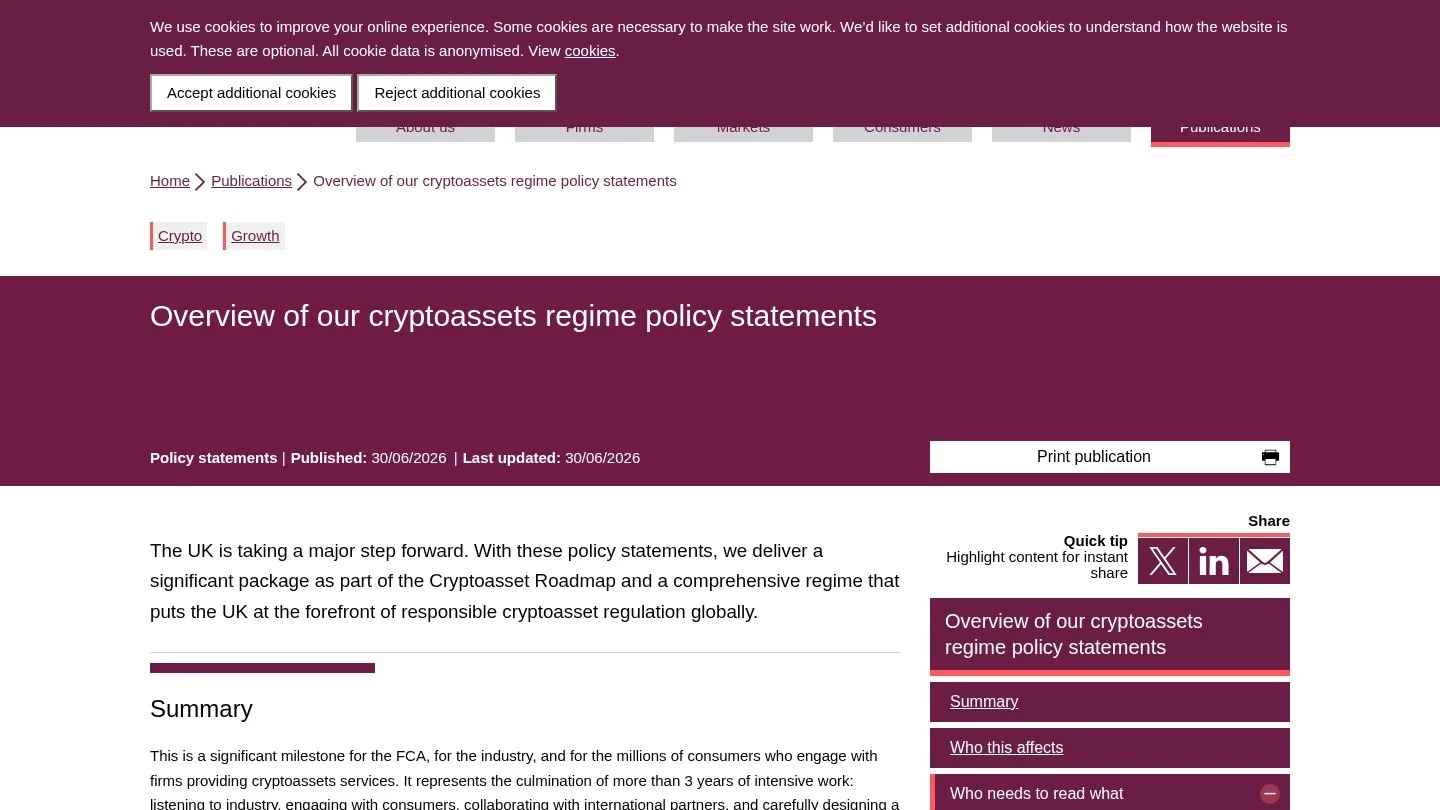
UK crypto regulation changes for good on 25 October 2027. From that day, exchanges, brokers, custodians, staking services and sterling stablecoin issuers serving UK customers need full FCA authorisation. Until now, most of them only needed an anti-money laundering registration. So the rules on custody, disclosures, complaints and capital will finally look like the rules for banks and brokers.
We read the FCA’s five policy statements from 30 June 2026, the HMRC guidance on crypto reporting and the regulator’s latest consumer survey. Then we compiled what changes for people who hold crypto in the UK. The short version is this. You get better custody rules and a route to the Financial Ombudsman. However, you still get no FSCS compensation if a crypto firm fails.
| Question | Answer |
|---|---|
| When do the new rules apply? | 25 October 2027 |
| Who must apply to the FCA? | Trading platforms, brokers, custodians, staking firms and UK stablecoin issuers |
| Application window for existing firms | 30 September 2026 to 28 February 2027 |
| Complaints route for consumers | Financial Ombudsman Service |
| FSCS compensation | Not included |
| Tax reporting to HMRC | Data collected since 1 January 2026; first reports due by 31 May 2027 |
Ten Dates on the Road to the New UK Crypto Regime
The regime did not arrive in one step. In fact, the FCA spent more than three years on it, with four discussion papers and ten consultation papers. We put the dates that matter to consumers and firms in one table, from the marketing rules to the first day of full authorisation.
| Date | What happened or happens |
|---|---|
| 8 October 2023 | FCA rules on crypto marketing to UK consumers took effect |
| October of last year | FCA lifted its ban on retail access to some crypto exchange-traded notes |
| 1 January 2026 | UK crypto firms began collecting user details for HMRC under CARF |
| 4 February 2026 | Parliament passed the Cryptoassets Regulations 2026 |
| 22 June 2026 | Bank of England dropped planned per-person holding caps for systemic stablecoins |
| 30 June 2026 | FCA published final rules in PS26/9 to PS26/13 |
| 30 September 2026 | FCA application window opened |
| 28 February 2027 | Application window closes for firms relying on transitional protection |
| 31 May 2027 | Deadline for the first CARF reports to HMRC, covering 2026 |
| 25 October 2027 | Full regime starts for all regulated crypto activities |
Which Crypto Firms Need FCA Authorisation Now
The new law creates nine regulated crypto activities. In practice, they cover six broad business models. Trading platforms, brokers and dealers, custodians, firms that arrange staking, and issuers of UK stablecoins all fall inside. Crypto lending and borrowing services also come under the rules.
DeFi is a grey area. The rules apply where an identifiable person or company controls the service. So the FCA will judge each DeFi case on its facts, and it plans separate DeFi guidance.
The Five-Month Window for Firms Already Serving UK Customers
The FCA opened its application gateway on 30 September 2026. Firms already active in the UK have until 28 February 2027 to apply. If they apply in time, they can keep running those activities until the FCA decides, even after October 2027. The FCA also handles applications in the order it receives them.
Missing the window has a real cost. A late applicant loses that transitional protection. As a result, it may have to stop the regulated activity until it gets authorised. For a customer, that could mean a sudden pause on trading or withdrawals through that firm.
Why an Existing MLR Registration Does Not Carry Over
Today, UK crypto exchanges and custodians register with the FCA under the Money Laundering Regulations. That registration only checks financial crime controls. But it does not convert into the new permission. The same goes for payment and e-money firms that offer crypto. Each must apply afresh if it carries out a regulated crypto activity.
What UK Crypto Investors Gain From the FCA Rules
Most of the rulebook is aimed at firms. Still, several parts change what you see as a customer. We went through PS26/9, PS26/11 and PS26/13 and pulled out the parts that touch a retail account.
Client Coins Held Apart Under CASS 17
Custodians must follow a new client assets chapter, CASS 17. It covers ownership rights, record keeping, reconciliation and the handling of private keys. So the firm must keep your coins apart from its own and prove it. The settlement float a firm may use is capped at 2%.
Past exchange failures explain the rule. When a platform mixes client coins with its own, customers queue as creditors after a collapse. Our post on how an exchange hack moved the bitcoin price covers the market side of such events.
Consent Before Your Coins Are Staked or Lent
Staking firms must give retail clients clear disclosures, written terms and a consent step. They must also keep records for every client. Auto-staking is allowed for current and future holdings, but only with consent and a yearly reminder.
Lending and borrowing get tighter controls. Retail customers face an appropriateness test first. Loans must be over-collateralised, and negative balance protection applies. So a sharp price drop should not leave you owing more than you put in. Firms also face limits on automatic collateral top-ups, although you can still top up by hand.
A Disclosure Document Before a Token Lists
Under PS26/9, a platform cannot admit a fungible token without a qualifying cryptoasset disclosure document. Platforms must also run due diligence and publish admission criteria. Next, a separate market abuse regime targets insider dealing and manipulation. Large UK platforms must watch for abuse, including some on-chain activity.
Complaints That Can Reach the Financial Ombudsman
Authorised crypto firms will have to follow the FCA’s complaints rules and the Consumer Duty. As a result, eligible consumers can take an unresolved complaint to the Financial Ombudsman Service. That is new. Today, a complaint about an unregulated crypto service usually has nowhere to go.

The FSCS Safety Net Stays Out of Crypto
The new regime does not give crypto holders access to the Financial Services Compensation Scheme. So if an authorised crypto firm goes bust, no scheme pays you back up to a set limit. Your protection comes from CASS 17 and from how well the firm kept client assets apart.
The Ombudsman route and the FSCS gap work in different situations. The Ombudsman handles a dispute with a firm that still exists. For example, it could look at a wrong fee or a blocked withdrawal. However, it cannot replace coins lost in an insolvency. Many users still expect some cover, too. In the FCA’s latest survey, 13% of crypto users thought they had financial protection.
Self-custody carries its own risk, too. If you lose the private key to a wallet you control, recovery may be impossible. Our guide to crypto address whitelisting shows one way to limit where an exchange can send your coins.
Sterling Stablecoins Under Two UK Regulators
UK-issued stablecoins come under FCA rules for the first time. Under PS26/10, a qualifying stablecoin must be fully backed and redeemable at par. Backing assets sit on a statutory trust for holders. Issuers may also hold up to 5% extra in the backing pool as a buffer.
Large sterling coins used for payments face a second layer. On 22 June 2026, the Bank of England dropped its planned holding caps of £20,000 per person and £10 million per business. Instead, it set a temporary £40 billion issuance cap per systemic stablecoin. It also cut the share of backing that must sit in unpaid Bank of England deposits from 40% to 30%.
Full backing lowers the risk of a coin slipping under £1, but it does not remove it. Our explainer on why stablecoins lose their peg walks through past cases.
What the FCA’s Latest Consumer Survey Tells Us About UK Holders
We also dug into the FCA’s sixth wave of crypto consumer research. YouGov ran the fieldwork in August and September of last year. It polled 2,353 adults, plus 1,053 current or former owners. The FCA published it in December.
First, ownership fell. Some 8% of UK adults said they held crypto, down from 12% a year earlier. Even so, holdings grew larger. The share of users holding £1,001 to £5,000 rose from 17% to 21%. Those holding £5,001 to £10,000 rose from 8% to 11%.
Second, many users did not know who they dealt with. That is the finding we charted. Among users who traded on an exchange, only 32% knew it was UK-registered. Another 34% did not know, and 25% could not remember.
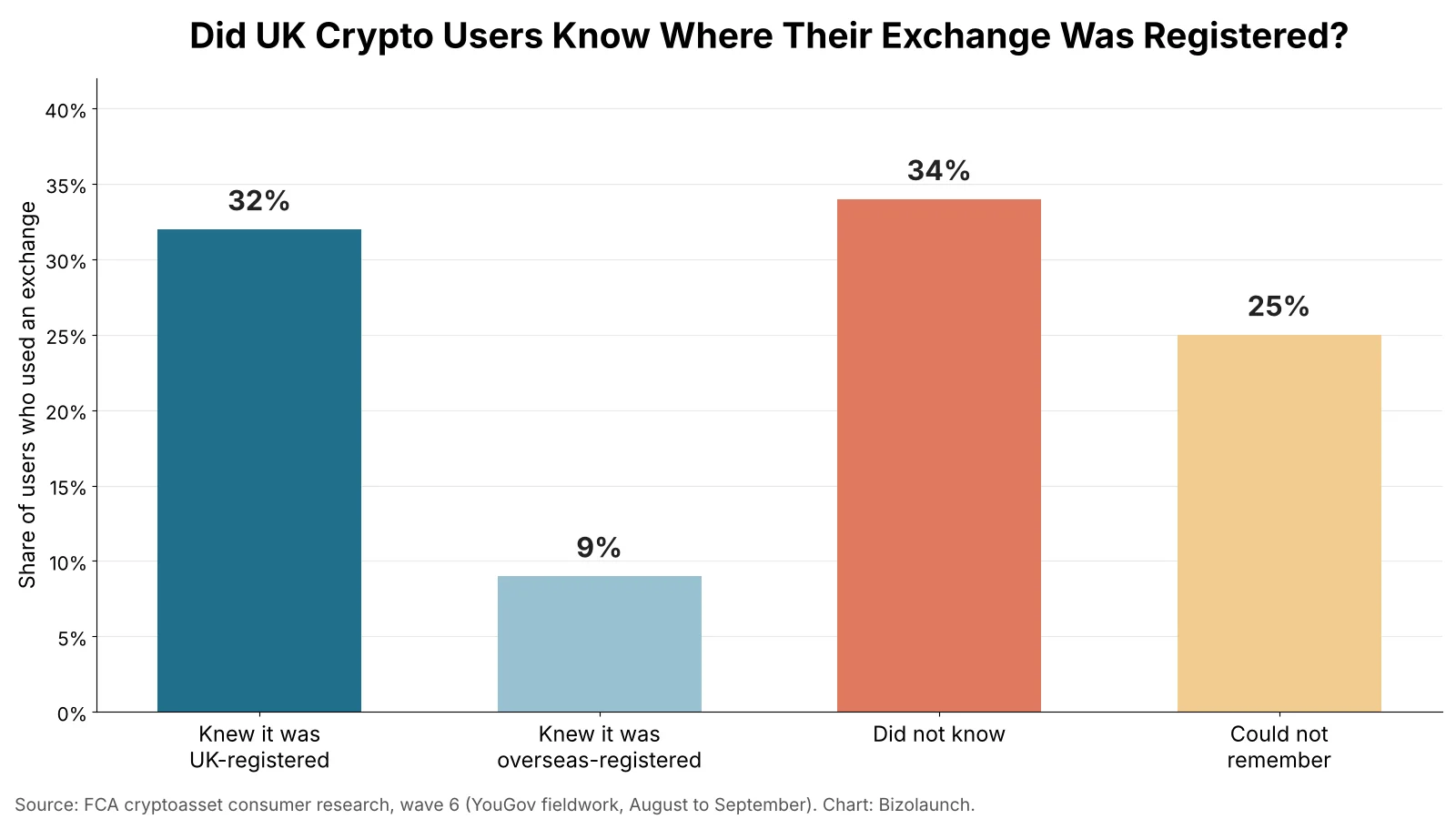
After October 2027, that gap gets costly. Authorisation status will decide whether the Ombudsman route and CASS 17 apply to your account. So knowing your firm’s status becomes a basic check, much like checking a bank’s licence.
| Finding from the FCA survey (crypto users) | Latest wave |
|---|---|
| Used a centralised exchange | 73% |
| Took part in staking | 22% |
| Paid with a credit card or other credit | 9% |
| Expected no protection if things went wrong | 66% |
| Happy trading in a largely unregulated market | 55% |
| More likely to invest if crypto were more regulated | 25% |
| Aware of stablecoins | 58% |
The staking figure caught our eye. More than one in five users stake coins today. So for them, the new consent and disclosure rules will change the sign-up screens they see.
HMRC Already Receives Your Crypto Data Under CARF
Tax reporting moved first. Since 1 January 2026, UK crypto service providers must collect details from every user under the Cryptoasset Reporting Framework, or CARF. The UK also extended CARF to UK residents, so domestic accounts are covered too.
Providers send their first reports between 1 January and 31 May 2027. Those reports cover every transaction from calendar year 2026. Also, if you give a UK provider wrong details or none at all, you face a penalty of up to £300. Providers face up to £300 per user for late or wrong reports.
So HMRC will soon see disposals that many people never declared. Unpaid tax found later can bring a penalty of up to 100% of the tax due, plus interest. The US runs a similar system through Form 1099-DA, which we covered in our guide to Form 1099-DA for crypto. For most UK gains, HMRC pools each token at an average cost. The method works much like the average stock price calculation for shares.
Six Checks for UK Holders Before the Application Window Closes
You do not need to act today. Still, a few checks now can save a scramble in 2027. We put them in the order we would follow ourselves.
- Look up each firm on the FCA Register: note whether it holds an MLR crypto registration today. After authorisation, the register will show its new permissions.
- Ask your platform about its application: a firm that applies by 28 February 2027 can keep serving you while the FCA decides.
- Keep a withdrawal route ready: whitelist a wallet address you control. Then a sudden pause at one firm will not trap you.
- Read staking and lending terms again: once the rules apply, you will see new consent screens. Check lock-up periods and who holds the coins.
- Update your tax details: give each provider your correct name, address and tax number. That avoids the £300 penalty.
- Download your 2026 trade history: HMRC will get the same data by May 2027, so your records should match it.
Rules elsewhere differ, too. For instance, the EU already licenses crypto firms under MiCA, and member states keep their own tax rules. Our post on Germany’s crypto holding period shows how one EU country taxes the same coins.
UK Crypto Rule Questions Readers Search For
When Does UK Crypto Regulation Start?
The full regime applies from 25 October 2027. However, parts already apply. The marketing rules have run since October 2023, and CARF data collection began on 1 January 2026.
Will the FSCS Protect My Crypto After October 2027?
No. The regime does not include FSCS protection. But you can take complaints about an authorised firm to the Financial Ombudsman Service.
Is My Crypto Exchange Regulated by the FCA Today?
Most UK exchanges hold only an anti-money laundering registration today. That covers financial crime checks only. It does not cover conduct or custody. Full authorisation comes with the new regime.
What Happens If My Exchange Misses the 28 February 2027 Deadline?
It loses the transitional protection. Then it may have to stop regulated crypto activities for UK customers until the FCA authorises it.
Does HMRC Know About My Crypto?
It soon will. UK providers must report 2026 user and transaction data to HMRC by 31 May 2027. Providers abroad in countries that signed up to CARF report to their own tax authorities, which then share the data with the UK.
FCA, HMRC and Bank of England Papers Behind This Post
- FCA: Overview of the cryptoasset regime policy statements PS26/9 to PS26/13 (30 June 2026)
- FCA: Cryptoassets information for firms and the application window
- FCA: CP26/4, Application of the FCA Handbook for regulated cryptoasset activities, part 2
- FCA: Research note on cryptoasset consumer research, wave 6
- GOV.UK: Information you’ll need to give to UK cryptoasset service providers
- GOV.UK: Reporting cryptoasset user and transaction data
- Finance Magnates: FCA opens five-month authorisation window for UK crypto firms
- Finance Magnates: Bank of England drops stablecoin holding limits (22 June 2026)
- Scottish Financial News: FCA urges crypto firms to prepare for October 2027, with no FSCS safety net
This article is for information and education only and is not investment, tax, legal or financial advice.