
Fixed expenses cost about the same amount every month, like rent, a car loan or an insurance premium. Variable expenses change from month to month, like groceries, fuel or eating out. In a business, the split works the same way: rent and salaries stay put, while materials and shipping rise and fall with sales.
We pulled the official definitions from the CFPB, the SBA and the IRS, and then built examples for homes and businesses around them. So every definition in this guide links to the agency or university page it came from. The examples use round sample numbers to show how each type behaves.
Fixed Expenses Explained
The Consumer Financial Protection Bureau (CFPB) gives a short definition. Fixed expenses are expenses, like bills, that must be paid each month and generally cost the same amount. In other words, you can predict them before the month begins.
For a business, the definition is close. The Small Business Administration (SBA) describes fixed costs as costs for a set period. They do not change when production or services go up or down. The SBA gives rental lease payments, salaries, property taxes, insurance, interest and depreciation as examples.
Fixed does not mean forever, though. Your landlord can raise the rent at renewal, and an insurer can change your premium each year. The point is that the amount does not move with how much you use or sell in a given month.
Variable Expenses Explained
Variable expenses are the CFPB’s second group: expenses that change in amount from month to month. For a household, that means spending that depends on your choices and your usage. More driving means more fuel, and a dinner out adds to the food bill.
In a business, variable costs track output. Oklahoma State University Extension describes them as costs incurred during production, using inputs that vary with the level of production. Its farm examples include seed, fertilizer, fuel, feed and veterinary costs. So if a farm plants nothing, those costs fall to zero, while the property tax bill still arrives.
Fixed vs Variable Expenses Compared
Next, the main differences sit side by side. Use this table when you sort your own bank statement.
| Point | Fixed expenses | Variable expenses |
|---|---|---|
| Amount each month | About the same | Changes month to month |
| What drives it | A contract or set price | Usage, choices or sales |
| Easy to predict? | Yes | Harder, so use an average |
| Household examples | Rent, mortgage, car loan, insurance | Groceries, fuel, dining out, clothing |
| Business examples | Lease, salaries, insurance, loan interest | Raw materials, packaging, shipping, sales commissions |
| How to cut it | Renegotiate, switch providers or cancel | Change habits, buy smarter, set limits |
| How fast a cut shows up | Often at renewal | Often within the same month |
Household Fixed and Variable Expense Examples
Most household budgets have the same core items. So we sorted the common ones into the two groups. A few sit in the middle, and we cover those in the semi-variable section.
| Household fixed expenses | Household variable expenses |
|---|---|
| Rent or mortgage payment | Groceries |
| Car loan or lease payment | Gas and car repairs |
| Car, home or renters insurance | Eating out and takeout |
| Student loan payment | Clothing and shoes |
| Childcare or school tuition | Entertainment and hobbies |
| Streaming and app subscriptions | Gifts and holidays |
| Gym membership | Medical copays and medicines |
| Property tax, if paid monthly | Household supplies |
| HOA or condo fees | Travel |
| Life insurance premium | Personal care and haircuts |
Try a quick test on any line of your statement. Ask if the amount would change if you lived more cheaply for one month. If the answer is no, it is fixed. If the answer is yes, it is variable. For example, you could skip dinners out next month, but your rent would stay the same.

Business Fixed and Variable Cost Examples
Businesses use the same idea, but the stakes are higher. Because fixed costs must be paid even in a slow month, they set how much you must sell just to break even.
| Business fixed costs | Business variable costs |
|---|---|
| Office, shop or warehouse lease | Raw materials and inventory |
| Salaries of permanent staff | Packaging |
| Business insurance | Shipping and delivery |
| Loan interest | Sales commissions |
| Property taxes | Card processing fees |
| Depreciation on equipment | Hourly or piece-rate labor for extra orders |
| Software subscriptions on a flat plan | Ad spend tied to sales |
| Accounting and legal retainers | Marketplace selling fees |
The SBA lists the first six fixed costs on its break-even page. On the variable side, the common thread is simple: each item grows when you sell or make more. For example, a seller pays more in shipping when ten orders go out than when two do.
To track both groups month by month, try our small business expense spreadsheet template. Then read the costs on your profit and loss statement to see which lines move with revenue.
Semi-Variable Expenses: Costs With a Fixed Part and a Moving Part
Many bills do not fit neatly in either group. The CFPB itself notes that some fixed expenses, like a utility bill, may also be variable, because the amount changes with usage. Accountants call these semi-variable or mixed costs.
A semi-variable cost has a base charge you always pay, plus a part that depends on use. For example:
- Electricity: A monthly service charge, plus a charge for each unit of electricity you use.
- Phone plans: A flat plan fee, plus charges if you go over your data.
- Water: A base fee, plus a charge based on how much you use.
- Sales staff: A base salary that is fixed, plus a commission that rises with sales.
- Delivery vans: A lease payment that is fixed, plus fuel and tolls that rise with each trip.
- Software on usage plans: A base seat price, plus fees for extra users or extra volume.
So how do you budget for them? Split each one in two. Put the base charge with your fixed costs. Then average the usage part over the last few months and treat it as variable. For yearly bills like car registration, a sinking fund helps, and our sinking funds examples show how to set one up.
Worked Example: Fixed and Variable Costs at a Small Bakery
Numbers make the difference real. So picture a small bakery with these sample monthly costs.
| Cost | Type | Monthly amount |
|---|---|---|
| Commercial kitchen lease | Fixed | $1,800 |
| Salary for a part-time baker | Fixed | $900 |
| Business insurance | Fixed | $150 |
| Equipment depreciation | Fixed | $150 |
| Flour, butter and other ingredients | Variable | $1.10 per loaf |
| Bags and labels | Variable | $0.25 per loaf |
| Card fees | Variable | $0.15 per loaf |
Fixed costs add up to $3,000 a month. Variable costs come to $1.50 per loaf. If a loaf sells for $6, the SBA break-even formula is fixed costs divided by (price minus variable cost per unit). That gives $3,000 ÷ ($6 − $1.50) = 667 loaves a month, rounded up.
The chart shows why volume matters so much. At 500 loaves a month, each loaf carries $6 of fixed cost, so the total cost per loaf is $7.50. That is more than the selling price. At 2,000 loaves, the fixed share drops to $1.50, and the total cost per loaf falls to $3.00.
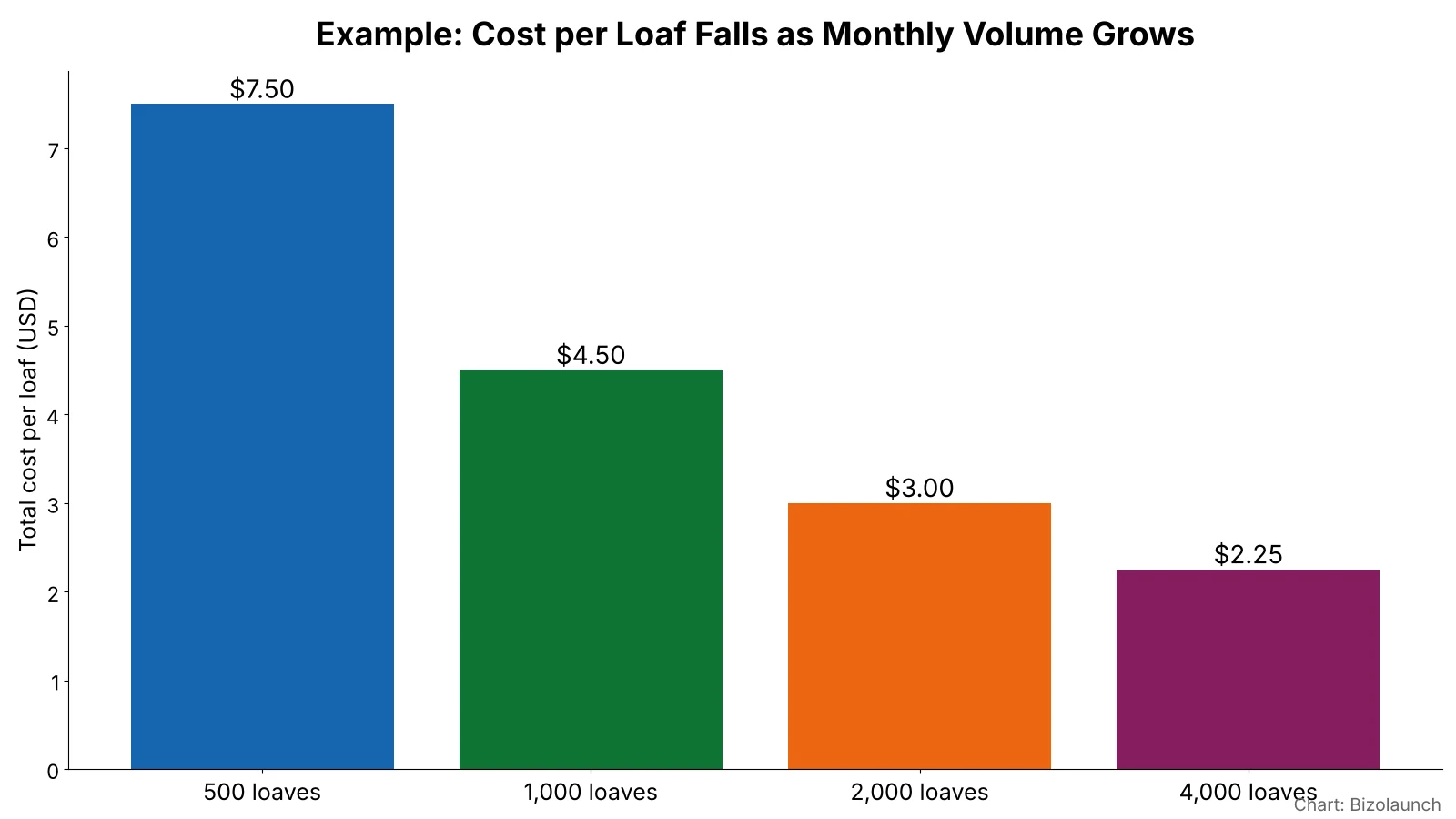
The lesson is plain. High fixed costs make a business riskier in slow months but more profitable once sales grow. In contrast, a business with mostly variable costs is safer when sales drop, but it earns less on each extra sale.
How to Cut Fixed Expenses
Fixed costs are hard to change month to month. However, one change keeps saving money every month after. The CFPB’s cutting expenses tool suggests several moves that apply here:
- Shop your insurance. Compare rates from other insurers and ask about discounts for putting home and car cover with one company. Also consider a higher car insurance deductible to lower the premium.
- Review your phone plan. Look at prepaid or fixed-rate plans, and check if you qualify for a Lifeline phone rate.
- Cut unused memberships. Cancel a gym or store membership you do not use often.
- Trim TV and streaming. Ask providers about lower-cost plans, or drop services you rarely watch.
- Check bank fees. Look for maintenance, ATM and overdraft fees, and think about a lower-fee account.
Bigger fixed costs need bigger moves. For example, you could refinance a loan, move to a cheaper rental or renegotiate a lease at renewal. Each of these can save more than all the small cuts together. For a business, the same logic applies to rent, software plans and insurance.
How to Cut Variable Expenses
Variable costs respond faster, because you control them every day. The same CFPB tool lists habits that lower them.
- Groceries: Use coupons, and buy in bulk with family or friends when the cost per serving is lower.
- Eating out: Bring lunch to work, and look for local restaurant deals such as kids-eat-free nights.
- Home energy: Set the thermostat lower in winter and higher in summer, and unplug appliances you are not using.
- Car costs: Keep up with oil changes and tire pressure to avoid bigger repair bills.
- Clothing and furniture: Buy second-hand or wait for sales.
- Late fees: Pay on time, and ask for new due dates that line up with payday.
In a business, cut variable costs per unit. For instance, compare supplier prices, order packaging in larger runs, or move to a cheaper shipping option for light parcels. Even small savings per unit add up quickly once volume grows.
If a household budget feels hard to plan, a zero-based budget gives every dollar a job. Our zero-based budgeting example for a family of four walks through one month.
Fixed and Variable Costs at Tax Time
For tax purposes, the IRS does not sort business costs into fixed and variable. Instead, it asks if a cost is ordinary and necessary. IRS Publication 583 says an ordinary expense is common and accepted in your field. A necessary expense is helpful and appropriate for your business. So both rent and raw materials can be deductible if they meet that test.
Large purchases work differently. The IRS says you usually recover the cost of assets like machinery or office equipment through depreciation, spread over more than one tax year. That is why depreciation shows up on the SBA’s list of fixed costs. Talk to a tax professional about your own case, because rules depend on the asset and the business.
Fixed and Variable Expense Questions
Is rent a fixed or variable expense?
Rent is a fixed expense. You pay the same amount each month under your lease, no matter how much time you spend at home or how much your business sells.
Are groceries fixed or variable?
Groceries are variable. The total changes with what you buy, how many people you feed and how often you eat out instead.
Is a utility bill fixed or variable?
Most utility bills are semi-variable. They have a base charge plus a usage charge, and the CFPB notes a utility bill can be fixed and variable at the same time.
Are salaries fixed or variable costs?
Salaries of permanent staff are fixed, and the SBA lists them as a fixed cost. However, commissions and hourly pay for extra orders are variable, because they rise with sales or output.
Which is easier to cut, fixed or variable expenses?
Variable expenses are easier to cut quickly, because you control them day to day. Fixed expenses take more effort, but one cut keeps saving money every month.