
“Where did my salary go this month?” A personal cash flow statement answers that question with numbers. It lists all the money that came in during a month, all the money that went out, and the gap between the two. That gap is your net cash flow.
A budget is a plan for next month. A cash flow statement is the record of what really happened. Most people need both, but the statement comes first. You cannot plan well until you know your real numbers.
Our template borrows the categories the Consumer Financial Protection Bureau (CFPB) uses in its own cash flow tools. We then filled it in for two households. One is a single renter in the US, paid in dollars. The other is a two-income family in India with yearly bills, paid in rupees.
Know What Goes Into a Personal Cash Flow Statement
A cash flow statement has three parts. Each one is simple on its own.
- Cash inflows. This is money that reached you during the period. Use take-home pay after tax, plus side income, benefits, rent you collect, interest and any gifts.
- Cash outflows. This is money that left your accounts. It covers bills, spending, debt payments and transfers into savings or investments.
- Net cash flow. This is inflows minus outflows. A positive number means money was left over. A negative number means you spent more than came in and covered the gap from savings or credit.
Split outflows into groups so the statement tells you something. Fixed costs stay about the same each month, such as rent and loan payments. Variable costs change, such as groceries and fuel. Periodic costs arrive a few times a year, such as insurance premiums or school fees. Our guide to fixed vs variable expenses goes deeper on sorting them.
Copy the Personal Cash Flow Statement Template
Copy this template into a spreadsheet or notebook. Use one column per month. After three months, you will see patterns that a single month hides.
| Line | Category | Month 1 | Month 2 | Month 3 |
|---|---|---|---|---|
| A | Take-home pay, person 1 | … | … | … |
| B | Take-home pay, person 2 | … | … | … |
| C | Side income or freelance | … | … | … |
| D | Benefits, rent received, interest, gifts | … | … | … |
| E | Total inflows (A+B+C+D) | … | … | … |
| F | Housing: rent or mortgage, utilities, phone | … | … | … |
| G | Food: groceries and eating out | … | … | … |
| H | Transport: car payment, insurance, fuel, transit | … | … | … |
| I | Debt payments: student loan, personal loan, card interest | … | … | … |
| J | Health, insurance and childcare | … | … | … |
| K | Personal, subscriptions, gifts, other | … | … | … |
| L | Periodic bills paid this month | … | … | … |
| M | Total spending (F to L) | … | … | … |
| N | Net cash flow before saving (E−M) | … | … | … |
| O | Moved to savings, retirement or investments | … | … | … |
| P | Money left unassigned (N−O) | … | … | … |
Line N shows what your income could support. Line P shows what is left after you pay yourself. If P is negative, savings went in and then came back out, or a card balance grew.
Fill In the Template From Your Statements
Use real numbers from your accounts, not guesses. Guesses always come out too low on spending.
- Pick the period. A calendar month works for most people. Use the same dates every time.
- Gather records. Download your bank, credit card and wallet app statements for that month. Add cash receipts if you use cash.
- Enter inflows first. Use the amount that reached your account, after tax and deductions.
- Tag every outflow. Put each transaction in one line of the template. A spreadsheet filter by payee speeds this up.
- Avoid double counting. If you count card purchases as spending, do not count the card bill payment again. Only count card interest and fees as a debt cost.
- Separate transfers. Moving money from checking to savings is not spending. It goes on line O.
- Total each line and subtract. Check that E − M − O equals the change in your total cash for the month. If it does not, you missed something.
The CFPB suggests a similar source list for its cash flow budget. Use a spending tracker if you keep one. Otherwise, use your checking account, credit card statements, bills and receipts. If you freelance and your records are messy, our monthly expense tracker for freelancers helps you log costs as they happen.
Example 1: A Single Renter in the US
Maya rents an apartment in the US and works a salaried job. She also earns a little from weekend tutoring. Her October cash flow statement follows. All numbers are illustrative.
Her two paychecks bring in $4,300 after tax. Tutoring adds $350, and her savings account pays $12 in interest. So her total inflows are $4,662.
| Line | Category | October |
|---|---|---|
| E | Total inflows | $4,662. |
| F | Rent $1,450, utilities and internet $180, phone $55 | $1,685. |
| G | Groceries $420, eating out $210 | $630. |
| H | Car payment $310, insurance $140, fuel $120 | $570. |
| I | Student loan | $230. |
| J | Doctor visits and prescriptions | $60. |
| K | Subscriptions $45, clothes and personal $150, gifts $80 | $275. |
| M | Total spending | $3,450. |
| N | Net cash flow before saving | $1,212. |
| O | Emergency fund $300, retirement account $250, car repair fund $100 | $650. |
| P | Left unassigned | $562. |
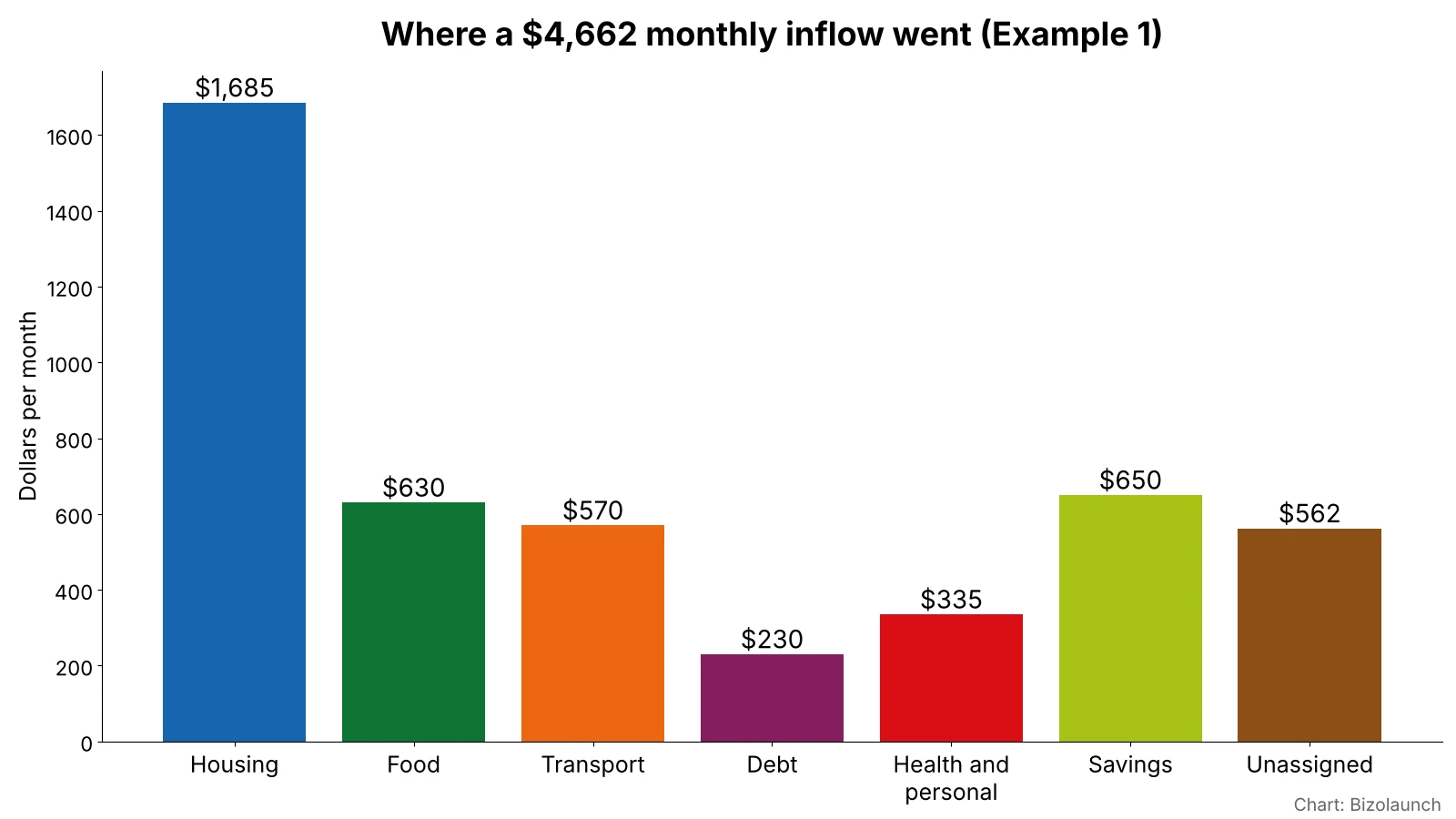
What Maya Learns From Her Statement
Maya’s net cash flow before saving is $1,212, or about 26% of her inflows. That is healthy. Still, three things jump out.
First, $562 has no job. Unassigned money tends to vanish into small purchases next month. So she decides to send $400 of it to her emergency fund and leave $162 as a buffer.
Second, housing takes 36% of inflows. She cannot change rent until her lease ends. However, she now knows the number to beat when she looks at new places.
Third, her fixed costs total $2,410 a month. That is rent, utilities, phone, car payment, insurance, student loan and subscriptions. If she lost her tutoring income and had a hard month, she would still owe that $2,410. So it is the right number to use when she sizes her emergency fund.
Example 2: A Two-Income Family in India
Rohan and Neha live in Pune with one child in school. Both have salaried jobs. Their take-home pay is ₹85,000 and ₹62,000 a month. They also face lumpy bills. The school fee is ₹30,000 a quarter, and the yearly family health insurance premium of ₹24,000 is due in October. Again, the numbers are illustrative.
We built two columns. One is a normal month, and the other is October, when both big bills land together.
| Line | Category | Normal month | October |
|---|---|---|---|
| E | Total inflows | ₹1,47,000 | ₹1,47,000. |
| F | Rent, electricity, gas, internet, mobile | ₹34,300 | ₹34,300. |
| G | Groceries and eating out | ₹20,000 | ₹20,000. |
| H | Fuel, cab and car upkeep | ₹6,000 | ₹6,000. |
| I | Car loan EMI | ₹18,500 | ₹18,500. |
| J | Medicines, domestic help, school bus | ₹9,500 | ₹9,500. |
| K | Personal spending and support for parents | ₹15,000 | ₹15,000. |
| L | School fee and health insurance premium | ₹0 | ₹54,000. |
| M | Total spending | ₹1,03,300 | ₹1,57,300. |
| N | Net cash flow before saving | ₹43,700 | −₹10,300. |
| O | Mutual fund SIP ₹15,000 and PPF ₹5,000 | ₹20,000 | ₹20,000. |
| P | Left unassigned | ₹23,700 | −₹30,300. |
In a normal month the family looks comfortable, with ₹23,700 left over. In October they are short by ₹30,300. Without a plan, that gap goes on a credit card or comes out of the SIP.
How the Family Fixes the October Gap
The fix is a sinking fund for the lumpy bills. Their school fees add up to ₹1,20,000 a year, and the premium is ₹24,000. So they need ₹1,44,000 a year, or ₹12,000 a month.
They now move ₹12,000 to a separate account every month. In October, the fee and premium come out of that account. As a result, every month looks the same: ₹23,700 − ₹12,000 = ₹11,700 left unassigned, with no shock months.
Our guides on sinking funds and saving for annual insurance premiums walk through more of these. If the couple wanted to split costs by income, our budget template for couples with different salaries shows a fair way to do it.
Read Your Net Cash Flow the Right Way
Once the statement is done, look at four numbers.
- Net cash flow before saving (line N). This is what your income covers after living costs. If it is negative, you are living on savings or credit.
- Savings rate. Divide line O by line E. Maya saves $650 of $4,662, about 14%. The Pune family saves ₹20,000 of ₹1,47,000, also about 14%.
- Fixed cost share. Add up fixed lines and divide by inflows. A high share leaves little room when income drops.
- Unassigned money (line P). Give it a job every month, or it gets spent.
Compare months side by side. A single month can mislead you, because a birthday or a car repair skews it. Three months show your real pattern.
Check Cash Flow by Week, Too
Monthly totals can look fine while a single week runs dry. Rent might be due on the 1st, while your paycheck arrives on the 7th.
The CFPB’s cash flow budget tool handles this with five weekly columns. You enter each income and expense in the week it arrives or is due. Then each week’s ending balance carries into the next week. The CFPB notes that a negative weekly number means you do not have enough money to cover your spending that week.
A second CFPB tool, Adjusting your cash flow, puts the same idea on a calendar. You mark income with a plus on the day it arrives and bills with a minus on the day they are due. Then you draw arrows to move bills to dates after payday. The tool then suggests three fixes. Change spending habits, ask creditors to move due dates, or split large bills into smaller payments.
Turn a Negative Cash Flow Positive
A negative month is a warning sign you can act on. Work through these in order.
- Find the cause. Was it a one-time cost, a periodic bill or a monthly habit? Each needs a different fix.
- Move due dates. Ask lenders and service providers to shift bills to the week after payday.
- Start sinking funds for periodic bills. Divide each yearly cost by 12 and save it monthly.
- Cut the biggest variable line first. Food and personal spending usually move fastest.
- Pause extra saving briefly. If the gap is short-term, lower investment transfers for a month or two. Do not stop retirement contributions for long.
- Raise income if costs are already lean. Overtime, freelance work or selling unused items can close a small gap.
If debt payments are the problem, our debt snowball vs avalanche guide shows which debt to pay off first.

Project Next Month From This Month’s Statement
A finished statement is also the fastest way to build a forecast. Copy last month’s column into a new one labelled with next month’s name. Then change only the lines you know will move.
For example, Maya knows three things about November. Her tutoring drops to $200 because of exam season. Her car insurance renews at $155 instead of $140. Also, she has a $240 flight home for a holiday. So her projected inflows fall to $4,512, and her projected spending rises to $3,705. Her net cash flow before saving drops from $1,212 to $807.
That projection tells her something useful before November starts. If she keeps saving $650, only $157 stays unassigned. So she skips one dinner out a week and books the flight with money from her buffer. Nothing lands on a credit card.
Repeat this at the end of each month. After a few rounds, your forecasts will land within a small range of the real figures.
Compare a Cash Flow Statement With Other Money Reports
People mix up these reports. Each answers a different question.
| Report | Question it answers | Time frame |
|---|---|---|
| Personal cash flow statement | Where did my money go? | A past month or year. |
| Budget | Where should my money go? | The next month or year. |
| Net worth statement | What do I own minus what I owe? | A single day. |
| Cash flow calendar | Will I have enough cash on each due date? | The weeks of one month. |
Your cash flow statement feeds the others. A positive net cash flow, saved or used to pay debt, is what grows your net worth over time. Our explainer on net worth vs income covers that link.
Fix the Errors That Skew a Cash Flow Statement
- Using gross salary. Taxes and deductions never reach you, so count take-home pay only.
- Counting card bills twice. Count purchases or the card payment, never both.
- Skipping cash and wallet spending. Small cash buys add up fast. Log them for at least one month.
- Leaving out yearly bills. Insurance, fees and renewals belong on the statement, even when they hit once a year.
- Calling savings transfers spending. They are outflows from checking, but they still belong to you. Keep them on their own line.
- Doing it once. One statement is a snapshot. A monthly habit shows trends.
Cash Flow Statement Doubts, Answered
What is the difference between a cash flow statement and a budget?
A cash flow statement records what already happened. A budget plans what you want to happen. Build the statement first, then use its real numbers to set your budget.
What is a good net cash flow?
Any positive number is a good start. Then aim to save a steady share of inflows each month and give the rest a job.
Should savings count as an outflow?
Yes, as a separate line. Money moved to savings leaves your spending account, but it is not spending. Showing it on its own line keeps your savings rate visible.
How often should I update my cash flow statement?
Once a month works for most households. Update it a few days after the month ends, once all statements are available.
This guide gives general information on tracking personal cash flow. It is not personal financial advice.