
Maya takes home $6,400 a month. Her partner Jordan takes home $3,600. Their shared bills come to $5,000. If they split everything 50/50, Jordan spends 69% of his pay on the household while Maya spends 39%. That gap is why most couples with different salaries move to a proportional budget.
The fix is a monthly budget template with one extra column: each partner’s share of the combined take-home pay. Maya earns 64% of the household income, so she pays 64% of every shared line. Jordan pays 36%. Both end up putting half their pay into the home, and both keep money of their own.
We built the template from scratch and ran Maya and Jordan through a full month. Then we tested four common twists. They are a raise, commission pay, a big income gap and a month that runs over budget. The numbers are an example, in US dollars, but the method works in any currency.
Copy This Couples Budget Template
The template has three parts: income, shared costs and personal money. Copy it into a spreadsheet or a notebook. Each row gets a planned amount, each partner’s share, the actual amount and the difference.
| Section | Row | What goes in it |
|---|---|---|
| Income | Partner A take-home pay | Pay after tax, retirement and health deductions. |
| Income | Partner B take-home pay | Same for the other partner. |
| Income | Each partner’s share | Their pay divided by the combined pay. |
| Shared costs | Housing | Rent or mortgage, plus renters or home insurance. |
| Shared costs | Utilities and internet | Electricity, water, gas, internet. |
| Shared costs | Groceries and household | Food, cleaning supplies, toiletries you both use. |
| Shared costs | Transport | Shared car costs, fuel, transit passes. |
| Shared costs | Phone and subscriptions | Family phone plan, streaming you both watch. |
| Shared costs | Sinking funds | Gifts, trips, car repairs, yearly bills. |
| Shared costs | Joint savings | Emergency fund, home deposit, shared goals. |
| Personal | Each partner’s own costs | Personal debts, hobbies, clothes, fun money. |
For each shared row, use one formula: partner’s payment = row total × partner’s share. In a spreadsheet, put each share in its own cell. Then point every row at that cell, so a pay change updates the whole budget at once.
Work Out Each Partner’s Share of Income
Use take-home pay, the money that actually lands in each account. It is fairer than gross pay when one partner pays more tax or saves more for retirement through payroll.
- Add both take-home amounts. Maya’s $6,400 plus Jordan’s $3,600 equals $10,000.
- Divide each person’s pay by the total. Maya: $6,400 ÷ $10,000 = 64%. Jordan: $3,600 ÷ $10,000 = 36%.
- Check the shares add up to 100%. If they do not, fix the rounding before you go on.
If either of you is paid every two weeks, convert to a monthly figure first. Multiply the paycheck by 26 and divide by 12. A $1,500 biweekly check works out to $3,250 a month.
Fill In the Template for a Real Couple
Maya and Jordan share an apartment and a car. They agreed which costs count as shared before they built the budget. Their filled-in template looks like this.
| Shared cost | Monthly total | Maya pays (64%) | Jordan pays (36%) |
|---|---|---|---|
| Rent | $2,400 | $1,536 | $864. |
| Utilities and internet | $280 | $179 | $101. |
| Groceries and household | $850 | $544 | $306. |
| Car insurance, fuel and transit | $420 | $269 | $151. |
| Phone plan and streaming | $150 | $96 | $54. |
| Sinking funds | $300 | $192 | $108. |
| Joint savings | $600 | $384 | $216. |
| Total | $5,000 | $3,200 | $1,800 |
Each partner now puts 50% of take-home pay toward the home. Maya keeps $3,200 for personal costs and savings. Jordan keeps $1,800.
We rounded a few lines to whole dollars. So check that each partner’s column adds up to the exact share of the total. Here, 64% of $5,000 is $3,200, and 36% is $1,800, so the rounding came out even.
Compare Proportional and 50/50 Splits for the Same Couple
Put the same $5,000 of shared costs through a 50/50 split and the picture changes. Each partner pays $2,500. Maya keeps $3,900, while Jordan keeps only $1,100.
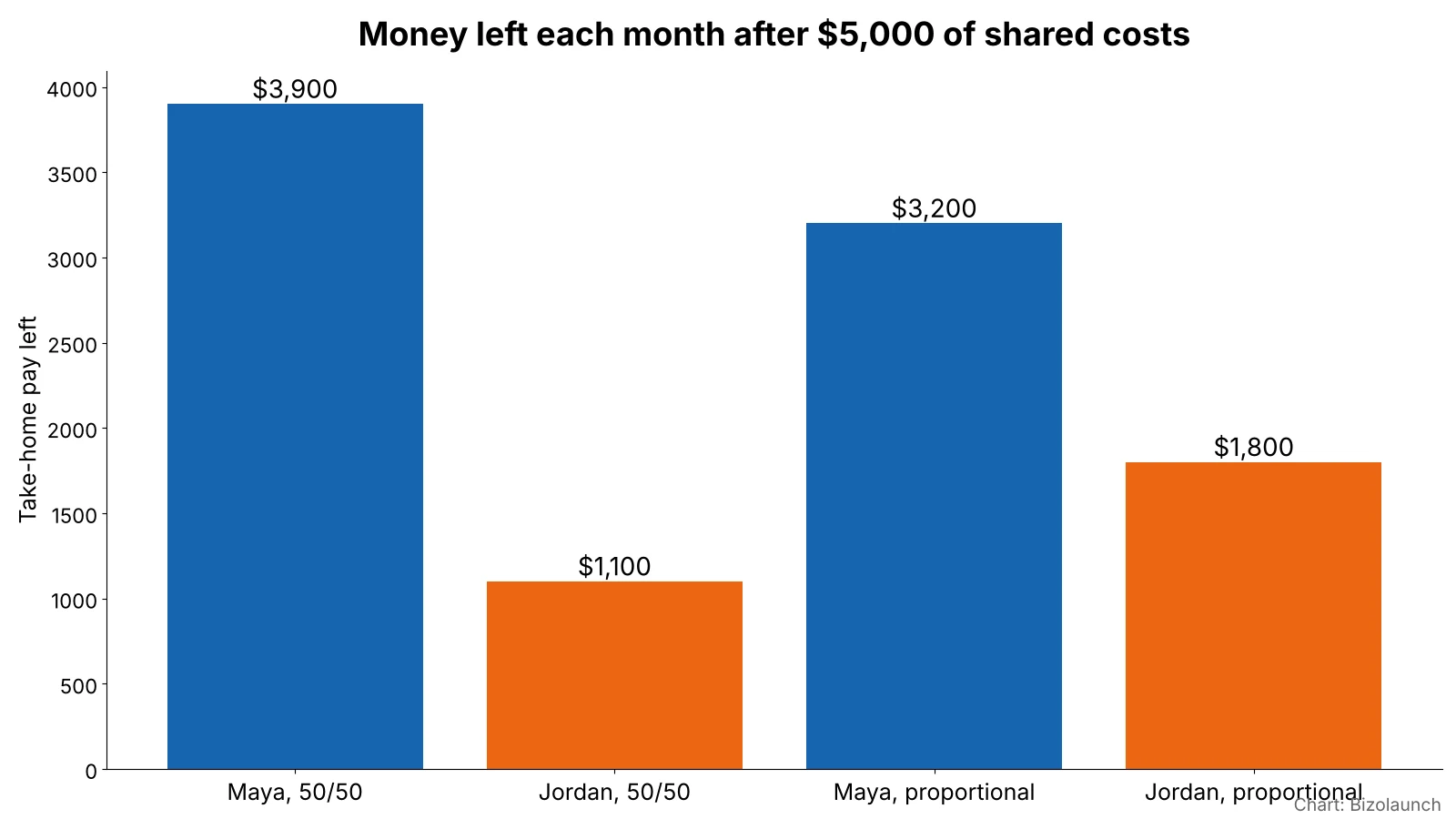
Under 50/50, Maya has $2,800 more spare cash each month than Jordan. Under the proportional split, the gap falls to $1,400. Jordan can now save, pay his own debts and say yes to a dinner out without stress.
Some couples want to go further and give both partners the same amount left over. That is the equal leftover method. We ran the numbers for it in our guide to splitting household expenses when one partner earns more. This template works with that method too. Just change the share cells to the amounts that leave you equal.
Build the Template in a Spreadsheet
You can run this budget in Google Sheets, Excel or Numbers. Set it up once, and every later month takes a few minutes. We used this layout for Maya and Jordan.
- Put income at the top. Type Maya’s take-home pay in cell B2 and Jordan’s in B3.
- Add the total. In B4, enter =B2+B3.
- Work out the shares. In C2, enter =B2/B4. In C3, enter =B3/B4. Format both as percentages.
- List shared costs from row 7. Put the category in column A and the monthly total in column B.
- Split each row. In C7, enter =B7*$C$2 for Maya. In D7, enter =B7*$C$3 for Jordan. Copy both formulas down the list.
- Add actual and difference columns. Put actual spending in column E. In F7, enter =E7-B7, so overspending shows as a positive number.
- Total everything. Use =SUM() at the bottom of each column. Then check that columns C and D add up to column B.
The dollar signs in $C$2 and $C$3 lock the share cells. So when you copy the formula down, every row still uses the same percentage. Next month, duplicate the tab, empty the actual column and update pay if it changed.
Track Actual Spending Against the Plan
A budget only helps if you compare it with what really happened. So add two columns to the shared section: actual and difference. At the end of the month, fill them in from your joint account.
| Shared cost | Planned | Actual | Difference |
|---|---|---|---|
| Rent | $2,400 | $2,400 | $0. |
| Utilities and internet | $280 | $265 | −$15. |
| Groceries and household | $850 | $910 | +$60. |
| Car insurance, fuel and transit | $420 | $420 | $0. |
| Phone plan and streaming | $150 | $150 | $0. |
| Sinking funds | $300 | $300 | $0. |
| Joint savings | $600 | $600 | $0. |
| Total | $5,000 | $5,045 | +$45 |
Maya and Jordan went $45 over, mostly on groceries. They split the overage with the same shares: Maya adds $28.80 and Jordan adds $16.20. If groceries run high for three months in a row, they raise the grocery line and trim something else.
The Consumer Financial Protection Bureau breaks budgeting into four steps. First, find where your money comes from and where it goes. Then list your bills and due dates, and build a working budget. It also suggests tracking spending one week at a time if a full month feels like too much. That works well for couples starting out, because a weekly check catches overspending early.
Budget Each Partner’s Personal Money
The shared section covers the home. However, each partner still needs a small budget for their own money. Otherwise personal debts and spending drift, and that strain lands on the relationship.
Maya keeps $3,200 after shared costs. Jordan keeps $1,800. Each one plans the rest in a personal section.
| Personal line | Maya | Jordan |
|---|---|---|
| Personal debt payments | $450 student loan | $250 credit card. |
| Extra retirement or investing | $800 | $300. |
| Personal savings | $700 | $400. |
| Clothes, hobbies and gym | $500 | $350. |
| Fun money, no questions asked | $750 | $500. |
| Total | $3,200 | $1,800 |
Debts from before the relationship usually stay personal. Even so, talk about them openly, because they affect how much each partner can add to shared goals. If one of you carries card debt, paying it down faster frees up cash for the household too.
Recalculate the Split After a Raise
Shares should follow income. So rerun the numbers whenever either salary changes by a noticeable amount. Many couples set a rule, such as any change over 5% or any new job.
Say Jordan gets a raise and now takes home $4,400 a month. The new total is $10,800.
- Maya’s share: $6,400 ÷ $10,800 = 59.26%.
- Jordan’s share: $4,400 ÷ $10,800 = 40.74%.
- On $5,000 of shared costs, Maya now pays $2,963 and Jordan pays $2,037.
Jordan’s raise is $800 a month, and $237 of it goes to the household. He keeps the other $563. Maya pays $237 less. The raise helps both partners, which is one reason couples tend to stick with this method.
Plan Shared Savings Goals With the Same Shares
Joint goals work like any other shared line. Set the monthly amount, then split it by income share.
Maya and Jordan want a $24,000 home deposit. At $600 a month, the goal takes 40 months. If they raise the line to $800, it takes 30 months. At 64% and 36%, the $800 line costs Maya $512 and Jordan $288 a month.
Keep the emergency fund separate from goals like a home deposit or a trip. That way, a car repair does not quietly eat the deposit. Also, decide what happens to joint savings if you split up. A short written note now saves a hard talk later, especially for couples who are not married.
Handle Commission, Bonus or Freelance Pay
Variable pay makes the share cells jump around. Instead of recalculating every month, use an average.
Jordan works in sales and his take-home pay over the last three months was $3,200, $4,100 and $3,500. The average is $3,600. So the couple keeps his share at 36% for the next three months, then checks the average again.
If a bonus arrives, decide in advance where it goes. One simple rule: the earner keeps half, and the other half goes to joint savings. Write the rule down before the money lands, because it is much easier to agree when nobody has the cash yet.
Freelancers also need to hold back tax, since no employer withholds it. For more on that, read our guide on budgeting with two sources of income.
Adjust the Template for a Big Income Gap
Proportional splits work well when both partners earn a fair amount. But if one partner’s pay drops sharply, the method can still leave them with very little. Parental leave, study or a career change can cause this.
Suppose Jordan goes on unpaid leave and earns $1,500 a month from part-time work. The household total is $7,900.
| Method | Maya pays | Jordan pays | Maya keeps | Jordan keeps |
|---|---|---|---|---|
| Proportional (81% / 19%) | $4,051 | $949 | $2,349 | $551. |
| Equal leftover | $4,950 | $50 | $1,450 | $1,450. |
Under the proportional split, Jordan keeps $551 for the month. That may not cover his own debts and basics. So many couples switch to equal leftover or pool all income for the period. Then they switch back when pay recovers. Agree on the end date or trigger before the change starts.
Set Up Accounts and Automatic Transfers
The template runs best with three accounts. Use a joint checking account for shared bills and a personal account for each partner. A joint savings account for shared goals is a useful fourth.
- Pay shared bills from the joint account. Set rent, utilities and insurance to come out of it automatically.
- Schedule transfers on payday. Maya sends $3,200 and Jordan sends $1,800 each month. If paydays differ, split each transfer across paychecks.
- Move savings on the same day. Send the $600 joint savings line straight to the joint savings account, so it does not get spent.
- Keep a small buffer. Leave one or two hundred dollars in the joint account to absorb a high bill.
If you are in the US, check how deposit insurance treats joint accounts. The FDIC insures each co-owner of joint accounts up to $250,000 at the same bank. Co-owners must be people, must have equal withdrawal rights and must each sign the signature card.
Run a Monthly Money Meeting
A short monthly check-in keeps the budget working. Pick a fixed date, such as the first Sunday of the month, and keep it to about 20 minutes.
- Fill in the actual column. Pull the numbers from the joint account and note each difference.
- Split any overage or surplus. Use the same shares. A surplus can go to joint savings.
- Check upcoming costs. Look at the next two months for birthdays, renewals and trips.
- Review income. Update the share cells if pay changed.
- Pick one goal. For example, raise the emergency fund line by $50 next month.
Keep the tone light. The meeting is about the plan, not about who bought what.
Avoid These Couples Budget Mistakes
We see the same slips in couples budgets again and again. Each one is easy to fix once you spot it.
- Using gross pay when taxes differ a lot. A higher earner in a higher tax bracket ends up paying more than their real share.
- Forgetting yearly costs. Car registration, insurance renewals and holiday gifts wreck a monthly budget. Our sinking funds examples show how to spread them out.
- Mixing fixed and flexible costs. Rent cannot change this month, but groceries can. Our guide to fixed vs variable expenses helps you sort them.
- Never updating the shares. A split set three years ago may no longer match your pay.
- No personal money. If every dollar is shared, small purchases turn into debates. Give each partner fun money.
- Keeping score on every coffee. Agree on which costs are shared, then stop tracking the small stuff.
Couples Ask About Budgeting With Different Salaries
How do couples with different salaries split a budget?
Most use a proportional split. Each partner pays the same percentage of their take-home pay toward shared costs. In our example, Maya pays 64% and Jordan pays 36%, so both put half their pay into the home.
Should we use gross or take-home pay for the split?
Take-home pay is usually fairer, because it reflects taxes and payroll deductions. Gross pay is simpler and changes less often. Pick one and use it every time.
What if one partner has a lot of debt?
Keep debts from before the relationship in that partner’s personal budget. Then talk about how faster payoff could help the household. Some couples add a joint savings goal once the debt is gone.
How often should we update our couples budget?
Fill in actual spending every month. Then update the share cells whenever either salary changes, or at least once a year.