
A $3,000 card balance, paid at the minimum each month, takes about 15 years to pay off. Over that time you would hand the bank roughly $7,500, and about $4,500 of it would be interest. That is what happens when you pay only the minimum credit card amount on a typical card today.
Paying the minimum does keep your account current. You avoid late fees, and the issuer does not report a missed payment. So it is a safe move for one tight month. As a long-term habit, though, it is one of the most expensive ways to borrow money.
We ran the payoff math in Python for four balance sizes and three payment styles. Every example uses a 22.36% APR. That was the average rate on card accounts charged interest in the third quarter of 2026. The figure comes from the Federal Reserve G.19 consumer credit release. The rules in this guide apply to US cards, with a short note for card holders in India.
See Why the Minimum Payment Moves So Slowly
Most of your minimum payment goes to interest in the early years. Only a small slice reduces what you owe.
Issuers set the minimum in different ways. TD Bank explains that it may be 1% of your principal balance plus interest charges and fees. Other issuers take a set percentage of the balance, or a flat dollar amount such as $25. Your own formula is in your cardholder agreement.
Take the common “1% plus interest” rule on a $3,000 balance:
- Interest for the month: $3,000 × 22.36% ÷ 12 = $55.90.
- 1% of the balance: $30.00.
- Minimum payment: $55.90 + $30.00 = $85.90.
So out of an $85.90 payment, only $30 cuts your debt. The other $55.90 is the price of borrowing for one more month. Next month the balance is $2,970, so the minimum drops a little. Then it drops again the month after. That shrinking payment is the trap. Because the minimum falls as the balance falls, you never speed up.
Follow a $3,000 Balance Paid at the Minimum
We tracked the same $3,000 balance month by month. We assumed no new purchases, a 1% plus interest minimum and a $25 floor.
| Point in time | Balance left | Total paid so far | Interest paid so far | Minimum that month |
|---|---|---|---|---|
| After 1 month | $2,970 | $86 | $56 | $85.90. |
| After 1 year | $2,659 | $976 | $635 | $76.91. |
| After 3 years | $2,089 | $2,608 | $1,697 | $60.43. |
| After 5 years | $1,641 | $3,890 | $2,531 | $47.48. |
| After 10 years | $898 | $6,018 | $3,916 | $25.98. |
| Paid off | $0 | $7,515 | $4,515 | Final payment. |
Look at the five-year row. You have paid $3,890, which is more than the original debt. Yet you still owe $1,641. The card is finally paid off after 180 payments, or 15 years.
The math assumes monthly interest at one-twelfth of the APR. Real issuers usually charge interest on your average daily balance, so your statement figures will differ by a few dollars. The pattern stays the same.
Compare the Minimum With Other Ways to Pay
Things change fast once the payment stops shrinking. We compared five payment plans for the same $3,000 at 22.36% APR.
| How you pay | Monthly payment | Time to pay off | Total interest |
|---|---|---|---|
| Minimum, 1% plus interest | Starts at $85.90, then falls | 15 years | $4,515. |
| Minimum, 3% of balance | Starts at $90.00, then falls | About 13.8 years | $4,033. |
| Fixed at your first minimum | $85.90 every month | 57 months | $1,895. |
| Fixed 36-month payment | $115.13 | 36 months | $1,145. |
| Fixed $300 | $300 | 12 months | $351. |
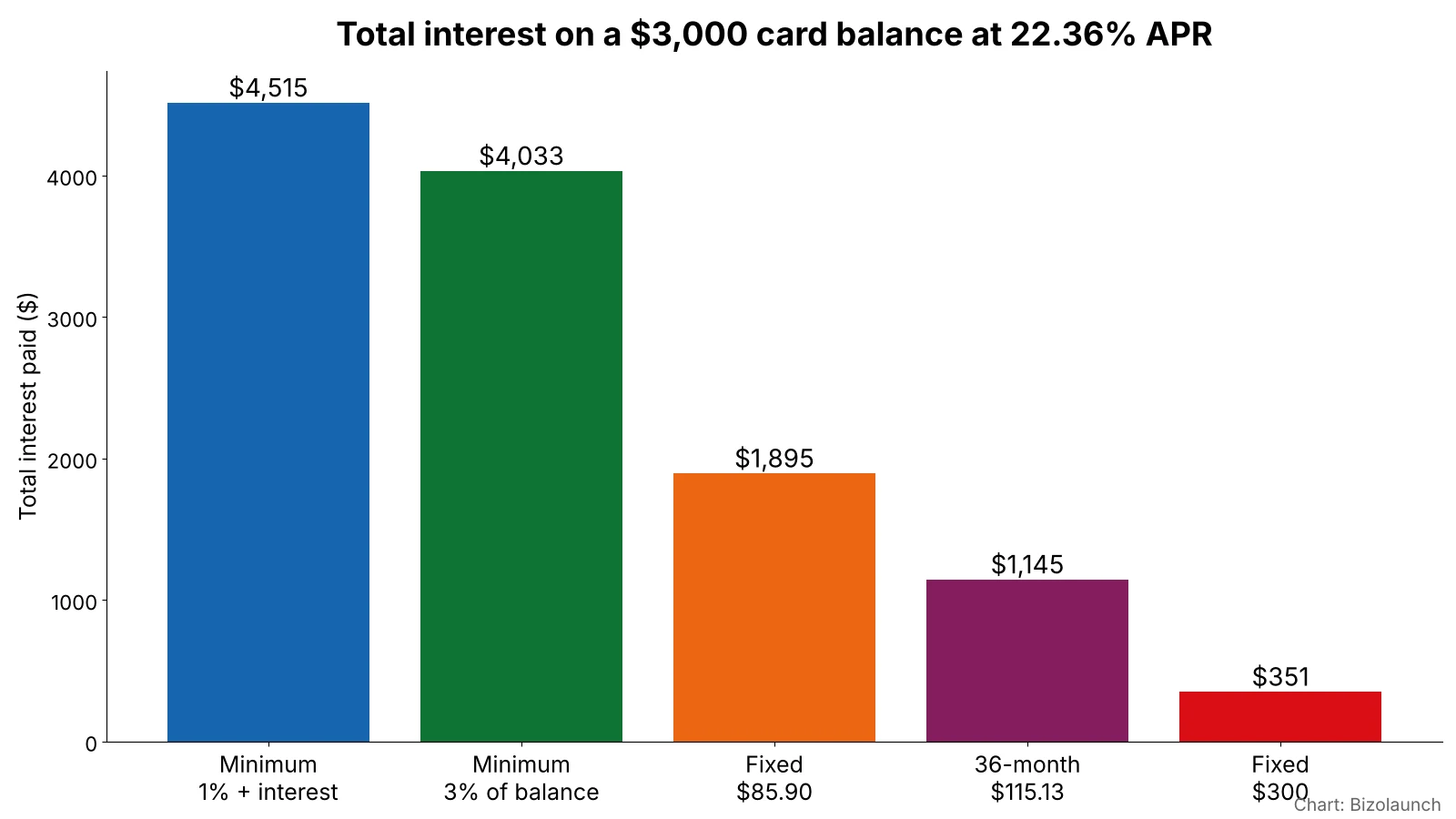
The third row is the easiest fix. Keep paying your first minimum of $85.90, even when the bank asks for less. That one habit cuts the payoff time from 15 years to under 5. It also saves you $2,620 in interest. You do not need a bigger budget to do it. You only need to stop following the shrinking number.
Check the Numbers for Bigger Balances
The trap gets worse as the balance grows. We ran the same 1% plus interest minimum on four balances.
| Balance | First minimum | Years at minimum | Interest at minimum | 36-month payment | 36-month interest |
|---|---|---|---|---|---|
| $1,000 | $28.63 | About 5.9 | $788 | $38.38 | $382. |
| $3,000 | $85.90 | 15 | $4,515 | $115.13 | $1,145. |
| $6,000 | $171.80 | About 20.8 | $10,105 | $230.26 | $2,289. |
| $10,000 | $286.33 | 25 | $17,558 | $383.77 | $3,816. |
A $10,000 balance paid at the minimum costs more in interest than the debt itself. In fact, you would pay $17,558 in interest on top of the $10,000. The 36-month plan costs $3,816 instead. It also frees you from the bill 22 years sooner.
Read the Minimum Payment Warning on Your Statement
US law makes your issuer show you this math. The Credit CARD Act of 2009 added a repayment box to card statements. The rule now sits in Regulation Z, section 1026.7(b)(12).
The box carries a bold “Minimum Payment Warning.” It says that paying only the minimum each period means more interest. It also says the balance will take longer to pay off. Under that heading, the issuer must show:
- Time to repay the current balance at the minimum payment.
- Total cost of paying it off at the minimum.
- The monthly payment needed to pay it off in 36 months, plus the total cost at that payment.
- Your savings from the 36-month plan compared with the minimum.
- A toll-free number for credit counseling. That line must give names and contact details for at least three approved counseling agencies.
The box has limits. The CFPB says the figures use your balance on the statement date and ignore future purchases. So if you keep spending on the card, the 36-month payment will not pay off your debt in 36 months. Also, you do not have to pay the 36-month amount. It is an estimate to help you plan.
Some statements skip the box. For example, charge cards that must be paid in full each month are exempt. A statement can also leave it out after two cycles in a row paid in full. The same goes for a month when the minimum would clear the whole balance.
Lose Your Grace Period on New Purchases
The payoff tables miss a second cost. When you carry a balance, you usually lose your grace period.
A grace period is the time between the end of your billing cycle and the due date. If you pay in full by then, you generally pay no interest on purchases. However, the CFPB explains what happens if you do not pay in full. You are charged interest on the unpaid amount and on new purchases from the day you make them.
So a minimum payer who keeps using the card pays interest on the morning coffee from the day it is bought. Then the coffee joins the balance that the shrinking minimum chips away at for years. To get the grace period back, you typically need to pay in full again. The CFPB adds a warning for people who pay in full only some months. You can lose the grace period for the month you miss and the one after it. Ask your issuer how it restores the grace period.
Know What Paying the Minimum Does to Your Credit
Paying the minimum on time counts as an on-time payment. So your payment history stays clean, and payment history carries the most weight in credit scores.
The bigger issue is the size of the balance. A high balance keeps your credit utilization high, and utilization is a large part of most scores. For example, a $3,000 balance on a $5,000 limit is 60% utilization. After a full year of minimum payments, it is still about 53%. Our guide on a good credit utilization ratio explains why most experts suggest staying under 30%.
Pay the Card Down Faster Without a Raise
You can beat the minimum trap with changes that fit inside a normal budget. Try these in order.
- Freeze your payment amount. Pay your current minimum every month from now on, even as the bank lowers it. On a $3,000 balance that alone saves about $2,620.
- Stop new charges on the card. Use a debit card for daily spending while you pay it down. Otherwise new purchases keep adding interest.
- Pay twice a month. Split your payment and send half mid-cycle. Your average daily balance drops, so the interest charge drops a little too.
- Add small windfalls. Put tax refunds, bonuses and cash gifts on the card the week you get them.
- Pick a payoff order for several cards. Our comparison of the debt snowball and debt avalanche methods shows which card to attack first.
- Look at moving the debt. A balance transfer card or a lower-rate loan can cut the rate you pay. Our guide to balance transfers vs personal loans runs the numbers on both.
- Call the toll-free number on your statement. It lists approved credit counseling agencies. A counselor can review your budget and may suggest a debt management plan.

Decide When Paying the Minimum Makes Sense
Paying the minimum is not always a mistake. In some months it is the right call.
- During a short cash crunch. If a car repair or a gap between jobs leaves you short, pay the minimum and protect your payment history. Then raise the payment once your income returns.
- On a 0% promotional balance. During a true 0% intro period, the minimum costs no interest. Still, divide the balance by the months left in the promotion and pay that amount, so the debt is gone before the regular rate starts.
- To keep cash for an emergency. If you have no savings at all, a small cash buffer can stop new debt from piling up. Build a few hundred dollars, then raise the card payment.
Our rule: treat the minimum as a floor for one hard month, and never as the plan.
Stop the Habits That Keep Card Balances Alive
These errors turn a manageable balance into a long one.
- Letting autopay follow the minimum. Many people set autopay to “minimum due” and forget it. Instead, set it to a fixed dollar amount above the minimum.
- Treating the 36-month figure as fixed. The 36-month payment on your statement assumes no new spending. Keep using the card and the date moves out.
- Paying late. A missed due date can trigger the late fee and penalty terms in your card agreement. It also breaks the payment history you are trying to protect.
- Ignoring the rate. At 22% APR, every month of delay costs real money. Check your APR on each statement and call to ask for a lower one.
- Opening a new card to pay an old one without a plan. A balance transfer only helps if you stop adding new debt.
Note for Credit Card Users in India
Indian rules on minimum payments come from the Reserve Bank of India. The RBI Master Direction on credit and debit cards says the minimum amount due must be set so that it causes no negative amortisation. In plain terms, paying the minimum amount due must reduce your balance over time.
The same direction says the interest-free credit period is suspended if any part of the previous bill is still unpaid. So, as in the US, paying only the minimum amount due means interest on new purchases too. Interest can be charged only on the outstanding amount after payments and refunds. Also, a card can be reported as past due, or charged a late fee, only after it stays past due for more than three days.
The payoff math works the same way in rupees. Only the rate and the minimum formula change, so check the most important terms document from your bank for both.
Quick Answers on Minimum Card Payments
Does paying the minimum hurt my credit score?
Not directly. An on-time minimum payment counts as on time. However, a large balance keeps your utilization high, and that can hold your score down.
What happens if I pay less than the minimum?
The issuer treats it as a missed payment. Your card agreement sets the late fee and any penalty rate. So if you cannot pay the minimum, call the issuer before the due date and ask about hardship options.
Is it better to pay the minimum or the statement balance?
Pay the statement balance whenever you can. If you pay it in full by the due date on a card with a grace period, you generally pay no interest on purchases.
Why did my minimum payment go up?
The minimum usually rises with the balance. New purchases, interest, late fees, annual fees and any past-due amount can all push it higher.
How do I find my own payoff time?
Look at the Minimum Payment Warning box on your monthly statement. It shows how long the current balance takes at the minimum and the payment needed to clear it in 36 months.
This guide is general information about how card minimum payments work. It is not personal financial advice.