
Keep your credit utilization under 30%, and aim for under 10% if you can. That is the short answer for anyone with a first credit card. On a card with a $500 limit, 30% is a $150 balance and 10% is a $50 balance.
The Consumer Financial Protection Bureau (CFPB) says many experts recommend using less than 30 percent of your total credit limit. It adds that people with the highest scores often use less than 10 percent. However, a new card holder faces a twist. Low starting limits mean a single grocery run can push the ratio past 30%.
We worked through the CFPB, myFICO and Experian guidance and then ran the math on small first-card limits. So this guide shows the real dollar amounts a beginner should watch, plus the timing trick that keeps a reported balance low. The advice applies to US credit scores.
Calculate Your Credit Utilization Ratio
Credit utilization is the share of your available revolving credit that you are using. Credit cards are the main revolving accounts for most beginners.
The formula is:
Utilization = total card balances ÷ total credit limits × 100
For example, you owe $120 on a card with a $400 limit. Then $120 ÷ $400 × 100 = 30%. If you pay that balance down to $40, your utilization drops to 10%.
With more than one card, add the balances together and the limits together. Two cards with $1,000 limits each and $200 owed in total give you 10% across both.
Lenders and scoring models also look at each card on its own. Experian explains that a model may consider the highest utilization on any single card. So one maxed-out card can hurt your score, even when your total ratio looks fine.
Know the Targets in Dollars for a First Card
Percentages are easy to forget at the checkout. Dollar caps are easier to follow. So we turned the 30% and 10% guides into dollar amounts for common beginner limits.
| Credit limit | 30% balance | 10% balance |
|---|---|---|
| $300 | $90 | $30 |
| $500 | $150 | $50 |
| $1,000 | $300 | $100 |
| $2,000 | $600 | $200 |
| $5,000 | $1,500 | $500 |
As you can see, a $300 secured card leaves very little room. A $90 balance already hits 30%. That is why the payment timing in the next section matters so much for beginners.
Understand Why Utilization Weighs So Much
Payment history is the biggest factor in most credit scores. The CFPB calls it the number one factor. But how much you owe comes close behind.
myFICO says the Amounts Owed category makes up 30% of your FICO Score. That category looks at total debt, the number of accounts with balances, the balance on each account and the share of revolving credit in use. It also considers how much is still owed on installment loans, such as a car loan. Still, myFICO notes that credit cards usually carry more weight than installment loans here.
Experian puts revolving utilization at roughly 20% to 30% of a score, depending on the scoring model. Either way, it is one of the factors you can change the fastest.
Look at What People With Top Scores Do
Experian’s own data shows the gap between average and excellent credit. In the third quarter of 2024, the average credit card utilization for people in the Exceptional FICO range (800 to 850) was 7.1%. By contrast, the US average overall utilization was 29%.
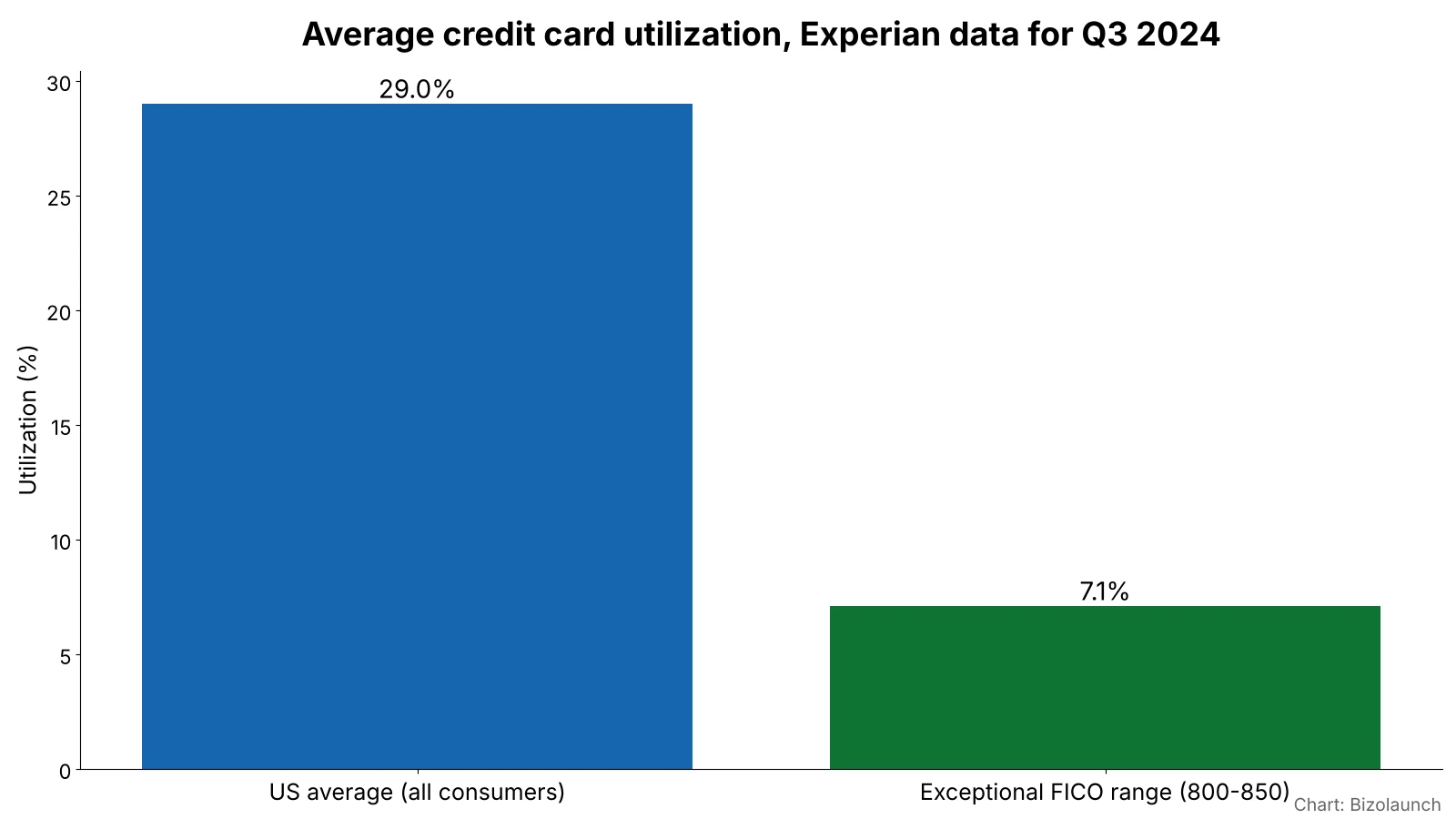
So treat 30% as a ceiling. Your real goal sits much lower. Experian says 30% is roughly where utilization starts to have a more pronounced negative effect. Even so, it also says no exact point exists where utilization turns from good to bad. People with the best scores tend to stay in single digits.
Pay Before the Statement Closes
This is the step most beginners miss. Your card issuer usually reports your balance to the credit bureaus once a month. Experian notes that the reported balance is often the amount owed on the day your statement closes.
So paying by the due date is not always enough. Take this example. You have a $500 limit, spend $300 during the month and pay in full by the due date. You never pay interest. However, the statement closed with $300 owed, so the bureaus may see 60% utilization.
The fix is to make a payment a few days before the statement closing date. Pay the balance down to about $50 or less. Then pay the rest by the due date. As a result, the reported balance stays near 10%, and you still pay no interest.
You can find your statement closing date on your monthly statement or in your card app. Set a phone reminder three or four days before it.
Skip the 0% Goal
Some beginners think the lowest possible number is always best. It is not. Experian says 0% utilization is actually worse than 1%, because scoring models need some usage to judge your habits.
Also, a card you never use may get its limit cut or be closed by the issuer. That shrinks your available credit. So use your card for one small, regular bill, such as a phone plan or a streaming service. Then pay it off each month.
Raise Your Available Credit Carefully
Utilization has two sides: what you owe and your total limit. So a higher limit lowers your ratio, as long as spending stays the same.
For example, $150 on a $500 limit is 30%. If the issuer raises the limit to $1,000, the same $150 is only 15%.
Beginners can add available credit over time in a few ways:
- Ask for a limit increase. Do it after a run of on-time payments. Before you apply, ask the issuer if the request uses a hard or soft credit check.
- Graduate from a secured card. Some issuers move secured card holders to a regular card with a higher limit.
- Keep old cards open. Closing a card removes its limit from your total. So your utilization rises even though your debt did not change.
- Add a second card slowly. Each new application can add a hard inquiry. Space them out, and only apply when you need one.
A higher limit only helps if your spending stays put. If it rises with the limit, your ratio stays the same and your debt grows.
Find Out If Old Balances Still Count
Most scores look only at your latest reported balances and limits. So if your utilization was high last month, paying it down can improve those scores quickly.
However, newer models work differently. Experian notes that VantageScore 4.0 and FICO Score 10 T use trended data, which looks at your balances over time. With those models, a pattern of high balances can count even after you pay them down. So steady low balances are the safer habit.
Watch Your Reports for Free
Utilization errors happen. For example, a report might show the wrong limit, which makes your ratio look higher. So check your reports.
The three bureaus, Equifax, Experian and TransUnion, let you check your credit report from each once a week for free at AnnualCreditReport.com. The FTC says it is the only website authorized to fill orders for the free annual reports. If you find a mistake, dispute it with the bureau that shows it.
A Beginner Utilization Routine
Follow this routine with your first card:
- Find your limit and your statement closing date. Both are on your statement or in the app.
- Write down your 10% number. On a $500 limit, that is $50.
- Put one small bill on the card. Use it for something you would pay anyway.
- Pay down to your 10% number before the statement closes. Then pay the rest by the due date.
- Turn on autopay for at least the minimum. Payment history matters most, so never miss one.
- Check one credit report every few months. Make sure the limit and balance are right.
If you want to compare cards once your credit grows, see our guides to annual fees vs rewards and what reward points are worth. Also, if you already carry debt across cards, our debt snowball vs avalanche comparison can help you pick a payoff order.

Credit Utilization Questions From New Card Holders
Is 30% credit utilization good for a beginner?
It is acceptable, but lower is better. The CFPB says many experts recommend staying under 30%, while people with the highest scores often use less than 10%.
Do I need to carry a balance to build credit?
No. The CFPB says you do not need to carry a balance to get a good score. Paying your balance in full each month can help your scores and saves you interest.
How fast does lowering my utilization help my score?
For most scores, it can help once the lower balance is reported, which usually happens at your next statement closing. Models that use trended data look at your history too, so steady habits count.
Does a debit card affect credit utilization?
No. A debit card draws on your own bank money, so it is not revolving credit. Only credit cards and other revolving lines count toward utilization.
This guide explains how US credit scoring treats utilization. It is general information, not personal financial advice.