
Do the savings math first, and let it choose your date and guest list. That is how you budget for a wedding without a loan. For example, $1,250 a month for 16 months pays for a $20,000 wedding with nothing owed after the honeymoon.
Most couples do it the other way. They pick a date, book a venue, and then try to find the cash. When the cash falls short, the gap goes on a credit card or a personal loan.
We pulled the latest wedding cost data from The Knot, loan and card rates from the Federal Reserve and FDIC savings rates. The savings timelines and payment plans in this guide are our own calculations. All figures are in US dollars.
Know What Weddings Cost Before You Set a Number
The average wedding cost about $34,000 in The Knot’s 2026 Real Weddings Study. The study surveyed 10,474 US couples who married last year. The average guest count was 117, and the average cost per guest was $292.
The Knot also lists average spending by vendor. These figures help you spot the big lines before you set your own plan.
| Wedding cost item | Average spend |
|---|---|
| Reception venue | $12,900. |
| Live band | $4,500. |
| Engagement ring | $4,600. |
| Photographer | $3,000. |
| Wedding rings | $3,000. |
| Florist | $2,800. |
| Wedding dress | $2,100. |
| Caterer | $80 per person. |
Averages are not targets. However, one detail in the data matters for anyone avoiding debt. Couples who paid for the whole wedding themselves spent $25,500 on average. Couples who paid for only a minority of it spent $39,600. When the money is your own, the budget tends to shrink.
Work Out Your Wedding Budget Ceiling
Your ceiling is the most you can spend without borrowing. Use this formula:
Budget ceiling = cash saved now + (monthly saving × months until final payments) + confirmed family gifts.
Take an example couple, Sam and Jordan. They have $4,000 saved for the wedding. After reviewing their spending, they can save $1,000 a month together. Their final vendor payments would be due 14 months from now. Also, Jordan’s parents have promised $2,000.
So their ceiling is $4,000 + ($1,000 × 14) + $2,000 = $20,000.
Two rules keep the number honest. First, count family money only once you know the amount and the date it arrives. A vague “we’ll help” is not a budget line. Second, keep your emergency fund out of the wedding fund. If a car breaks down two months before the wedding, you do not want to choose between the repair and the caterer.
If the two of you earn very different salaries, agree on how much each person puts in. Our guide to splitting expenses on unequal incomes covers the fair ways to do it.
Set the Wedding Date From Your Savings Timeline
Once you know your monthly saving, the date picks itself. This table shows the monthly saving needed for three budgets over three timelines.
| Wedding budget | 12 months away | 18 months away | 24 months away |
|---|---|---|---|
| $15,000 | $1,250 a month | $833 a month | $625 a month. |
| $25,000 | $2,083 a month | $1,389 a month | $1,042 a month. |
| $34,000 | $2,833 a month | $1,889 a month | $1,417 a month. |
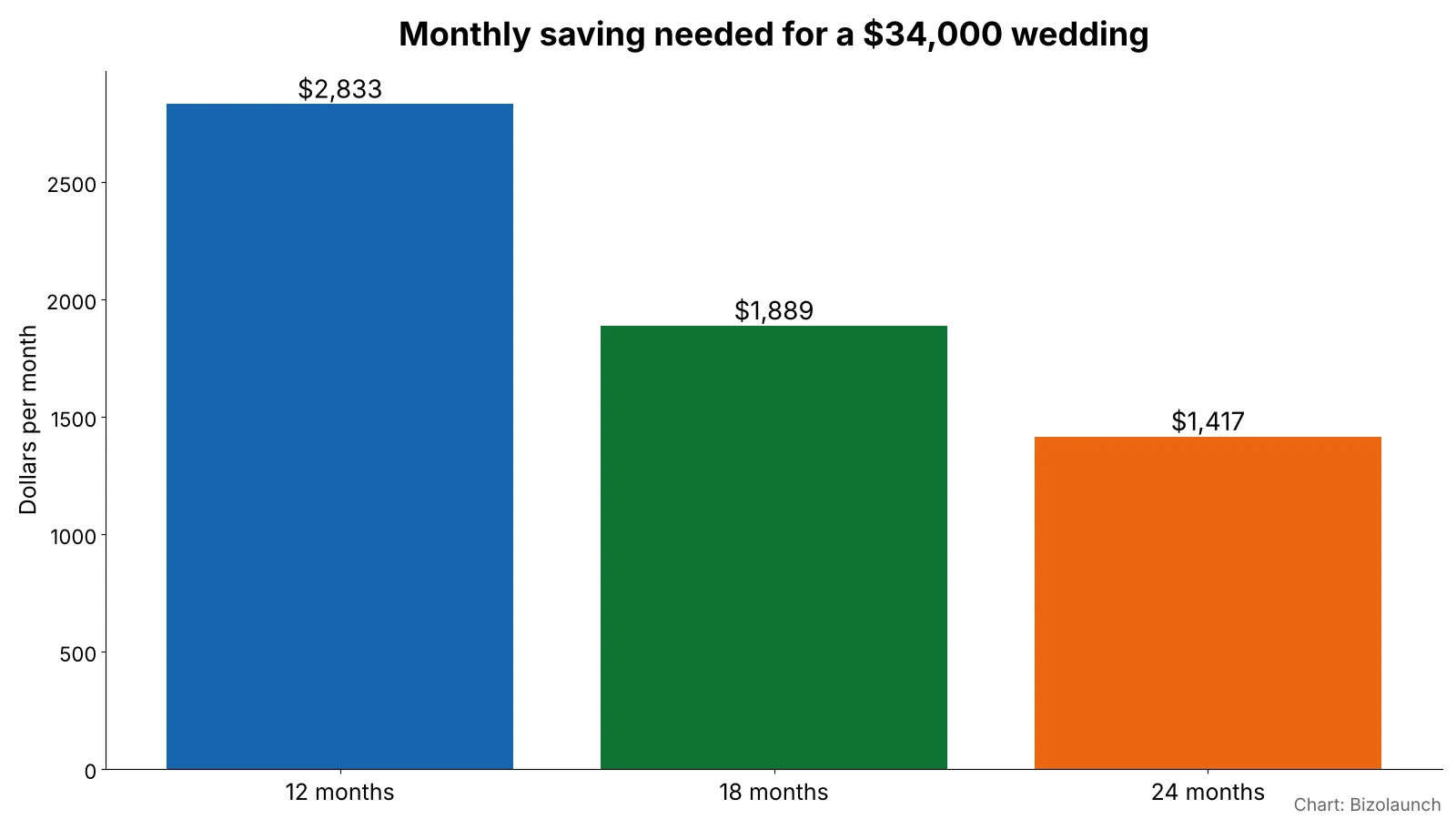
Find your monthly saving in the table. Then read across to the timeline that matches it. For example, a couple who can save $1,000 a month cannot reach $25,000 in 18 months. They need about 25 months, or a smaller budget.
Remember that vendors want money before the wedding day. So the real deadline is the date of the final vendor payment, often a few weeks before the wedding. Count months to that date, not to the ceremony.
Our wedding budget calculator runs this math for your own numbers and splits the total across categories.
See What a Wedding Loan Would Really Cost
Borrowing feels painless when the payment is spread out. The interest tells a different story.
The Federal Reserve tracks these rates in its G.19 consumer credit release. In the third quarter of 2026, the average bank rate on a 24-month personal loan was 11.90%. The average rate on card accounts charged interest was 22.36%. We ran both on a typical shortfall.
| How you cover a $20,000 shortfall | Monthly payment | Time to pay off | Interest paid |
|---|---|---|---|
| Personal loan at 11.90%, 24 months | $940.54 | 24 months | $2,573. |
| Personal loan at 11.90%, 36 months | $663.33 | 36 months | $3,880. |
| Saving first, no loan | $1,250 for 16 months | Paid before the wedding | $0. |
A smaller gap on a credit card is not cheap either. For example, $10,000 at 22.36%, paid at $400 a month, takes 34 months to pay off and costs about $3,586 in interest. That is three years of wedding payments while you set up a home together.
If you already carry card debt, pay it off before you start the wedding fund. Our guide to balance transfers vs personal loans compares two ways to cut the rate while you do.
Find the Monthly Savings in Your Current Budget
The timeline only works if the monthly number is real. So build it from your actual spending, line by line. Pull the last three months of bank and card statements and add up each category.
Sam and Jordan needed $1,000 a month. They found it with these changes. Again, the amounts are our example.
| Change | Monthly saving |
|---|---|
| Eating out cut from $480 to $250 | $230. |
| Two streaming services and a gym they rarely used, cancelled | $70. |
| Grocery list and one bulk shop a week | $120. |
| Jordan’s weekend photo editing work | $300. |
| Sam’s yearly raise, sent straight to the wedding fund | $180. |
| Phone plans switched to a cheaper carrier | $100. |
| Total | $1,000. |
Set the transfer to run automatically on payday. Money that never reaches the checking account is much harder to spend. Also, send windfalls to the fund the day they arrive. A tax refund or a work bonus can cover a whole vendor deposit.
Track the fund once a month against the payment calendar. If you fall behind by more than one month of saving, act early. Trim a category in the sample plan, or move the date back. Both are cheaper than a loan. Our sinking funds examples show how to run the wedding fund next to your other savings goals.
Cut the Guest List First
Guest count drives most wedding costs. Catering, rentals, invitations, favors and the size of the venue all grow with every name.
At The Knot’s average of $292 per guest, a 117-guest wedding works out to about $34,164. Cut the list to 80 guests, and the same per-guest cost gives about $23,360. That is a $10,804 difference, more than many couples spend on the dress, photos and flowers combined.
Use three lists to make the cut easier:
- Must invite. Close family and the friends you see often.
- Want to invite. People you like but might not see this year.
- Feel we should invite. Coworkers, plus-ones and distant relatives.
Set your ceiling first, divide it by a realistic per-guest cost, and invite down the lists until you hit the number.
Build a Sample $20,000 Wedding Plan
Sam and Jordan’s ceiling is $20,000 for 80 guests. We built their plan around the biggest costs first. The amounts are our example, not industry averages.
| Category | Planned amount | Share of budget |
|---|---|---|
| Venue and rentals | $6,000 | 30%. |
| Catering and drinks, 80 guests | $5,600 | 28%. |
| Photography | $2,400 | 12%. |
| Attire, hair and makeup | $1,600 | 8%. |
| Music | $1,200 | 6%. |
| Flowers and decor | $1,000 | 5%. |
| Rings | $800 | 4%. |
| Invitations, cake and small items | $600 | 3%. |
| Buffer for surprises | $800 | 4%. |
| Total | $20,000 | 100%. |
The buffer matters. Taxes, service charges, tips, alterations and late extras often appear in the final weeks. Without a buffer, those costs land on a card.
Map Vendor Deposits to Your Savings Calendar
Vendors usually take a deposit when you book and the rest closer to the date. Ask each one for its payment schedule in writing before you sign. Then line those dates up against your savings.
Sam and Jordan’s calendar shows how it works.
| Month from today | Payment due | Running wedding fund after payments |
|---|---|---|
| Month 2 | Venue deposit $2,000 | $4,000. |
| Month 4 | Photographer deposit $800 | $5,200. |
| Month 6 | Caterer deposit $1,500 | $5,700. |
| Month 9 | Music and florist deposits $700 | $8,000. |
| Month 12 | Attire and rings $2,400 | $10,600. |
| Month 14 | All final balances $12,600 | $0. |
The running fund includes the starting $4,000, $1,000 saved each month and the $2,000 family gift in month 12. The fund never drops under zero, so no payment needs a card. If a deposit date comes before you have the money, ask the vendor to move it or split it.
Keep the Wedding Fund in the Right Account
Put wedding money in its own savings account. A separate account stops it from drifting into daily spending, and you can watch it grow.
Rates vary a lot. The FDIC’s national average savings rate was 0.39% in November 2026. On $1,500 a month for 18 months, that earns only about $75. At a hypothetical 4%, the same deposits would earn about $779. So compare rates at banks and credit unions before you open the account, and check that it is federally insured.
Keep the money out of the stock market if the wedding is less than a few years away. A drop in prices right before the final payments could leave you short.
Trim Costs Without Shrinking the Day
Once the guest list is set, these moves cut costs without changing much for your guests.
- Ask about off-peak dates. Get Friday, Sunday and off-season quotes from each venue before you book. Then compare them with the Saturday price.
- Hire fewer vendors. The Knot found couples hired 13 wedding professionals on average. A venue that includes tables, chairs and catering can replace several of them.
- Look at lab-grown stones. The same study found 61% of engagement rings had a lab-grown center stone.
- Choose a shorter reception. Fewer hours can lower venue, band and photographer costs.
- Use digital invitations. Save on printing and postage, and track replies more easily.
- Use free and low-cost planning tools. Our list of AI tools for wedding planners covers apps that help with seating charts, budgets and vendor messages.

Talk About Money Before You Book Anything
Couples who skip the money talk usually have it later, under pressure. So before you book, sit down together and agree on four things.
- The ceiling. Write down the number from the formula and agree not to go over it.
- The top three priorities. Pick what matters most, such as food, photos or music. Then spend less on the rest.
- Family money. Confirm amounts, dates and any conditions. Some parents expect a say in the guest list in return.
- The rule for overspending. If one line goes over, agree on which other line gives up the money.
Plan for the Money You Need After the Wedding
A debt-free wedding can still leave you broke the week after. So plan the first two months of married life before you set the final budget.
List the costs that arrive right after the day. A honeymoon is the big one, so give it its own savings target or move it to a later date. Then add thank-you cards, dress cleaning, any name-change paperwork and moving costs if you plan to live together for the first time.
Keep at least one month of normal living costs in your regular account on the wedding day. That cash covers rent and bills while late vendor tips and small extras go through. After the wedding, keep the automatic transfer running and point it at your next goal, such as an emergency fund or a home deposit. The saving habit you built is worth keeping.
Skip the Wedding Budget Traps That Lead to Debt
- Booking the venue before the budget. The venue sets the tone, and often the guest count, for everything else.
- Counting gifts from guests. Cash gifts arrive after the bills are due. Do not plan to pay vendors with them.
- Forgetting the hidden lines. Service charges, tax, tips, alterations and marriage license fees add up.
- Using a “buy now, pay later” plan for the dress. It is still borrowing, and the payments land after the wedding.
- Draining the emergency fund. You still need a cushion after the wedding.
- Not tracking spending. Update one shared sheet after every payment.
What Engaged Couples Ask About Paying Cash
How much should we save each month for a wedding?
Divide your target budget by the months left until the final vendor payments. A $20,000 wedding with 16 months to go needs $1,250 a month.
Is it a bad idea to take out a loan for a wedding?
It adds cost. A $20,000 personal loan at the latest average bank rate of 11.90% costs about $2,573 in interest over 24 months. Saving first costs nothing extra.
What is the cheapest way to cut a wedding budget?
Invite fewer guests. Most wedding costs scale with headcount, so each name you cut saves on food, drinks, rentals and invitations.
Should we use a credit card for wedding payments?
Only for payments you can clear in full that month. Carrying a balance at an average rate of 22.36% makes the wedding much more expensive.
This guide gives general information on paying for a US wedding without debt. It is not personal financial advice.