A $1,200 car insurance renewal costs $100 a month if you start saving a year ahead. Start three months ahead, and it costs $400 a month. So timing decides how hard this feels. To save for annual insurance premiums, list every policy and its renewal date. Then divide each premium by the months left, and move that amount to a separate account on payday.
Most people know their rent to the dollar. Far fewer can name the month their home or car policy renews. So the bill shows up as a surprise, and it lands on a credit card. We built this guide for US households who pay premiums once or twice a year and want those bills to stop hurting.
We pulled the payment-plan rules from a state insurance regulator and the saving tips from the Consumer Financial Protection Bureau (CFPB). Then we ran the catch-up math for different start dates, so you can see what waiting really costs.
List Every Policy That Bills Once or Twice a Year
First, find every premium that does not come out monthly. Go through last year’s bank and card statements and look for large insurance charges. Then check your email for renewal notices.
Common ones include:
- Car insurance. Many policies run for six or 12 months, so you may face two bills a year.
- Homeowners insurance. If it is not paid through a mortgage escrow account, you pay it yourself at renewal.
- Renters insurance. It is often cheap, so people forget it until the charge hits.
- Term life insurance. Some insurers offer a yearly payment option.
- Pet insurance. Some plans let you pay once a year. Our guide on is pet insurance worth it covers the costs.
- Umbrella or boat policies. These small policies are easy to miss.
Write each one down with three details: the premium, the renewal month and how you pay. A short table in a notebook or a spreadsheet is enough.
| Policy | Annual premium | Renews in | Months left | Save per month |
|---|---|---|---|---|
| Car insurance | $1,200 | August | 9 | $133 |
| Renters insurance | $180 | March | 4 | $45 |
| Term life | $420 | November | 12 | $35 |
Together, those three policies need $213 a month. Your own numbers will differ, of course. Still, the method stays the same for every policy.
Divide Each Premium by the Months You Have Left
Next, work out the monthly amount. The formula is short:
Monthly savings = annual premium ÷ months until the bill is due
If the bill is 12 months away, divide by 12. However, if it is closer, divide by the months you actually have. Then the money is ready on time, even though you started late.
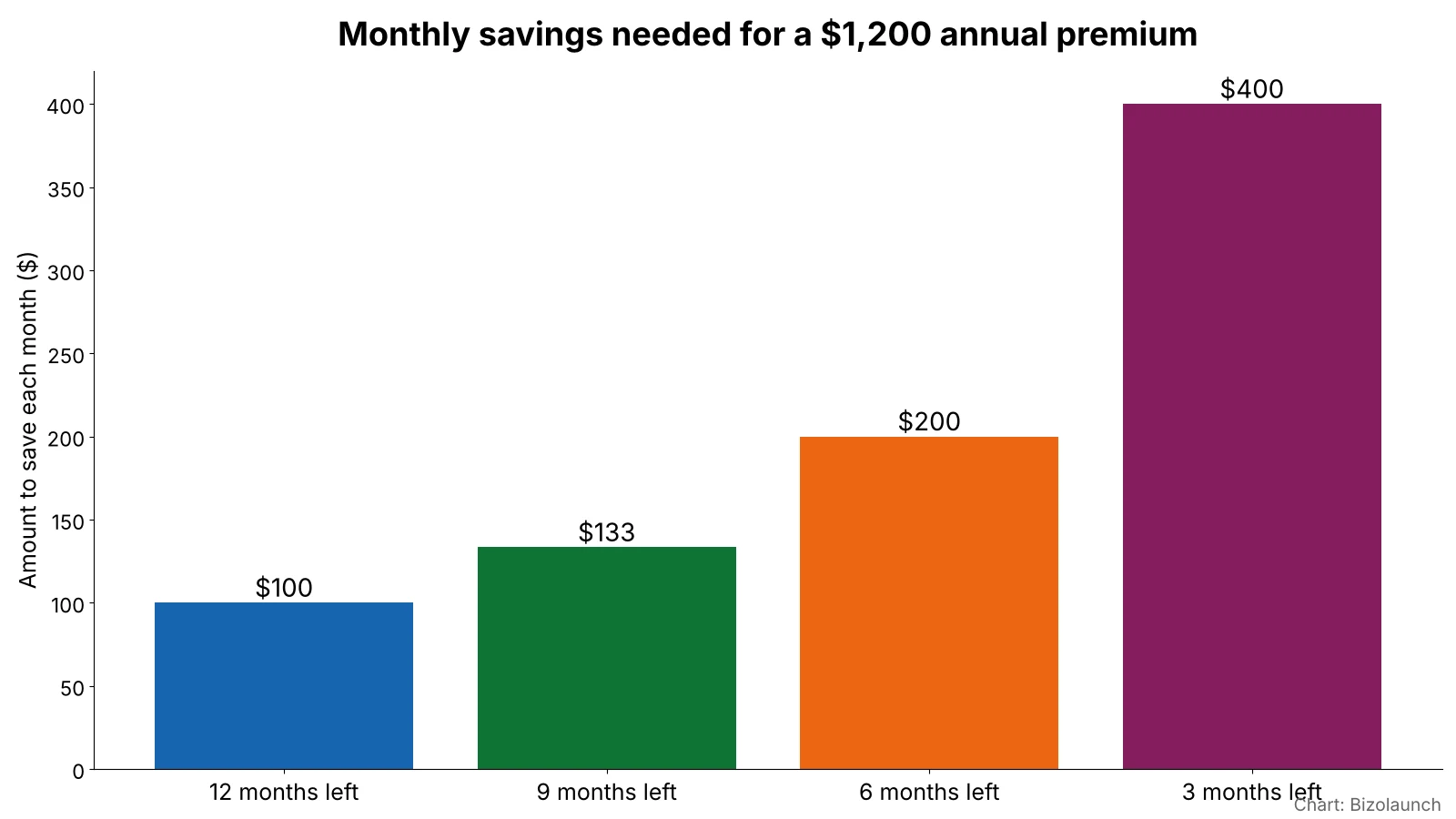
The chart shows why timing counts. With 12 months to go, a $1,200 premium needs $100 a month. With three months left, it needs $400. So the best month to begin is the month after you pay this year’s bill.
After the first full year, the plan gets smoother. Every policy then has 12 months of lead time. As a result, your monthly total stops jumping around.
Give Premium Money Its Own Account
Money for premiums should not sit in checking. Otherwise it looks free to spend, and it often gets spent.
So open a separate savings account just for insurance bills. Many banks and credit unions let you name sub-accounts, such as “Car insurance” and “Renters.” Then you can see each pot grow on its own.
The CFPB savings guide suggests two ways to move money without thinking about it. One is an automatic transfer that your bank runs on a set date. The other is a split paycheck, where your employer routes a slice of each deposit into savings. Also, check your balance before each transfer date, so a transfer never triggers an overdraft fee.
Keep this account apart from your emergency fund too. An emergency fund covers costs you cannot predict. A premium is a bill you know is coming, so it needs its own line. Our guide to sinking funds uses the same idea for other yearly costs.
Match Transfers to Your Pay Schedule
Monthly targets are easy to read. But many people are paid every two weeks. So convert the monthly figure to a per-paycheck amount.
For example, $213 a month is $2,556 a year. Divide that by 26 paychecks, and you get about $98 per paycheck. Because there are 26 paydays, not 24, you also end up with a small cushion in the two months that have a third paycheck.
Then set the transfer for the day after payday. The money leaves before you have time to spend it.
Compare Paying in Full With Paying Monthly
Once the money is saved, you can pay the premium in one go. That choice can lower your cost, so check it each year.
Many insurers charge extra to spread payments out. The Massachusetts Division of Insurance notes that a company typically adds a service fee to policies that use an installment plan. It also says that paying installments by electronic funds transfer may save you all or part of that fee.
So call your insurer or agent and ask two questions:
- What is the total cost if I pay monthly, including fees?
- Is there a discount if I pay the full term at once?
Then compare the two totals. If paying in full costs less, your premium fund has already paid you back. If the totals are the same, monthly autopay may be fine, and your fund becomes a backup for the months money is tight.
Shrink the Premium Before It Renews
Saving is half the job. The other half is making the bill smaller. Start shopping about a month before renewal, so you have time to switch if you find a better price.
The Oklahoma Insurance Department lists several ways to lower home and auto rates:
- Raise your deductible. It says moving a car deductible from $500 to $1,000 could reduce the premium a lot. However, you then pay more yourself when you claim, so keep that amount in savings.
- Bundle policies. Home and auto from one insurer can earn a discount of 5% to 15%. Still, compare the bundled total with separate quotes, because a bundle does not always win.
- Ask about discounts. Smoke detectors, alarms and deadbolts can cut home premiums. For cars, anti-theft devices, good grades, a driver course and a clean three-year record can help.
- Review older cars. The department says full coverage is often not cost effective on a car worth less than 10 times the premium.
The Maryland Insurance Administration adds a few more. It mentions discounts for continuous coverage, telematics programs and memberships such as credit unions, alumni groups or your employer. It also advises getting several quotes with the exact same details, so you compare like with like.
Every dollar you cut from the premium also cuts what you must save each month. For instance, a $150 discount on a $1,200 policy lowers the monthly set-aside from $100 to $87.50.
Handle a Renewal You Cannot Cover Yet
Sometimes the bill arrives before the fund is full. Do not let the policy lapse. A gap in coverage can leave you unprotected, and some insurers reward continuous coverage.
Instead, work through these options in order:
- Switch to the insurer’s installment plan for this term. Ask about any fee first, and then pay by electronic transfer if that lowers it.
- Pay part from the fund and spread the rest. Then restart the savings plan the next month.
- Shop the policy again. A lower quote may close the gap.
- Use your emergency fund as a last resort. Then rebuild it before the next renewal.
Avoid putting the full premium on a credit card you cannot pay off that month. The interest can wipe out any pay-in-full discount. If you already carry card debt, our comparison of balance transfers and personal loans explains the options.
Set Up the System in One Evening
You can set all of this up in about an hour:
- Pull 12 months of bank and card statements.
- List every insurance policy, its premium and its renewal month.
- Divide each premium by the months left until it renews.
- Open a separate savings account, with sub-accounts if your bank offers them.
- Set a recurring transfer for the day after payday.
- Put a reminder in your calendar 30 days before each renewal to shop around.
After that, the plan mostly runs itself. Review the list once a year, when premiums change.

Premium Saving Questions People Ask
Is it better to pay insurance annually or monthly?
It depends on your insurer’s fees and discounts. Many insurers add a service fee to installment plans. So ask for the total cost both ways, and pick the lower one if you have the cash saved.
How much should I save each month for insurance?
Divide each annual premium by the number of months until it renews. Then add the results together. For a $1,200 policy that renews in 12 months, that is $100 a month.
Should insurance savings go in my emergency fund?
Keep them apart. A premium is a known bill with a known date. An emergency fund is for costs you cannot predict, so mixing the two makes both harder to track.
What if my premium goes up at renewal?
Recalculate the monthly amount with the new premium for the next term. Then shop around before you renew, and ask about discounts you may have missed.
This guide covers general saving methods for US households. Insurance rules and fees vary by state and by insurer, so confirm the details with your own insurer.