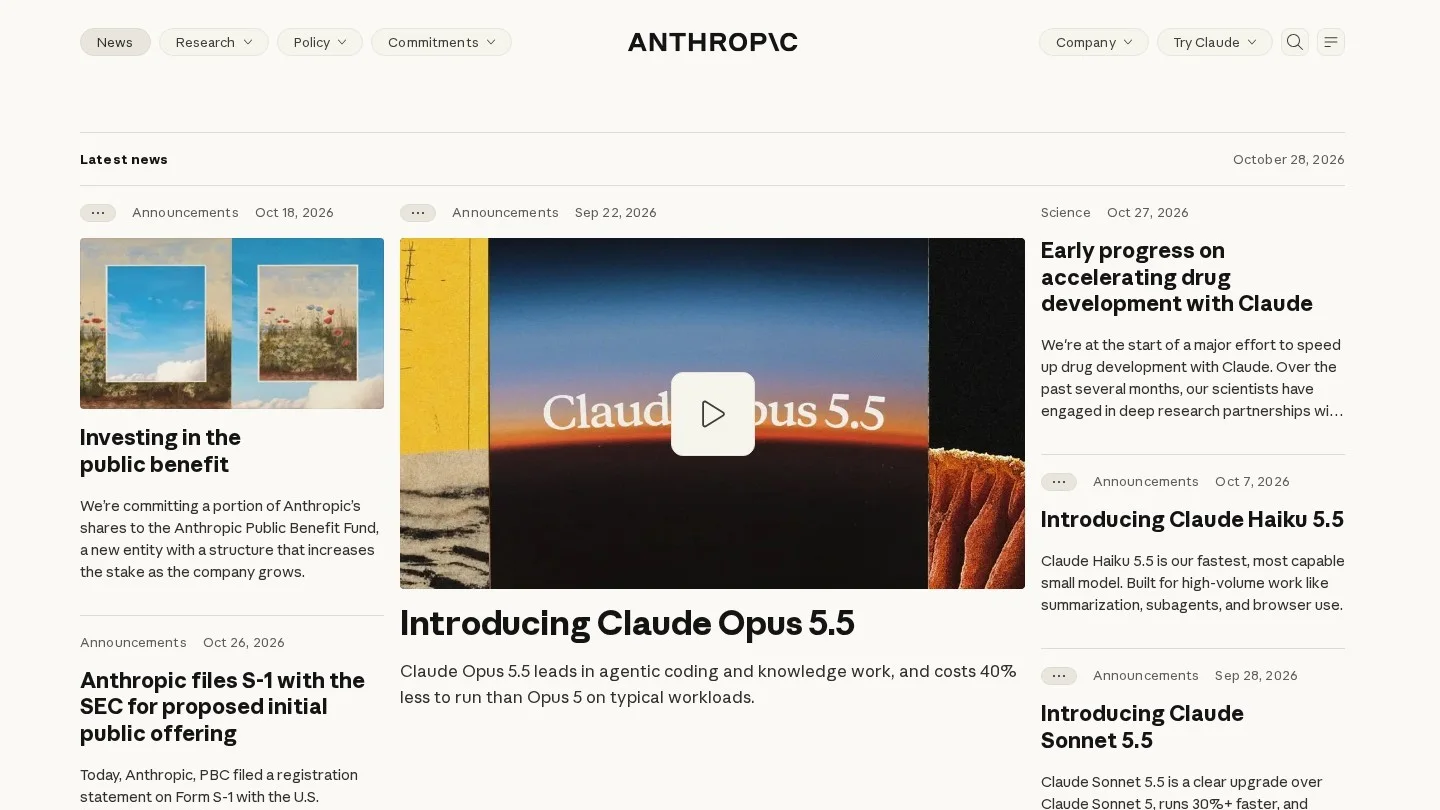
Anthropic spent the last week of October 2026 moving from private lab to soon-to-be public company. On October 26 it filed an S-1 registration statement with the US Securities and Exchange Commission for a proposed listing on the Nasdaq Global Select Market under the ticker ANT. The filing showed $16.3 billion of revenue in the first half of 2026. In the same week, the Claude maker cut prices for US government buyers, shared early drug discovery results, widened its science credits program and shipped several developer updates.
This roundup covers Anthropic news from October 26 to November 2, 2026. Each item comes from Anthropic’s own newsroom or release notes, checked against reporting from outlets such as Yahoo Finance and ExecutiveGov.
Anthropic’s Week in Five Lines
- The S-1 for an IPO of Class A shares was filed on October 26. Goldman Sachs and Morgan Stanley lead the deal, and the price range and share count are still blank.
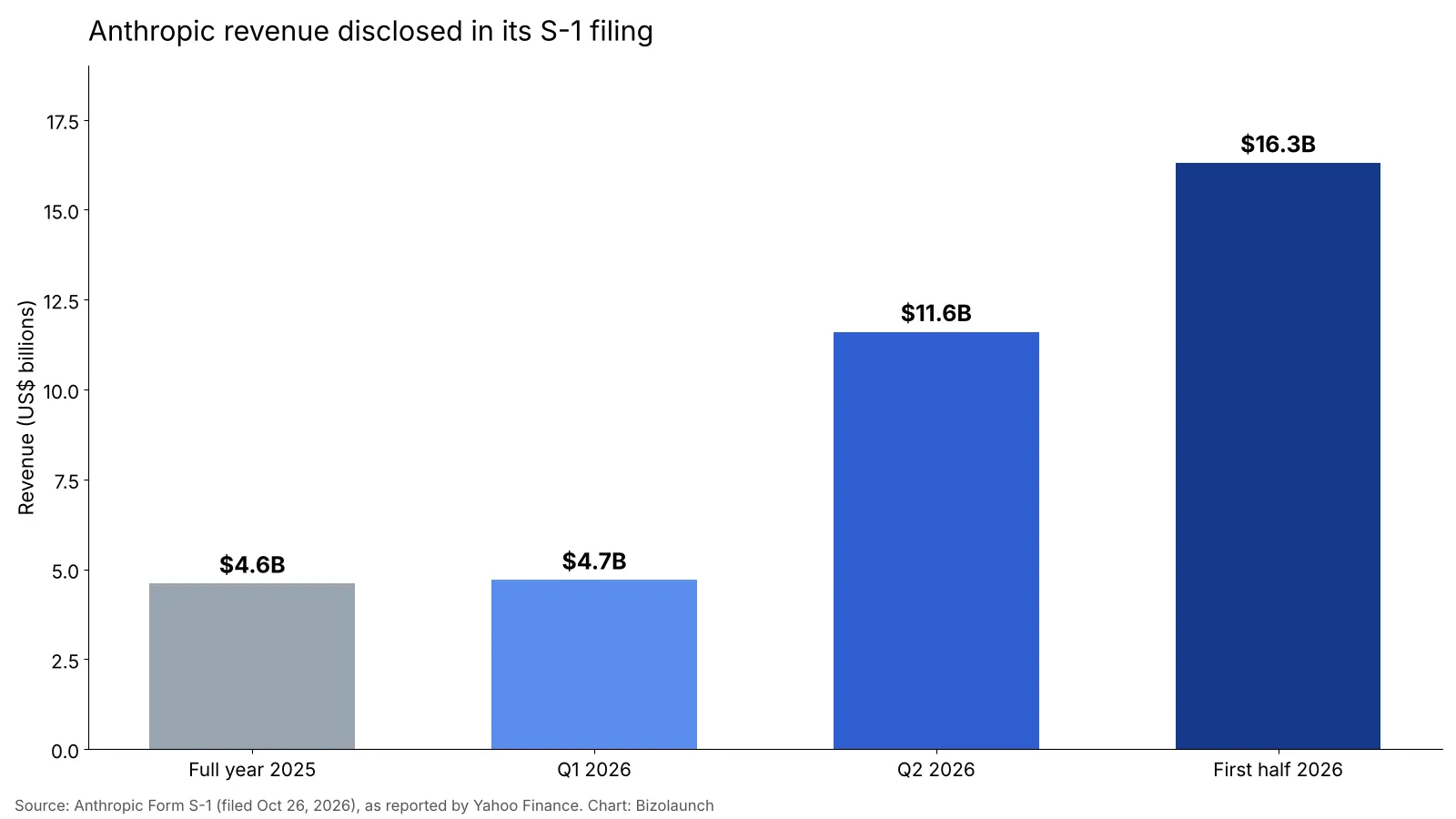
- First-half 2026 revenue was $16.3 billion, against $4.6 billion for all of 2025. The second quarter brought the company’s first operating profit, $974 million.
- A new GSA OneGov deal gives federal, state, local and tribal buyers 40% off token-based Claude usage.
- Anthropic shared results from six drug development partners and acquired Mithril Medicine.
- Developers got a larger 128 MB request limit, a new usage and cost analytics API, and notice that fast mode on Claude Opus 4.8 ends on November 30.

Every Anthropic Announcement From October 26 to 30
The table lists the week’s news in date order. No new posts appeared on Anthropic’s newsroom or release notes pages between October 31 and November 2.
| Date | Announcement | Type |
|---|---|---|
| Oct 26 | S-1 filed with the SEC for a proposed Nasdaq IPO (ticker ANT) | Funding and listing |
| Oct 27 | Expanded GSA partnership: 40% off Claude for all levels of US government | Partnership and policy |
| Oct 27 | Research update on accelerating drug development with Claude | Research |
| Oct 28 | AI for Science program expands to 20 foundations and institutions | Partnership |
| Oct 28 | Maximum API request size raised from 32 MB to 128 MB | Product |
| Oct 29 | Usage and Cost Analytics API launched in beta | Product |
| Oct 30 | Fast mode for Claude Opus 4.8 deprecated, removal set for Nov 30 | Product |
The ANT Listing: What Anthropic’s S-1 Says
Anthropic, PBC filed to sell Class A common stock. The number of shares and the price range have not yet been determined, and the shares cannot be sold until the registration becomes effective. Goldman Sachs and Morgan Stanley are named as the contacts for the preliminary prospectus. The underwriting group has 22 banks.
The filing gives the public its first detailed look at how fast the company has grown. These are the headline figures:
| Measure | Figure from the S-1 |
|---|---|
| Revenue, full year 2025 | $4.6 billion |
| Revenue, Q1 2026 | $4.7 billion |
| Revenue, Q2 2026 | $11.6 billion |
| Revenue, first half 2026 | $16.3 billion |
| Operating result, Q1 2026 | $1.7 billion loss |
| Operating result, Q2 2026 | $974 million profit |
| Compute costs, Q1 and Q2 2026 | $3.4 billion, then $5.6 billion |
| Net loss, first half 2026 | $80.7 billion |
| Employees, September 30, 2026 | About 5,300 |
The net loss looks alarming until you read the footnote. Of the $80.7 billion loss, $72.4 billion came from non-cash changes in the fair value of convertible notes, derivatives and SAFEs. Those are accounting marks on early investor instruments, and they tend to swell when a company’s value jumps. Our guide to how SAFE notes work explains why a fast-rising valuation shows up as a loss on paper.
Customer numbers grew just as quickly. Customers paying $100,000 or more a year rose from over 950 to over 11,900 in the twelve months to September 30, 2026. Revenue per employee comes to more than $6.6 million, up from $1.4 million a year earlier.
Founder Control and the Long-Term Benefit Trust
Anthropic is a public benefit corporation, and its share structure reflects that. The VC Corner’s summary of the cover page says the seven co-founders hold 50.1% of the vote through a single Class F share. The Long-Term Benefit Trust, an independent body, elects a majority of the board. Buyers of Class A stock will own part of the business but will have limited say over its direction.
Valuation Talk and Timing
Anthropic’s last private round, in May 2026, valued it at $965 billion. A listing valuation of about $2 trillion has been discussed, with a $1.5 trillion to $2 trillion range also in play. The listing is expected later this fall. Anthropic itself has not given a date. This roundup is not investment advice, and the final prospectus will carry the price range and share count.
Risks Anthropic Flagged to Investors
The risk section is unusually direct for a tech prospectus. Anthropic warns that insurers may not cover its liability from a catastrophic AI incident, and that tighter AI regulation could hurt the business. It also warns that advanced AI could pose catastrophic risks if misused. That candour fits the company’s stated legal purpose: the responsible development of advanced AI for the long-term benefit of humanity.
Claude for Government at 40% Off Under OneGov
On October 27 Anthropic announced an expanded deal with the US General Services Administration. Under a new OneGov agreement, federal, state, local, tribal and territorial governments can use Claude at 40% off. The discount applies to token-based usage of all Claude models offered to government. That includes models in FedRAMP-authorized environments for sensitive unclassified work.
Agencies pay only for what they use, with no minimum order. They can buy directly from Anthropic, through resellers or through the major cloud providers. The new terms replace a 2025 offer that gave all three branches of the federal government Claude for Enterprise and Claude for Government for $1. That $1 offer expired on October 31. GSA says its OneGov program has delivered over $1.8 billion in savings, about $1.6 billion of it from AI agreements.
For a city IT team or a county office, the change matters more than the federal headline. Smaller public bodies rarely get enterprise pricing. A consumption model with no minimum lets a team run a small pilot first. Writing clear rules before staff start using it is wise, and our template for an AI acceptable use policy is a fair starting point for any small office.
Six Drug Developers Report Early Results With Claude
Anthropic’s research team published an update on October 27 titled “Early progress on accelerating drug development with Claude.” It describes months of work with six organizations. These are the company-reported results:
- Generate Biomedicines: scientists used Claude Code to redesign part of a CAR T-cell therapy. One design was about 70% shorter and let cells make roughly 10 times more receptors.
- Divergence Labs: Claude produced about 35,000 antibody designs against IgE in roughly a month.
- BigHat Biosciences: linked to BigHat’s lab data, Claude proposed antibody changes, and the best versions bound more than 10 times more tightly.
- Enveda: Claude reviewed 1,061 pages of manufacturing documents. It caught all 11 issues human reviewers found plus seven more, and review time fell 89%.
- Bristol Myers Squibb and Pleiades: Bristol Myers Squibb uses Claude to evaluate early clinical trial plans. Pleiades, a new company from The Column Group, is the sixth partner.
Anthropic also bought Mithril Medicine, a one-person company. Its founder, Cody Tranbarger, used Claude to coordinate work with 11 outside labs on a muscular dystrophy treatment. The program went from idea to promising mouse results in under 18 months. Anthropic says a drug could reach human trials as early as late 2028 if the candidates hold up. The company is careful to stress that this work is early and mostly preclinical.
AI for Science Adds NSF, Simons and 18 Other Partners
A day later, on October 28, Anthropic widened its AI for Science program, which began in May 2025. Twenty new partners will pass free Claude credits to researchers. Named partners include the US National Science Foundation, the Alfred P. Sloan Foundation and the Simons Foundation. Labs such as the Wellcome Sanger Institute, the Francis Crick Institute and EMBL joined too. So did projects like gnomAD at the Broad Institute and FlyWire at Princeton.
Researchers inside a partner’s network can get credits through their institution. Anyone else can still apply directly for up to $50,000 in credits per project. Graduate students and postdocs on NSF-funded projects can likely get credits through their principal investigator.
Developer Changes on the Claude Platform
Anthropic shipped three Claude Platform changes in the same week. Each one affects teams that build on the API.
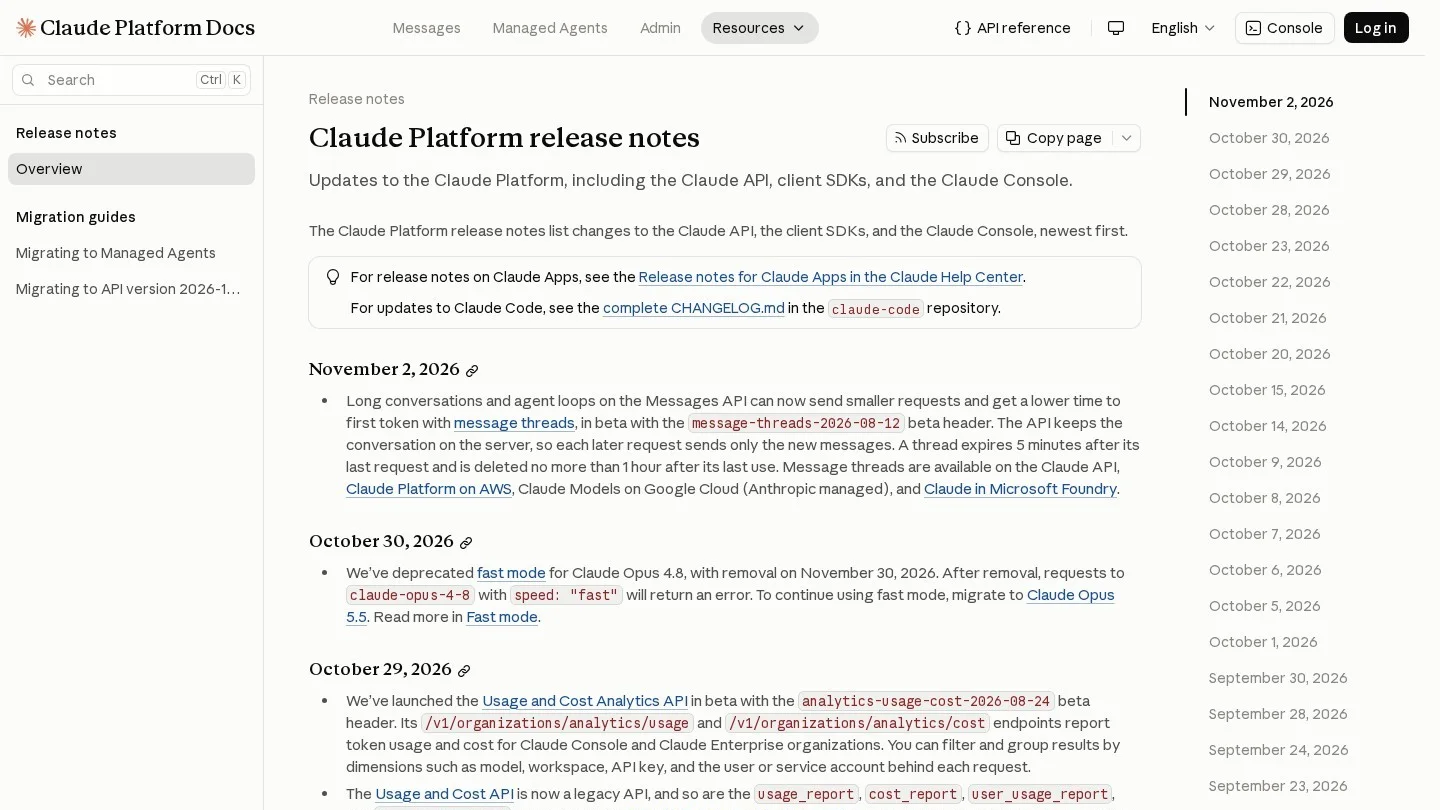
- Bigger requests (October 28): the maximum request size for the Messages API and Token Counting API rose from 32 MB to 128 MB. Teams that send long contracts, large PDFs or many images in one call will hit the ceiling less often.
- Usage and cost reporting (October 29): a new Usage and Cost Analytics API entered beta. It reports token use and spend for Console and Enterprise organizations, broken down by model, workspace, API key or user. The older usage and cost reporting endpoints are now legacy but still supported.
- Fast mode retirement (October 30): fast mode for Claude Opus 4.8 is deprecated and will be removed on November 30, 2026. After that date, fast requests to that model return an error. Anthropic points users to Claude Opus 5.5 instead.
The larger request limit helps document-heavy apps. Many teams still split big files and use retrieval to send only the relevant parts, a method explained in our guide to retrieval-augmented generation. Fewer tokens per call also keeps the new cost reports easier to read.
How the IPO Filing Changes the AI Race
We think the S-1 matters most as a disclosure event. For three years, buyers of AI services have guessed at the finances of the labs they rely on. Anthropic’s numbers now sit in a public filing. They show revenue that more than doubled from the first quarter to the second, and an operating profit in the second quarter.
Rivals are moving as well. OpenAI is said to be targeting an IPO in early 2027. OpenAI also cut prices with its GPT-6.1 Terra model on the same day Anthropic filed. Smaller labs keep raising private money, as Cohere did in its Series E with Canadian backing. For business buyers, more public reporting and more price competition are both good news. The 40% government discount shows that price competition is reaching the public sector too.
The things to watch next are the price range and share count in an amended filing, the date of the roadshow, and the end of Opus 4.8 fast mode on November 30.
Questions Readers Ask About Anthropic Right Now
Is Anthropic Going Public?
Yes, it has filed to. Anthropic filed an S-1 with the SEC on October 26, 2026, for an IPO of Class A shares on the Nasdaq Global Select Market. The registration is not yet effective, and no listing date has been set.
What Is Anthropic’s Stock Ticker?
Anthropic plans to trade under the symbol ANT on Nasdaq once the offering is complete.
How Much Revenue Does Anthropic Make?
The S-1 shows $16.3 billion of revenue in the first half of 2026, including $11.6 billion in the second quarter. Revenue for all of 2025 was $4.6 billion.
Can State and Local Governments Buy Claude at a Discount?
Yes. The expanded GSA OneGov agreement of October 27, 2026, offers 40% off token-based Claude usage to federal, state, local and tribal buyers, with no minimum order.
Anthropic Announcements and Reports Used Here
- Anthropic: Anthropic files S-1 with the SEC for proposed initial public offering (October 26, 2026)
- Yahoo Finance: Anthropic IPO live updates
- The VC Corner: Anthropic S-1 filing breakdown
- ExecutiveGov: GSA expands Anthropic OneGov deal
- Anthropic: Early progress on accelerating drug development with Claude
- TUN: Anthropic expands AI for Science program to 20 research partners
- Claude Platform release notes
- Anthropic on X: expanded OneGov agreement with GSA
- AI/TLDR: Anthropic drug development results summary