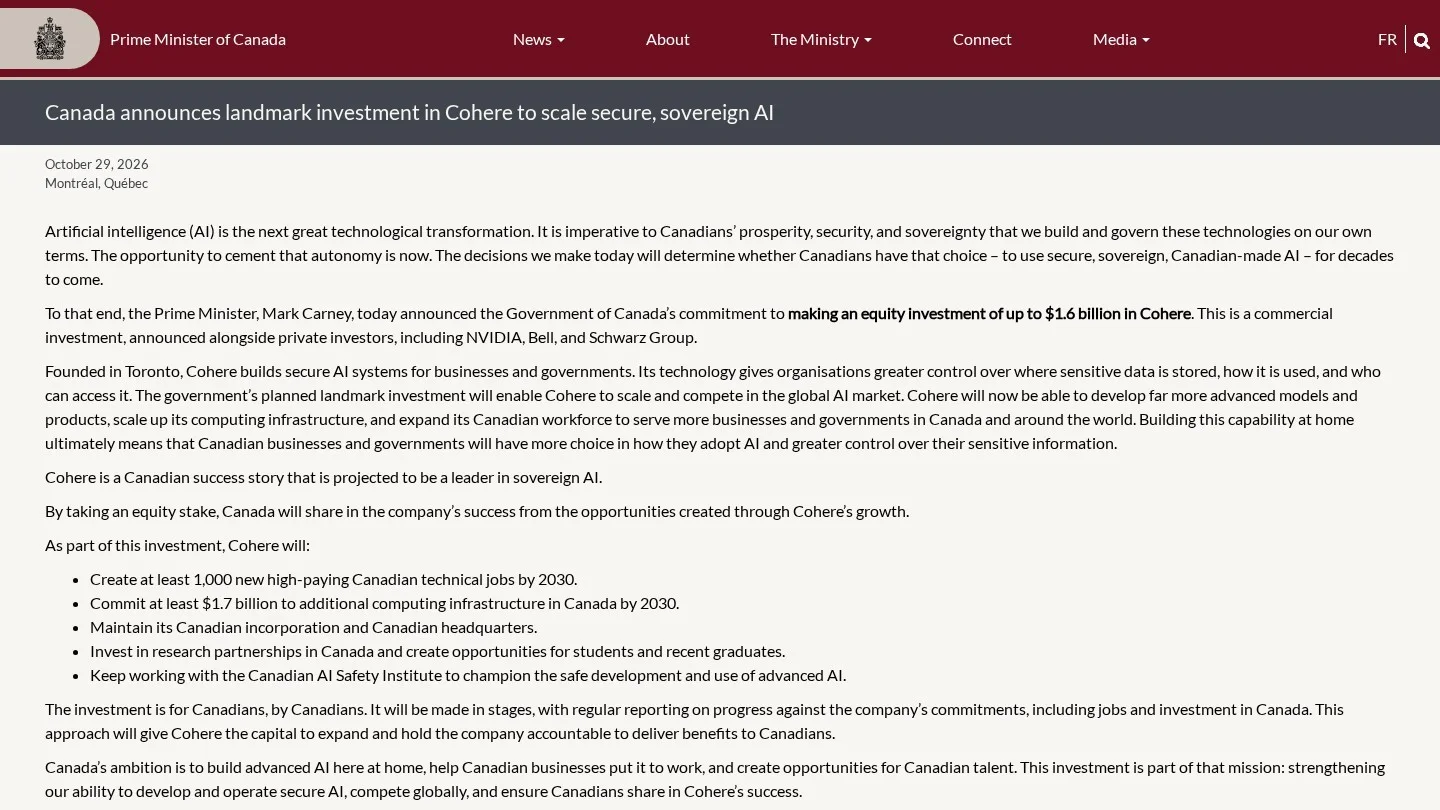
Canada’s government is becoming a shareholder in its biggest AI company. On October 29, 2026, Prime Minister Mark Carney announced an equity investment of up to C$1.6 billion in Cohere, the Toronto firm that builds AI models and agents for businesses and governments. The money is part of a Series E that Cohere says targets up to C$7 billion at a C$35.7 billion valuation. If the round fills, it will be the largest private financing ever raised by a Canadian tech company.
The deal was announced at Mila in Montreal on the first day of the Canada-EU Summit. It ties public money to hard targets on jobs and computing power, and it gives Ottawa a direct stake in the race to build AI that sits outside the largest US labs.
Where Canada’s Money Goes and What It Buys
- Up to C$1.6 billion: the federal equity stake, paid in stages through the Canada Development Investment Corporation.
- Up to C$7 billion: the Series E target, led by companies of Germany’s Schwarz Group, at a C$35.7 billion valuation.
- 165%: Cohere’s year-over-year growth in annual recurring revenue at the end of the third quarter of 2026.
- 1,000 jobs: the minimum number of new Canadian technical roles Cohere has promised by 2030.
- C$1.7 billion: what Cohere must commit to new computing infrastructure in Canada by 2030.

What Ottawa Is Buying and What Cohere Promised in Return
The government calls this a commercial investment, not a grant. The money will flow in stages, with regular reporting on how Cohere meets its side of the bargain. Evan Solomon, the minister for AI and digital innovation, said the stake is tied to milestones and that “jobs and revenue targets are key.” He did not disclose the full commercial terms.
In return, Cohere has agreed to five conditions listed in the official release:
- Jobs: create at least 1,000 new high-paying technical jobs in Canada by 2030. Cohere currently employs more than 800 people.
- Compute: commit at least C$1.7 billion to more computing infrastructure in Canada by 2030.
- Headquarters: keep its Canadian incorporation and its head office in Canada.
- Talent: fund research partnerships and create openings for students and recent graduates.
- Safety: keep working with the Canadian AI Safety Institute.
Carney framed the stake as a matter of national control, calling it “an investment in choice, in security” in the release. The same day, his government published Canada’s first national security strategy in 20 years, which lists AI among its sovereignty priorities.
Who Else Is Writing Cheques in the Series E
Cohere has completed an initial close but has not said how much of the C$7 billion is already committed. The company says it has secured most of the target.
| Investor | Role in the round | Background |
|---|---|---|
| Schwarz Group companies | Lead investor | Owner of Lidl and Kaufland; its STACKIT cloud will host Cohere models |
| Government of Canada | New, up to C$1.6 billion | Investing through the Canada Development Investment Corporation, a Crown corporation |
| Bell Ventures | New | Venture arm of Bell, which is also a Cohere customer |
| Bullhound Capital | New | Luxembourg-based investor |
| NVIDIA | Returning | Chipmaker and earlier backer |
| Inovia Capital | Returning | Canadian venture firm |
| Prosperity7 Ventures | Returning | Fund owned by Saudi Aramco |
Revenue Growth and the Products Behind the Valuation
Cohere sells to banks, telecoms, manufacturers and public bodies that want AI they can run in their own cloud, on their own servers or in fully air-gapped setups. The company says it ended the third quarter of 2026 with annual recurring revenue up 165% from a year earlier. Its customer count grew twentyfold in a year to 300, including RBC, TD Bank, Bell Canada, Fujitsu, PwC, RWS, TKMS and Aston Martin Aramco.
The main product is North, an agent platform that lets staff search company files and automate work, with North 2 released this year. Under it sit Cohere’s own models. The 2026 releases listed by the company include Command A+, Cohere Transcribe, Parse 5, Embed 5 and Rerank 5. Embed and Rerank are the search layers firms use to build retrieval-augmented generation (RAG) systems that answer questions from internal documents.
Cohere says the new money will go to its model and product roadmap, AI built for regulated sectors, long-term compute for training enterprise models, and expansion across North America, Europe, the Middle East and Asia.
The Aleph Alpha Merger and a Transatlantic Pitch
The lead investor explains a lot about this round. In April, Cohere said it would combine with Aleph Alpha, the German AI developer in which Schwarz Group is a major shareholder. The combined company would be anchored in both Canada and Germany, and Carney said the agreement keeps Cohere Canadian. Schwarz plans to run Cohere’s frontier models on STACKIT, its cloud business, which could serve European clients who want their data kept on European soil.
Cohere has also been buying. In 2026 it struck deals with Aleph Alpha, Reliant AI and AISLE, the Czech cybersecurity AI startup. Chief executive Aidan Gomez called the financing “the largest private capital raise in Canadian history” and said the company is now the largest AI firm outside the US and China.
How the Cohere Round Compares With Earlier Canadian Records
The jump is large. Cohere’s previous round raised US$600 million across two closings in 2025 at a US$7 billion valuation. The biggest Canadian private rounds before this were Clio’s C$1.24 billion in 2024, which included some secondary sales, and Waabi’s US$1 billion in January.
Ottawa was already involved. In 2024, the government offered up to C$240 million through its Sovereign AI Compute Strategy toward a C$725 million computing project at a CoreWeave data centre in Cambridge, Ontario, with Cohere as the anchor tenant. The new stake is separate from the planned C$500 million Canadian Tech Growth Fund, which will take equity in smaller companies.

What Changes for Businesses, Job Seekers and Investors
Businesses that buy AI, especially in banking, healthcare, defence and government, get a better-funded supplier that pitches data control as its main selling point. If you are drafting rules for staff use of these tools, our guide to an AI acceptable use policy for small businesses covers the basics.
Job seekers in Canada gain the most direct benefit. The 1,000-role pledge runs to 2030 and comes with promised openings for students and recent graduates. Engineers weighing study options can compare programmes such as these US master’s degrees in AI against Canadian routes into firms like Cohere.
Investors cannot buy Cohere shares directly, since the company is private. The round does give a fresh reference price for enterprise-focused AI labs, and it shows that governments are now willing to hold equity in model makers. Early-stage founders tracking AI funding can see how smaller rounds look in our report on Sunlight AI’s seed funding.
Why Staged Equity Suits Ottawa Better Than a Grant
We think the structure is smarter than a subsidy. Staged equity tied to jobs and compute gives taxpayers upside if Cohere grows, and gives Ottawa a lever if it does not. The conditions on headquarters and incorporation also answer the obvious worry after the Aleph Alpha tie-up, which was that the company might drift toward Germany.
The open questions are commercial. Cohere’s 300 customers and 165% growth are strong for a business-to-business model maker, but the company has not published revenue in dollars, and the round is not fully closed. It also competes with far larger US labs for the same enterprise budgets. Its edge is trust, and whether that edge holds as rivals add private deployment options will decide whether C$35.7 billion looks cheap or rich by 2030.
What Canadians Want to Know About the Cohere Deal
How Much Is Canada Investing in Cohere?
Up to C$1.6 billion in equity, paid in stages through the Canada Development Investment Corporation, with regular reporting on Cohere’s commitments.
What Is Cohere’s Valuation After the Series E?
Cohere says the round targets up to C$7 billion at a valuation of C$35.7 billion. The company completed an initial close on October 29, 2026, and has not disclosed the final amount raised.
Who Leads Cohere’s Funding Round?
Companies of Germany’s Schwarz Group lead the Series E. New investors include the Government of Canada, Bell Ventures and Bullhound Capital, and NVIDIA, Inovia Capital and Prosperity7 Ventures returned.
Is Cohere Moving to Germany After the Aleph Alpha Merger?
No. A condition of the federal investment is that Cohere keeps its Canadian incorporation and headquarters. The combined business will have a large presence in Germany through Aleph Alpha and Schwarz Group.
Announcements and Reporting Used for the Cohere Story
- Prime Minister of Canada: Canada announces landmark investment in Cohere (October 29, 2026)
- Cohere: Series E fundraise targeting CAD $7 billion (Newswire, October 29, 2026)
- The Canadian Press via CP24: Ottawa investing up to $1.6B in Canadian AI company Cohere
- BetaKit: Feds to buy stake in Cohere via planned $7-billion Series E
- The Logic: Cohere funding round and earlier valuation